Arch 315 Building Systems
 Call Kai
 Learn
Learn Practice Test
 Spaced Repetition
 Match
Match Flashcards
 Knowt Play
1/73

There's no tags or description
Looks like no tags are added yet.
Name | Mastery | Learn | Test | Matching | Spaced | Call with Kai |
|---|
No analytics yet
Send a link to your students to track their progress
74 Terms
Which type of mobility device must be accommodated in public spaces?
a. manual wheelchairs
b. All of the choices
c. Power wheelchairs
d. Motorized Scooters
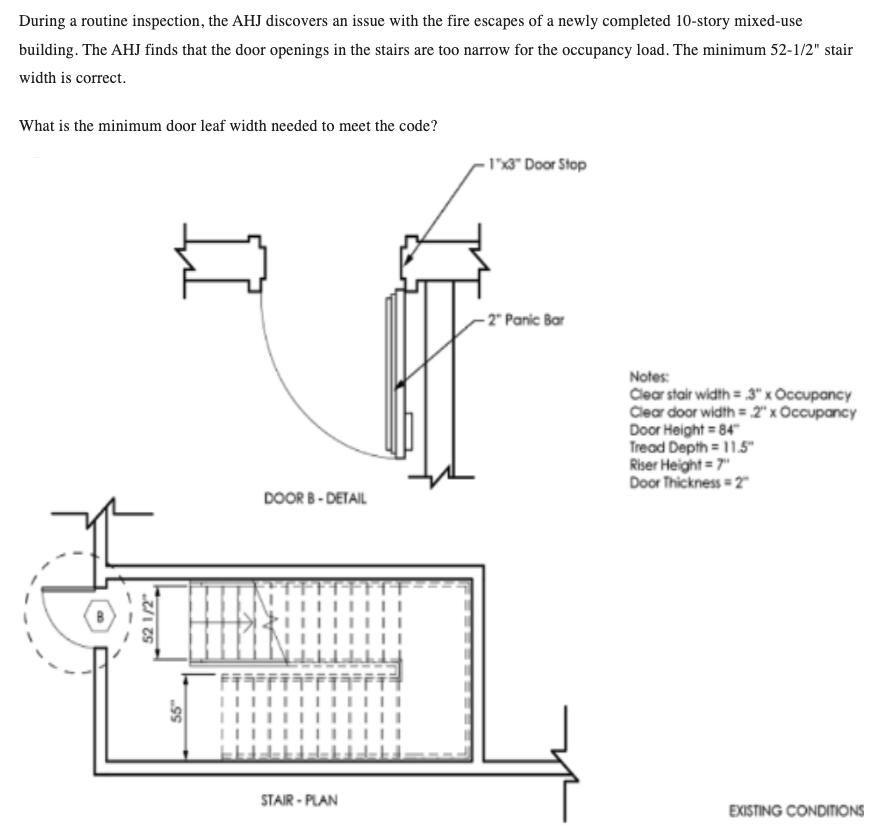
a. 36”
b. 38”
c. 34”
d. 32”
During an inspection of a 200-unit residential project, an architect notices that the overall length of kitchen cabinetry in accessible units is shorter than designed. The contractor informs the architect that when the cabinets arrived, the 32-inch-wide cabinets had been replaced with 28-inch-wide cabinets due to an oversight in the architect's review of the shop drawings.
The owner wants to occupy the area as soon as possible and insists on accepting the cabinets as-built. The AHJ requires that the narrower removable cabinets allow 30-inch-wide clear floor spaces. Who is responsible for the error?
a. Architect
b. Contractor
c. No one. The 28” cabinets were accepted by the owner
d. Owner
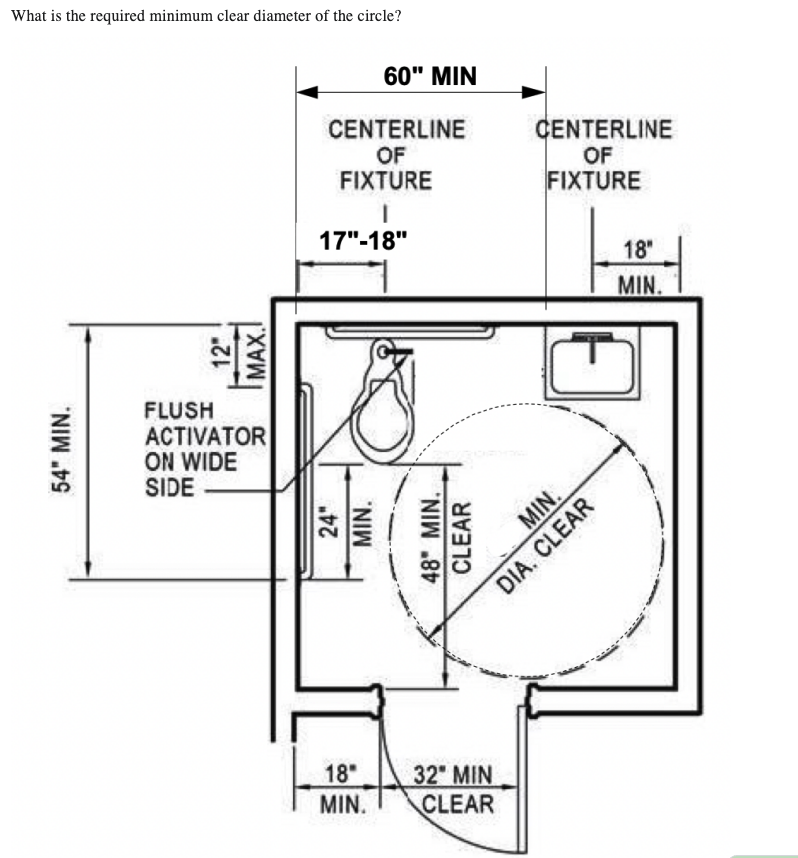
a. 50”
b. There is no minimum as long as a wheelchair can turn around in the bathroom
c. 60”
d. 70”
A “primary function” is a major activity for which the facility is intended. Which of these is not an area for a primary function?
a. office in a high rise
b. Mechanical room in a commercial building
c. Meeting room in a conference center
d. Dining area of a cafe
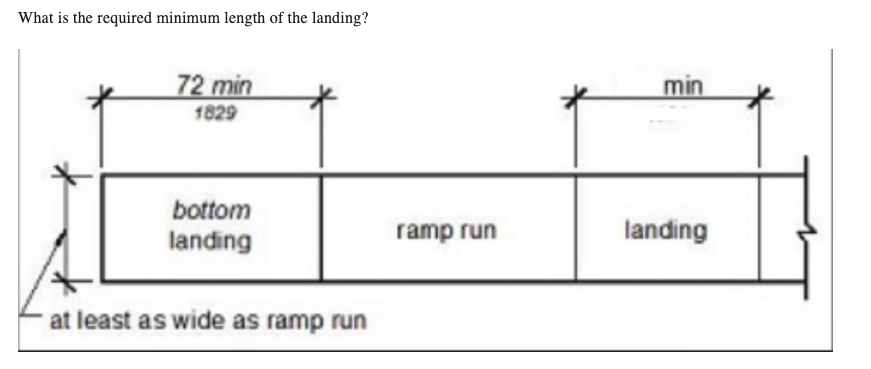
a. 60”
b. 48”
c. 80”
d. 72”
Which of the following would have the greatest impact on the size and configuration of an accessible restroom?
a. minimum 36” access route into and through the room
b. clear space at towel dispensers and full height mirrors
c. 5 ft clear circular turnaround space
d. Maneuvering space on the outside of the entry door to the room
A “path of travel” includes a continuous, unobstructed way of pedestrian passage by means of which the altered area may be approached, entered, and exited, and which connects the altered area with an exterior approach (including sidewalks, streets, and parking areas), an entrance to the facility, and other parts of the facility. An accessible path of travel may consist of (choose the most complete true answer)
a. Parking access aisles
b. Walks, sidewalks and curb ramps
c. walks, sidewalks, curb ramps, parking access aisles and elevators/lifts
d. curb ramps
e. elevators and lifts
f. Walks, sidewalks, curb ramps and parking access aisles
g. walks and sidewalks
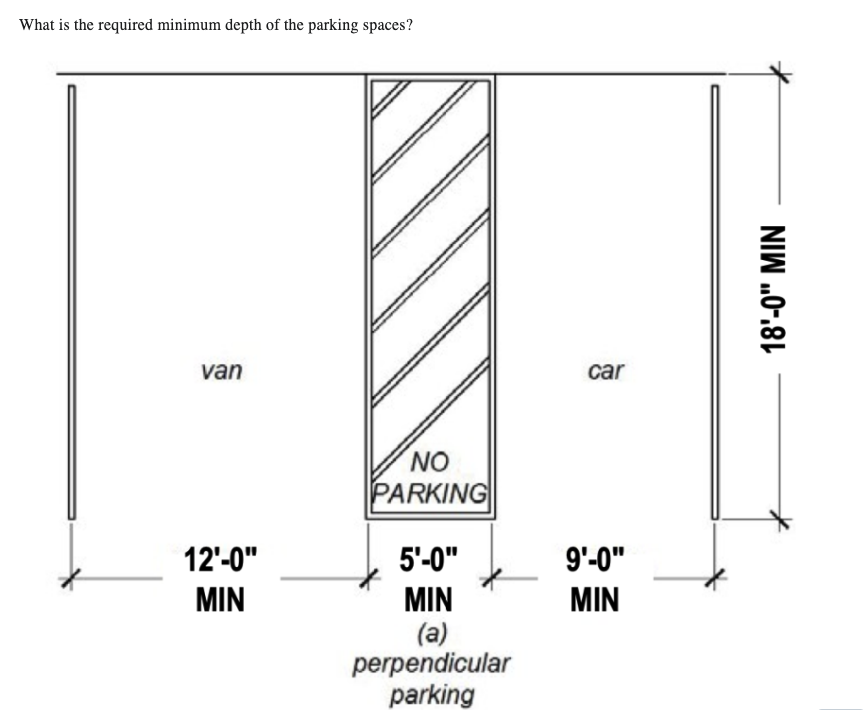
a. 14’
b. 20’
c. 18’
d. 10’
An accessible route must:
a. have a slope along the accessible route of 1:12
b. be provided from the accessible parking to any entrance
c. include handrails along the entire route
d. be at least 3 feet wide
An accessible route must serve:
a. Those areas where physically disabled people are likely to need access
b. Entrances, parking, toilet rooms, corridors and drinking fountains
c. All accessible spaces and parts of a building
d. The corridors, stairs, elevators and toilet rooms of a building
If it is deemed structurally impractical (a rare circumstance) to provide accessibility for individuals using wheel chairs, accessibility should be ensured for persons with other types of disabilities, for example:
a. sight and hearing impairments
b. No other impairments as the exception has already been made for mobility
c. sight, hearing and mental impairments
d. mental impairments
Which of the following is a key ADA requirement for emergency preparations?
a. having emergency exits only on the first floor
b. ensuring emergency information is provided only in printed format
c. requiring individuals with disabilities to arrange their own emergency assistance.
d. Developing emergency plans that include individuals with disabilities
Which of the following in NOT an example of a service animal according to ADA:
a. A person who has a comfort dog to hold so that they are less stressful.
b. A person who uses a wheelchair may have a dog that is trained to retrieve objects for them.
c. A person with PTSD may have a dog that is trained to lick their hand to alert them to an oncoming panic attack.
d. A person with depression may have a dog that is trained to perform a task to remind them to take their medication.
Each area listed below is included in the plans for the construction of a new high school. Which areas must comply with ADA Accessibility Guidelines. (Choose the one that does NOT apply.)
a. copy room designated “faculty only”
b. special collections area in the library
c. Additional bleachers constructed for a weekend football game
d. lifeguard tower within the indoor pool area.
e. Temporary passageway during construction for pedestrian access to the football field
Which of the following is NOT a recommended ADA-compliant emergency planning measure?
a. Placing emergency exit signs at a high level, out of reach of wheelchair users
b. training staff on how to assist individuals with disabilities during evacuations
c. Ensuring evacuation shelters are accessible
d. Installing audible and visual fire alarms
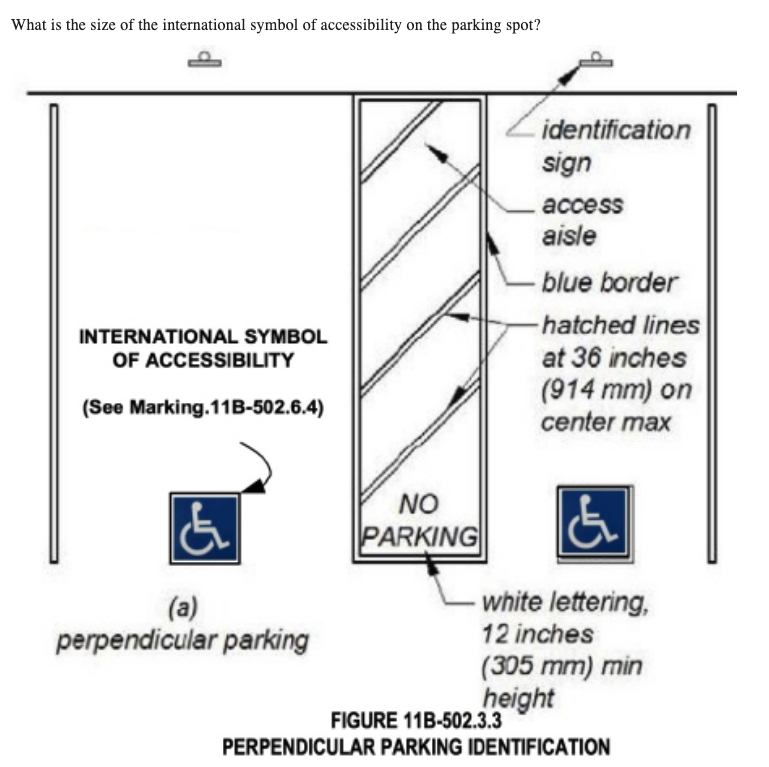
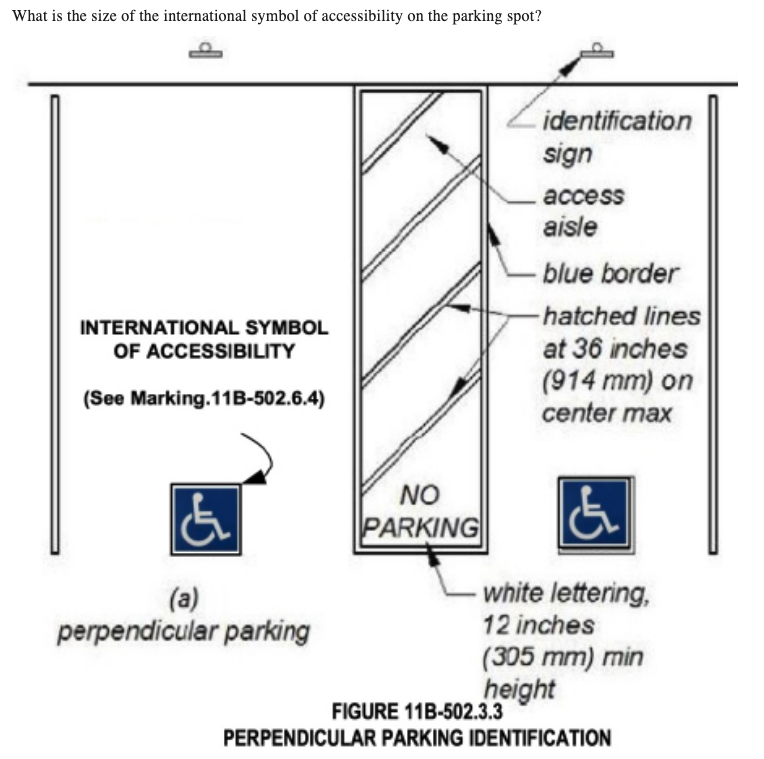
a. it is optional, not a requirement, so any size is good
b. 36”x36”
c. 32”x32”
d. 38”x38”
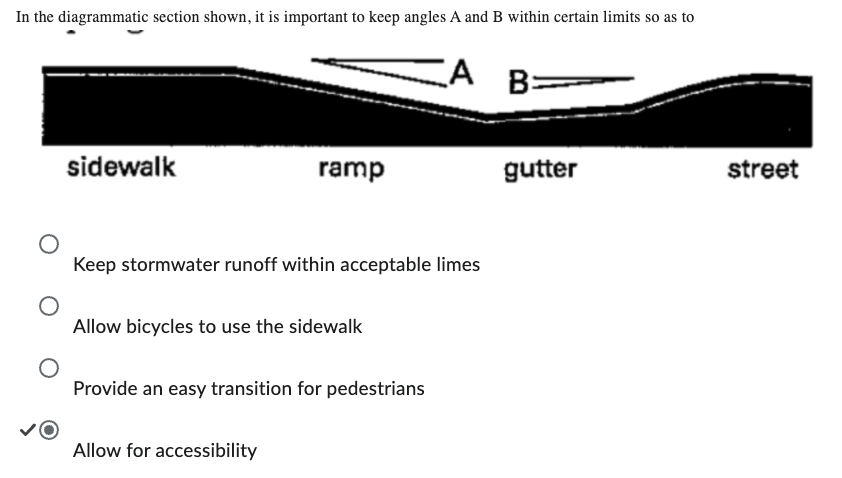
a. keep stormwater runoff within acceptable limits
b. allow bicycles to use the sidewalk
c. provide an easy transition for pedestrians
d. allow for accessibility
What’s the minimum number of accessible parking spaces for a parking space that provides 26 to 50 parking spaces?
a. 5
b. 10
c. 4
d. 2
Which of the following is NOT one of the seven principles of Universal Design?
a. aesthetic appeal
b. perceptible information
c. simple and intuitive use
d. flexibility in use
Under the ADA, a service animal is:
a. Trained to perform a task directly related to a person's disability
b. NOT allowed on public transportations like the bus or subway unless they have special training
c. required to go through a professional training program
d. required to be certified by state authorities
What is one way to make emergency communication accessible?
a. use flashing lights and visual alarms for individuals who are deaf
b. provide only audio announcements
c. use small text on emergency signage
d. expect people with disabilities to reply on personal contacts for emergency updates
A building has 10 floors. How many total accessible exits should the building have, including those for each floor?
a. 25
b. 15
c. 10
d. 20
What are the other powered options for people with disabilities to get around in addition to wheelchairs?
a. All of the choices
b. Golf carts
c. Segways
d. All terrain vehicles (ATVs)
What is the primary goal of Universal Design?
a. to make buildings accessible for wheelchair users
b. to reduce the cost of construction
c. to make environments usable by all people
d. to create designs that are stylish and modern
In a mid-rise office building, the elevator system may account for as much as:
a. 1% of the total construction cost
b. 10% of the total construction cost
c. 25% of the total construction cost
d. 50% of the total construction cost
Regeneration describes the process whereby:
a. elevator cables stretch over time
b, elevators impose a lateral load on the building structure
c. existing elevator systems are upgraded to current standards
d. the elevator machine generates electricity when a car is lowered
Approximately ________of the energy expended in lifting a traction elevator car is returned to the system by regeneration when the car is lowered.
a. 45%
b. 55%
c. 65%
d. 75%
A traction elevator machine room is generally located
a. at the base of the hoistway
b. adjacent to the elevator doors on each floor
c. directly above the hoistway
e. the building's main mechanical space
Considering geared and gearless drive options:
a. Geared is generally considered to provide superior operation
b. Gearless is generally considered to provide superior operation
c. Gearless is another term for hydraulic elevator
d. Geared elevators are no longer allowed under the ANSI
The three layers of control associated with an elevator system include:
a. drive, operating, and supervisory controls
b. accelerating, running, and decelerating controls
c. normal, holiday, and fire emergency controls
d. zoned, unzoned, and multi-zone controls
A hydraulic elevator uses:
a. a piston arrangement to lift cars instead of a rotating drive
b. a fluid-based transmission to control a rotating drive and lift arrangement
c. energy from rooftop water tanks to power the system instead of electricity
d. an innovative fluid logic system to replace conventional computer controls
The primary advantages of a hydraulic elevator system versus a traction elevator system are best summarized as:
a. no penthouse or upper machine room, faster speeds, better ride
b. higher capacities, faster speeds, better ride
c. no elevator penthouse, loads are supported at the ground, the shafts are slightly smaller
d. lower first costs, greater energy efficiency, higher speeds
Typical applications for hydraulic elevator systems would include:
a. low-rise passenger and freight service
b. high-rise passenger and freight service
c.freight service only—never for passenger service (in any building type)
d. passenger service only—never for freight (in any building type)
The carrying capacity and speed of elevator cars are rated, respectively, in terms of:
a. number of passengers and miles per hour
b.pounds and feet per minute
c. square feet and feet per second
d. cubic feet and feet per minute
In an elevator system, a motor-generator (m-g) set is used to:
a. provide emergency power to operate selected elevators
b. improve elevator efficiency through cogeneration
c. make commercial use of regenerated energy
d. provide accurate speed control through the drive system
A “thyristor” is used to:
a. sense occupant load in an elevator car
b. make logical decisions regarding car dispatches
c. provide a means of speed control for AC or DC motors
d. sense smoke in the event of a fire near an elevator shaft
Handling capacity refers to:
a. the passenger carrying capacity of a single elevator car
b. the percentage of building population that can be carried by an elevator system
c. the freight capacity of a dual-purpose passenger/freight elevator
d. the strength of an elevator cable system
Handling capacity is completely determined by car size and by which of the following factors?
a. passenger weight
b. number of floors served
c. interval
Interval refers to:
a. the time it takes elevator car doors to open and close
b. the horizontal spacing between elevator cars in a lobby layout
c. the average time between car departures from an elevator lobby
d. the time it takes a motor-generator set to wake from sleep mode
As a rule, no bank of elevators should have more than:
a. 2 cars in a row
b. 4 cars in a row
c. 8 cars in a row
d. 12 cars in a row
Energy and power in an elevator system are related as follows:
a. Energy is a function of power needs and operational patterns
b. Energy is totally independent of power
c. Power has no bearing on energy consumption
d. Power times efficiency equals energy
An elevator’s counterweight should be equal to the weight of:
a. a loaded car plus 10% of the rated live load
b. an empty car plus 40% of the rated live load
c.an empty car plus 120% of the rated live load
d. a loaded car plus 20% of the rated live load
Gearless traction machines are usually used for passenger service, with car capacities between:
a. 1000 lb (454 kg) and 2000 lb (907 kg)
b. 2000 lb (907 kg) and 4000 lb (1814 kg)
c. 5000 lb (2268 kg) and 10,000 lb (4536 kg)
d. 10,000 lb (4536 kg) and 20,000 lb (9072 kg)
Which of the following is not an advantage of a geared traction machine over a gearless machine?
a. A geared machine is smaller.
b. A geared machine is cheaper.
c. A geared machine is faster.
d. A geared machine requires less maintenance.
Hydraulic elevators currently use _______ as their system fluid:
a. water
b. oil
c. silicon
d. glycol
To completely allow passengers to simultaneously enter and exit an elevator doorway, an opening _______ wide may be necessary.
a. 36 in. (0.9 m)
b. 40 in. (1.0 m)
c. 48 in. (1.2 m)
d. 60 in. (1.5 m)
The minimum ADA-permitted door opening for an elevator is:
a. 36 in. (0.9 m)
b. 40 in. (1.0 m)
c. 48 in. (1.2 m)
d. 60 in. (1.5 m)
An elevator system using selective collective operation has the advantage of:
a. allowing the use of more than three cars
b. greater load handling capacity than a single-car system
c. bunching groups of cars together on trips
d. shorter waiting periods
Of emergency and standby power systems, which one is typically a code requirement:
a. emergency power
b. neither standby or emergency power
c. standby power
d. both standby and emergency power.
Which means of service delivery is typically more expensive to install?
(a) overhead service
(b) underground service
(c) neither, overhead and underground service generally cost the same
All of the following are advantages to underground electric service, EXCEPT:
(a) attractiveness
(b) service reliability
(c) ease of repair
(d) long life
The purpose of an electrical transformer is to:
(a) convert utility-provided DC power to AC power for building use
(b) convert high-frequency utility power to 60 Hz building power
(c) change the voltage of electric distribution
(d) remove noise and disturbances from utility-provided
From an electrical (as opposed to architectural) point of view:
(a) it is always preferable to install a transformer outdoors
(b) it is always preferable to install a transformer indoors
(c) if properly selected, indoor versus outdoor installation makes no difference.
Ventilation is generally required for indoor transformer installations because:
(a) transformers present a significant fire hazard
(b) transformers generate a great deal of heat during operation
(c) transformers off-gas toxic particulate matter
(d) transformers must be electrically isolated
Dry-type electrical transformers:
(a) can be installed virtually anywhere in a building
(b) can only be installed in special transformer vaults
(c) cannot be installed inside a building
(d) are not ever used for building applications
Transformers may require a protective vault because:
(a) transformers are hazardous devices prone to faults
(b) transformers must be acoustically isolated
(c) they are capable of sustaining prolonged overloads
(d) an oil-filled transformer is a potential fire hazard
The purpose of a “service switch” is to:
(a) control the operation of lights and similar loads
(b) isolate items of electrical equipment for maintenance and repair
(c) automatically bring backup power systems on line
(d) isolate the building electrical system from the utility
Solid-state switches are finding greater use in buildings:
(a) because they are very low cost and long-lived
(b) because they are so exceptionally small
(c) because they do not use liquid coolants
(d) because they can be easily paired with automatic control functions
Fuses and circuit breakers:
(a) have similar uses but different construction and operation
(b) have very different uses and constructions
(c) are two terms for the exact same device
A switchboard typically contains:
(a) switches, fuses/circuit breakers, meters
(b) switches, transformer, power conditioning devices
(c) switches and receptacles
(d) fuses, circuit breakers, branches, and feeders
A panelboard is typically installed:
(a) at the service entrance to a building
(b) next to the primary building transformer
(c) adjacent to all switchboards
(d) between electrical feeders and branches
The most common motor in building applications is:
(a) the DC wound rotor motor
(b) the AC squirrel-cage induction motor
(c) the NEMA standard motor
(d) the ASHRAE premium performance motor
A VVVF or VFD control system is used to:
(a) vary the speed of a motor
(b) dim electric lights
(c) adjust transformer efficiency
(d) disconnect loads to control demand
A power line carrier system refers to:
(a) a system of supports for electrical conductors
(b) a type of overhead service conductor
(c) a cooperative association of public utility companies
(d) a type of control system
Computer-grade power refers to:
(a) high-frequency power needed to operate most laptop computers
(b) power that is generally free of power quality problems
(c) power that is available at all times
(d) low-voltage power used for data transmissions
In a transformer, ___________ remains constant.
(a) voltage
(b) current
(c) power capacity
(d) resistance
The most popular form of exterior transformer installation for individual buildings is:
(a) mounted on a pole
(b) mounted on a concrete pad
(c) underground
(d) incorporated into the building façade
Oil-insulated transformers can be expensive to install indoors because:
(a) they must be placed in a fire-resistant vault
(b) the price of oil is rising
(c) of their high purchase cost
(d) most contractors do not understand how to install them
The use of nonflammable liquid coolants has largely been discontinued in transformers because:
(a) this was the most expensive and least efficient way to cool the devices
(b) of their tendency to explode
(c) the coolants contain PCBs, which are banned in new installations
(d) they presented a higher than normal risk of electrocution
The advantage of using a contactor rather than a switch is that:
(a) a contactor can be remote controlled
(b) a contactor is less likely to fail
(c) a contactor can handle higher voltages
(d) a contactor can handle more current
To protect against all types of weather conditions, one should specify an equipment enclosure of type:
(a) 3R
(b) 3S
(c) 4
(d) 4R
A “drawout” switchboard is:
(a) a type of switchboard that has a breaker that trips when a current of more than 3000 A is drawn
(b) a type of switchboard that has circuit breakers mounted in a movable drawer
(c) a type of switchboard that can be easily removed from its mounting and transported
(d) a switchboard that has been recovered from a demolished building and repaired to meet the needs of its current building.
Which of the following would be a typical dimension of a single-phase uninterruptible power supply (UPS) unit?
(a) 6 in. x 6 in. x 12 in. (152 x 152 x 305 mm)
(b) 18 in. x 10 in. x 24 in. (457 x 254 x 610 mm)
(c) 36 in. x 12 in. x 36 in. (915 x 305 x 915 mm)
(d) 60 in. x 24 in. x 36 in. (1525 x 610 x 915 mm)