H6 Holland- What is a vertebrate?

0.0(0)
Studied by 0 people
call kaiCall Kai
learnLearn
examPractice Test
spaced repetitionSpaced Repetition
heart puzzleMatch
flashcardsFlashcards
GameKnowt Play
Card Sorting

1/3

encourage image

There's no tags or description

Looks like no tags are added yet.

Last updated 8:54 AM on 4/30/26
Name
Mastery
Learn
Test
Matching
Spaced
Call with Kai

No analytics yet

Send a link to your students to track their progress

4 Terms

1
New cards

what extra features did vertebrates evolve?

bony living skeleton

  • made of secreted collagen fibres + calcium phosphate crystals

  • osteoblasts make bone, osteoclasts break down bone, and osteocytes are strain/crack sensors

  • vertebra are formed from fusing of bone produced at the sclerotome, the inner part of the somites (dorsal, segmented mesoderm- unlike the ventral, lateral plate mesoderm)

neural crest cells

  • individual cells migrating from the inner section of the infolding of the dorsal hollow nerve cord

  • these form: sensory nerves to the skin, pigment cells, nerves in the gut for peristalsis, autonomic nervous system, some blood vessel muscle, and the bone + cartilage of the skull

red blood cells

  • invertebrates only have a few cells in the blood for phagocytosis, but vertebrates have red cells with haemoglobin

adaptive immune system

  • the innate immune system of invertebrates recognises common pathogens, but the adaptive immune system in vertebrates changes with the environment by dna rearrangement

  • this is due to antibody genes and t-cell receptors

these traits allowed early vertebrates to evolve into big, active, swimming, hunting predators
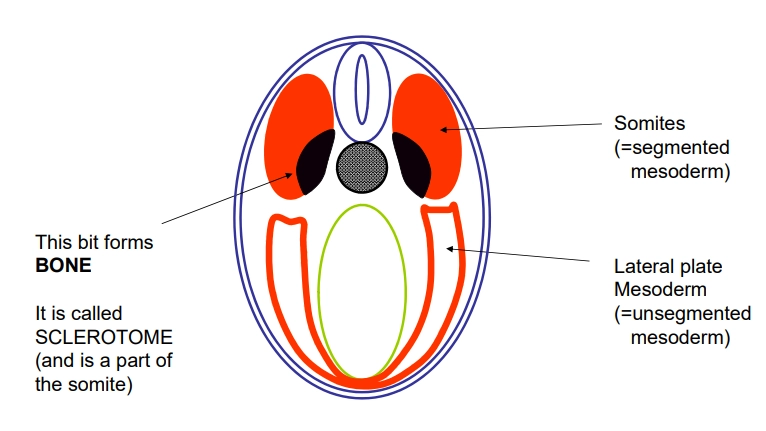
<p><strong>bony living skeleton</strong></p><ul><li><p>made of <strong>secreted collagen fibres + calcium phosphate crystals</strong></p></li><li><p><strong>osteoblasts </strong>make bone, <strong>osteoclasts </strong>break down bone, and <strong>osteocytes </strong>are strain/crack sensors</p></li><li><p>vertebra are formed from fusing of bone produced at the <strong>sclerotome</strong>, the inner part of the <strong>somites </strong>(dorsal, segmented mesoderm- unlike the ventral, lateral plate mesoderm)</p></li></ul><p><strong>neural crest cells</strong></p><ul><li><p>individual cells <strong>migrating </strong>from the inner section of the <strong>infolding </strong>of the dorsal hollow nerve cord</p></li><li><p>these form: sensory nerves to the skin, pigment cells, nerves in the gut for peristalsis, autonomic nervous system, some blood vessel muscle, and the<strong> bone + cartilage of the skull</strong></p></li></ul><p><strong>red blood cells</strong></p><ul><li><p>invertebrates only have a few cells in the blood for phagocytosis, but vertebrates have red cells with <strong>haemoglobin</strong></p></li></ul><p><strong>adaptive immune system</strong></p><ul><li><p>the innate immune system of invertebrates recognises common pathogens, but the adaptive immune system in vertebrates <strong>changes </strong>with the <strong>environment </strong>by<strong> dna rearrangement</strong></p></li><li><p>this is due to antibody genes and t-cell receptors</p></li></ul><p></p><p>these traits allowed early vertebrates to evolve into big, active, swimming, hunting predators</p><p></p>
2
New cards

what features of vertebrates became more complex?

sense organs of the head

  • olfactory- chemical sensing

  • optic- light sensing

  • otic- mechanical sensing

larger brain

  • forebrain- olfaction + thinking in some vertebrates

  • midbrain- optic lobes

  • hindbrain- neural crest cells in this region make the cartilagenous gill skeleton:

pharyngeal slits

  • supports gills in fish

  • the first slit is the jaw bone, the second is a jaw support bone

these traits allowed early vertebrates to evolve into big, active, swimming, hunting predators
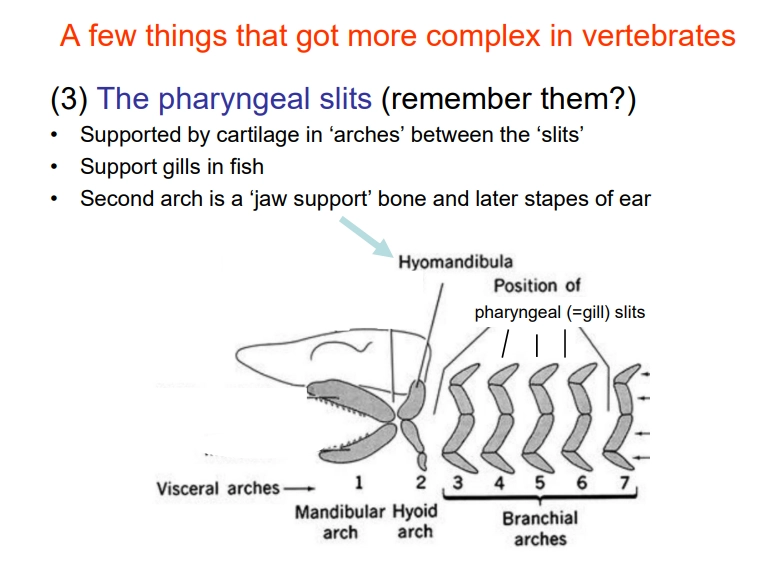
<p><strong>sense organs of the head</strong></p><ul><li><p>olfactory- chemical sensing</p></li><li><p>optic- light sensing</p></li><li><p>otic- mechanical sensing</p></li></ul><p><strong>larger brain</strong></p><ul><li><p>forebrain- olfaction + thinking in some vertebrates</p></li><li><p>midbrain- optic lobes</p></li><li><p>hindbrain- neural crest cells in this region make the cartilagenous gill skeleton:</p></li></ul><p><strong>pharyngeal slits</strong></p><ul><li><p>supports gills in fish</p></li><li><p>the first slit is the jaw bone, the second is a jaw support bone</p></li></ul><p></p><p>these traits allowed early vertebrates to evolve into big, active, swimming, hunting predators</p><p></p>
3
New cards

describe the phylogeny of the vertebrates

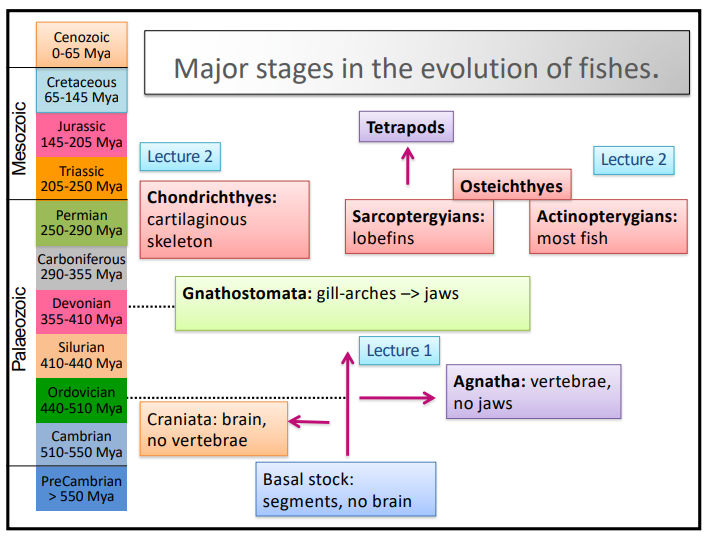
  • vertebrates are a subphylum of the chordate phylum in the deuterostomia clade of bilaterian animals

the first lineage to evolve was the agnatha (lamprey + hagfish), before the gnathostomata developed jaws + paired fins:

  • chondrichthyans- cartilagenous fish eg. sharks + rays

  • osteichthyes- bony fish

    • actinopterygians- ray-finned fish eg. most fish

    • sarcopterygians- lobe-finned fish + tetrapods (terrestrial)

the ‘fish’ is a paraphyletic group/grade, not a clade- it contains the most recent common ancestor but not all the descendants (no tetrapods)
<ul><li><p>vertebrates are a <strong>subphylum </strong>of the <strong>chordate phylum </strong>in the <strong>deuterostomia clade </strong>of <strong>bilaterian </strong>animals</p></li></ul><p></p><p>the first lineage to evolve was the <strong>agnatha </strong>(lamprey + hagfish), before the <strong>gnathostomata </strong>developed <strong>jaws </strong>+ paired fins:</p><ul><li><p><strong>chondrichthyans</strong>- cartilagenous fish eg. sharks + rays</p></li><li><p><strong>osteichthyes</strong>- bony fish</p><ul><li><p><strong>actinopterygians</strong>- ray-finned fish eg. most fish</p></li><li><p><strong>sarcopterygians</strong>- lobe-finned fish + tetrapods (terrestrial)</p></li></ul></li></ul><p>the ‘<strong>fish</strong>’ is a <strong>paraphyletic </strong>group/grade, not a clade- it contains the most recent common ancestor but <strong>not all the descendants (no tetrapods)</strong></p>
4
New cards

n



