Cardio Exam 2: Anti-Coags
 Call Kai
 Learn
Learn Practice Test
 Spaced Repetition
 Match
Match Flashcards
 Knowt Play
1/41

There's no tags or description
Looks like no tags are added yet.
Name | Mastery | Learn | Test | Matching | Spaced | Call with Kai |
|---|
No analytics yet
Send a link to your students to track their progress
42 Terms
KNOW
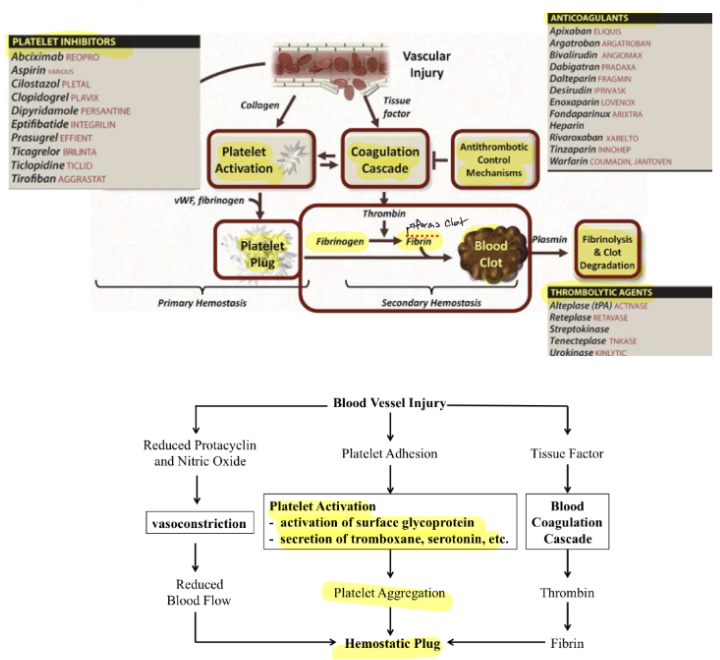
Pathways of Clot Formation
Tissue Factor _____ forms activated complex (_____)
Activates Factor _____ → Factor _____
Xla proceeds the cascade
Activates Factor _____ → _____
_____ activates/converts prothrombin (Factor _____) → Thrombin (Factor _____)
_____ (_____) converts _____ (Factor _____) → _____ (Factor _____)
Forms a blood clot
VII, VIIa-TF, XI, XIa, XIa, X, Xa, Xa, II, IIa, Thrombin, IIA, Fibrinogen, I, Fibrin, IA
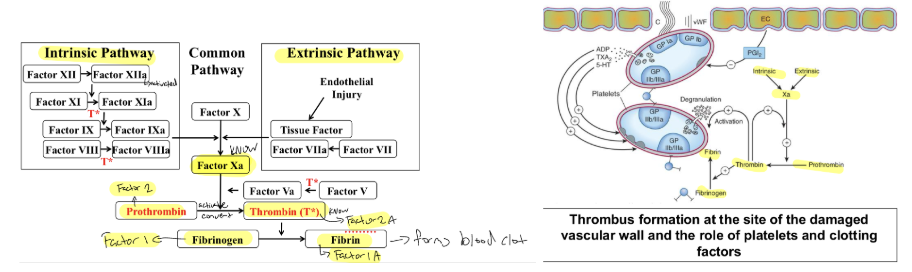
Pathways of Clot Formation
Additional Info:
_____, acting in the blood, activates anti-clotting factors, specifically _____, which _____ the factors enclosed in _____ (makes it _____)
_____, acting in the liver, _____ the _____ of the factors enclosed in _____ (_____)
__________ = decreased clotting factors
Heparin, anti-thrombin, inactivates, rectangles, work better, Warfarin, inhibits, synthesis, circles, prevention, non-functional liver
KNOW
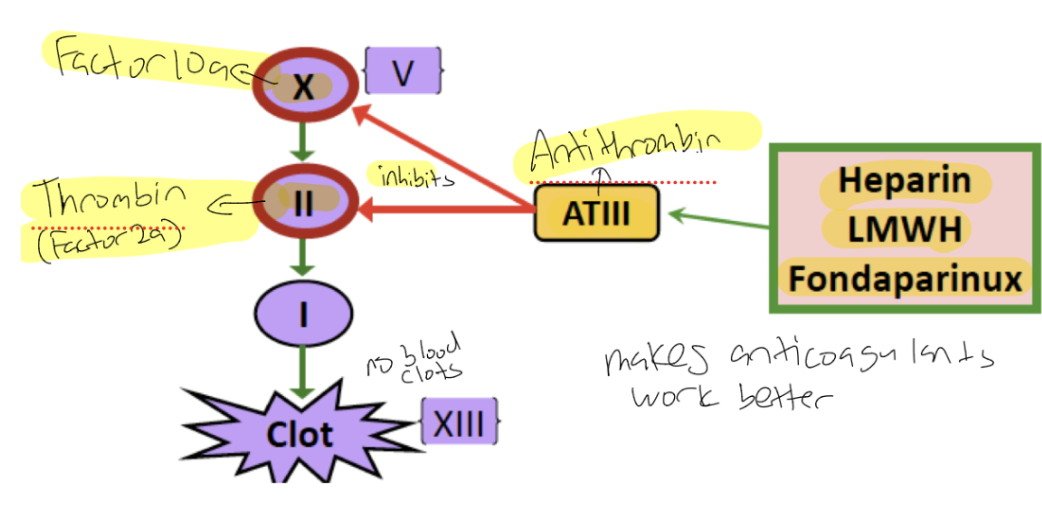
Indirect Inhibitors of Common Pathway: Anti-thrombin
Made by the _____, circulates _____
_____ clotting factors _____ by binding in a stable _____ complex
liver, blood, Inhibits, IIa and Xa, 1:1
__________
MOA: binds to ATIII → enhance ATIII’s ability to inactivate IIa (thrombin) + Xa
Allosteric activation of ATIII
Forms complex with ATIII + thrombin and ATIII + Xa
ATIII: endogenous inhibitor of thrombin (IIa) + changes conformation
5-saccharide sequence → allosteric activation
Binds to ATIII
>18-saccharide length → thrombin inhibition
Binds + inhibits Xa/Thrombin (IIa)
Unfractionated Heparin (UFH)
Unfractionated Heparin (UFH)
MOA: binds to _____ → enhance its ability to _____ (_____) + _____
__-saccharide sequence → _____
Binds to _____
> __-saccharide length → _____
Binds to _____ (_____)
ATIII, inactivate IIa, Thrombin, Xa, 5, allosteric activation, ATIII, 18, thrombin inhibition, and inhibits Xa/IIa, thrombin
__________
Ends with “parin”
Enoxaparin (Lovenox, doesn’t bind thrombin as effectively as heparin)
SubQ
Weight-based + needs renal dose adjustment
Preferred anticoag in oncology + pregnant pts
Dalteparin
Tinzaparin
Low Molecular Weight Heparin (LMWH)
Low Molecular Weight Heparin (LMWH)
_____ (Lovenox, doesn’t bind thrombin as effectively as heparin)
_____
Weight-based + needs renal dose adjustment
Preferred anticoag in _____
_____
_____
Enoxaparin, SubQ, oncology and pregnant, Dalteparin, Tinzaparin
Low Molecular Weight Heparin (LMWH)
Low MW Heparin bc it’s a _____ chain
Less _____ (<18 saccharides), but still _____
ATIII (Anti-Thrombin) → Inhibits Factor _____
_____ (Heparin-Induced Thrombocytopenia/HIT) + _____: LMHW < UFH
HIT: platelet _____, _____, and _____
TYPE-2 HIT:
_____-mediated
Onset: _____
Discontinue all heparin agents → Start _____
shorter, thrombin inhibition, inhibits Xa, X and II, Bleeding, Hyperkalemia, activation, consumption, thrombosis, Ab, 5-10 days, non-heparin anticoagulants
_____
MOA: synthetic pentasaccharide analog that inhibits Factor Xa (no inhibition of thrombin)
Pentasaccharide binds to antithrombin → causes allosteric activation → allows to inhibit Factor Xa
Can use in pts with HIT
Weight-based dosing
Fondaparinux
Fondaparinux
MOA: _____ analog that inhibits Factor _____ (no inhibition of _____)
_____ binds to antithrombin → causes _____ → allows to inhibit Factor _____
Can use in pts with _____
Weight-based dosing
synthetic pentasaccharide, Xa, thrombin, Pentasaccharide, allosteric activation, Xa, HIT,
Heparin
Target: _____
Antidote Effect (Reversal): _____
Xa and II2, Complete
LMWH
Target: _____
Antidote Effect (Reversal): _____
Xa and IIa, partial
Fondaparinux
Target: _____
Antidote Effect (Reversal): _____
Xa, None
__________
MOA: inhibits both circulating + clot-bound thrombin (Factor IIa)
Can be used in patients with heparin-induced thrombocytopenia (HIT)
Direct Thrombin Inhibitors
Oral Direct Thrombin Inhibitor = __________
DVT/PE treatment (blood stays in atria → coag cascade starts → increases blood clots)
A. fib.
Dabigatran (Pradadex)
Direct Thrombin Inhibitors
MOA: inhibits both circulating + clot-bound _____ (Factor _____)
Can be used in patients with __________
thrombin, IIa, Heparin-Induced Thrombocytopenia (HIT)
IV Direct Thrombin Inhibitors: IV bolus + IV cont. infusion
_____ → HIT + ACS → renal
_____ → HIT + Acute Coronary Syndrome (ACS) → hepatic
Bivalirudin, Argatroban
__________
Edoxaban, Apixaban, Rivaroxaban
Indications: Non-Valvular A. fib. + treatment of DVT/PE
DDIs (CYP3A4, p-gp)
C/I with prosthetic heart valves
Direct Factor Xa Inhibitors
Direct Factor Xa Inhibitors
_____, _____, _____
Indications: Non-Valvular A. fib. + treatment of DVT/PE
DDIs (_____, _____)
C/I with __________
Edoxaban, Apixaban, and Rivaroxaban, CYP3A4, p-gp, prosthetic heart valves
Vitamin K-Dependent Clotting Factors
In the _____
Diet → Vitamin K (_____) → Inactive Factors → Active Factors → Vitamin K _____ (oxidized) → Vitamin K _____ (VKOR) → Vitamin K
Pro-Coagulating Factors: _____
Anti-Coagulating Factors: _____
Liver, co-factor, Epoxide, epoxide reductase, II, VII, IX, X, S, C
__________
Vitamin K Antagonist
In the liver
Prevents new coag factors from being produced
Starts when existing coag factors are turned over (5-7 days)
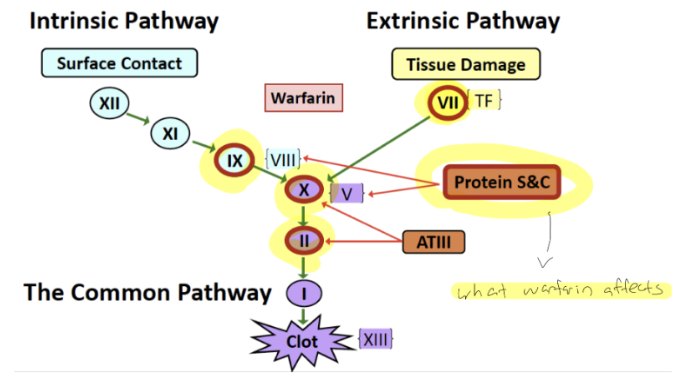
MOA: Inhibits VKOR → depletes Vitamin K → Prevents activation of clotting factors: II, VII, IX, X, S, C
Warfarin
Warfarin
_____
In the _____
Prevents _____ coag factors from being produced
Starts when _____ coag factors are turned over (5-7 days)
MOA: _____ → depletes _____ → _____ of clotting factors: II, VII, IX, X, S, C
Vitamin K Antagonist, liver, new, existing, inhibits VKOR, Vitamin K, prevents activation
Warfarin
Indication: Prophylaxis of DVT/PE, Thromboembolic, and A. fib.
Warfarin specifically affects Protein _____
Warfarin Sensitivity due to __________ (_____)
Warfarin Monitoring: _____ therapeutic window medication
Increased INR intensity = _____ Haemorrhagic SEs + _____ thromboembotic SEs (Goal INR = 2-3)
S and C, Enzyme Gene Polymorphisms, CYP2C9, Narrow, Increased, decreased
Warfarin
MOA: _____
Route: _____
Reversal Agent: _____
Titration Labs: _____
VKOR inhibitor, oral, Vitamin K, Ecentra, INR
Dabigatran
MOA: _____
Route: _____
Reversal Agent: _____
Titration Labs: _____
IIa inhibitor, Oral, Praxbind, n/a
Rivaroxaban
MOA: _____
Route: _____
Reversal Agent: _____
Titration Labs: _____
Xa inhibitor, Oral, Andexxa, n/a
Apixaban
MOA: _____
Route: _____
Reversal Agent: _____
Titration Labs: _____
Xa inhibitor, oral, andexxa, n/a
Edoxaban
MOA: _____
Route: _____
Reversal Agent: _____
Titration Labs: _____
Xa inhibitor, oral, n/a, n/a
Argatroban
MOA: _____
Route: _____
Reversal Agent: _____
Causes HIT? → _____
IIa inhibitor, IV, n/a, n/a
Bivalirudin
MOA: _____
Route: _____
Reversal Agent: _____
Causes HIT? → _____
IIa inhibitor, IV, n/a, n/a
UFH
MOA: _____, _____ = _____
Route: _____
Reversal Agent: _____
Causes HIT? → _____
ATIII activator, Xa:IIa, 1:1, IV or SQ, Protamine, Sometimes
LMWH
MOA: _____, _____ = _____
Route: _____
Reversal Agent: _____
Causes HIT? → _____
ATIII activator, Xa:IIa, 3:1, SQ, Protamine (partial), Rarely
Fondaparinux
MOA: _____, _____
Route: _____
Reversal Agent: _____
Causes HIT? → _____
ATIII activator, Xa only, SQ, n/a, n/a
__________
Reversal Agent for UFH (full) + LMWH (partial)
MOA: _____ by binding to it so it does not bind to _____
Heparin = acid (negatively-charged)
_____ = base (positively-charged)
1 mg _____ for every 100 units of heparin given in the last 30 mins
Protamine, chemically neutralized heparin, ATIII, Protamine, Protamine
Idarucizumab (__________)
Reversal Agent for Dabigatran
MOA: _____
Dabigatran is _____ (2nd best option (other than Ab) = _____ than Ab)
Praxbind, humanized mouse Mab, dialyzable, longer
__________
Reversal Agent for Warfarin
Prothrombin Complex Concentrates → has heparin (stabilizes coag factors)
Ready to use (already _____) + _____ coag factors (for _____)
Administer with _____ → waiting is not an option (quick administration)
Kcentra, activated, infusible, active bleeding, Vitamin K
__________
Reversal for Rivaroxaban + Apixaban
Removed from market due to increased risk of _____
Andexxa, clot formation
Parenteral Agents (4):
UFH, LMWH, Factor Xa inhibitors, DTIs
Oral Agents (3):
Vitamin K Antagonist, Factor Xa Inhibitors, DTIs
_____ + _____ = DOACs or NOACs
DOAC → _____ Oral Anticoag
NOAC → _____ Oral Anticoag
Factor Xa Inhibitors, DTIs, Direct, New