FDHRC MOCK EXAMS
 Call Kai
 Learn
Learn Practice Test
 Spaced Repetition
 Match
Match Flashcards
 Knowt Play
1/223

There's no tags or description
Looks like no tags are added yet.
Name | Mastery | Learn | Test | Matching | Spaced | Call with Kai |
|---|
No analytics yet
Send a link to your students to track their progress
224 Terms
72 mg (2 cartridges) of lidocaine 2% with epinephrine 1:100,000 and 72 mg (1 cartridge) of articaine 4% with epinephrine 1:100,000.
During periodontal debridement, the dental hygienist administered 2 cartridges of lidocaine (Xylocaine 2%) with epinephrine 1:100,000 and an additional cartridge of articaine (Septanest SP 4%) with epinephrine 1:100,000. What information should be documented in the client's chart?
Explain to the client what happened.
During periodontal debridement, the tip of the ultrasonic scaler cuts the client's tongue resulting in a minor laceration and minimal bleeding. What should the dental hygienist do next?
Position the client so that their Frankfort plane is parallel to the floor.
How can the dental hygienist correct the frown image seen on the following panoramic raograph?
Align the positioning indicating device with the centre of the film.
How should the dental hygienist avoid the technique error evident on the following bitewing radiograph? (CONE CUT)
Treat with an approved chemical disinfectant.
In keeping with infection prevention protocols, how should the dental hygienist deal with the dental unit light handles?
Sodium fluoride varnish
Mrs. Savage, 73 years old, presents for her 6-month continuing care appointment. She presents with generalized periodontitis Stage II Grade B, generalized gingival recession of 2 mm on the facial surfaces of sextant 5 and porcelain crowns on teeth 13 to 23. The dental hygienist notices the presence of carious lesions on the roots of the maxillary premolars. What fluoride agent should the dental hygienist select for Mrs. Savage?
Consult with a dentist.
Mrs. Jackson, 65 vears old, arrives for her dental hygiene appointment. The dental hygienist observes tooth 12 has a carious lesion with an elevated draining fistula on the attached gingiva. Which one of the following interventions would be appropriate?
Eruption follide
In reviewing the following radiograph, how should the area surrounding the crown of tooth 15 be interpreted?
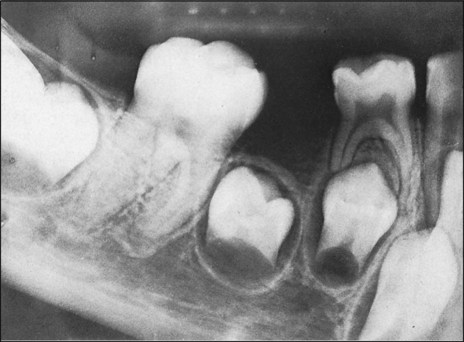
Comprehensive documentation. (Diligent record keeping is the key to tracking frequency of care, disease episodes, client response and the success rate of interventions)
What is the best indicator that a client has received the planned services?
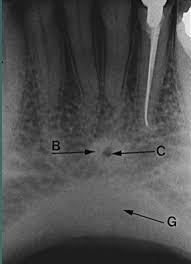
Genial tubercles.
What landmark is located inferor to the apices of teeth 31 and 41 and shows on the following periapical radiograph as a circular radiopacity? (ring-shaped radiopacity)
Use a saliva substitute
Ms. Cameron, 44 years old, is taking antidepressant medication and is experiencing mild xerostomia. What should the dental hygienist suggest to alleviate Ms. Cameron's discomfort?
A reduction in the Dental Biofilm Score,
At the previous 4-month continuing care appointment, the dental hygienist recommended the use of a powered toothbrush for 66-year-old Mrs. Louks. Which one of the following measures would indicate the success of this intervention?
inferor alveolar nerve block with lidocalne 2% with vasoconstrictor.
Mr. Connors, 25 years old, presents for a 1-hour appointment where periodontal debridement under local anesthesia will be done on quadrant 3. His health history is clear but he presents with acute sensitivity and moderate bleeding probing in the area, Which type of injection and local anesthetic agent should be used for Mr. Connors?
Withdraw 3/4 of the needle length and reposition the barrel of the syringe more posteriorly, then reinsert until bony contact is made at the correct depth.
A dental hygienist is administering a right inferior alveolar nerve block. The needle has been inserted into the hub and bony contact has not been achieved. What should the dental hygienist do next?
180 mg
A dental hygienist administered 2.5 cartridges of 1.8 ml of articaine 4% with epinephrine 1:200,000 to a client for non-surgical periodontal therapy. What is the appropriate amount of articaine to record in the client's chart?
Periodontal Screening and Recording Index (PSRI)
As part of a team of volunteers in an overseas dental outreach program, dental hygienists are asked to screen adult clients for periodontal disease. Which one of the following indices would be most appropriate to use?
Measurable criteria were used. (During the evaluation phase, the client's current status is compared with the baseline data using measurable criteria.)
How can a dental hygienist determine the success of previous dental hygiene interventions?
Focal trough
The area in which the dental anatomy is reproduced most distinctly on a panoramic radiooraph.
Smoking cessation.
Mrs. Stokich, 53 years old, presents for her 6-month continuing care appointment. She informs the dental hygienist that she resumed her smoking habit to "calm her nerves" following her husband's recent death. Mrs. Stokich's periodontal status has worsened. What is most important for the dental hygienist to discuss with Mrs. Stokich?
Consult with Mrs. Rooney's physician to obtain clearance for treatment
Mrs. Rooney, 75 vears old, presents for her continuing care appointment. During the review of her health history, Mrs. Rooney reports that she had a stroke 3 months ago. How should the dental hygienist proceed?
Negligence (There was a breach in the standard of care and harm resulted)
A curette tip has broken off in a client's mouth, but the dental hygienist fails to inform the client. In the event of a lawsuit, what would be the most likely grounds?
Soak the appliance in a tuberculocidal disinfectant.
How can the dental hygienist prevent cross contamination prior to transporting an orthodontic Hawley retainer to a laboratory for repair?
Submerge the denture in an alkaline peroxide solution for 15 minutes or overnight.
What should the dental hygienist recommend to Mr. Blank, 68 years old, regarding the care of his new chrome-cobalt partial denture?
The correlation between dental biofilm and gingivitis is much stronger than the correlation between calculus and gingivitis.
Which one of the following statements about the clinical significance of calculus is true?
Information about the proposed and alternative treatments
In order to obtain informed consent, what information is the most important to provide to the client prior to proceeding with treatment?
Reposition the bed and perform periodontal debridement
A dental hygienist is asked to visit a long term care facility to provide periodontal therapy for 92-year-old Mr. Whelan. The dental hyglenist finds Mr. Whelan confined to a single bed that is placed against a wall. He does not wish to be transported to the on site dental clinic. The dental hygienist cannot provide dental hygiene therapy using their dominant hand. Which one of the following actions would be most appropriate for the dental hygienist to take?
The occlusal surfaces of the teeth.
The dental hygienist notes bilateral hypertrophy of the masseter muscles during the head and neck assessment of a client. Based on this finding, what should the dental hygienist investigate further in the client's mouth
Replace the currently used toothbrush.
What oral self-care strategy should be recommended in the recovery phase of oral candidiasis?
Increased cinical attachment loss
Ms. Hughes, 36 years old, presents for her continuing care appointment. She was diagnosed with type 2 diabetes 1 year ago and reports she has had some difficulties adhering to her prescribed regimen. What should the dental hygienist anticipate finding during the assessment?
Rinse the mouth with water after using the Beclovent inhaler.
Ben, 18 years old, has asthma. His medications include the daily use of beclomethasone (Beclovent) and salbutamol (Ventolin), The dental hygienist observes a circular red and white patch on Ben's palate. What recommendation should the dental hygienist provide to Ben?
Necrotizing gingivitis
Jane, 18 vears old, presents with fetid breath and a generalized pseudomembrane on her gingival tissue, Radiographs indicate no bone loss. What best defines Jane's oral health status?
Heavy continuous orthodontic forces were used
Charlotte, 16 years old, presents for her continuing care appointment. She completed active fixed orthodontic treatment 4 months ago and now wears a removable maxillary retainer and a fixed mandibular lingual wire. Clinical assessment reveals mobility of M2 on tooth 22 and radiographic findings of resorption of approximately one third of the root length on tooth 22. What is the best explanation for this finding?
Wear single gloves, eve protection, mask, and clinical attire.
A client with HIV positive status presents for periodontal debridement. Bleeding is evident as part of generalized linear gingival erythema. Which one of the following infection prevention procedures should the dental hygienist implement7
Metronidazole therapy
Rupal, 15 years old, presents for her annual dental hygiene appointment. The oral assessment reveals light deposits and mild, localized inflammation. Bitewing radiographs are taken and reveal bone loss around all first permanent molars that were not present on radiographs taken 2 years previously. The dental hygienist probes all areas and finds 5 mm periodontal probing depths around the molars and the maxillary incisors. In addition to periodontal debridement, what intervention would be indicated at this time?
Explorer 11/12
Which one of the following assessment instruments should a dental hygienist use to best detect subgingival calculus throughout the mouth?
Refer her to a dentist for a consultation
Ms. Fisher, 23 years old, presents for her continuing care appointment with a Biofilm Control Record of 10%, generalized pink gingiva and no bleeding on probing. Based on the following bitewing radiograph, what should the dental hygienist do next? You can click on the image to make it larger.
Molar/Incisor pattern periodontitis, Stage II, Grade C.
Sasha, 16 years old, presents for her initial dental hygiene appointment. Radiographs reveal crestal bone between teeth 26 and 27 is 4 mm apical to the cementoenamel junction (CEJ), The crestal bone between teeth 11 and 21 is 4 mm apical to the CEJ and 2 mm between teeth 46 and 47. What would Sasha's periodontal status be?
Cyclosporine (Neoral) stimulates diffuse, firm, fibrous gingival overgrowth.
Mr Nelson, 28 vears old, presents for his continuing care appointment. His health history indicates that he had a kidney transplant 9 months ago. The client's intraoral assessment reveals a low dental biofilm score and generalized gingival enlargement. What should the dental hygienist consider regarding Mr. Nelson's medication regimen?
Discuss the findings and the plan with the client.
Mr. Hudon, 27 years old, presents for an initial dental hygiene appointment. The dental hygienist completes an assessment and the dental hygiene care plan. Which one of the following procedures is essential prior to the implementation of the plan?
The survey results of the community's oral health status.
The dental hygienist is presenting a proposal for an oral health education initiative to a community agency Which of the Following elements of the planning process should be described first?
Confirm that she understands that this treatment may not extend the life of her teeth.
Mrs. Attwell, 65 years old, has been diagnosed with Stage IV Grade C periodontal disease. She understands that her condition is severe but is currently unable to accept the loss of her teeth and refuses to consider complete dentures. When she presents for her initial periodontal debridement appointment, what should the dental hygienist do first?
Residual ridge resorption.
Mrs. Ng, 67 Vears old, has been diagnosed with osteoporosis. Each day, she smokes 15 cigarettes, drinks 6 cups of coffee, and consumes 1 - 2 alcoholic beverages a day. She wears a partial mandibular denture. What should the dental hygienist expect to find upon examining Mrs. Ng?
He is making realistic progress toward meeting his goal.
Louis, 18 years old, presents for his continuing care appointment. At his last visit, 6 mes ago, the dental hygienist had discussed tobacco cessation strategles with him. Louis indicated that he would reduce his 20-cigarette-per-day habit to zero. Today, he states he has read the literature the dental hygienist provided but is still smoking 15 cigarettes per day. He has some new friends who are nonsmokers and feels this may help him. Which one of the following conclusions is most appropriate for the dental hygienist to make regarding Louis' behaviour?
9 (Acid exposures are the number of times sugars are consumed in greater than 20-minute intervals.
The dental hygienist is analyzing a client's food diary. Findings suggest the client has eaten 15 fermentable carbohydrates. Three of these foods were consumed with breakfast, one was consumed mid-morning, two were consumed with lunch and four were consumed with dinner. The remaining five foods were consumed during the evening at greater than 20-minute intervals. What was the client's total number of acid exposures?
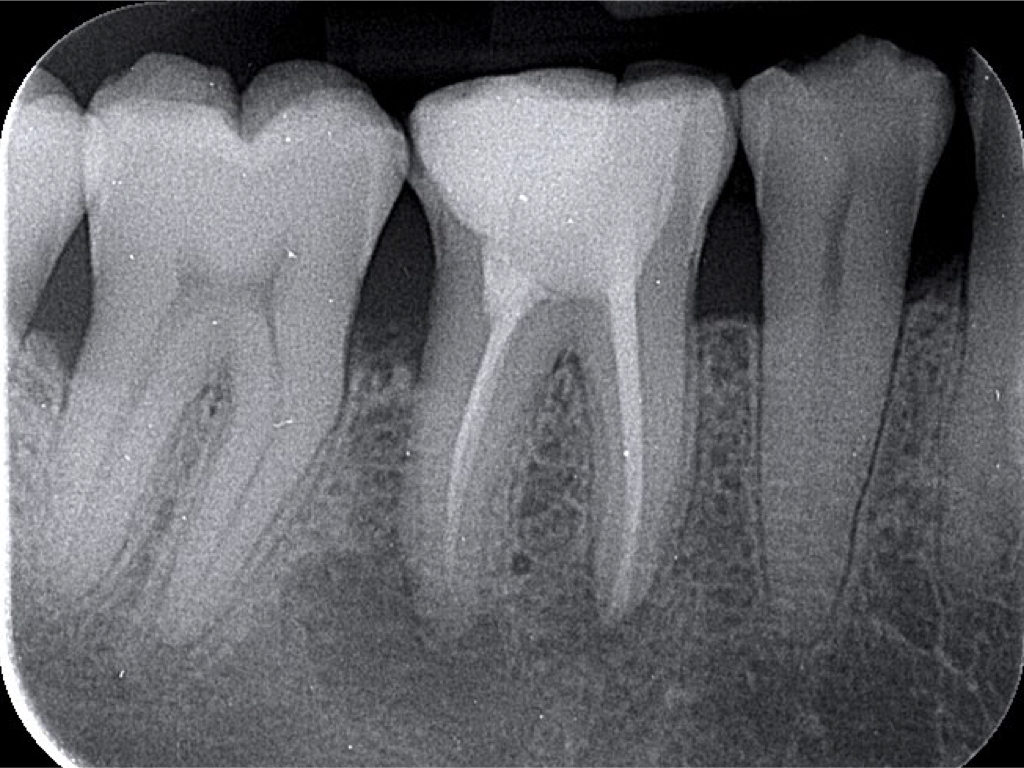
Endodontic filling material
What is the radiopacity on the distal portion of the mesial root of tooth 36
Riboflavin (Vitamin B2)
Mrs. Weinberg, 78 years old, indicates a concern about small ulcers at the corners of her mouth that do not heal. What vitamin or mineral deficiency may cause this type of lesion?
Position the syringe parallel to the long axls of the first premolar and deposit 0.9 - 1.2 ml for 30 - 40 seconds
After locating the infraorbital foramen, what steps should the dental hygienist take to prepare for the insertion and deposition of local anesthetic for an infraorbital nerve block?
File a report with the children's protection agency.
A child presents for their 6-month continuing care appointment. The dental hygienist notices extraoral findings that indicate sions of abuse. The dental hygienist discusses the suspicions with the dentist. The dentist explains they know the family well as they have been clients for a very long time, and there is no concern about abuse, so no action is needed. How should the dental hygienist proceed?
Practice nonmaleficence by postponing the appointment
A client, 45 vears old, presents for a 3-month continuing care appointment. The client hesa medical condition that requires antibiotic prophylaxis prior to dental hygiene care. The client informs the dental hygienist they did not take the medication because antibiotics make them feel sick, but they still want their cleaning today. How should the dental hygienist proceed?
Postpone the appointment until the client no longer has symptoms.
A dental hygienist is working at a long term care facility. One of the residents arrives for their dental hygiene appointment and reports a sore throat and generally feeling unwell. Upon intraoral inspection, the dental hygienist suspects strep throat. How should the dental hygienist proceed?
Health Belief Model.
A client wants to make a behaviour change because they perceive a threat posed by their medical problems. This is Consistent with which one of the following behaviour change theories?
Summarize the findings.
A dental hygienist is planning a series of information sessions for a youth group home that addresses oral health issues. Data has been collected on 30 youths. What is the next step in the planning process?
Determine his oral health knowledge
Client Profile
Mark, 17 Vears old, is a member of the high school Student Council and is involved in school sports
Chief Concern
He reports that his gums bleed very easily.
Health History:
He is in good health and is not taking any medications.
Dental History
Mark is wearing fixed orthodontic appliances. He has poor oral hygiene.
Intraoral Assessment:
There is generalized gingival inflammation and signs of cervical demineralization. Teeth 43, 44, and 45 have a mobility of M2, M1, and M2 respectively.
What is the first step the dental hygienist should take to best facilitate a behaviour change for Mark7
Dental biofilm control should be emphasized and reinforced to reduce inflammation.
Client Profile
Mark, 17 Vears old, is a member of the high school Student Council and is involved in school sports
Chief Concern
He reports that his gums bleed very easily.
Health History:
He is in good health and is not taking any medications.
Dental History
Mark is wearing fixed orthodontic appliances. He has poor oral hygiene.
Intraoral Assessment:
There is generalized gingival inflammation and signs of cervical demineralization. Teeth 43, 44, and 45 have a mobility of M2, M1, and M2 respectively.
How would the condition of the gingiva affect the dental hygiene care plan for Mark?
Teaching the Charter method of toothbrushing, then on successive appointments, introducing flossing techniques and fluoride use.
Client Profile
Mark, 17 Vears old, is a member of the high school Student Council and is involved in school sports
Chief Concern
He reports that his gums bleed very easily.
Health History:
He is in good health and is not taking any medications.
Dental History
Mark is wearing fixed orthodontic appliances. He has poor oral hygiene.
Intraoral Assessment:
There is generalized gingival inflammation and signs of cervical demineralization. Teeth 43, 44, and 45 have a mobility of M2, M1, and M2 respectively.
Which one of the following dental hygiene interventions would be the most effective when teaching Mark about oral self-care
There would be limited benefits at Mark's age
Client Profile
Mark, 17 Vears old, is a member of the high school Student Council and is involved in school sports
Chief Concern
He reports that his gums bleed very easily.
Health History:
He is in good health and is not taking any medications.
Dental History
Mark is wearing fixed orthodontic appliances. He has poor oral hygiene.
Intraoral Assessment:
There is generalized gingival inflammation and signs of cervical demineralization. Teeth 43, 44, and 45 have a mobility of M2, M1, and M2 respectively.
What would be the most likely effect of systemic fluoride supplements for Mark?
Rinse with Water and use saliva substitutes,
Use the following information to answer the next 4 questions:
Client Profile
Mr. Fox, 65 years old, quit smoking 10 years ago.
Chief Concern:
He is presenting for dental hygiene care prior to radiation therapy
Health History:
Mr. Fox has recently been diagnosed with squamous cell carcinoma on the tongue and is scheduled for surgery and radiation therapy.
Intraoral Assessment:
There is an 8 mm by 3 mm, irregular, indurated, cratered and primarily white lesion with areas of erythema on the right lateral border of the tongue. There is a rough amalgam restoration on the lingual surface of tooth 46. Several teeth are scheduled for extraction.
What should the dental hygienist suggest to Mr. Fox to relieve the xerostomia, loss of taste sensation, and difficulty swallowing that he will be experiencing post radiation therapy?
Reduced salivary flow may result in increased food retention.
Use the following information to answer the next 4 questions:
Client Profile
Mr. Fox, 65 years old, quit smoking 10 years ago.
Chief Concern:
He is presenting for dental hygiene care prior to radiation therapy
Health History:
Mr. Fox has recently been diagnosed with squamous cell carcinoma on the tongue and is scheduled for surgery and radiation therapy.
Intraoral Assessment:
There is an 8 mm by 3 mm, irregular, indurated, cratered and primarily white lesion with areas of erythema on the right lateral border of the tongue. There is a rough amalgam restoration on the lingual surface of tooth 46. Several teeth are scheduled for extraction.
Following radiation therapy, what information should the dental hygienist give Mr. Fox regarding his increased risk for dental caries?
Three weeks before the first radiation treatment
Use the following information to answer the next 4 questions:
Client Profile
Mr. Fox, 65 years old, quit smoking 10 years ago.
Chief Concern:
He is presenting for dental hygiene care prior to radiation therapy
Health History:
Mr. Fox has recently been diagnosed with squamous cell carcinoma on the tongue and is scheduled for surgery and radiation therapy.
Intraoral Assessment:
There is an 8 mm by 3 mm, irregular, indurated, cratered and primarily white lesion with areas of erythema on the right lateral border of the tongue. There is a rough amalgam restoration on the lingual surface of tooth 46. Several teeth are scheduled for extraction.
When is the best time for Mr. Fox to be scheduled for his extractions?
Consult with the oncologist regarding the ASA solution and discuss the resulting oral effects.
Use the following information to answer the next 4 questions:
Client Profile
Mr. Fox, 65 years old, quit smoking 10 years ago.
Chief Concern:
He is presenting for dental hygiene care prior to radiation therapy
Health History:
Mr. Fox has recently been diagnosed with squamous cell carcinoma on the tongue and is scheduled for surgery and radiation therapy.
Intraoral Assessment:
There is an 8 mm by 3 mm, irregular, indurated, cratered and primarily white lesion with areas of erythema on the right lateral border of the tongue. There is a rough amalgam restoration on the lingual surface of tooth 46. Several teeth are scheduled for extraction.
Following several sessions of radiation therapy, Mr. Fox is experiencing soft tissue sensitivity. He is gargling with an acetylsalicylic acid (ASA) and water solution that he said was recommended by his oncologist. what should the dental hygienist do?
Observe his toothbrushing technique, making changes as necessary and provide positive reinforcement
Use the following information to answer the next 3 questions:
Client profile
Hugo, 9 years old, presents for a new client appointment and he is accompanied by his mother.
Chief Concern
His mother wants him to have his "teeth cleaned and checked", brtne refuses to cooperate with the
dental hyglenist.
Dental History
When he was younger, Hugo had a traumatic experience watching his twin brother having dental extractions, during which he saw dental forceps covered with blood
The dental hygienist determines that Hugo could benefit from improved dental biofilm control. What strategy should the dental hygienist use?
A honey sandwich.
Use the following information to answer the next 3 questions:
Client profile
Hugo, 9 years old, presents for a new client appointment and he is accompanied by his mother.
Chief Concern
His mother wants him to have his "teeth cleaned and checked", brtne refuses to cooperate with the
dental hyglenist.
Dental History
When he was younger, Hugo had a traumatic experience watching his twin brother having dental extractions, during which he saw dental forceps covered with blood
The mother discusses her son's favourite treats with the dental hygienist. Which one of the following items poses the greatest risk for dental caries for Hugo?
Have him watch another child being treated, who is praised and rewarded for being cooperative.
Use the following information to answer the next 3 questions:
Client profile
Hugo, 9 years old, presents for a new client appointment and he is accompanied by his mother.
Chief Concern
His mother wants him to have his "teeth cleaned and checked", brtne refuses to cooperate with the
dental hyglenist.
Dental History
When he was younger, Hugo had a traumatic experience watching his twin brother having dental extractions, during which he saw dental forceps covered with blood
What behaviour modification strategy should the dental hygienist use with Hugo?
Generalized periodontitis Stage III Grade B
Use the following information to answer the next 3 questions:
Client Profile:
Mr. Ferguson, 70 vears old, presents for his initial dental hygiene appointment.
Chief Concern:
He reports bleeding gums and a dry mouth".
Health History
He has been prescribed furosemide (Lasix) for hypertension and glyburide (DiaBeta) for diabetes, Both conditions remain poorly controlled.
Dental History
He has posterior amalgam restorations with overhanging margins
Intraoral Assessment:
There is generalized marginal redness of the gingiva and bleeding on probing. There are 7mm periodontal probing depths in the posterior areas
Radiographic Findings
There is generalized moderate bone loss, with localized vertical bone loss on teeth 17, 26 and 46
What periodontal classification best describes Mr. Ferguson's oral findings?
His understanding of the care plan.
Use the following information to answer the next 3 questions:
Client Profile:
Mr. Ferguson, 70 vears old, presents for his initial dental hygiene appointment.
Chief Concern:
He reports bleeding gums and a dry mouth".
Health History
He has been prescribed furosemide (Lasix) for hypertension and glyburide (DiaBeta) for diabetes, Both conditions remain poorly controlled.
Dental History
He has posterior amalgam restorations with overhanging margins
Intraoral Assessment:
There is generalized marginal redness of the gingiva and bleeding on probing. There are 7mm periodontal probing depths in the posterior areas
Radiographic Findings
There is generalized moderate bone loss, with localized vertical bone loss on teeth 17, 26 and 46
Which one of the following factors would be most important when obtaining Mr. Ferguson's informed consent?
Referral to his physician.
Use the following information to answer the next 3 questions:
Client Profile:
Mr. Ferguson, 70 vears old, presents for his initial dental hygiene appointment.
Chief Concern:
He reports bleeding gums and a dry mouth".
Health History
He has been prescribed furosemide (Lasix) for hypertension and glyburide (DiaBeta) for diabetes, Both conditions remain poorly controlled.
Dental History
He has posterior amalgam restorations with overhanging margins
Intraoral Assessment:
There is generalized marginal redness of the gingiva and bleeding on probing. There are 7mm periodontal probing depths in the posterior areas
Radiographic Findings
There is generalized moderate bone loss, with localized vertical bone loss on teeth 17, 26 and 46
Which one of the following interventions should be given the highest priority in the dental hygiene care plan for Mr. Ferguson?
There is access to restorative dental care.
Use the following information to answer the next 4 questions:
Client Profile
A dental hygienist is asked to screen a class of 40 local high school students between the ages of 14 and 16.
Chief Concern:
The dental hygienist must determine the oral health status of the group of students by using the DMFT index.
Intraoral Assessment:
The DMFT rating for this group was as follows: D - 40; M - 44; F = 76. The total DMET for the group is 160.
What does the relatively high F value of 76 indicate for this target group?
The need for services from an oral health program.
Use the following information to answer the next 4 questions:
Client Profile
A dental hygienist is asked to screen a class of 40 local high school students between the ages of 14 and 16.
Chief Concern:
The dental hygienist must determine the oral health status of the group of students by using the DMFT index.
Intraoral Assessment:
The DMFT rating for this group was as follows: D - 40; M - 44; F = 76. The total DMET for the group is 160.
By collecting the DMFT for this target group, the dental hygienist will be able to use the data to draw which one of the following conclusions?
4.0. (To find the average, add all the scores and divide by the total number. Total DMFT score for the group (160) divided by the number of students (40) equals 4.)
Use the following information to answer the next 4 questions:
Client Profile
A dental hygienist is asked to screen a class of 40 local high school students between the ages of 14 and 16.
Chief Concern:
The dental hygienist must determine the oral health status of the group of students by using the DMFT index.
Intraoral Assessment:
The DMFT rating for this group was as follows: D - 40; M - 44; F = 76. The total DMET for the group is 160.
What is the group average DMFT?
The missing teeth are a result of caries and periodontal disease
Use the following information to answer the next 4 questions:
Client Profile
A dental hygienist is asked to screen a class of 40 local high school students between the ages of 14 and 16.
Chief Concern:
The dental hygienist must determine the oral health status of the group of students by using the DMFT index.
Intraoral Assessment:
The DMFT rating for this group was as follows: D - 40; M - 44; F = 76. The total DMET for the group is 160.
What does the M value of this group's DMFT represent?
Generalized biofilm-induced gingivitis with localized traumatic occlusal forces in sextant 2
Use the following information to answer the next 4 questions:
Client Profile:
Ms. Sterling, 24 years old, presents 18-months overdue for her continuing care appointment. She completed er fiked orthodontic treatment 2 years ago
Chief Concern:
She reports that her mandibular lingual wire is broken and that, shortly after the orthodontic treatment was completed, her maxillary anterior teeth started to move.
Dental History
Prior to orthodontic treatment, her occlusion cassification was Class I1 division 1 with severe mandibular anterior crowding, an overjet of 8 mm, and an overbite of 60% with a tongue thrusting habit
Intraoral Assessment.
She now presents with a Class I malocclusion, an overjet of 5 mm, and an overbite of 20%. The periodontal assessment includes generalized redness of the marginal gingiva. The interproximal periodontal probing depths are all 3 mm accompanied with bleeding on probing and type 1 embrasures. All anterior teeth including teeth 34 and 44 present with gingival recession of 2 mm on the buccal surfaces. There is mobility of M1 on the maxillary anterior teeth. Today's O'Leary Biofilm Record score is 30%
What periodontal diagnosis should be recorded in Ms. Sterling's dental chart?
Take anterior periapical radiographs
Use the following information to answer the next 4 questions:
Client Profile:
Ms. Sterling, 24 years old, presents 18-months overdue for her continuing care appointment. She completed er fiked orthodontic treatment 2 years ago
Chief Concern:
She reports that her mandibular lingual wire is broken and that, shortly after the orthodontic treatment was completed, her maxillary anterior teeth started to move.
Dental History
Prior to orthodontic treatment, her occlusion cassification was Class I1 division 1 with severe mandibular anterior crowding, an overjet of 8 mm, and an overbite of 60% with a tongue thrusting habit
Intraoral Assessment.
She now presents with a Class I malocclusion, an overjet of 5 mm, and an overbite of 20%. The periodontal assessment includes generalized redness of the marginal gingiva. The interproximal periodontal probing depths are all 3 mm accompanied with bleeding on probing and type 1 embrasures. All anterior teeth including teeth 34 and 44 present with gingival recession of 2 mm on the buccal surfaces. There is mobility of M1 on the maxillary anterior teeth. Today's O'Leary Biofilm Record score is 30%
At Ms. Sterling's next continuing care appointment, she is concerned about the continued mobility in sextant 2 Assessment findings include mobility of M1 on teeth 12 and 22 and M2 on teeth 11 and 21 with no calculus or bleeding on probing. What should the dental hygienist do next?
3 months
Use the following information to answer the next 4 questions:
Client Profile:
Ms. Sterling, 24 years old, presents 18-months overdue for her continuing care appointment. She completed er fiked orthodontic treatment 2 years ago
Chief Concern:
She reports that her mandibular lingual wire is broken and that, shortly after the orthodontic treatment was completed, her maxillary anterior teeth started to move.
Dental History
Prior to orthodontic treatment, her occlusion cassification was Class I1 division 1 with severe mandibular anterior crowding, an overjet of 8 mm, and an overbite of 60% with a tongue thrusting habit
Intraoral Assessment.
She now presents with a Class I malocclusion, an overjet of 5 mm, and an overbite of 20%. The periodontal assessment includes generalized redness of the marginal gingiva. The interproximal periodontal probing depths are all 3 mm accompanied with bleeding on probing and type 1 embrasures. All anterior teeth including teeth 34 and 44 present with gingival recession of 2 mm on the buccal surfaces. There is mobility of M1 on the maxillary anterior teeth. Today's O'Leary Biofilm Record score is 30%
Which one of the following continuing care intervals would be most appropriate for Ms. Sterling?
Traumatic tooth movement
Use the following information to answer the next 4 questions:
Client Profile:
Ms. Sterling, 24 years old, presents 18-months overdue for her continuing care appointment. She completed er fiked orthodontic treatment 2 years ago
Chief Concern:
She reports that her mandibular lingual wire is broken and that, shortly after the orthodontic treatment was completed, her maxillary anterior teeth started to move.
Dental History
Prior to orthodontic treatment, her occlusion cassification was Class I1 division 1 with severe mandibular anterior crowding, an overjet of 8 mm, and an overbite of 60% with a tongue thrusting habit
Intraoral Assessment.
She now presents with a Class I malocclusion, an overjet of 5 mm, and an overbite of 20%. The periodontal assessment includes generalized redness of the marginal gingiva. The interproximal periodontal probing depths are all 3 mm accompanied with bleeding on probing and type 1 embrasures. All anterior teeth including teeth 34 and 44 present with gingival recession of 2 mm on the buccal surfaces. There is mobility of M1 on the maxillary anterior teeth. Today's O'Leary Biofilm Record score is 30%
Which factor is most likely to contribute to Ms. Sterling's gingival recession?
Frictional hyperkeratosis
The intraoral assessment of a 27-year-old female client reveals a raised, white, non-sloughing, painless lesion on the left lateral border of the tongue, The client is on long-term corticosteroid therapy, Which one of the following conditions is most likely to be present?
A short dental needle is recommended
In order to avoid a hematoma, what should the dental hygienist consider when delivering local anesthetic using a posterior superior alveolar nerve block technique?
Mr Lindsay likely has high levels of endotoxins in his periodontal pockets
Diagnostic tests reveal that Mr. Lindsay, 73 years old, has a predominance of gram-negative bacteria in his periodontal pockets.What conclusion should the dental hygienist draw?
Motivation is essential for behaviour modification.
The dental hygienist suggests to 5-year-old Yin and his mother that his teeth be brushed twice daily. The dental hygienist provides them with a colourful calendar to record Yin's toothbrushing frequency. What learning principle is the dental hygienist using to help Yin learn a new oral self care technique?
Place an ice pack on the area to minimize the size of the hemaroma
Shortly after administering a posterior superior alveolar injection for subgingival periodontal debridement of sextant 3, the dental hygienist notices a hematoma developing extraorally on the anesthetized side. What should the dental hygienist do?
Aspirate twice, rotating the bevel after the first aspiration
The dental hygienist administers local anesthetic for periodontal debridement in sextant 1. The needle tip is inserted and advanced to the correct depth and location. Which one of the following steps must be performed to ensure proper aspiration?
Beneficence.
The dental hygienist ensures that 84-year-old Mrs. Chipman takes prescribed premedication before a periodontal debridement appointment. Which one of the following ethical principles is being addressed?
A list of the hazards of the material, precautions that should be taken when the material is used and procedur to follow in case of an emergency.
What information regarding a hazardous material should be on a Material Safety Data Sheet (MSDS)?
Local anesthetic overdose
A dental hygienist begins periodontal debridement immediately following the administration of focal anesthetic. The client becomes excessively talkative and appears apprehensive and confüsed. These signs suggest which one of the following medical emergencies?
Teach the nunses to provide oral hygiene education and to distribute supplies to the clients.
The supervisor of a local shelter for homeless men has requested assistance in promoting oral health care. The dental hygienist determines that a team of volunteer nurses works at the shelter a total of 6 hours per week and that a fund of $100 is available for this project. Which one of the following actions by the dental hygienist would best address the supervisor's request?
Choose firm fibrous foods and take vitamin B daily
Matthew, 23 years old, has generalized severe dental biofilm-induced gingivitis and a burning tongue. He reports that his diet consists mainly of soft, processed foods. What nutritional recommendations should the dental hygienist provide?
Determine the possible causes of halitosis
Ms. Isfeld, 33 years old, reports to the dental hygienist that she has "bad breath." What is the best course of action for the dental hygienist to take?
A posterior superior alveolar, infraorbital, oreater palatine, and nasopalatine nerve blocks using prilocaine 4% with epinephrine 1:200,000
Mr Palson, 67 years old, is healthy and requires local anesthesia for periodontal debridement of quadrant 1. This quadrant presents with acute inflammation and 4 - 6 mm periodontal probing depths, What would be the best combination of local anesthetic agent and injection site(s) for Mr. Palson?
Right PSA block, deposited 1/2 cartridge of 1.8 ml prilocaine 4%,1:200,000 epinephrine; no negative reactions
The dental hygienist performed a posterior superior alveolar nerve block for teeth 1.8 and 1.7 on a healthy 45-vear-old 60 kg female client. The dental hygienist deposited 0.9 ml of prilocaine 4% with 1:200,000 epinephrine. What information should the dental hygienist document in the client's record?
To facilitate accurate conclusions.
When designing a community-based program, why is it important to plan the evaluation phase?
Document Ms. Lemieux's informed refusal
Ms. Lemieux, 51 years old, has been attending regular 9-month continuing cafe appointments for the past 15 years. The clinical attachment levels and Bleeding Points Index have increased over the past 2 years. These findings have been clearly explained twice to Ms. Lemieux and it was recommended that she return for dental hygiene therapy every 3 months. She prefers to continue with her 9-month interval. How should the dental hygienist proceed?
Explain the effects of tooth polishing
Mr. Pica, 58 years old, presents for his continuing care appointment. He wants his teeth "polished" even though it is unnecessary. How should the dental hygienist proceed?
Bleeding on probing.
What clinical finding indicates periodontal inflammation?
Class II division 1.
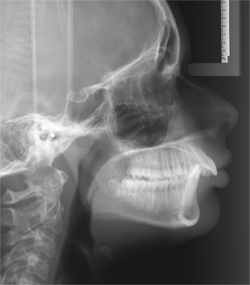
What is the occlusion seen in the cephalogram below?
Flush for a minimum of 20 seconds after each client
What is the best practice for flushing waterlines connected to dental devices?
Offer the client a non-alcoholic antiseptic alternative
The office protocol calls for the implementation of a preprocedural mouthrinse prior to periodontal debridement. A client refuses to rinse his mouth due to his religious beliefs that prevents him from using alcohol. How should the dental hygienist proceed?
Use an electric toothbrush.
Mr Dawson, 49 vears old, presents to his dental hygiene appointment after an absence of 5 years. Mr. Dawson has multiple sclerosis and reports difficulty with daily oral self-care due to limited manual dexterity. Which one of the following recommendations should be made to Mr. Dawson in order to assist him in improving his oral self-care practices?
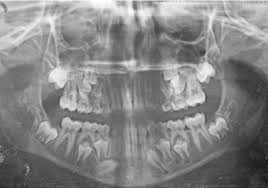
10
What is the approximate age, in years, of this client?
Inform the client that the appointment will be postboned until she is asymptomatic for 24 hours.
Mrs. Esponita, 32 years old, presents with a cough, a stuffy nose and body aches. Her blood pressure is 118/70 mm Hg and her temperature is 40℃. She tells the dental hygienist that she feels well enough to proceed with treatment. What should the dental hygienist do?
Sodium fluoride
Mr. Kell, 54 years old, is at moderate risk for root caries due to medication-induced xerostomia. What oral self-care mouthrinse should the dental hygienist recommend to Mr. Kell?
Position Ms. Romani so her head is even with the upper edde of the headrest
During periodontal debridement for Ms. Romani, 34 vears old, the dental hygienist experiences lower back discomfort from balancing on the edge of the clinician's stool to obtain optimal visibility, Ms. Romani is 1.52 m tall and of average weight. What initial adjustment should the dental hygienist make to avoid lower back strain7