Quantum Year 2
 Call Kai
 Learn
Learn Practice Test
 Spaced Repetition
 Match
Match Flashcards
 Knowt Play
1/168

There's no tags or description
Looks like no tags are added yet.
Name | Mastery | Learn | Test | Matching | Spaced | Call with Kai |
|---|
No analytics yet
Send a link to your students to track their progress
169 Terms
What is a differential operator?

What is the Hamiltonian function and what does it represent?
H = T+V
Represents total energy of a system
What is the equation obtained by substituting H = V+T into TDSE?

What are two general properties of the Time Dependent Schrödinger Equation?
PDE - 1st order in time
PDE - 2nd order in space
What does it mean that the TDSE is linear in Ψ(x, t)?
If Ψ(x, t) is a solution of the Schrödinger equation, then aΨ(x, t) is also a solution where a is some complex number
If Ψ1(x, t) and Ψ2(x, t) are both some solutions then aΨ1(x, t) + bΨ2(x, t) where a and b are both complex numbers
What does the wave function describe?
The quantum state of the system
What does postulate probabilistic interpretation of Ψ via the Born rule give? + what is the equation
probability density for finding a particle at position x at time t

What is the equation for the probability of finding a particle between x and x+dx at a time t?

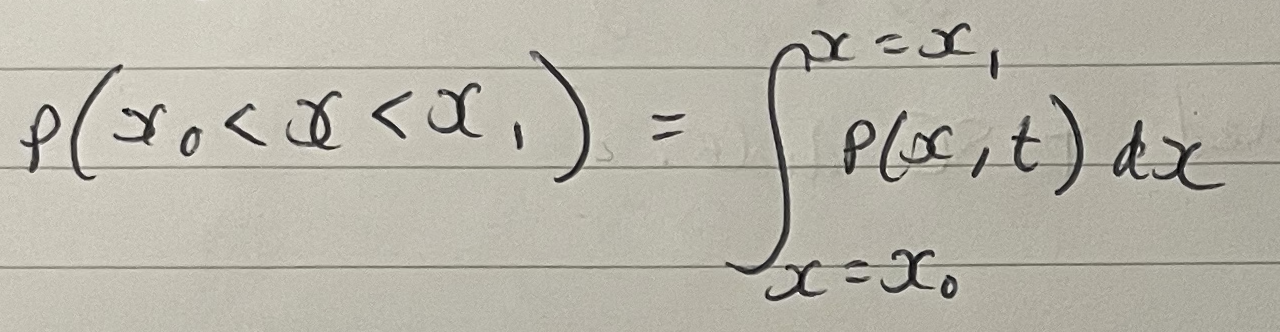
How do you find the probability that a particle is between x0 and x1?
Calculate integral
What are three constraints on the wave function?
Ψ(x, t) must be square-integrable
Ψ(x, t) must be continuous and single valued otherwise the probability is ill-defined
(equation in image) must be continuous
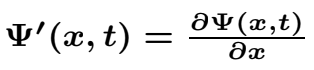
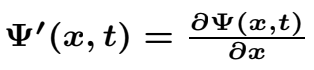
Explain the constraint that the equation in the image must be continuous
Otherwise there will be infinite momenta
Except when there is infinite discontinuity in V(x, t) (so only have this constraint when there is a finite discontinuity in the potential)
When is the potential of a system independent of time?
In closed systems, no external force

What is the general solution for the TDSE when the potential is independent of time?

What is the equation for the Time Independent Schrödinger Equation?

Explain what is meant by TISE is an eigenvalue equation
E is the energy eigenvalue
E represents total energy of the system
E is conserved for time independent potentials

What are stationary states?
TDSE solutions of the form shown in the image, also called energy eigenstates

What is the expression for E in the TISE?
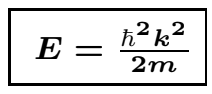
What is the equation for E in the TISE for a free non-relativistic particle?

For a free particle with energy described by QM, is energy quantised or not quantised? Why?
NOT quantised because idk i haven’t checked with dan
What is the equation for the full wave function for a planar wave moving either in the positive or negative x direction?

For a particle in an infinite potential well, what does classical physics predict?
Continuous values of total energy, E=>0
What are the boundary conditions for the IPW?
ψ must be continuous - this means that ψ = 0 at the boundaries of the well
x=0: Asink0+Bcosk0 gives B=0
x=L: AsinkL=0 gives kL=nπ, n=1,2,3..
Solutions are discrete (quantised) states q
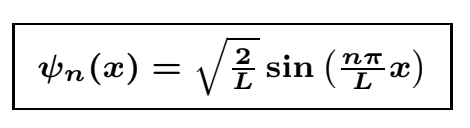
What is the wave function for a particle in the IPW?

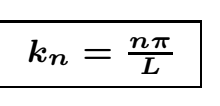
What is the equation for kn in the IPW?
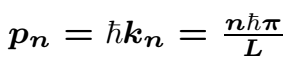
What is the associated momentum for a particle in the IPW?
What is the total energy associated with a particle in the IPW?

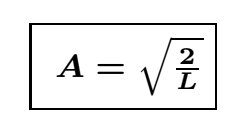
When normalising IPW wave functions, what is the equation for A?
When normalising IPW wave functions, what is the full equation for the wave function?
What does HUP stand for?
Heisenberg Uncertainty Principle
What is the HUP for position and momentum?

What are the two uncertainties associated with En from the HUP?

What is the equation for the number of nodes for the nth state?
num nodes = n-1
What is the equation for ψ’(x)?

Why is it allowed for ψ’(x) to not be continuous at x=0?
There is an infinite jump in V(x) at x=0,L
What are the conditions for the symmetric IPW?

How do you obtain wave functions from the symmetric IPW?
Taking the solutions of the IPW at 0<x<L and making a substitution x→x+L/2
What are two pieces of information gained by solving the symmetric IPW?
odd n, symmetric, even parity
even n, antisymmetric, odd parity
What does parity relate to?
symmetry, transformations about the y-axis
What is a parity transformation?
Reflecting in the y-axis
What does antisymmetric mean?
Odd symmetry
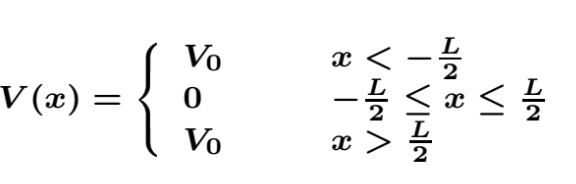
Draw a diagram for the FPW with the conditions on the potential
Including E and KE
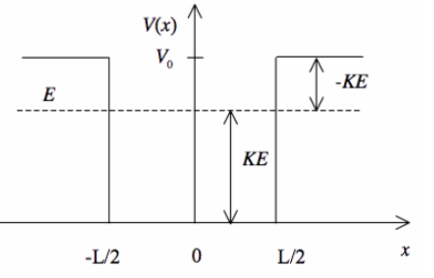
In the FPW, when E>V0, what is happening?
Unbound states
Total energy E continuous, not quantised
In the FPW, when E<V0, what is happening?
Bound states
Expect discrete values
In Region I (-L/2<x<L/2) of the FPW, what are the solutions for the wavefunction?
ψ1(x) = A sin kx + B cos kx
In Region II (x>L/2) of the FPW, what are the solutions for the wavefunction?
ψ2(x)= C exp(-αx) + D exp(αx)
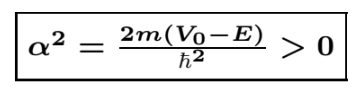
with alpha2 expression in the image
Set D=0 or not square integrable (blows up at large +ve x)
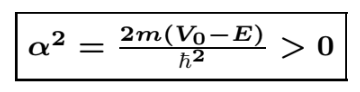
In Region II (x<-L/2) of the FPW, what are the solutions for the wavefunction?
ψ3(x)= F exp(-αx) + G exp(αx)
with alpha2 expression in the image
Set F=0 or not square integrable (blows up at large -ve x)
For the FPW, in what way is there symmetry and what should you expect as a result?
potential is symmetric wrt x=0 -> expect symmetric and antisymmetric states (odd and even parity)
Considering even-parity solutions for the FPW only, what happens for larger and smaller values of V0?
Larger V0 gives more bound states
Smaller V0 gives fewer bound states
In the FPW what is the condition for the number of bound states?
There is always at least one bound state, even in a very shallow well (V0→0)
Compare the wavenumber and energy of the nth state between the IPW and the FPW
the wavenumber and energy of the nth state is always less in the FPW than in the IPW

For even-parity only in the FPW, when the condition in the image is true, how many symmetric or antisymmetric states are there?
Only one symmetric state exists

For odd-parity only in the FPW, when the condition in the image is true, how many symmetric or antisymmetric states are there?
No antisymmetric state exists
Compare the FPW and the IPW
Infinite well:
ψ(x) confined to the well
kn = nπ/L
Infinite tower of states
No unbound states
Finite well:
ψ(x) spreads out beyond the well
kn and energies lower
Finite tower of states
Unbound states when E>V0
Why are the energy levels in the FPW lower than in the IPW?
Lower in the FPW because the wavefunction spreads out by penetrating the classically forbidden region, and reduces its kinetic energy
In the FPW, at x>L/2, what is the wavefunction proportional to?
e-αx
In the FPW, at x<-L/2, what is the wavefunction proportional to?
eαx
What is the expression for α2 in the FPW?
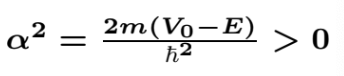
As V0→infinity, what happens to α and 1/α in the potential well?
α→infinity
1/α→0
As E→V0, what happens to α and 1/α in the potential well?
α →0
1/α→infinity
What is the definition of penetration depth?
The depth of quantum tunnelling
What is penetration depth or depth of tunnelling determined by?
1/α
What does non-zero wavefunction in classically forbidden regions allow?
Tunnelling between classically allowed regions
What are quantum energy states a typical property of?
Any well-type potential
Describe non-zero tails
Corresponding wave functions and probabilities for quantum energy states are mostly confined in the potential well but exhibit non-zero tails in the classically forbidden regions of KE<0
When are the non-zero tails in the classically forbidden KE<0 region not allowed?
When V(x)→infinity
What are 2 consequences of the Heisenberg Uncertainty Principle in the context of quantum states in potential wells?
The lowest energy state is always above the bottom of the potential and is symmetric
The wide and/or more shallow the potential, the lower the energies of the quantum states
Inside the FPW is the number of quantum states finite or infinite?
Finite
In a potential well, when the total E is larger than the height of the potential, is the energy continuous or quantised?
Continuous
When V=V(x) in the potential well, what does form do the time-dependent wave functions take and what does this mean?
This means that both the bound and continuous states are stationary

In the example {λn} what do the curly brackets denote?
The set of
What does orthonormal mean?
The function is both orthogonal and normalised
What does it mean to say “the different potentials V(x) give different Hamiltonians for which there are different sets of energy eigenstates”
Different potentials lead to different sets of energy levels
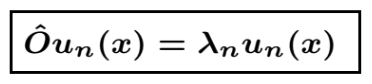
What is the eigenvalue equation involving the linear operator Ô?
{λn} and eigenfunctions {un(x)} are solutions
What is δnm and what does it mean?
Kronecker delta
δ=1 when n=m, δ=0 when n!=m
What is the expression for the eigenfunctions corresponding to different eigenvalues λn = λm?

The set of eigenfunctions {un(x)} form a complete set in a space of functions: how can any function u(x) that obeys the same boundary conditions as the un(x) be expressed?

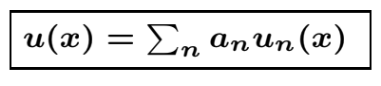
What does an represent in this expression?
the coefficients of expansion, probability amplitudes
What is an observable?
A measurable quantity
What is the operator for position x?
x^
What is the operator for momentum?
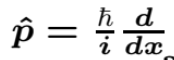
What is the operator for kinetic energy?
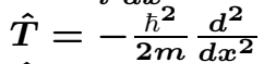
What is the operator for potential energy?
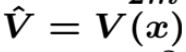
What is the operator for total energy E?

What is the operator for parity?
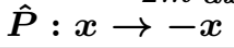
Why do bound states have a definite value of momentum squared but not of momentum?
Because do not know direction which defines whether it is the positive or negative root
What are the two solutions for parity eigenfunction and what do they refer to?

What is the postulate for QM that refers to the probability of measuring a specific eigenstate?
the system described by ψ(x) can be found in the state ψ_n(x) with probability
Pn = |an|2
What does collapse of the wavefunction refer to?
When a measurement has been made yielding En, the system collapses to the state ψn(x) and remains there
i.e. the act of measuring the system changes the wavefunction
What is the integral equation for the associated average value for some observable λ at a specific time t?

What does the equation for the average value of an observable become if we know the probability amplitudes an?

What are the two equations for the rms fluctuation?

What does the rms fluctuation show?
The spread of values around the average value of the observable <λ>
What does ∆λ provide information on?
How much a measured value of λ can differ from the average value <λ>
What is the value of ∆λ when the identical systems are all in an eigenstate ψn of some linear operator Ô associated with an observable λ?
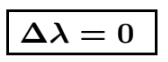
What is the condition for when two observables can be measured simultaneously with absolute precision?
When the commutator of the associated operators of two observables A and B, [Â , B^]=0, then the observables can be measured simultaneously
When can two observables A and B be measured with total precision?
When the commutator [Â , B^]=0
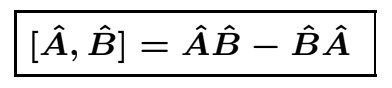
What is the equation for the commutator of two operators  and B^?
Why can two observables A and B be measured with total precision when the commutator of their associated hermitian operators equals 0?
If [A^,B^]=0 then A^ and B^ have a common set of eigenfunctions
The system is initially at
The measurement of A makes the system collapse
This yields an eigenstate ψ_n, A_n
Since A^ and B^ have a common set of eigenfunctions, this means that a measurement of B yields B_n, the system remains in the state ψ_n, and ∆B=0
What is the condition for when two observables CANNOT be measured with total precision?
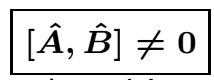
What is the full HUP equation?
