Face perception
 Call Kai
 Learn
Learn Practice Test
 Spaced Repetition
 Match
Match Flashcards
 Knowt Play
1/46

There's no tags or description
Looks like no tags are added yet.
Name | Mastery | Learn | Test | Matching | Spaced | Call with Kai |
|---|
No analytics yet
Send a link to your students to track their progress
47 Terms
What has been found in relation to cell selectivity for faces in monkeys?
Monkey temporal cortex cells (IT, STS) respond to faces
What is hierarchical processing of visual information (Hubel and Wiesel)?
Findings in visual cortex.
Simple cell→ complex cell → hyper complex cell
What was found in a study of one particular cells response to a range of diverse faces?
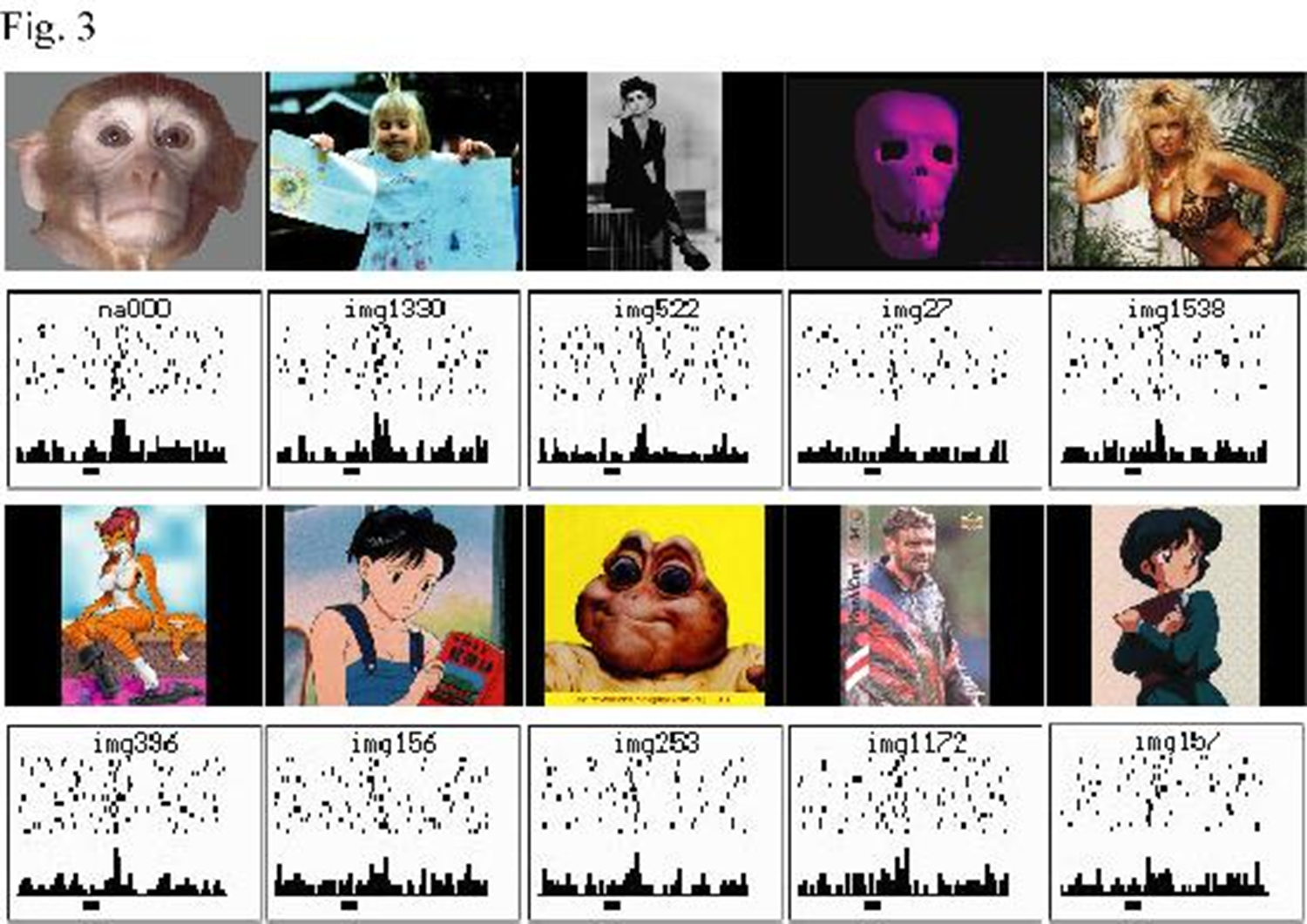
Despite diversity of faces still response from one cell
What are grandmother cells?
Specificity, respond to one object only
Generalisation, respond to many instances.
E.g. when you see your grandmother, hear her, see her name written.
What problems are associated with the idea of grandmother cells?
Not enough cells in the brain?
Death of cell results in inability to recognise grandmother
Evidence of population coding in temporal cortex
Unlikely to ever find them, would have to take electrode and test millions of different cells.
What are external and internal facial features?
External → nose, eyes, mouth, etc
Internal → teeth, hair
Important for processing
What is the Thatcher illusion (Thompson, 1980)?
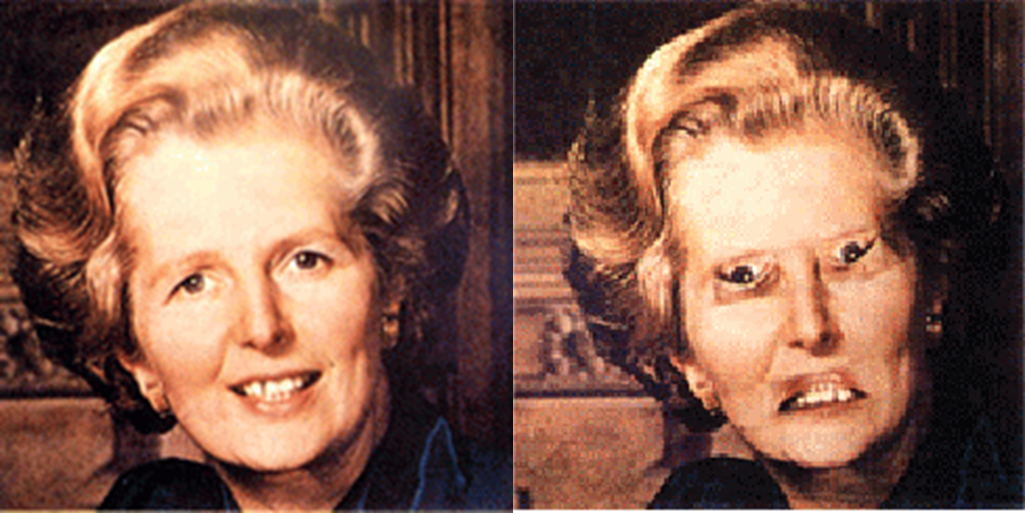
Upright:
Features analysed holistically
Inverted:
Holistic face processing impaired
Features analysed independently
Each feature coded relative to gravity
How does configuration relate to processing facial features?
Features have to be in the right place, relative position affects processing.
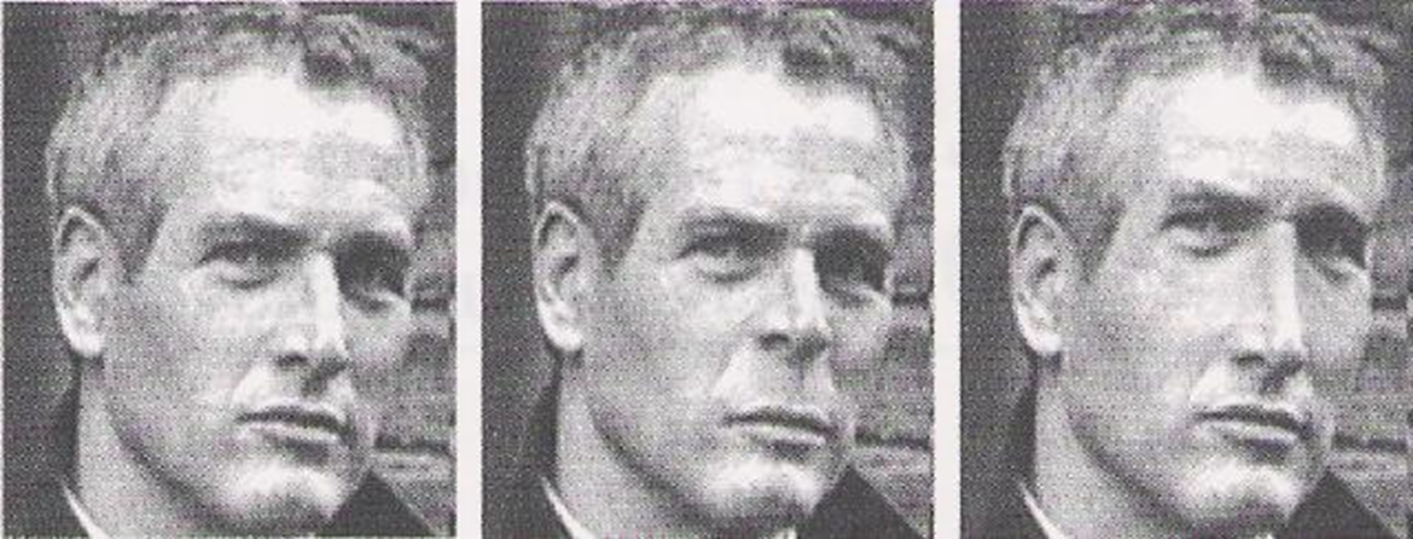
For example, these images of Paul Newman don’t get recognised due to slight shift of facial features.
How are internal and external features related to unfamiliar and famous faces?
External features more important for unfamiliar faces
Internal features more important for famous faces
What did Perrett et al find in a study of face cells and detection of features when images of monkeys presented with all features visible, eyes blocked out or only eyes visible?
Different cells respond selectively to internal and external features.
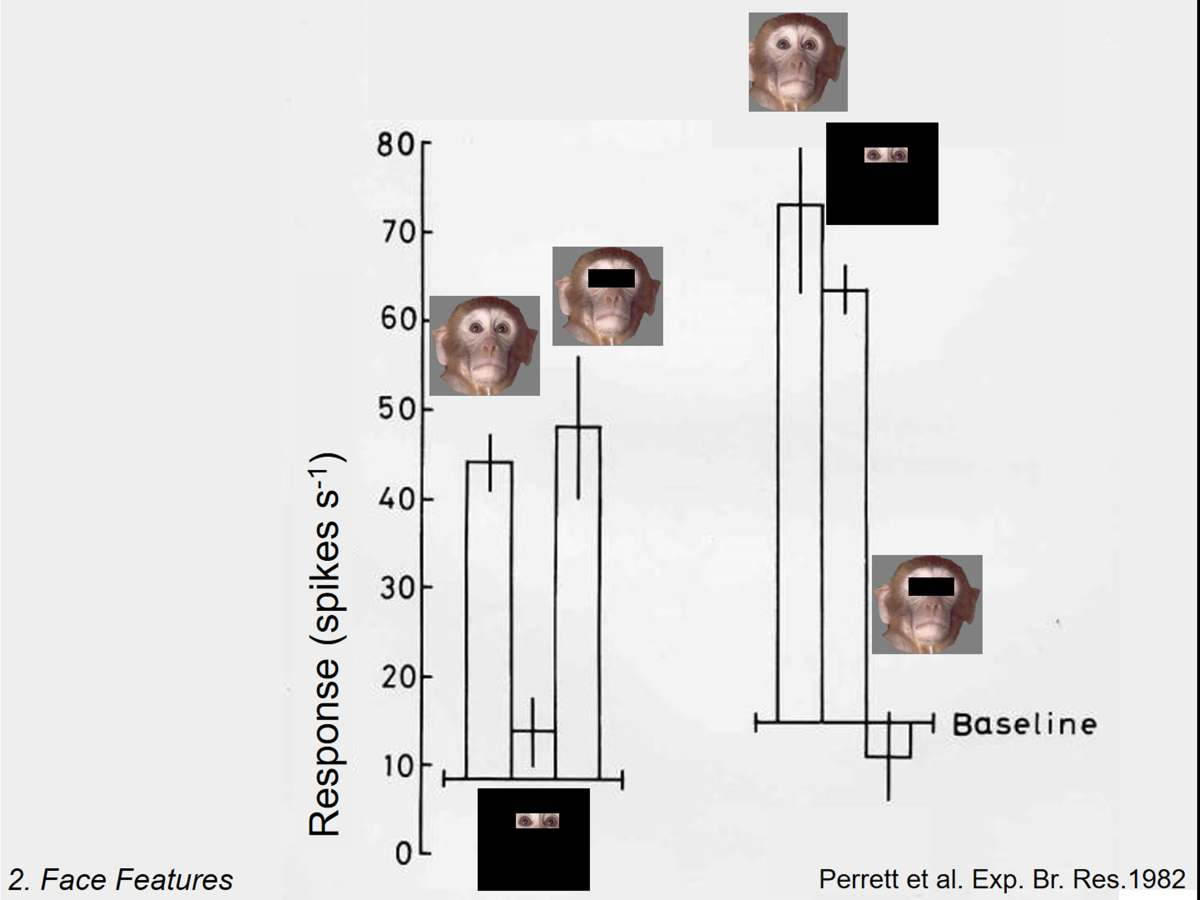
What did Perrett et al find in a study of cell sensitivity to feature combination?
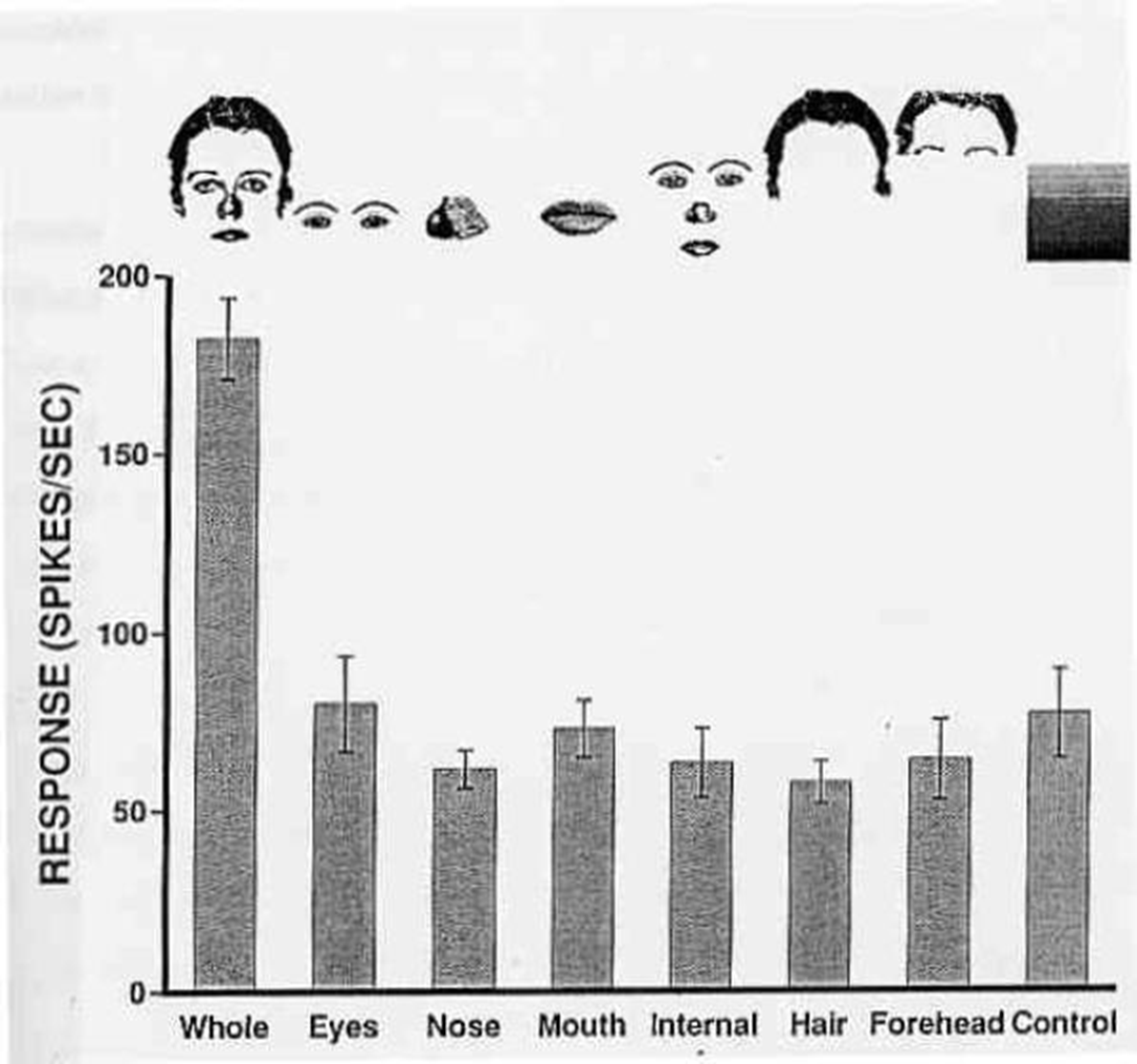
Some cells will only respond when correct combination of features is presented (e.g. whole face).
Must have internal and external features for response.
How do we process face identity?
Ability to recognise faces: learnt
Learning may operate over short timescales
Evidence for short term learning from face adaption
What did Rhodes et al find in a study where ppts adapted to either average Caucasian or Asian faces for 5 minutes and then asked to discriminate faces?
Participants were better at discriminating faces of the race adapted
Adaption reduces responses of cells coding common properties of the population? Cells then signal only the differences between faces.
e.g. if adapting to Caucasian suppressing cells which respond to whatever is common about caucasian faces such that cells that are not adapted can signal differences between different faces. Use remaining info to make meaningful distinctions
What does face adaptation tell us?
Face coding mechanisms (cells) subject to adaptation like lower level cells (waterfall illusion).
Face adaptation causes suppression of face cells
Suggests: separate cells coding different identities
Adaptation calibrates our visual system to the statistics of the social environment
What did Perrett et al find in a study where monkeys were presented with either face of PS and then shown different pictures of both people (DP and PS)?
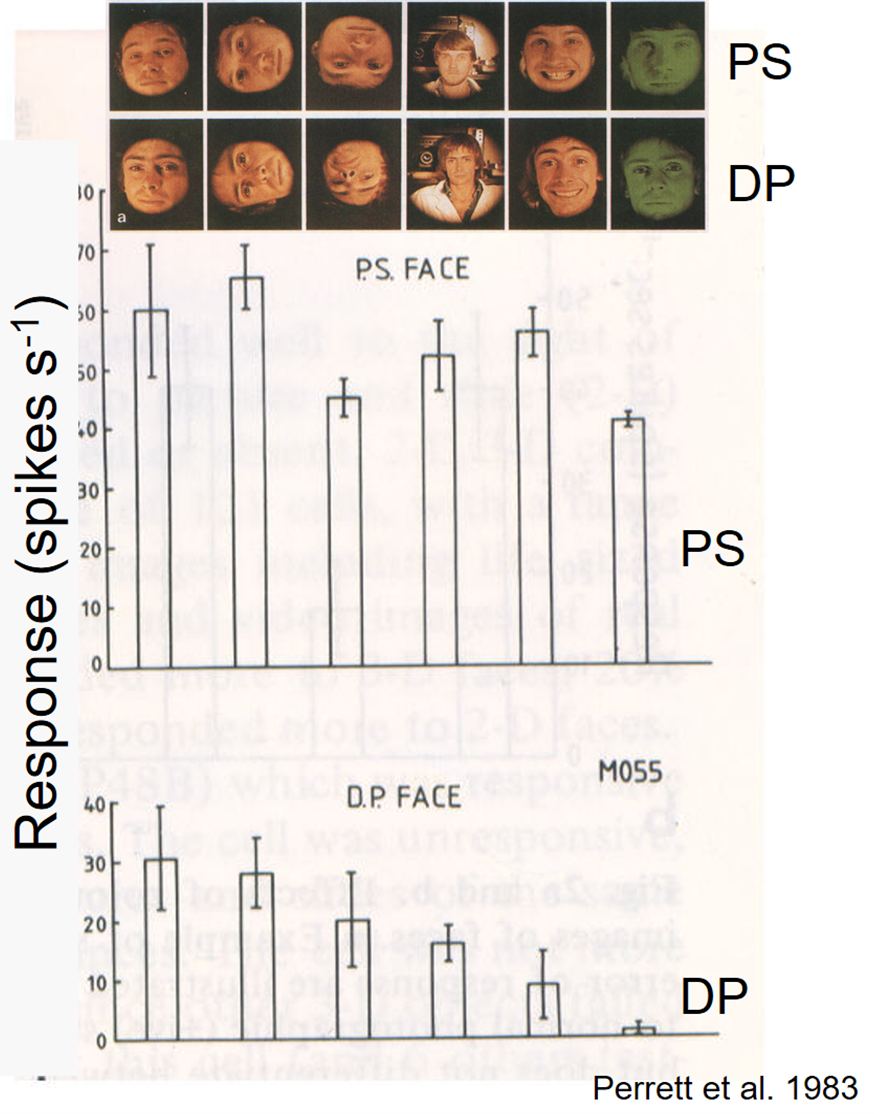
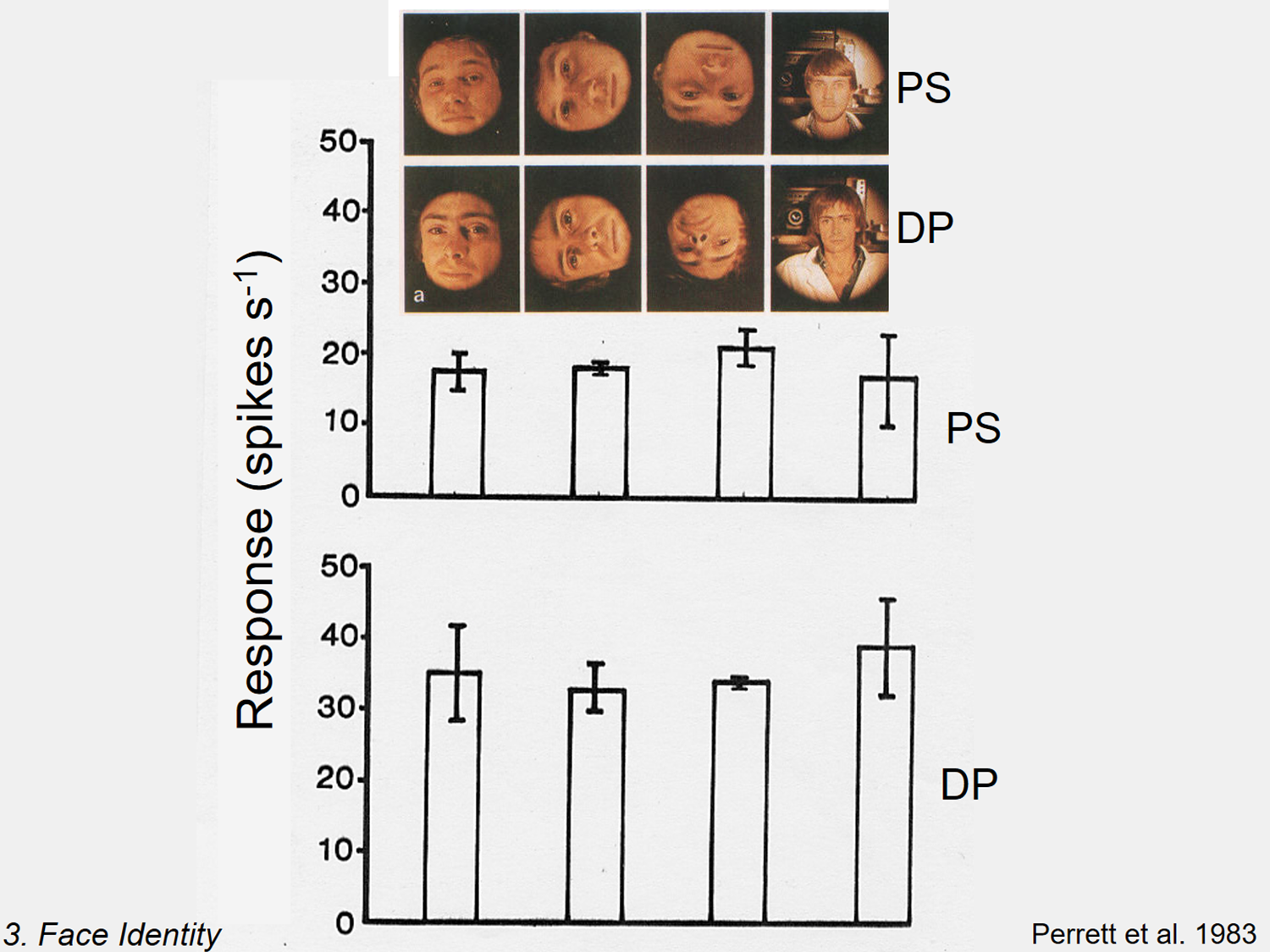
Monkeys respond selectively, able to discriminate between the two experimenters. Show preference for PS.
How can face identity recognition be explored in humans?
Treatment for epilepsy allows use of electrogrids on the brain to record from cells while patient is awake. Can map out abnormal activity.
What did Quiroga et al find in study of cells in human temporal cortex and response to faces?
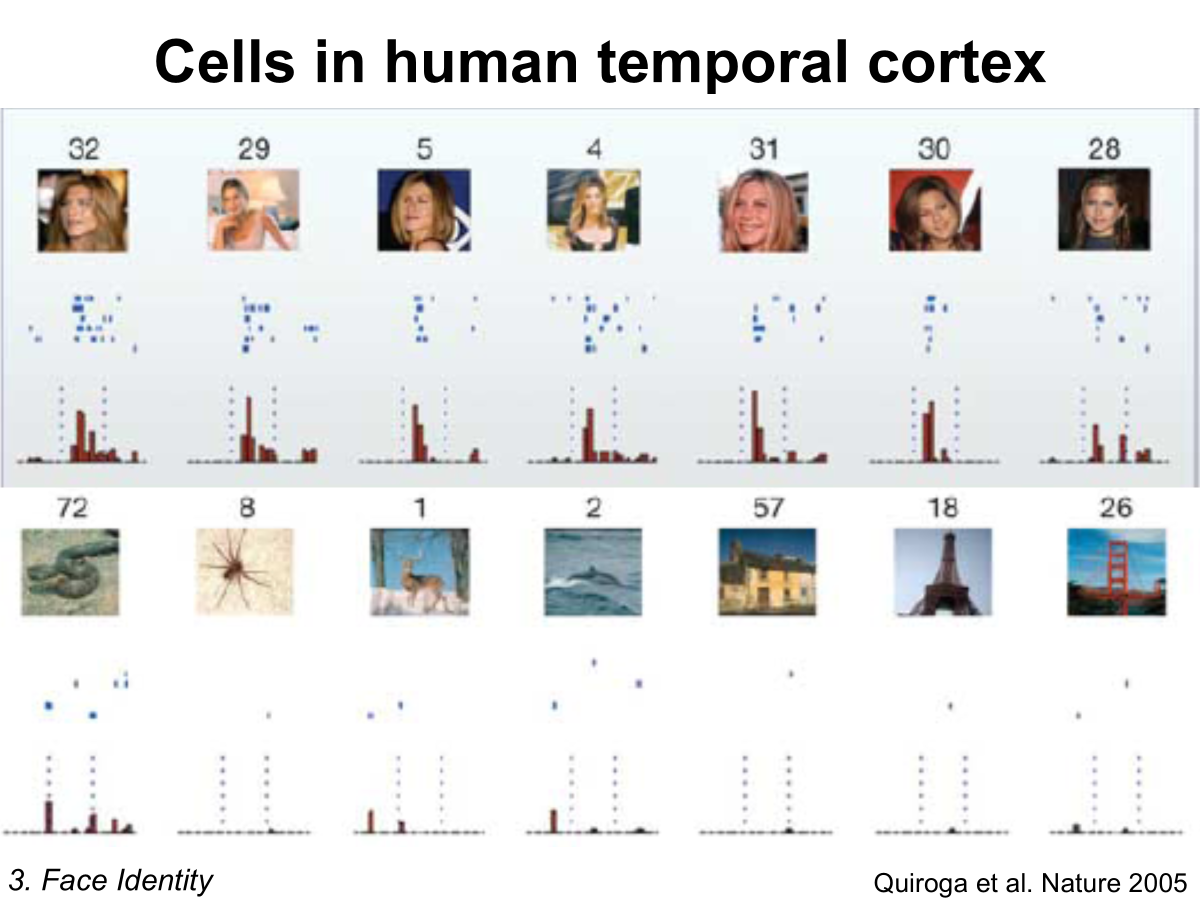
Response of one neuron to different faces
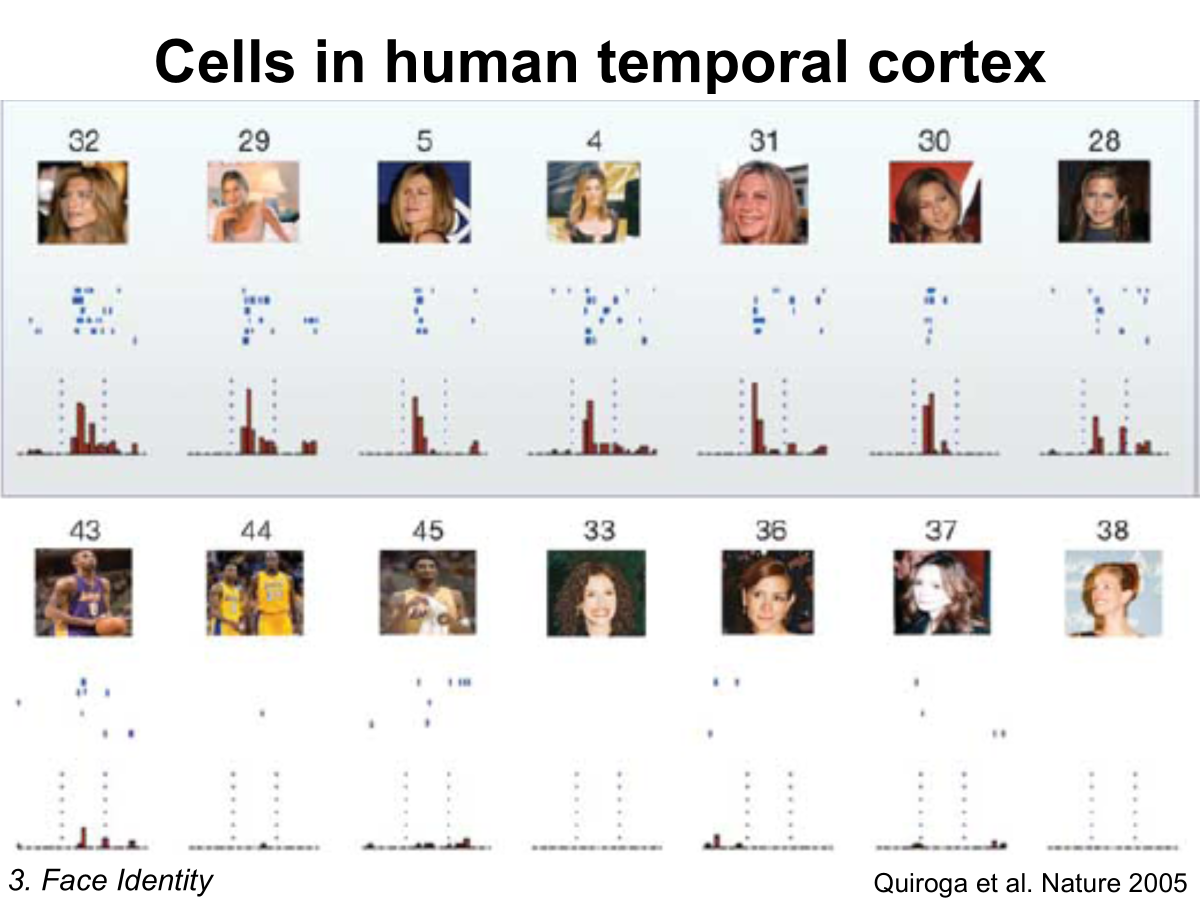
However, some have no response
What did Quiroga et al’s study on cells in human temporal cortex in relation to Halle Berry suggest about face identity in humans?
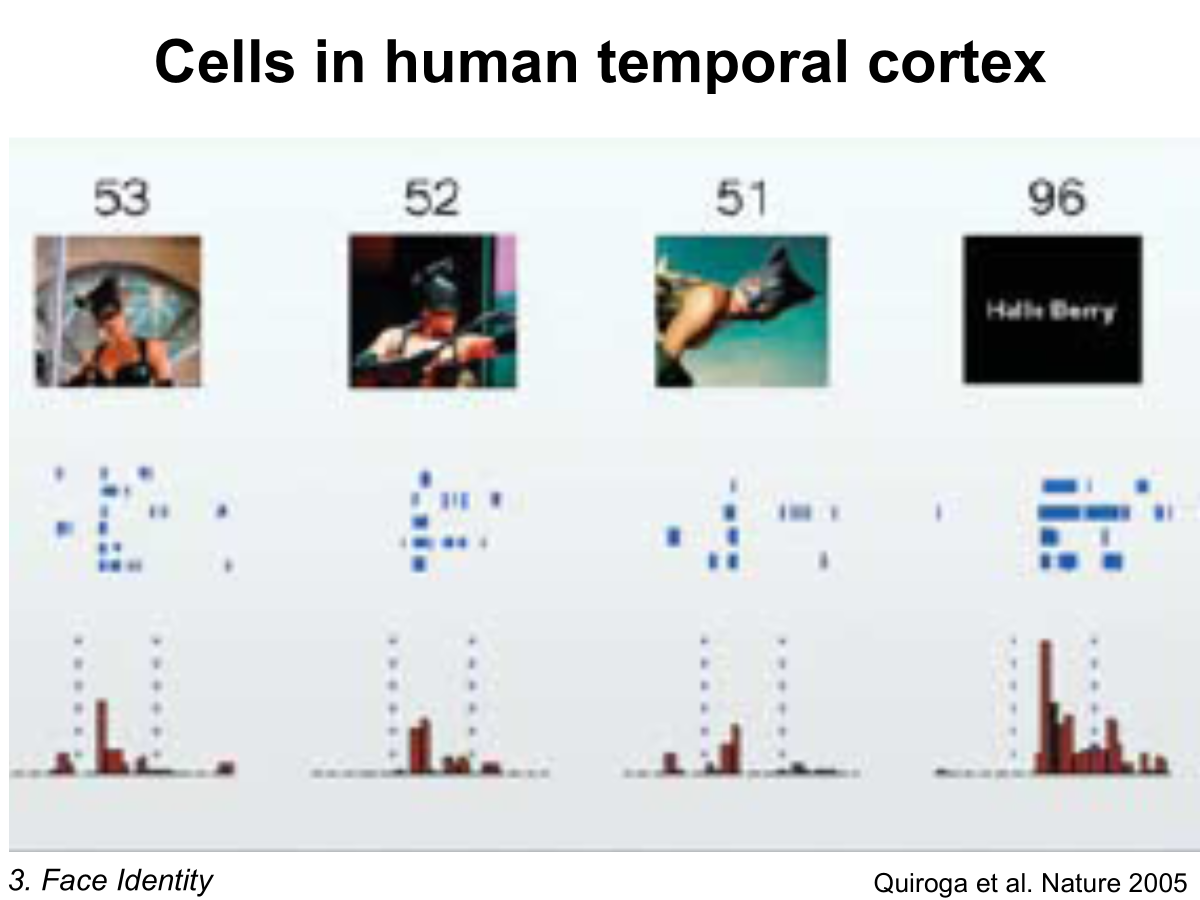
Still responsive to Halle Berry even if you cannot see her face (e.g. name). Very specific, shows tight identity tuning.
What did Perrett et al find in relation to STS cell sensitivity to face view?
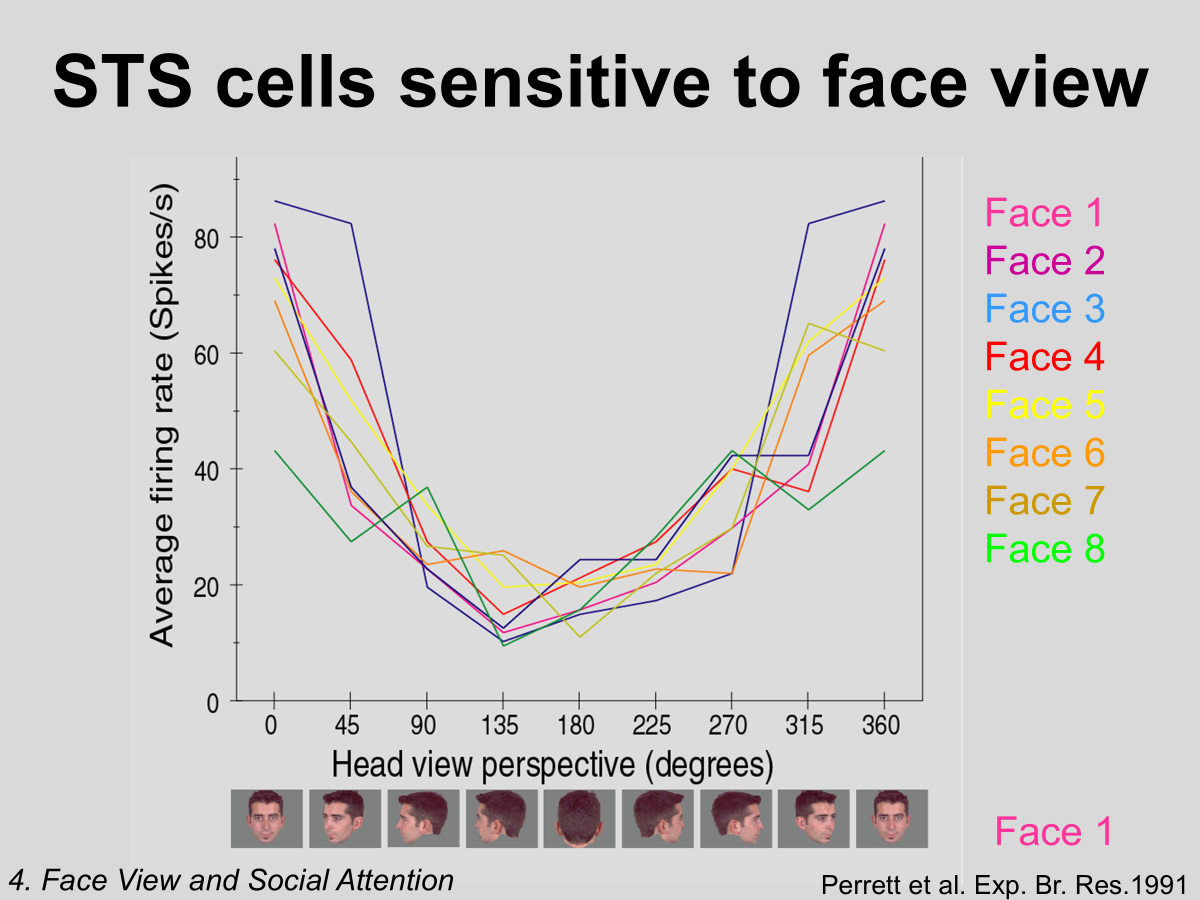
Response of some cells great when face seen from full frontal view. Doesn’t care about identity, cares about view
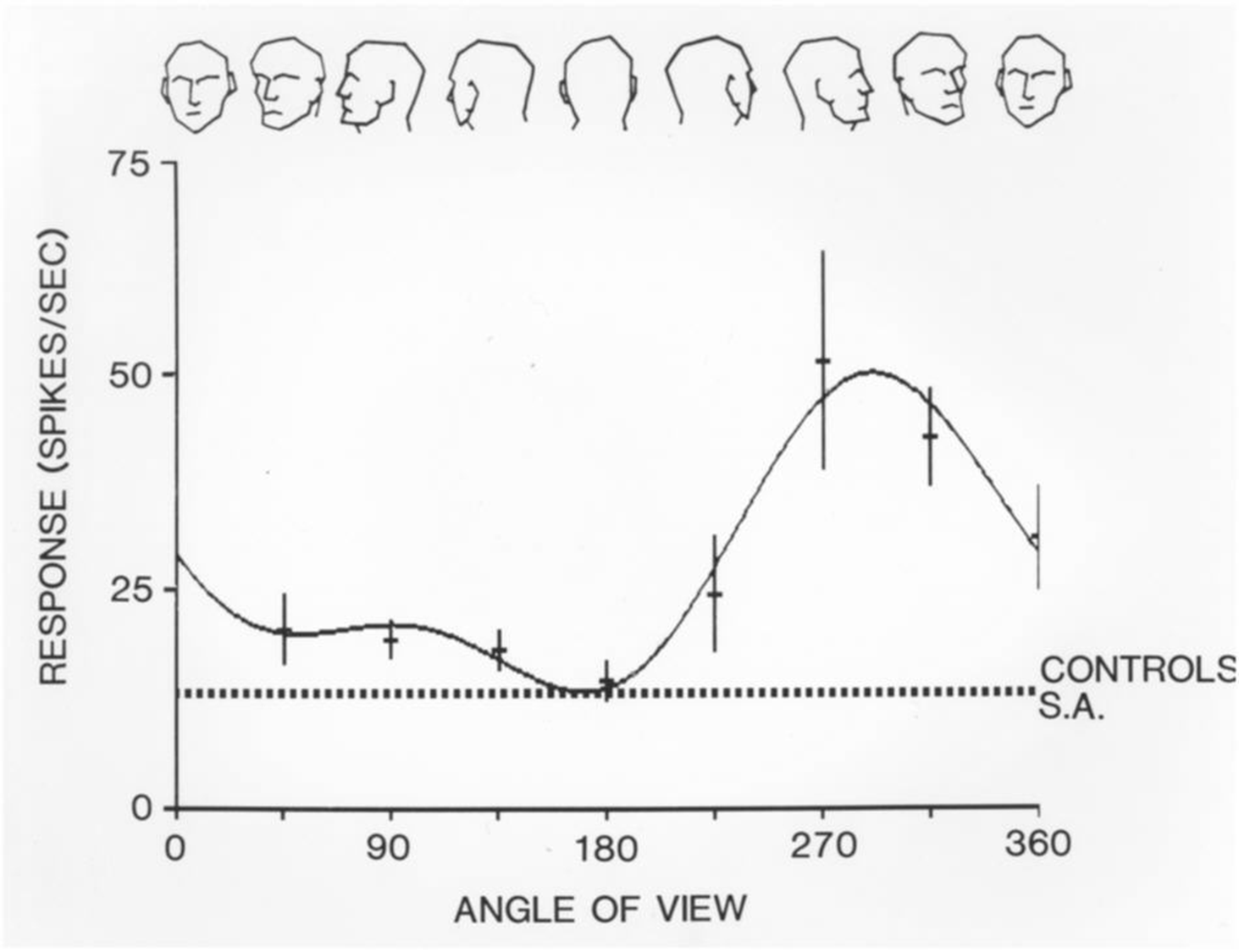
Selective cell for right profile view
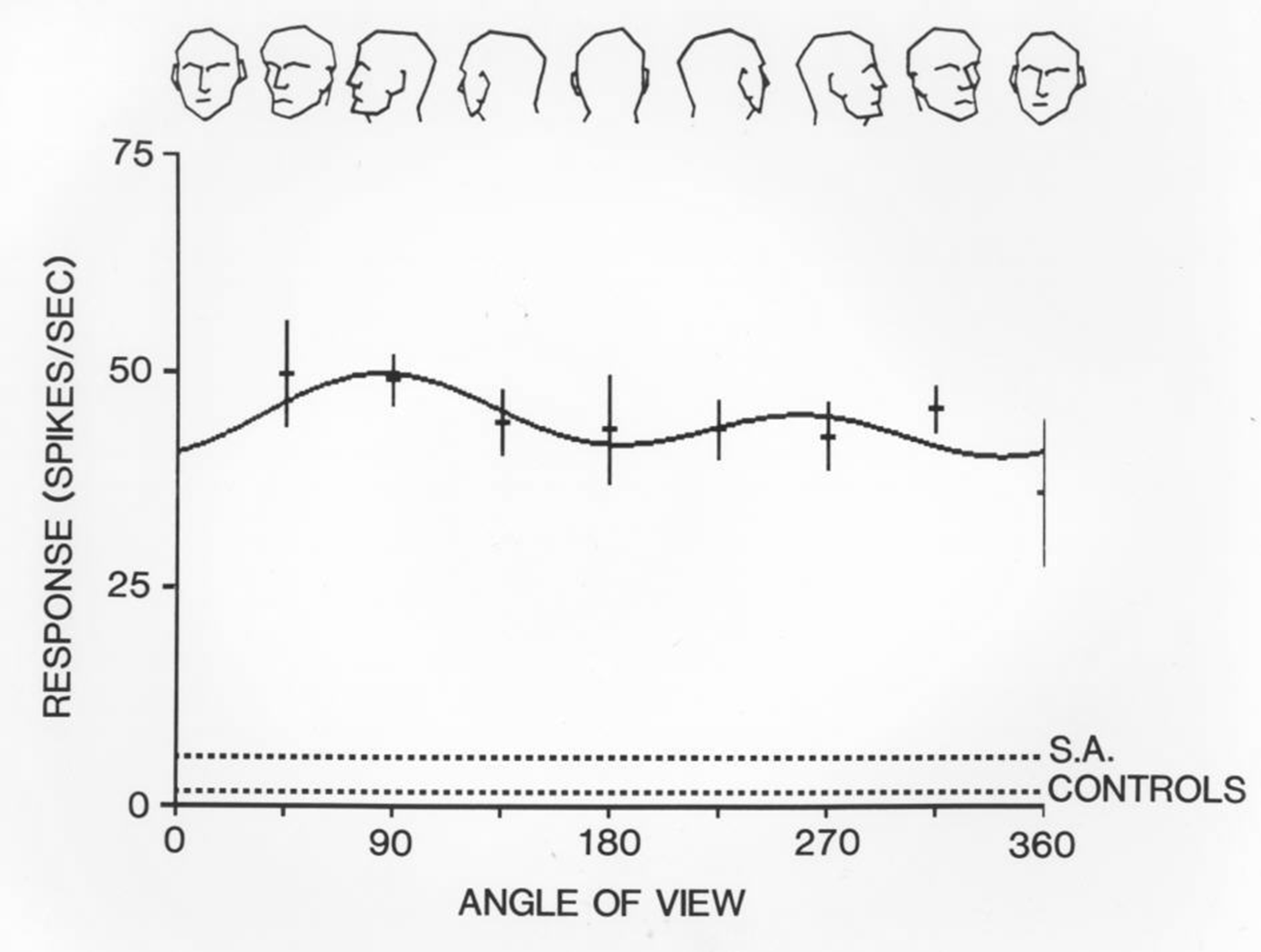
Cell responds to head seen from any angle
What is view centred coding?
Many cells in temporal cortex respond preferentially to views of face, e.g. front view, left profile
What is object centred coding?
Some cells respond to all views of the face
What physiological findings in the temporal cortex are there in relation to cell populations selective for the sight of faces?
Combining features
Generalise over size, position, orientation, lighting
Some cells show sensitivity to identity
Most selective for view
What did Perrett et al find in a study of cell selectivity in response to facial attention?
Some cells respond selectively when attention and face is focused forward. Show less response even when face is still facing forward but attention elsewhere.
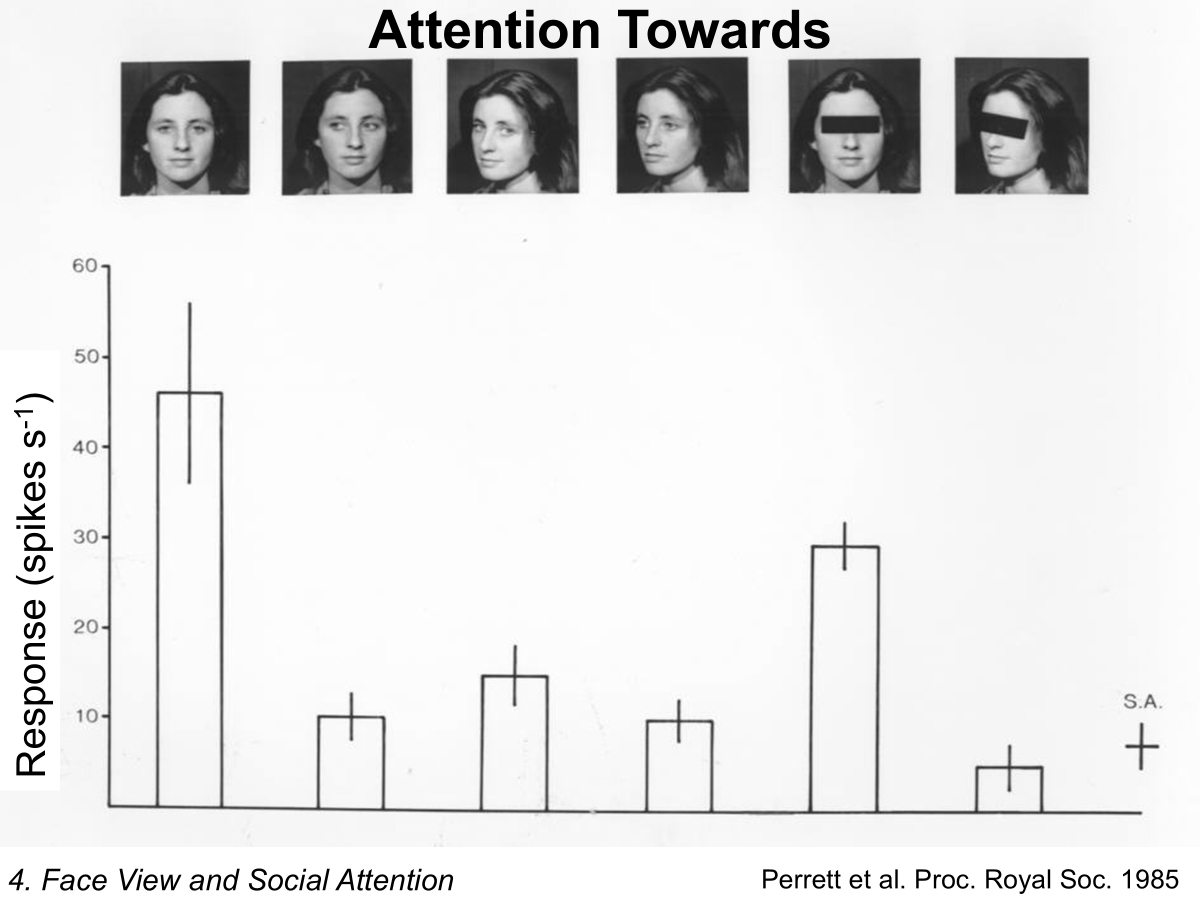
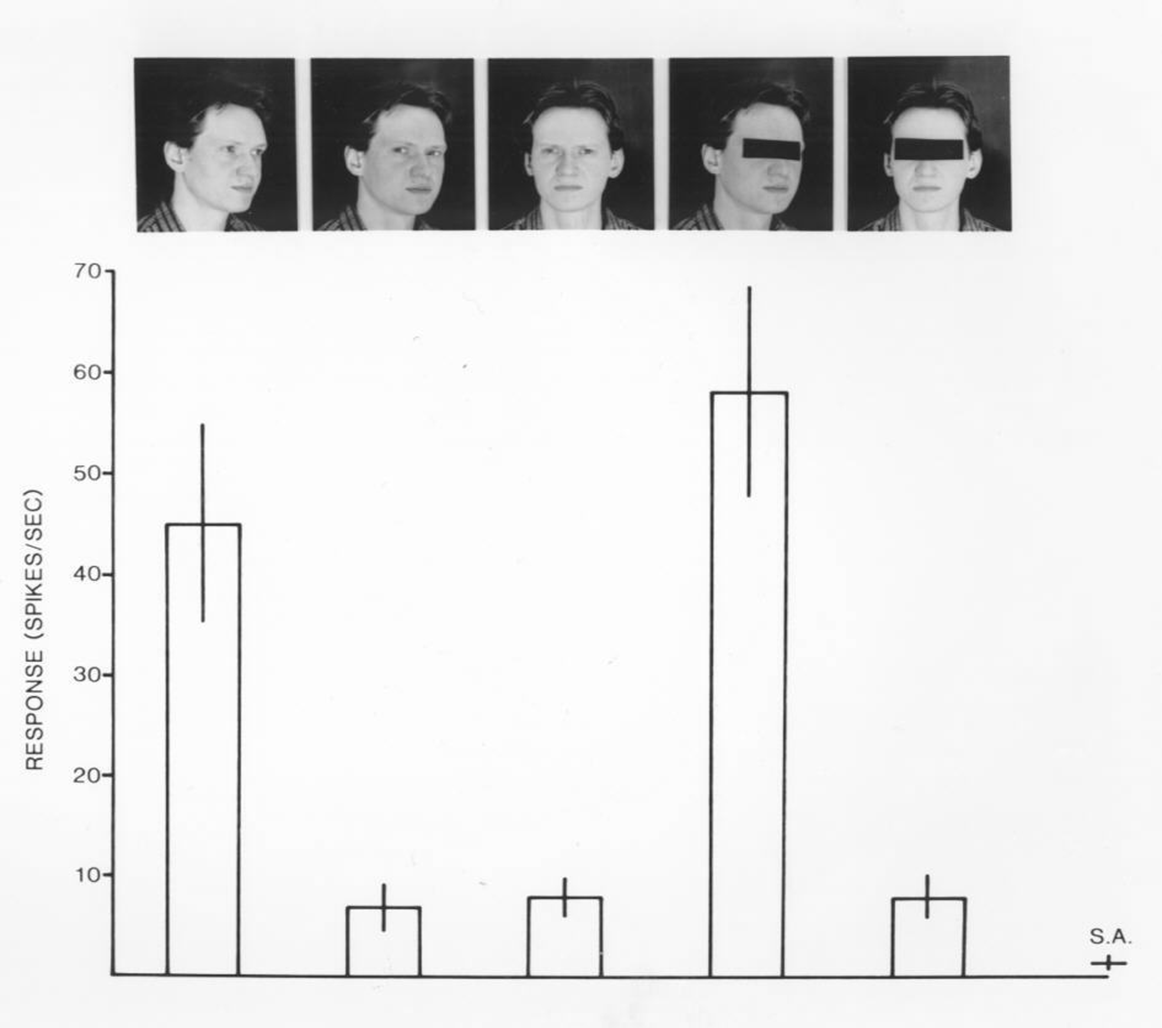
Responds to face and eyes averted to right, inferences made.
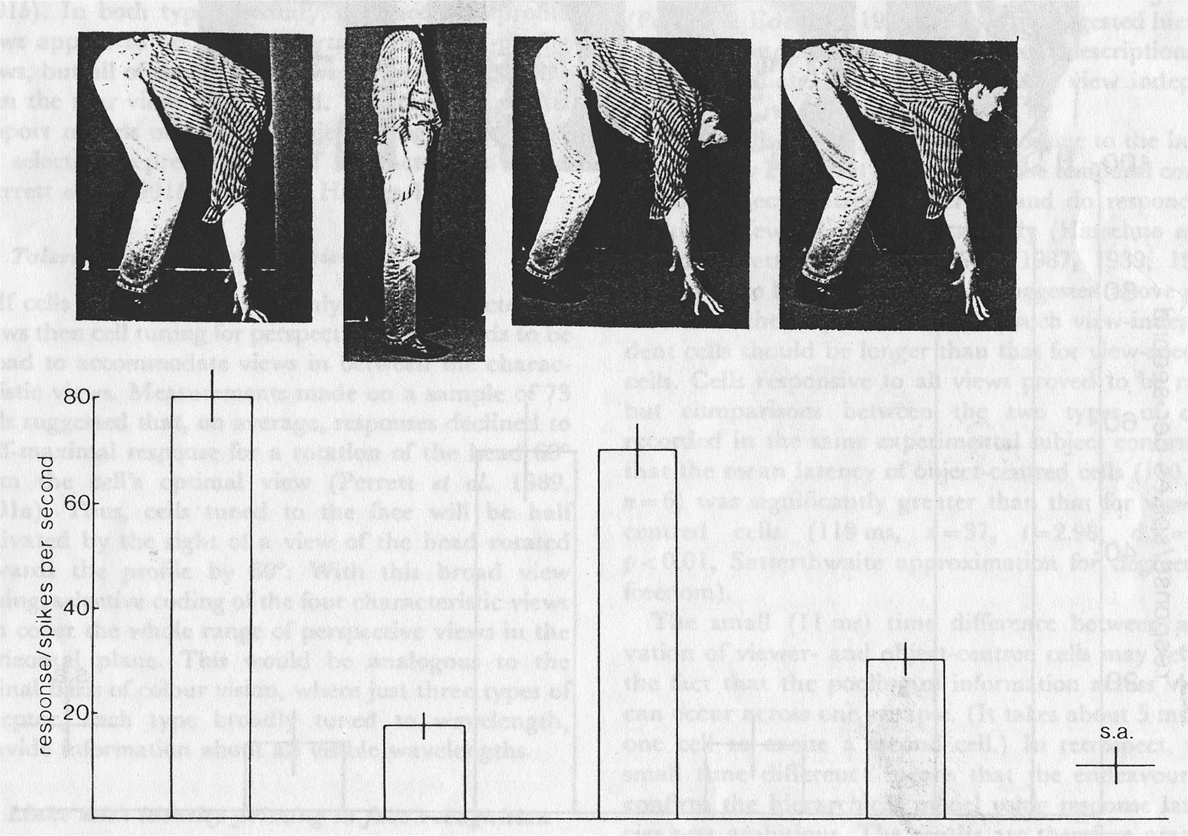
Can infer person attending downwards
Which order is most important when combining body, face and gaze direction for understanding perception?
Eyes>head>body
Tuning consistent with attention direction, social attention
What has been found in relation to autistic children and gaze?
Have problems following the gaze of others
What suggests emission of faces and emotion is innate?
Cross cultural similarity of expressions and causes
Deaf and blind children’s expressions are normal
Therefore production of expressions is innate
What are the 6 universal basic emotions suggested by Ekman?
Happy, sad, angry, fear, surprise, disgust
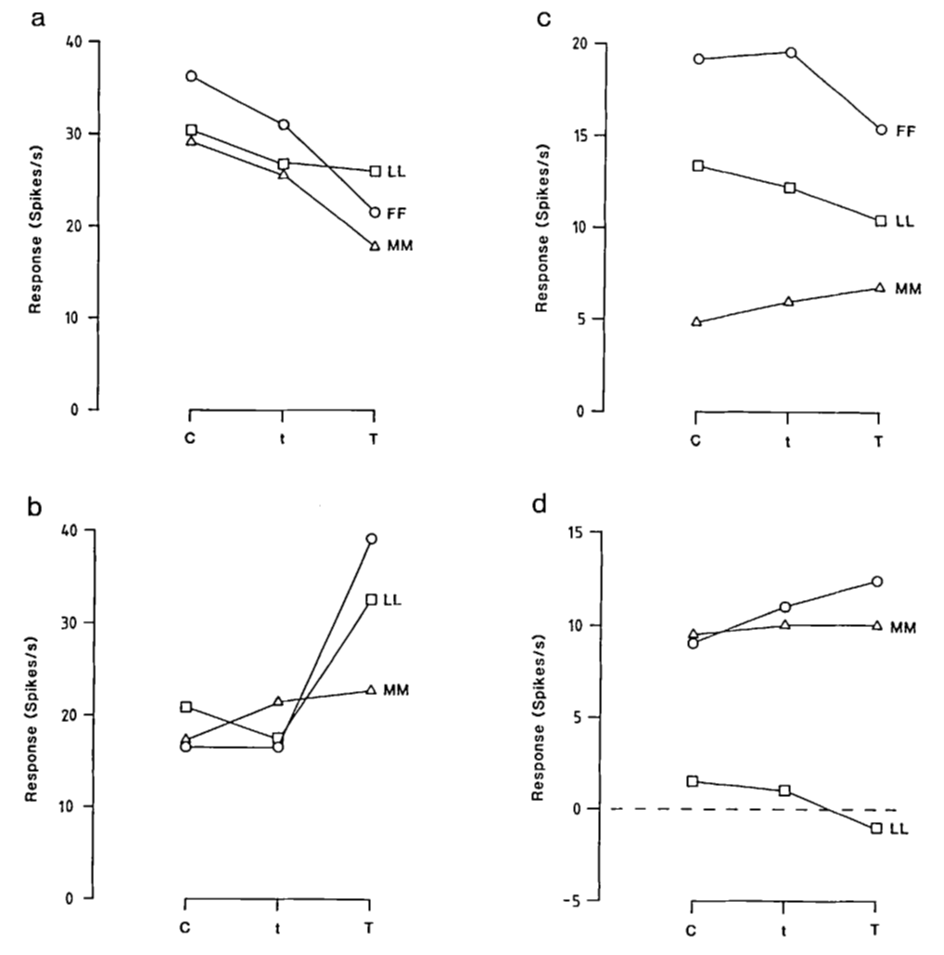
What did Hasselmo et al find in a study where faces of monkeys pulling different facial expressions were presented and cell selectivity?
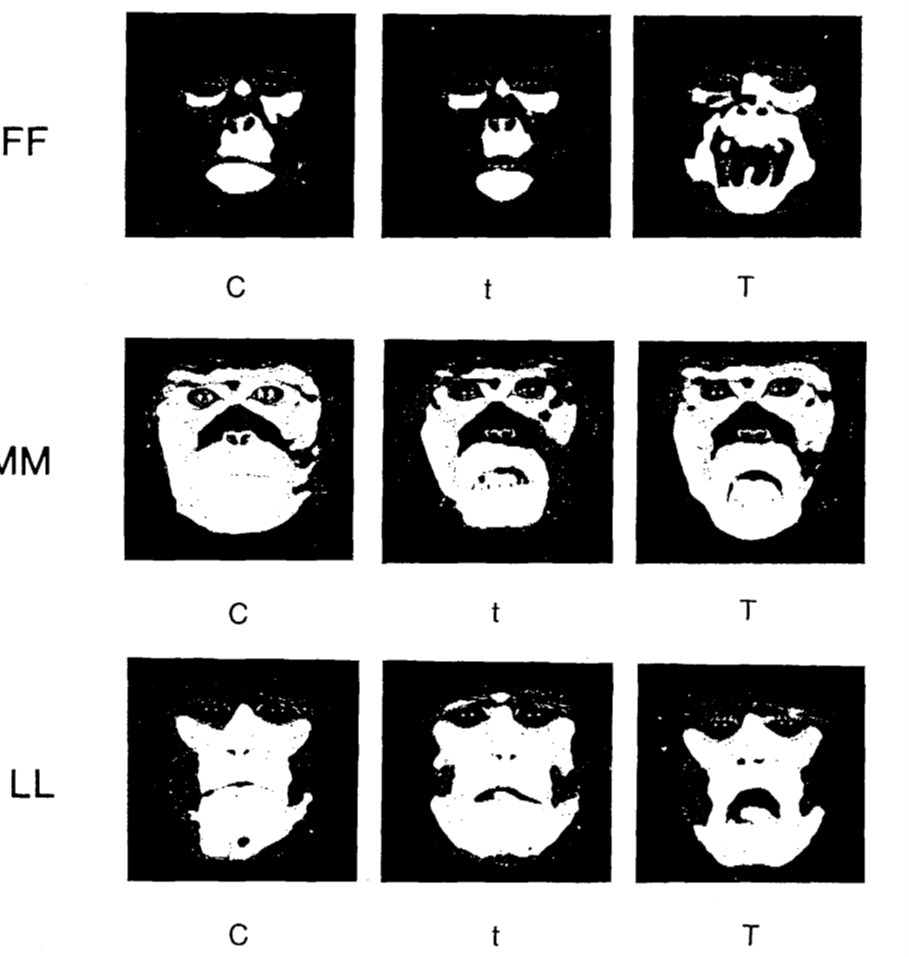
Some cells will respond selectively to different expressions. Some for calm, some for threat, etc.
Expression cells respond to specific expression, irrespective of which monkey produced it
Which area of the brain did Morris et al find fear expressions activate?
Amygdala
Which area in the brain do disgust expressions activate?
Insular cortex
If the amygdala is damaged what is usually seen in relation to facial expression recognition?
No recognition of fear
What is considered to make a face attractive?
Symmetry
Averageness
Secondary sexual traits
Skin health and colour
Hormone levels and fertility
Why is face perception biased?
Right hemisphere dominant in facial processing, specialised for face identification and emotion.
Visual pathways are crossed so when looking at face straight on, info from the left is processed by right brain and vice versa.
How does symmetry make a face attractive?
One half of the face is the same as the other. Results from successful development. Potentially a signal of quality of the individual.
How does averageness make a face attractive?
Signals genetic health
Non-average faces may indicate genotypes that are homozygous for deleterious alleles (gene variants that reduce an organism’s fitness, health, or survival, often causing genetic disorders or reproductive failure).
How do secondary sexual traits make a face attractive?
Male and female faces differ in their shapes, e.g. men square jaw
Advertise the quality of an individual in terms of their hereditable benefits (i.e. good genes, healthy immune systems)
How does skin health and colour make a face attractive?
Healthy looking faces appear more attractive
Possible to make your face artificially more attractive → makeup, tanning, beta carotene
How do hormone levels and fertility make a face attractive?
Masculine characteristics in male faces = long term medical health, reproductive potential, physical strength
Feminine characteristics in male faces= investment in long term relationships over short term ones
Female preference of faces affected by hormone levels
Preference for masculine faces at ovulation
Taking oral contraceptives disrupts the above effect
What did Fantz find in a study when presenting cartoon faces to babies, one with correct configuration and one scrambled face?
Babies as young as 2-3 months spent more time looking at correctly arranged face.
What did Tanaka and Farah find in a study of holistic facial recognition where ppts had to learn names of faces constructed from kit of various features?
Ppts did better if the feature to be identified was presented in context of owner’s face compared to isolation of features.
Holistic cues over featural cues
What did Rhodes et al find in study of caricatures and facial recognition?
Such caricatures of famous people were identified faster and rated as being better likeliness than exact line drawings.
What age did Meltzoff and Moore find infants can recognise and respond to facial expressions?
As young as 12 days old
What did Calder et al find in study presenting a blend of happy or sad faces and then asked ppts to distinguish between pairs of pictures?
Performance best for pictures near 50:50 ration, boundary between categories happy and sad.
Those with lots of happy pictures always categories as happy, vice versal
How can adaption be explained if adapting to happy or angry faces and presentation of neutral face?
If stared at happy face and neutral then appears angry → after effects may arise as cells encoding these expressions are deactivated by presentation of favourite stimulus (e.g. happy cell reduces firing after firing for a long time because of presence of happy face)
Hence when neutral is presented, it’s happiness is underestimated and appears more angry.
What is prosopagnosia?
Normal visual functions but fail to identify and recognise familiar faces
What did Tranel and Damasio find in study of facial recognition in prosopagnosic patients when measuring skin conductance during presentation of familiar and unfamiliar faces?
Poor naming of all faces but familiar faces produced responses in patient’s skin that unfamiliar did not
Covert response without overt response
What is capgras syndrome?
Patient believes someone has been replaced by an imposter or double.
Patient recognises person but may fail to get feeling of familiaritiy
Emotional valence of faces impaired