Derm/Otolary/Rheum Exam 1: Week 1 MEDS/Pathways
 Call Kai
 Learn
Learn Practice Test
 Spaced Repetition
 Match
Match Flashcards
 Knowt Play
1/45

There's no tags or description
Looks like no tags are added yet.
Name | Mastery | Learn | Test | Matching | Spaced | Call with Kai |
|---|
No analytics yet
Send a link to your students to track their progress
46 Terms
Corticosteroids (ex: _______) are drugs that mimic cortisol
_______ = natural stress hormone made by the body
Main job → reduce _______ + _______ the immune system
Prednisone, cortisol, inflammation, suppress
Where Cortisol Comes From
Made in the _______
Outer part of the _______
They sit on top of _______
adrenal cortex, adrenal gland, kidneys
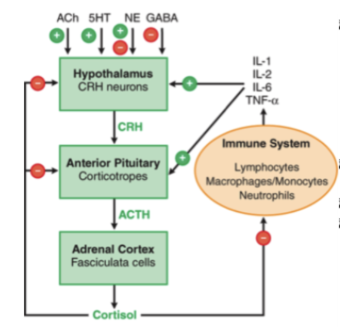
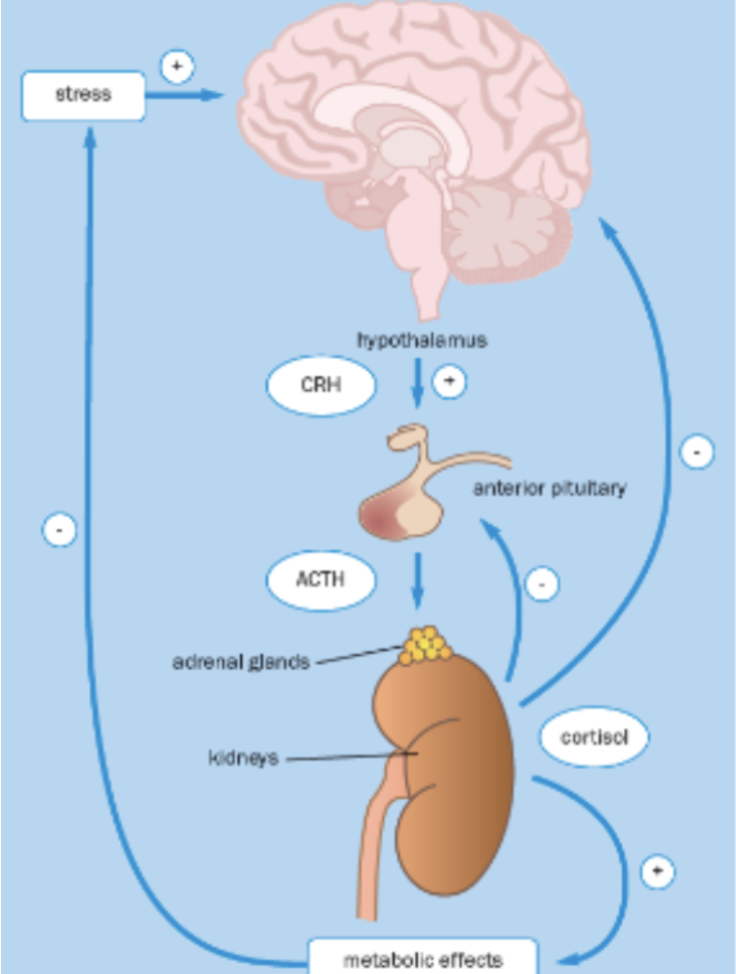
HPA Axis (How Cortisol is Released)
Step 1: _______
Releases _______ (corticotropin-releasing hormone)
Step 2: _______
_______ tells it to release _______ (adrenocorticotropic hormone)
Step 3: _______
_______ tells it to release _______
Hypothalamus, CRH, Anterior Pituitary, CRH, ACTH, Adrenal Cortex, ACTH, Cortisol
What Triggers Cortisol Release?
Inflammation & immune activation
Important inflammatory cytokines:
_______
_______
_______
These activate the _______ → cortisol release
IL-1, IL-6, TNF-alpha, HPA axis
What Does Cortisol Do?
Main effect: Suppresses the immune system
It inhibits:
_______
_______
_______
Result:
↓ inflammation
↓ immune response
lymphocytes, macrophages, neutrophils
How Corticosteroid Drugs Work
Drugs like _______:
Copy cortisol’s effects
Used to decrease inflammation
Dose-Dependent Effects
Low doses → Mainly _______
High doses → _______
Higher doses increase risk of:
_______
_______
Prednisone, anti-inflammatory, immuosuppressive, opportunistic infections, systemic SEs
Main Treatment Goal: Corticosteroids
Use:
_______ effective dose
_______ amount of time
Why? → To reduce _______ + _______
lowest, shortest, SEs, immunosuppression
Negative Feedback (VERY IMPORTANT)
Cortisol controls its _______.
When cortisol levels are high:
It inhibits the _______ + _______
So:
↓ _______
↓ _______
↓ _______
own release, hypothalamus, anterior pituitary, CRH, ACTH, cortisol production
1. _______ activates the HPA axis
_______ → CRH → ACTH → Cortisol
2. Cortisol _______ the immune system
That’s why corticosteroids work for inflammatory diseases.
3. Corticosteroids _______ cortisol
Examples:
Prednisone
_______
_______
4. Cortisol uses _______
High cortisol tells the body: “We have enough — stop making more.”
Inflammation, Inflammation, suppresses, mimic, methylprednisolone, dexamethasone, negative feedback
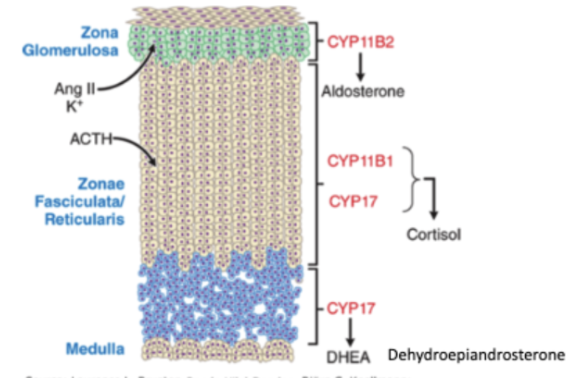
_______ + _______ are the 2 physiologic corticosteroids secreted by adrenal cortex
Cortisol, Aldosterone
KNOW IMAGE
Cortisol released under influence of _______
Aldosterone → _______ + _______
Dehydroepiandosterone → _______, weekly-made hormone in both males + females
ACTH, Ang II, potassium, DHEA
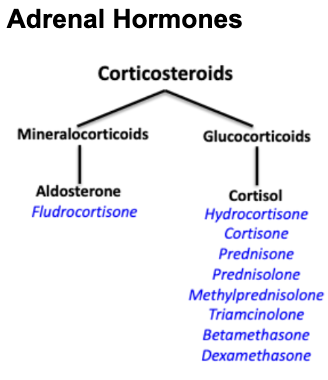
KNOW IMAGE
Corticosteroid: _______ drug that’s based off a hormone produced by the _______
_______: ↑ glucagongenesis (glucose synthesis) → retain/mimic metabolic effects of cortisol → anti-inflammatory/immunosuppressive agents
_______: function of Na-K balance → in kidney
Fludrocortisone → powerful aldosterone
steroid, adrenal cortex, glucocorticoids, Mineralocorticoids
Glucocorticoid effect mediated by GR (Glucocorticoid Receptor)
Glucocorticoid (cortisol and glucocorticoid drugs, denoted as S): Acts as _______ on glucocorticoid receptor (GR)
Glucocorticoid Receptor → _______ (_______) controls gene expression (slow process bc altering function)
Binding of drug to GR → conformational change + nuclear translocation.
Binding to _______ (GRE) → ↑ gene expression of target genes and altered cell function resulting in:
Anti-inflammatory + immunosuppressive effect
Metabolic effects including lipolysis, gluconeogenesis, protein breakdown.
Ex. _______
ligands/agonists, TF, nuclear receptor, Promoter Region, Dexamethasone
Glucocorticoids
Receptor location: throughout the body, including the _______
Glucocorticoid Effects
_______ Actions
↑ _______
↑ _______ from High levels of Cortisol (preserves _______ while breaking down protein) → more _______ → less _______
brain, anti-inflammatory, gluconeogenesis, protein breakdown, fat, stress, muscle pain
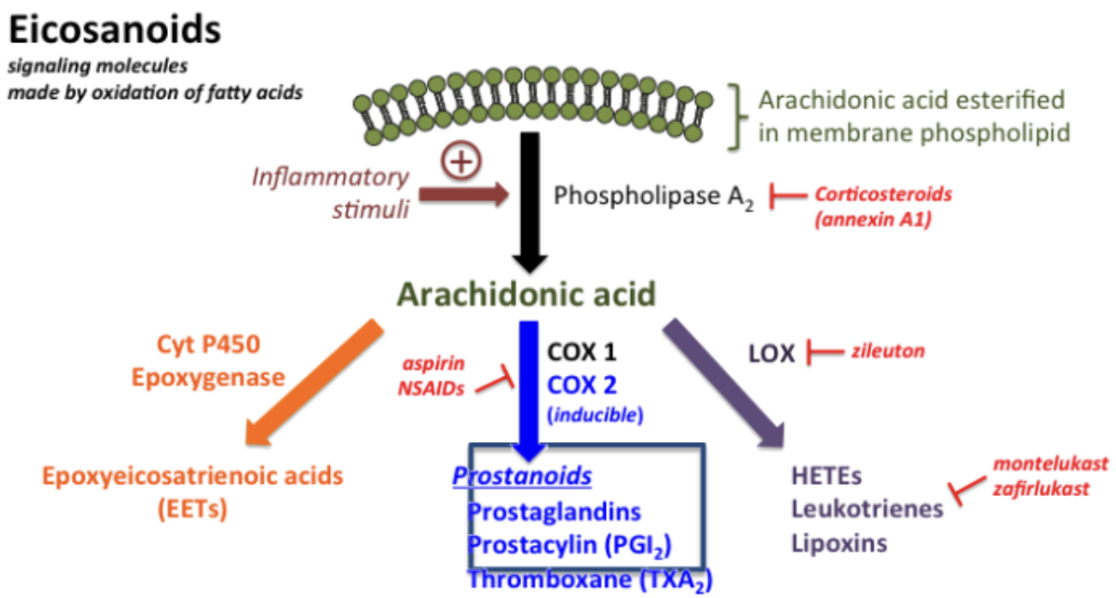
KNOW IMAGE
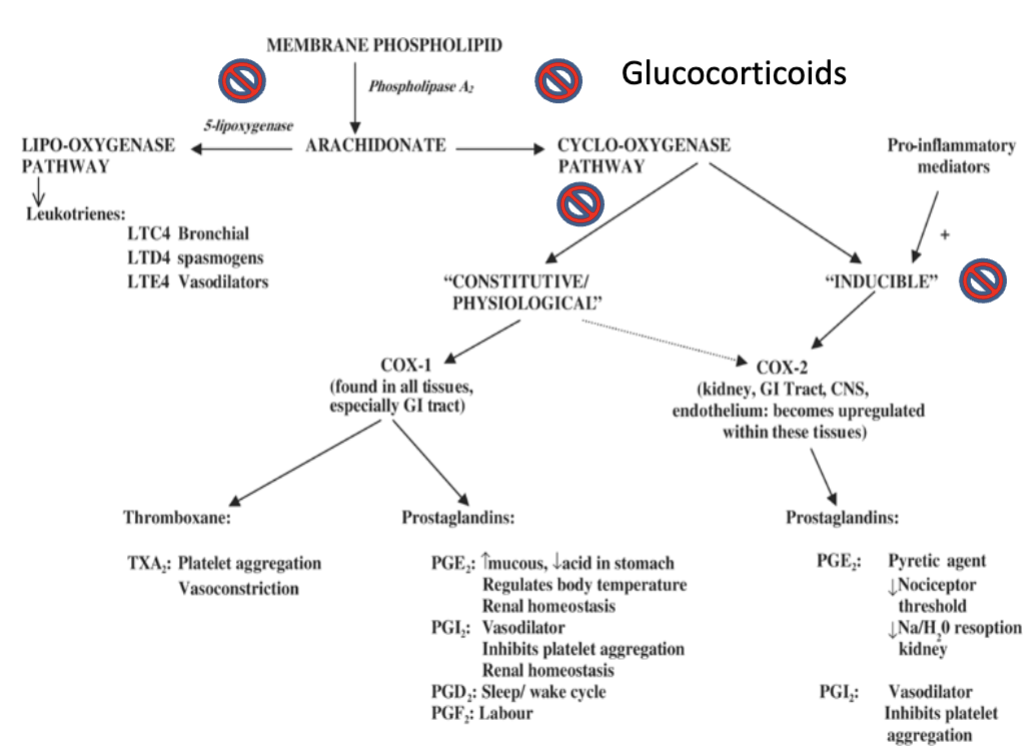
_______: examples of prostaglandins (inflammation = ↑ prostaglandins)
_______: Inflammatory stimuli → _______ (via downregulation) → _______ → Affected by _______ enzyme to produce prostaglandins
_______ → determines synthesis of Prostaglandins
Eicosanoids, prostaglandins, Phospholipase A2, arachidonic acid, COX, Phospholipase A2
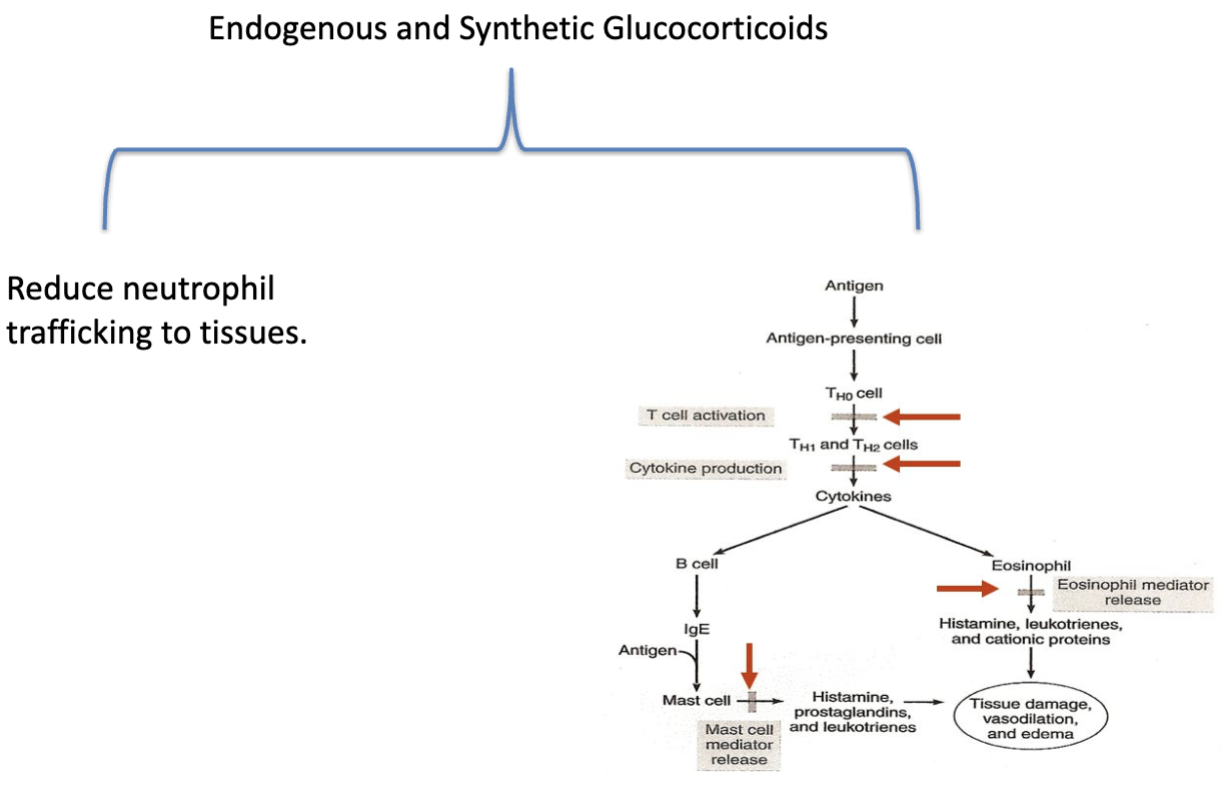
Effect of Glucocorticoids on Inflammation: Multiple Sites for Inhibition
KNOW IMAGE
Mineralocorticoid effect mediated by MR (Mineralocorticoid Receptor)
Mineralocorticoids regulate _______ exchange in the renal _______ with the net effect of _______ reabsorption (and _______ retention) and _______ excretion.
_______ binds to MR (Mineralocorticoid Receptor)
↑ cortisol levels → ↑ _______ retained → ↑ _______
Excess Cortisol → Hypertension Relation?
Cortisol has _______ affinities for GR + MR receptors.
Syndrome of cortisol excess include _______ retention and _______
Na/K, collecting duct, sodium, water, potassium, aldosterone, water, BP, equal, Na/H2O, HTN
Anti-Inflammatory Potency → _______ binding
Sodium-Retaining Potency → _______ binding
GR, MR
_______ → EQUAL affinity (=1)
_______ → powerful Na+ retention → used as _______ supplement/replacement (mimics effect)
NOT GOOD for _______ agent bc it results in HTN
Hydrocortisone, Fludrocortisone, aldosterone, anti-inflammatory
Adverse Effects (PREDNISONE)
_______ & _______ effects (delirium, mood swings, euphoria)
_______ of _______ → ↑ _______
_______: cataracts, glaucoma
_______
_______: HA, insomnia, seizure
_______; increased appetite
_______
_______
_______
_______ & _______ changes (↓ __+ ↓ __+ ↑ __+)
PUD, psychiatric, Retention, sodium and water, HTN, Eye, Diabetes, Neurologic, infection, swelling, osteoporosis, nausea, electrolyte, pH, K, H, Na
Long-term effect of supraphysiologic glucocorticoids on HPA axis regulation
A steroid taper approach is used to avoid precipitating _______ as a result of abrupt treatment discontinuation.
Oral predisone causes _______ → _______ production is inhibited in the adrenal cortex
adrenal insufficiency, negative feedback inhibition, cortisol
KNOW IMAGE
Both OA + RA → _______
_______ is supposed to dampen it → but doesn’t always work bc it doesn’t work or inflammation is too strong → overwhelmed
inflammation, cortisol
_______ → chronic progressive joint disease, involving cartilage loss
_______ → immune system mistakenly attacks its own tissues, primarily in joint linings → systemic problem
_______ → wear and tear arthritis → chronic + slowly gets worse
_______ → not localized pain
OA, RA, OA, RA
_______
Irreversible loss of articular cartilage (cusions joints) → synovial inflammation + bone thickening (pain and not being able to move well) → progressive loss of joint function
OA
_______
Autoimmune disease → immune system mistakenly targets synovial tissues in the joints
Immune cells, especially _______ cells, get activated → produce _______ → release cytokines (_______ → drives chronic inflammation + pannus)
Pannus: overgrown synovial tissue that invades + destroys _______ → hallmark of _______
RA, B and T, Abs, TNF-alpha, cartilage and bone, RA
HPA Axis: body’s main stress regulator
Feedback loop: Triggered by _______ + _______
Hypothalamus releases _______ → tells pituitary to pump out _______ → leads to _______ (adrenal cortex makes it)
Stress = cortisol (fights inflammation + suppresses immune cells): lymphocytes/macrophages → reducing inflammation
Affects metabolism
Increases blood sugar
Breaks down protein
Drugs like Prednisone mimic cortisol (synthetic cortisol)
Low-Dose → _______
High-Dose → _______ → trick the body
IFN-alpha, IL-1, CRH, ACTH, cortisol, anti-inflammatory, immunosuppressive
Outermost: Zona _______ → where _______ is produced
Middle/Thickest Layer: Zona _______ → main _______ producer
Innermost Layer: Zona _______ → produces _______ (_______ precursor, hormone in both males + females)
Glomularosa, aldosterone, Fasciculata, cortisol, Reticularis, DHEA, androgen
Protein Citrullination Detail
Citrullination = _______ of _______ → citrulline
Creates abnormal antigens that trigger _______
deamination, arginine, autoimmunity
Immune Complex Formation
_______ + _______ form immune complexes
Macrophages recognize immune complexes → more _______
Prognosis: Higher RF levels = _______ RA
Missing RA Lab Tests
ESR
CRP
ANA
CBC
You only included _______ + _______.
RF, IgG, inflammation, more severe, RF, ACPA
Negative Feedback Concept:
High cortisol:
↓ _______
↓ _______
↓ _______
Easy idea: “Too much cortisol shuts off the pathway.”
CRH, ACTH, natural cortisol production
Aldosterone controlled mainly by:
_______
_______
Ang II, Potassium
Glucocorticoid Receptor (GR) Mechanism
Glucocorticoids bind _______ glucocorticoid receptor (GR)
GR is a _______
Drug binding causes:
Conformational change
Nuclear translocation
Binding to GREs (glucocorticoid response elements)
Altered gene transcription
intracellular, nuclear TF
Glucocorticoid Metabolic Effects
↑ _______ specifically
↑ protein _______
_______
gluconeogenesis, breakdown, lipolysis
Eicosanoid / Prostaglandin Pathway Details
You simplified it well, but missing exact pathway:
Inflammation → _______ → _______ → _______ enzyme → Prostaglandins
Key Point: _______ determines prostaglandin synthesis
Phospholipase A2, Arachidonic Acid, COX, Phospholipase A2
Mineralocorticoid Details
Site of Action: _______
Receptor Name: Mineralocorticoid receptor (MR)
Electrolyte Effects → Original notes specifically said:
↓ __⁺
↓ __⁺
↑ __⁺
renal collecting duct, K, H, Na
_______ steroids suppress the _______ via _______
Exogenous, HPA axis, negative feedback
Na⁺ retention → _______ retention → ↑ _______
water, BP
_______ prostaglandin levels → glucocorticoid-induced protein that directly inhibits phospholipase A2 → _______ (_______)
Decreased, annexin-1, lipocortin-1
_______ + _____kalemia + metabolic _______ + bilateral _______ → excess excretion of aldosterone (zona _______) → Regulated by Ang II and K+
HTN, hypo, alkalosis, adrenal hyperplasia, glomerulosa
Greatest reduction in joint inflammation when on biologic → _______
Excess aldosterone secretion → _______ serum _______ concentration
Zona glomerulosa → _______ production stimulated by potassium
Direct activation of this → enhances _______ → pt has hyperaldosteronism (suppressed _______) → _______ + _______
TNF-alpha, high, potassium, aldosterone, aldosterone synthesis, plasma renin, HTN, hypokalemia
What type of receptor is glucocorticoids
Acts as _______ on GR (_______ receptor)
Drug of cortisol
_______
Pro-inflammatory cytokines
IL-_______
IL-_______
IL-_______
_______
What agent is used for its mineralocorticoid activity, NOT for glucocorticoid effects?
_______
agonists, intracellular nuclear, hydrocortisone, 1-Beta, 6, 17, TNF-alpha, fludrocortisone
Prednisone is ______ (irreversible, agonist, antagonist) to cortisol
Mimic effect of cortisol → _______
Dexamethasone (WHAT WAS THE QUESTION?)
_______ + _______ glucocorticoids
_______ on GR → translocation to _______ → altering gene expression → _______ + _______ effects
25x _______ than cortisol + our hormone → need _______ dose to do same effect as prednisone
Does NOT activate _______ receptor
GR agonist, powerful, potent, agonist, nucleus, anti-inflammatory, metabolic, more potent, lower, MR