Ch 15- Microbial Mechanisms of Pathogenicity
 Call Kai
 Learn
Learn Practice Test
 Spaced Repetition
 Match
Match Flashcards
 Knowt Play
1/90

There's no tags or description
Looks like no tags are added yet.
Name | Mastery | Learn | Test | Matching | Spaced | Call with Kai |
|---|
No analytics yet
Send a link to your students to track their progress
91 Terms
pathogenicity
ability to cause disease
virulence
the degree (intensity) of pathogenicity
portals of entry
mucous membranes
skin
direct deposition beneath skin/membranes (parenteral route)
most have preferred portal of entry
mucous membranes
respiratory tract- Easiest, most freq (inhale dust/moisture)
GI tract- contaminated fingers
Genitourinary tract- STI or cut/abrasion
conjunctiva
skin
Unbroken skin impenetrable by most microorganisms
Some microbes go thru openings in skin (hair follicles and sweat gland ducts)
Larvae of hookworm bore through intact skin
some fungi grow on keratin or infect skin itself
parenteral
deposited directly into tissues beneath skin/mucous membranes when barriers are penetrated/injured
injections, bites, cuts, wounds, surgery, and splitting
ID50
infectious dose for 50% of a sample population
Measures virulence of MICROBE
LD50
lethal dose for 50% of a sample population
Measures potency of a TOXIN
id50 bacillus anthracis
Skin 10–50 endospores
Inhalation 10,000–20,000
Ingestion 250,000–1,000,000
ld50 toxins
Botulinum 0.03 ng/kg
Shiga toxin 250 ng/kg
Staphylococcal enterotoxin 1350 ng/kg
adherence
Almost all pathogens attach to host tissues
Adhesins (ligands) on the pathogen bind to receptors
on the host cells
glycocalyx ex
Streptococcus have this
mutans (made of dextran) enables bacteria to
adhere to teeth
fimbriae ex
fimbriae of Actinomyces
adheres to the glycocalyx of S. mutans
viral spikes ex
spikes of SARS-CoV2 –
adhere to ACE2 receptor on host cells
capsules adherence
Glycocalyx around the cell wall
impair phagocytosis
Streptococcus pneumonia
pneumonia
Haemophilus influenzae
pneumonia and meningitis
Bacillus anthracis
anthrax
Yersinia pestis
plague
cell wall components
m protein
opa
waxy lipid
m protein
resists phagocytosis
• Streptococcus pyogenes
opa
protein allows attachment to host cells
• Neisseria gonorrhoeae
waxy lipid
(mycolic acid) resists digestion
• Mycobacterium tuberculosis
enzymes
coagulases
kinases
hyalouronidase
collagenase
iga proteases
coagulases
coagulate fibrinogen
Kinases
digest fibrin clots
Hyaluronidase
digests polysaccharides that hold
cells together
Collagenase
breaks down collagen
IgA proteases
destroy IgA antibodies
antigenic variation
Pathogens alter their surface antigens; the antibodies that a host made
against those antigens are rendered ineffective
• Ex:
influenza virus
Neisseria gonorrhoeae
Trypanosome brucei gambiense
penetration into host
invasin
actin
phagocytes
invasin
Surface proteins produced by bacteria that rearrange
actin filaments of the cytoskeleton
• Cause membrane ruffling
actin
used to move from one cell to next
Shigella and Listeria
survival inside phagocytes
Requirement for low pH in phagolysosome
• Escape from phagosome before lysosomal fusion
• Prevention of fusion of lysosome with phagosome
biofilms
Resist antibiotics and disinfectants
• Involved in 65% of all infections
• Play a role in evading phagocytes
– Biofilm bacteria more resistant to phagocytosis, shielded by extracellular
polymeric substance (EPS) of biofilms
siderophores
uses host’s nutrients
Iron is required for most pathogenic bacteria
proteins secreted by pathogens
that bind iron more tightly than host cells
direct damage
Disrupts host cell function
• Uses host cell nutrients
• Produces waste products
• Multiplies in host cells and causes ruptures
toxins
poisonous substances produced by
microorganisms
• Produce fever, cardiovascular problems, diarrhea,
and shock
toxigenicity
ability of a microorganism to produce a
toxin
toxemia
presence of toxin in the host’s blood
intoxication
presence of toxin without microbial
growth
exotoxins
Proteins produced and secreted by bacteria
– Soluble in bodily fluids; destroy host cells and inhibit metabolic functions
– HIGHLY specific for targets
– Some highly lethal
antitoxins
antibodies against specific exotoxins that provide immunity
toxoids
inactivated exotoxins used in vaccines
ab toxins
enzyme component (A part)
binding component (B part)
• Diphtheria toxin
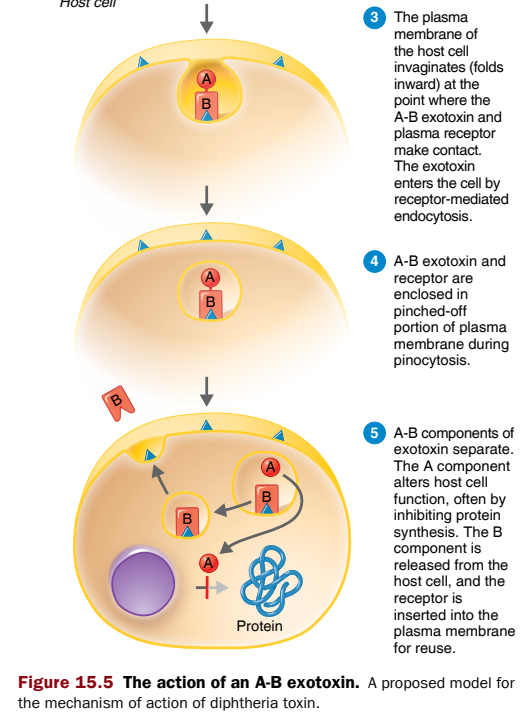
ab toxin action
bacterium produces and releases ab toxin
b attaches to host cell receptor
plasma membrane of host cell folds inward where A-B exotoxin touches plasma receptor
exotoxin enters cell by receptor-mediated endocytosis
pinocytosis- plasma membrane closes and ab are bubbled in
ab separate
a- alters host cell function
b- released from host cell
DIPTHERIA TOXIN
a toxin
part of ab exotoxin
alters host cell funct by inhibiting protein synth at end
enzyme component
b toxin
binding component
gets released at end
part of ab exotoxin
genotoxins
damage DNA (causing mutations,
disrupting cell division, and leading to cancer)
membrane disrupting toxins
lyse host cells by
disrupting plasma membranes
leukocidins
kill phagocytic leukocytes (wbc)
hemolysins
kill erythrocytes by forming protein channels
streptolysins
hemolysins produced by streptococci
superantigens
bacterial proteins that combine w macrophage protein
cause an intense immune response
due to release of cytokines from host cells (T cells)
• Cause symptoms of fever, nausea, vomiting,
diarrhea, shock, and death
exotoxin types
anitoxin
toxoid
ab toxin
genotoxins
membrane disrupting toxins
leukocidins
hemolysins
streptolysins
superantigens
botulism
Clostridium botulinum
A-B Neurotoxin
prevents transmission of nerve impulses; flaccid paralysis
tetanus
C. tetani A-B Neurotoxin
blocks nerve impulses to muscle relaxation pathway; uncontrollable muscle contractions
diptheria
Corynebacterium diphtheriae
A-B Cytotoxin
inhibits protein synthesis, especially in nerve, heart, and kidney
cells
scalded skin syndrome
S. aureus
A-B Exotoxin
causes skin layers to separate and slough off.
cholera
V. cholerae
A-B Enterotoxin
causes secretion of large amounts of fluids and electrolytes that
result in diarrhea
travelers diarrhea
Enterotoxigenic E. Coli and Shigella spp.
A-B Enterotoxin
causes secretion of large amounts of fluids and electrolytes that
result in diarrhea
anthrax
bacillus anthracis
A-B
TWO A components enter the cell via the
same B component. A proteins cause shock and reduce immune
response
gastric (stomach) cancer
Helicobacter spp
A-B toxin
Genotoxin; causes breaks in DNA
colorectal cancer
E. coli
A-B toxin
Genotoxin (colibactin); binds to adenines
in DNA.
skin and soft tissue infection
Methicillin-resistant S. aureus
Membrane-disrupting
The Panton-Valentine leukocidin found in community-acquired strain of MRSA
makes pores in WBC membranes
gas gangrene and food poisoning
C. perfringens and other species of
Clostridium
Membrane-disrupting One cytotoxin (exotoxin) causes massive red blood cell destruction (hemolysis); enterotoxin (exotoxin) related to food poisoning
and causes diarrhea.
antibiotic diarrhea
Clostridioides difficile Membrane-disrupting Enterotoxin
causes secretion of fluids and electrolytes that results in diarrhea;
acts as cytotoxin that disrupts host
cytoskeleton.
food poisoning
S. aureus
Superantigen
Enterotoxin causes secretion of fluids
and electrolytes that results in diarrhea.
toxic shock syndrom
S. aureus
Superantigen
Causes secretion of fluids and electrolytes from capillaries that
decreases blood volume and lowers blood pressure.
lipid A
ENDOTOXIN
(exotoxins r proteins)
portion of lipopolysaccharides (LPS) of gn bacteria
• Released during bacterial multiplication and when gram-
negative bacteria die
– Stimulate macrophages to release large quantities of
cytokines
– fever, chills, weakness, generalized aches
– disseminated intravascular coagulation
– endotoxic shock: life threatening drop in blood
volume and blood pressure
– May weaken blood-brain barrier
endotoxin pyrogenic response
A macrophage ingests a gram-negative bacterium
bacterium is degraded in vacuole, releasing endotoxins that induce
macrophage to produce cytokines, interleukin-1 (IL-1), and tumor necrosis factor alpha (TNF-α).
cytokines released into blood- stream by macrophages, travel to hypothalamus (temp center)
cytokines induce hypothalamus to produce prostaglandins, which reset
body's "thermostat" to higher temperature, producing fever
Limulus amebocyte lysate (LAL) assay
test for endotoxins
• Blood of horseshoe crabs contains amebocytes
• Amebocytes lyse in the presence of endotoxin,
producing a clot
endotoxin source
gn ONLY
exotoxin source
gp, gn
plasmids
may carry genes for toxins, production of antibiotics,
and enzymes
r plasmids
carry genes encoding resistance to some
antibiotics
Virulence plasmids
carry genes that affect a
microorganisms pathogenicity
Tetanus neurotoxin
▪ Staphylococcal enterotoxin
▪ Adhesins and coagulase of Staphylococcus aureus
lysogenic conversion
changes characteristics of a microbe
due to incorporation of a prophage
– Genes for diphtheria toxin, erythrogenic toxin
cytopathic effects (CPE)
visible effects of viral infection on a cell
• Stopping cell synthesis
• cell lysosomes release enzymes
• inclusion bodies in the cell cytoplasm
• Fusing cells to create syncytium
• Changing host cell function/ inducing chromosomal
changes
• Inducing antigenic changes on the cell surface
• Loss of contact inhibition in the cell, leading to
cancer
• Inducing a cytokine storm (SARS-CoV-2 and
Alphainfluenzavirus)
fungi definition and ex
Toxic metabolic products
• Provoke an allergic response
• Trichothecene
• Proteases
– Candida albicans
– Cryptococcus neoformans
• Ergot
• Aflatoxin
• Mycotoxins
• Phalloidin and amanitin
Trichothecene toxins
inhibit protein synthesis
proteases
modify host cell membranes
– Candida albicans
capsules
prevent phagocytosis
– Cryptococcus neoformans
ergot
alkaloid toxins that cause hallucinations
aflatoxin
carcinogenic toxin produced by
Aspergillus
mycotoxin
produced by mushrooms and are
neurotoxic
• Phalloidin and amanitin
Protozoa
Presence of these and their waste products causes symptoms
• Avoid host defenses by:
– Digesting cells and tissue fluids
– Growing in phagocytes
– Antigenic variation
Giardia intestinalis
Digesting cells and tissue fluids
Toxoplasma gondii
growing in phagocytes
trypanosoma
–Antigenic variation
portals of exit
Respiratory tract- coughing sneezing
GI tract- feces saliva
• Genitourinary tract
• Urine; secretions from the penis and vagina
• Skin
• Blood
• Arthropods that bite; needles or syringes