Jason Dion Network+ Section 7 IP Addressing with accurate solutions + explanations(pass guaranteed)
 Call Kai
 Learn
Learn Practice Test
 Spaced Repetition
 Match
Match Flashcards
1/80

There's no tags or description
Looks like no tags are added yet.
Name | Mastery | Learn | Test | Matching | Spaced | Call with Kai |
|---|
No analytics yet
Send a link to your students to track their progress
81 Terms
What is an Internet Protocol (IP) address?
A unique numerical address that is used to ID internet communicating devices on a computer network.
What are the two main formats for IP addressing?
1. IPv4
2. IPv6
What makes up an IPv4 address?
Unique 32 bit numerical value divided into four octets of 8 bits each.
What is the subnet mask?
A tool that separates IP addresses into network and host portions. The network portion IDs the network while the host portion represents the individual client.
Ex: 255.255.255.0, 255=network & 0=host
What are the 5 different classes of IPv4 addresses?
A, B, C, D, E
What are the characteristics of Class A IPv4 addresses?
1. First Octet Value is 1-127
2. Default Subnet Mask: 255.0.0.0
3. Possible Hosts: 16.7 million
What are the characteristics of Class B IPv4 addresses?
1. First octet value is 128-191
2. Default Subnet Mask: 255.255.0.0
3. Possible Hosts: 65,536
What are the characteristics of Class C IPv4 addresses?
1. First octet value is 192-223
2. Default subnet mask: 255.255.255.0
Possible Hosts: 256
What are the characteristics of Class D IPv4 addresses?
1. First octet value is 224-239.
2. No subnet masks, they're used only for multicasting or multicast routing.
What is a multicast address?
A logical identifier for a group of hosts in a computer network.
What are the characteristics of Class E IPv4 addresses?
1. First octet value is 240-255
2. No default subnet mask, used for experiments and R&D only.
3. Has 268 million possible hosts.
What is a classful mask?
The default subnet mask for a given class of IP addresses.
What is classless inter-domain routing (CIDR)?
Concept that lets you borrow some bits from a host and reassign them to the network portion of an IP address.
What is a CIDR notation?
Notation used in CIDR that designates which part of an IP address is the network. Represented with a slash and a number at the end of the address.
Example: 192.168.1.4 /24 so subnet mask is 255.255.255.0
What are two types of IPv4 addresses?
1. Public (routable)
2. Private (non-routable)
What is a public (routable) IPv4 address?
Can be accessed over the Internet and is assigned to the network by an ISP. Have to be purchased before use (from your ISP).
What is the Internet Corporation for Assigned Names and Numbers (ICANN)?
An organization that manages and leases publicly routable IP addresses. Made up of 5 different organizations that manage IP leasing based on geography.
What are the 5 sub-organizations under ICANN and their geographic areas?
1. ARIN (North America)
2. LACNIC (Latin America)
3. AFNIC (AFrica)
4. APNIC (Asia Pacific)
5. RIPE (Europe)
What is a private (non-routable) IPv4 address?
An IP address that can be used by anyone at any time, but only within a local network. They're not routable across the Internet.
What allows private IP addresses to be routed across the Internet?
Network Address Translation (NAT) which allows for routing by turning the private IP into the public IP of the router forwarding the traffic.
What is RFC 1918?
A document outlining how organizations can allocate private IP addresses for private Internets (Intranets).
What is the private IP address range for Class A addresses as defined by RFC 1918?
1. Starting value is 10 in the first octet
2. Range is 10.0.0.0 - 10.255.255.255
3. Possible hosts are 16.7 million
What is the private IP address range for Class B addresses as defined by RFC 1918?
1. Starting value is 172.16 - 172.31
2. Range is 172.16.0.0 - 172.31.255.255
3. Possible hosts are 1.05 million.
What is the private IP address range for Class C addresses as defined by RFC 1918?
1. Starting value is 192.168
2. Range is 192.168.0.0 - 192.168.255.255
3. Possible hosts are 65,536
What is the IPv4 loopback address?
127.0.0.1, creates a loopback to the host and is used for troubleshooting and testing network protocols on a system.
What is the IPv4 Automatic Private IP Addresses (APIPA) address?
Used when a device does not have a static IP address or cannot reach a DHCP server.
Range is 169.254.0.0 to 169.254.255.255
What is DORA?
Discover, Offer, Request, Acknowledgement
A four-step process used to acquire IP addresses through DHCP by devices.
What is a virtual IP address (VIP/VIPA)?
An address that does not correlate to an actual physical network interface. Used for NAT, fault tolerance, and virtualization.
What is a subinterface?
A virtual interface that is created by dividing up one physical interface into multiple logical interfaces.
What are the three ways data can flow in a IPv4 environment?
1. Unicast
2. Multicast
3. Broadcast
Describe the data flow method: unicast.
Data travels from a single source device to a single destination device.
Describe the data flow method: multicast
Data travels from a single source device to multiple (but specific) destination devices.
Describe the data flow method: broadcast
Data travels from one source to all devices on a destination network.
What are the two ways DHCP assigns IP addresses?
1. Static
2. Dynamic
Describe how to statically assign IP addresses?
Manually putting in the host IP addresses, subnet mask, default gateway, and DNS server. These addresses are permanent unless otherwise reassigned. Impractical on large networks.
How does dynamic IP addressing work?
IP addresses are assigned automatically by the DHCP server to client devices. Most SOHO network devices already have a DHCP server enabled and dynamic allocation on by default.
What are the four parts of any assigned IPv4 address?
1. IP Address
2. Subnet Mask
3. Default Gateway (usually a router's IP address)
4. Server Address (DNS or WINS server)
What is a Windows Internet Name Service (WINS) server?
IDs NetBIOS systems on a TCP/IP network and converts those NetBIOS names to IP addresses. Used within Windows domains.
What four protocols can be used to dynamically assigned the critical parts of an IP address?
1. BOOTP
2. DHCP
3. APIPA
4. ZeroConf
Describe the dynamic IP assignment protocol: Bootstrap Protocol (BOOTP)?
Oldest option for dynamically assigning IP addresses. Allows a workstation to load a copy of their boot image over the network. The least used and oldest.
Describe the dynamic IP assignment protocol: Dynamic Host Configuration Protocol (DHCP).
Replacement for BOOTP, assigns IPs based on their assignable scope/pool of addresses and allows for other configuration options as well.
Each IP is leased for a set period of time and expires and returns to the pool when a lease expires. The leases can be renewed.
How does DHCP manage IPs being assigned and returned?
Using it's IP Address Management feature.
Describe the dynamic IP assignment protocol: APIPA
Used when a device does not have a static IP address or cannot reach a DNS server. Let's you quickly configure a LAN without a DHCP server. Cannot connect outside the LAN with these addresses though.
Describe the dynamic IP assignment protocol: Zero Configuration (ZeroConf).
A newer APIPA-based technology that provides many of the same features and some new ones.
What are some newer features of ZeroConf.
1. Can assign an IPv4 link-local address to a client.
2. Resolve computer names to IP addresses w/o DNS by using mDNS (multicast domain name service)
3. Perform service discovery on a network.
What are some other names for ZeroConf used by other providers?
1. Bonjour (by Apple, for service discover)
2. LLMNR (Windows, provides name resolution and service discovery along with network conductivity).
3. SystemD (Linux)
How do computers talk to each other?
In base 2 (binary), using 1s and 0s.
What is subnetting?
Taking a large network and splitting it up into smaller networks. This where subnet masks come into play by modifying the subnets and creating better scoped networks.
What features do subnets improve?
1. Better efficiency
2. Better security
3. Better bandwidth control
How can you calculate the number of subnets?
2^S where S=number of borrowed bits from the host.
So for /25 because of the 1 borrowed bit
2^1 = 2 subnets
How can you calculate the number of assignable IP addresses?
2^H-2 where h=the number of host bits.
So for /25
2^7-2= 126 because 32-25 is 7.
What are two IP addresses that are always unusable in any network.
1. Network ID (the first IP address in the network)
2. Broadcast ID (the last IP address in the network)
What is a variable-length subnet mask?
Allows subnets of various sizes to be used and requires a routing protocol that supports it. Most modern routing protocols do support this feature.
TLDR the subnetting of subnets.
What is address exhaustion?
The exhaustion of all available IPv4 addresses
How many available addresses are there for IPv6?
340 undecillion addresses
What are some benefits of IPv6 over IPv4?
1. Larger address space
2. No broadcasts, makes networks more efficient.
3. No fragmentation of data, makes networks more secure.
4. Backwards compatible with IPv4.
5. Simplified header
What is dual stack?
When a network runs IPv4 and IPv6 protocols simultaneously.
What is IPv6 tunneling?
Allows an existing IPv4 router to carry IPv6 traffic.
How long is an IPv6 address?
128-bits or 16 octets long, uses hexadecimal digits (each 4 bits long) and allows for shorthand notation.
What are the two rules for IPv6 shorthand?
1. If you have a segment with 4 zeroes, you can replace it with a single zero.
2. If you have multiple segments with zeros in a chain you can convert them into ::, this can only be done once.
Ex: 2018:0000:0000:0000:0000:0000:4815:54ae becomes
2018::4815:54ae
What are the three types of addresses available in IPv6?
1. Unicast
2. Multicast
3. Anycast
What is a IPv6 unicast address?
Used to identify a single interface. These are broken into globally-routed unicast addresses and link-local addresses.
Describe a globally routed IPv6 unicast address.
Similar to IPv4's unicast class A, B, and C addresses and begins with 2000-3999.
Ex: 20A5::3330
Describe a link-local routed IPv6 unicast address.
Like the privates IPs used in IPv4, they can only be used on local area networks and begin with FE80.
Ex: FE80:2599::0132
What is Stateless Address Autoconfiguration (SLAAC)?
Part of IPv6 systems, gets rid of the need to obtain addresses or other configuration info from a central service. Allows IPv6 systems to create link-local addresses for each interface when it starts up.
Uses EUI as part of the process.
What is extended unique identifier (EUI)?
Part of SLAAC. Allows a host to assign itself a unique 64-bit IPv6 interface identifier called a EUI-64.
How is EUI-64 address made?
Using the interface's 48-bit MAC address. Splitting it into 24 bits, and inserting a 16-bit hexadecimal value of FFFE into it. The first half of the 128-bit network's IPv6 address (64 bits network portion) will then be put in front of the a EUI-64 address to create a unicast globally routable IPv6 address.
What does an EUI-64 address look like?
Ex: 00:21:2F:FF:FE:B5:6E:10
What is a IPv6 multicast address?
Used to identify a group of interfaces and begins with FF.
Ex: FF56::35A2:5601
What is a IPv6 anycast address?
Address used to ID a set of interfaces so that a packet can be sent to any member of a set. They are allocated from the unicast address space, so you can't tell them apart.
What is the DHCPv6 protocol?
Allows DHCP to automatically assign addresses from a DHCPv6 server.
What is the Neighbor Discovery Protocol (NDP)?
Protocol used by IPv6 to learn the Layer 2 addresses that are on a given network. Performs 5 things.
What are the five things NDP performs?
1. Router Solicitation
2. Router Advertisement
3. Neighbor Solicitation
4. Neighbor Advertisement
5. Redirection
Describe the NDP feature: Router solicitation.
When the client sends a message to locate the routers on the network so it can learn the default gateway to connect to the internet.
Describe the NDP feature: Router advertisement
The ability for routers advertising themselves on a network
Describe the NDP feature: Neighbor Solicitation
Feature where the IPv6 system starts asking around on the network to see what devices are on it.
Describe the NDP feature: Neighbor Advertisement
Feature where devices on a network advertise themselves to other devices and what services they can offer.
Describe the NDP feature: Redirection
Where routers can inform hosts of better first-hop options to increase network efficiency.
What are the differences between IPv4 and IPv6 with their different kinds of addresses?
1. The only difference with unicast and multicast is the use of IPv4 vs. IPv6 addresses.
2. Anycast sends data from one source device to the device nearest to multiple (specific) destination device.
What are anycast IPv6 addresses designed for?
To allow one host to start an efficient updating of router tables for a group of other hosts.
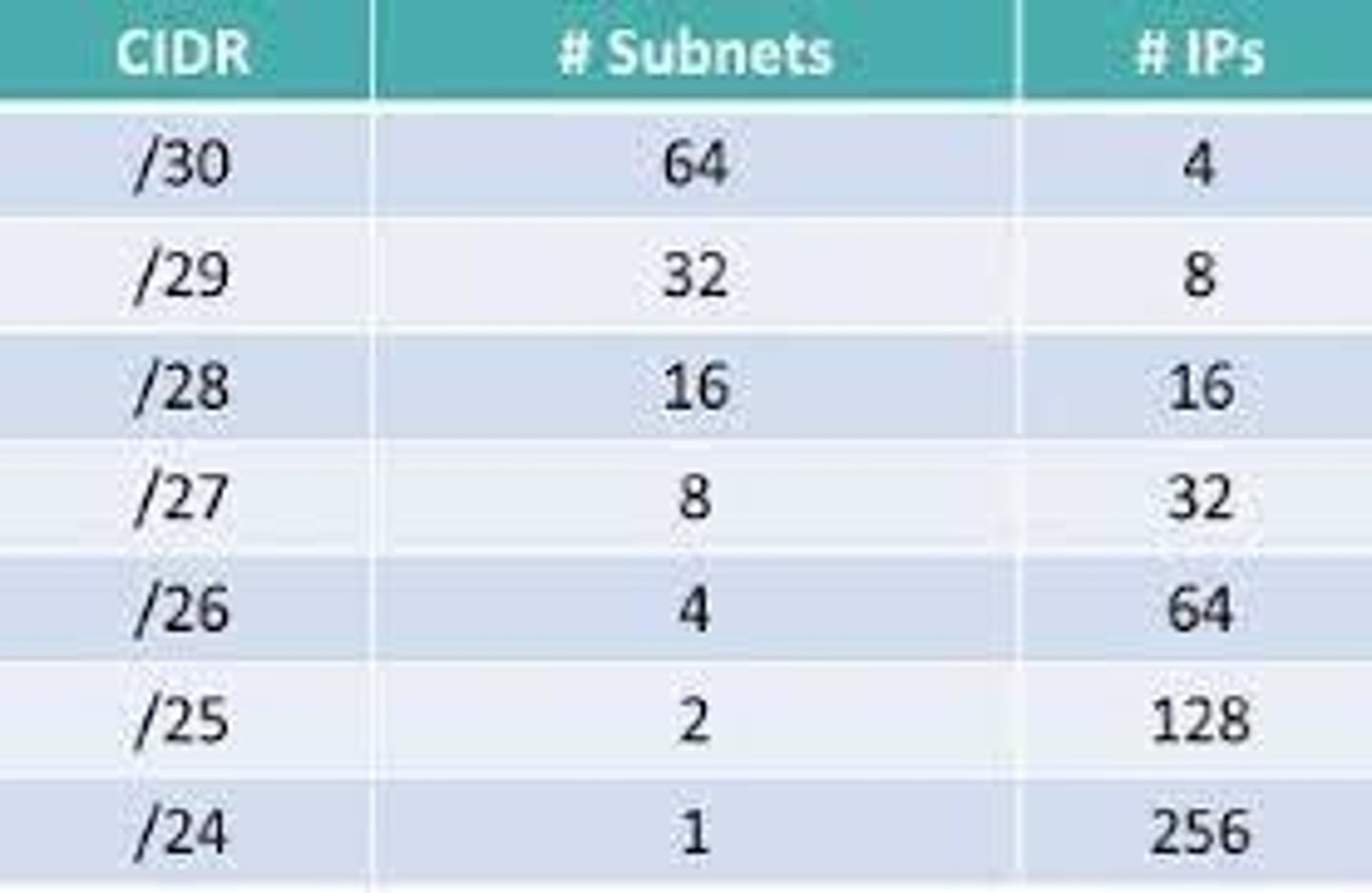
Describe the CIDR Subnet/IP table