AP Psychology Unit 2: Foundations of Psychology
 Call Kai
 Learn
Learn Practice Test
 Spaced Repetition
 Match
Match Flashcards
 Knowt Play
1/74

There's no tags or description
Looks like no tags are added yet.
Name | Mastery | Learn | Test | Matching | Spaced | Call with Kai |
|---|
No analytics yet
Send a link to your students to track their progress
75 Terms
Theory
An explanation using an integrated set of principles that organizes observations and predicts behaviors or events.
-An explanation with a set of principles that is used to observe and predict behaviors or events.
-Explanation of something -Hunch with no evidence
Hypothesis
A testable prediction that is often implied by a theory.
-Testable theory
-Theory implies this -hypoTHESIS (thesis = theory)
Operational Definition
A carefully worded statement of the exact procedures (operations) used in a research study.
-Specific instructions -Needed for replication
Replication
Repeating the essence of a research study, usually with different participants in different situations, to see whether the basic finding can be reproduced.
-Repeating the research with different participants to test whether the findings can be reproduced (same results).
-Confirmation of original research -Similarity = Replication
Case Study
A descriptive technique in which one individual or group is studied in depth in the hope of revealing universal principles.
-Very small group -In depth -One of the descriptive research
Bimodal Distribution
The data has two peaks.
-Bi = two -Modes (big quantity of specific number)
Naturalistic Observation
A descriptive technique of observing and recording behavior in naturally occurring situations without trying to manipulate and control the situation.
-Natural Observation -No manipulation of variables -Descriptive Research
Confounding Variable
A factor other than the IV being studied that might influence a study's results.
-Other Independent Variable -Confounding = surprise = surprise variable
Independent Variable (IV)
In an experiment, the factor that is being manipulated.
-Manipulated variable -Independent of other factors
Dependent Variable (DV)
In an experiment, the outcome is being measured.
-Dependent of other variables -After experiment
Population
All those in a group being studied where samples are drawn from.
-Bigger group -Samples are studied from this
Random Sampling
A sample that fairly represents a population because each member has an equal chance of inclusion.
-Equal chance of inclusion into a sample -Fair representation of a population
Representative Sample
A sample that has characteristics that are similar to those in the population, better allows researchers to generalize to the population.
-Representation of population -Better generalization
Sampling bias
A flawed sampling process that produces an unrepresentative sample.
-Results in unrepresentative sample -Bias selection -Something that causes it to not be random
Experimental Group
In an experiment, it is the group being exposed to the treatment.
-Experimented group -The group being tested -Groups apart of an experiment
Control Group
In an experiment, the group that is not exposed to the treatment.
-Controlled with no treatment -Unexperimented on -Groups apart of an experiment
Random Assignment
Assigning participants to experimental and control groups by chance.
-Assigning people to experimental or control groups -Coin flip -random 50/50
Correlation
A measure of the extent to which two factors vary together, and thus of how well either factor predicts the other.
-Relationships but no causation -Shown through scatterplots
Experimenter Bias
Consciously or unconsciously conducting research to ensure the outcome fits with their expectations.
-Conductors are biased -Wants research to fit their expectations
Informed Consent
Giving potential participants enough information about a study to enable them to choose whether they wish to participate.
-Participants choose to join the study -Participants are INFORMED
Effect Size
Any of the various measures of magnitude/meaningfulness of a relationship between two variables.
-Meaningfulness of a relationship between two variables.
-SIZE in meaningfulness/magnitude -Is the difference significant
Statistical Significance
The observed difference in data is not due to chance.
-Results of observation is due or not due to chance -P-Value 0.05 (5%) -The less the better
Double-Blind Procedure
An experimental procedure where both the participants and the research staff are ignorant about who received the treatment versus the placebo.
-Eliminates Experimenter bias -Participants & staff are blank
Percentile rank
The percentage of people that scored at or above a given score.
-Rank above _% of takers -Ranks show percentage
Mean
Average (most likely skewed by outliers)
-Add all, divide by the amount you added -The average
Median
Middle value, midpoint, 50% percentile
-Medium -Numbers in sequential order, number in middle
Mode
Most frequent score
-Many MODES in games -MOst reoccurring
Range
The difference between the highest and lowest scores.
- Highest minus lowest -in math, domain and _
Survey
A descriptive technique for obtaining the self-reported attitudes or behaviors of a particular group, usually by questioning a representative, random sample of the group.
-Less depth -More rapid results -Descriptive research method
Measures of Variation
Explains the amount of variation within a set of data.
-Looking at the variety -Assessing variation of data
Standard Deviation
How much any score differ from the mean score.
- Difference from mean -Standard = Average = Mean
Negative Skew
The mean is lower than the median.
-Tail on left -One person does bad makes everyone look like they do bad
Positive Skew
The mean is higher than the median.
-Tail on right -High salary in average salary brings up average salary
Scatterplot
A graphed cluster of dots, each of which represents the values of two variables. The slope of the points suggests the direction of the relationship between the two variables.
-SCATTERED dots on graph -Shows potential relationship between two variables or if theres any relationship at all
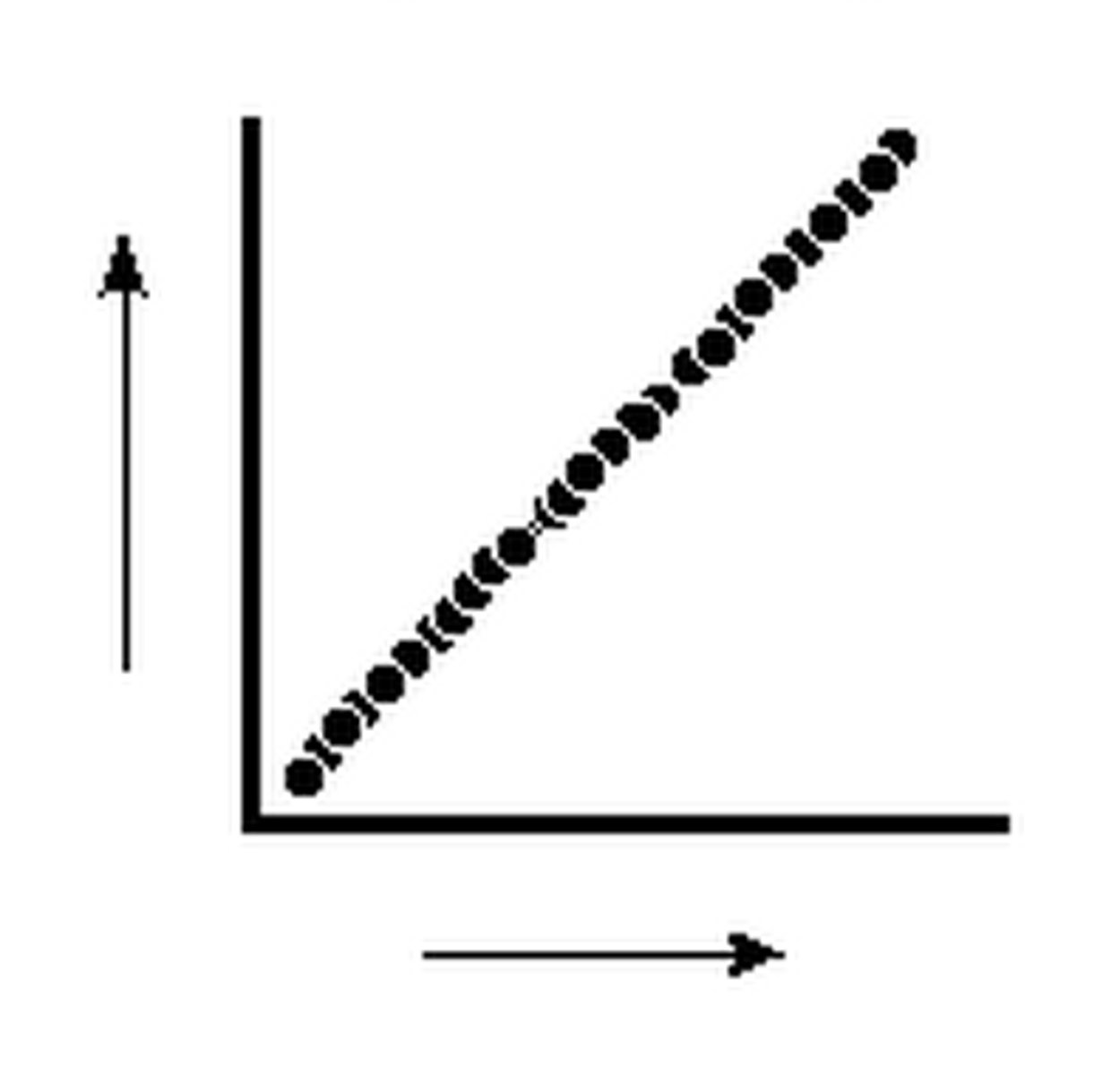
Positive Correlation
A relationship between two variables in which both rise and fall together.
-As we go right (x-> pos inf), the top also increases (y-> pos inf)
-+1.00 = higher correlation
Experiment
A research method in which an investigator manipulates one or more factors to observe the effect on some behavior or mental process.
-Manipulation of factors -"Cause and effect"
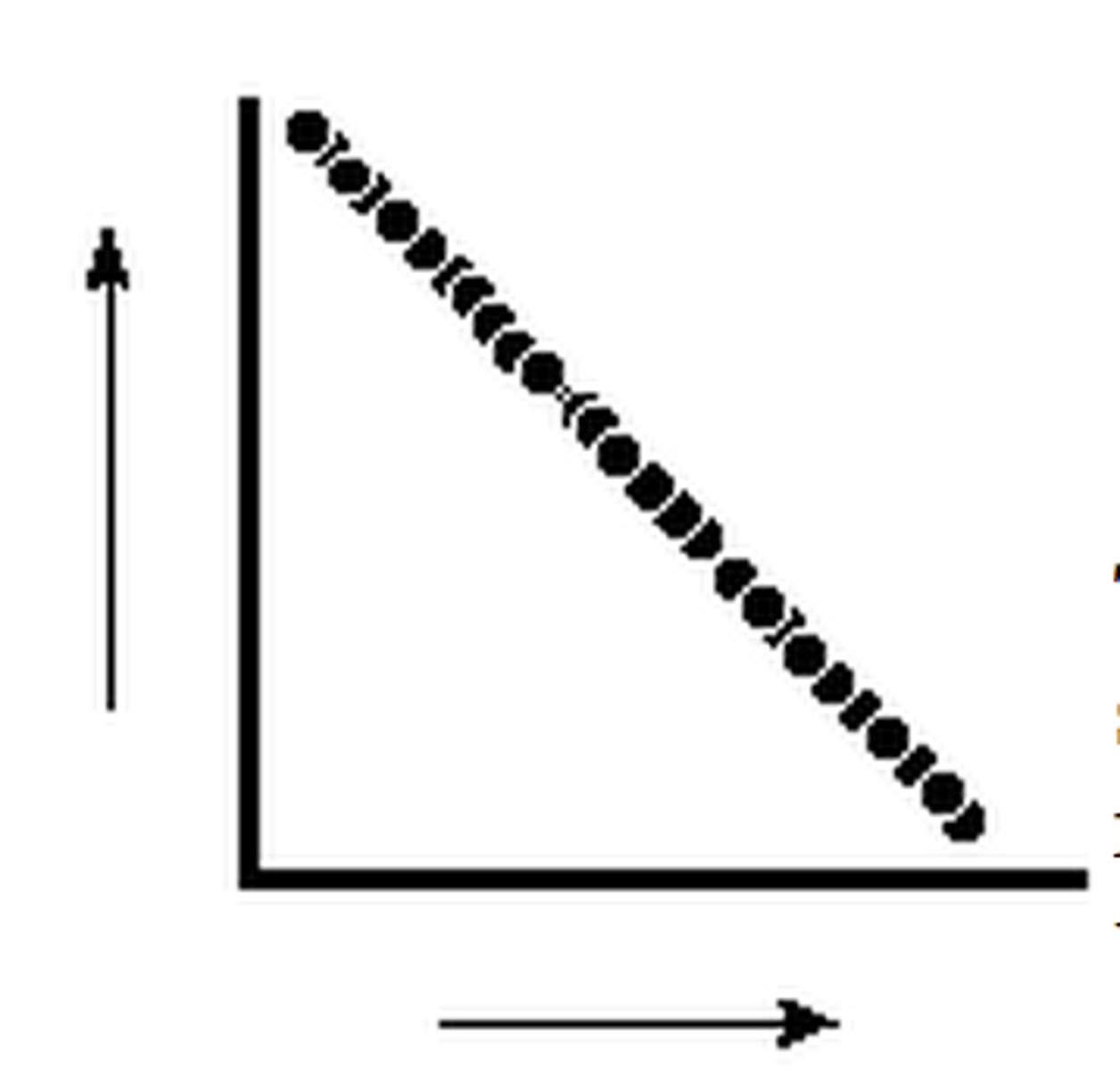
Negative Correlation
A relationship between two variables in which the value of one variable increases as the value of the other decreases.
-As we go right (x->pos inf), the the top decreases (y->neg inf)
-(-1.00) = higher correlation
Generalizability
The extent to which results or findings obtained from a sample are applicable to a broader population.
-Reliability, validity, representative -Can it be used to describe GENERAL population?
Falsifiability / falsifiable hypothesis
The logical possibility is that an assertion, hypothesis, or theory can be shown to be false by an observation or experiment.
-Can it be proven false? -makes a hypothesis valid
Eugenics
Describing a factor or influence that is favorable to heredity.
-euGEN = GENetics -"eu" = good = favorable
Likert scales
A direct attitude measure that consists of statements reflecting strong positive or negative evaluations of an object. Five-point scales are common.
-Five-point scale assessments -"Like"ly -School environmental survey
Convenience sampling
A researcher selects participants who are available (Not able to be generalized).
-Convenient selection -"Lazy" finding -NOT representative (maybe slight chance with luck)
Placebo Effect
Experimental results caused by expectations alone; any effect on behavior caused by the administration of an inert substance or condition, which the recipient assumes is an active agent.
-Results caused from expectations
-PLACEd yourself into those expectations - "false reality"
Informed Assent
A process through which minors agree to participate in clinical trials.
-Minors agreement -Consent but with children
Institutional Review (Board (IRB))
A committee named by an agency or institution to review research proposals originating within that agency for ethical acceptability and compliance with the organization's codes of conduct.
-A committee that reviews research proposals, and determines if they are ethnically accepted.
-Institutions = Places of education = Places of research
-REVIEWS proposals
Individualism
A social or cultural tradition, ideology, or personal outlook that emphasizes the individual and their rights, independence, and relationships with other individuals.
Or
In ethical and political theory, the view that individuals have intrinsic value. This implies that the unique values, desires, and perspectives of individuals should also be valued in their own right. Thus, individualism often manifests itself as an approach to life that emphasizes the essential right to be oneself and to seek fulfillment of one's own needs and desires.
-Individuals valuing themselves above all else.
-Intrinsic values -ME first -INDIVIDUAL
Collectivism
The tendency to view oneself as a member of a larger (family or social) group, rather than as an isolated, independent being.
Or
A social or cultural tradition, ideology, or personal outlook that emphasizes the unity of the group or community rather than each person's individuality. Most Asian, African, and South American societies tend to put more value on collectivism than do Western societies, insofar as they stress cooperation, communalism, constructive interdependence, and conformity to cultural roles and mores.
-Tendency to view ourselves a part of a larger group.
-Collection (of people) -Community
Placebo
Any medical or psychological intervention or treatment that is believed to be "inert," thus making it valuable as a control condition against which to compare the intervention or treatment of interest.
-Only believed to have effect, in reality has no effect.
-Sugar pills -No active properties -DECOY
Structured Interviews
A method for gathering information, used particularly in surveys and personnel selection, in which questions, their wordings, and their order of administration are determined in advance. The choice of answers tends to be fixed and determined in advance as well.
-Gathering information through a specific order of questions to receive fixed answers.
-Pre-determined -Ordered -Questions
Single-Blind Procedure
A procedure in which participants are unaware of the experimental conditions under which they are operating.
-Prevents participant bias -SINGLE - only participators are unaware
Sample
A subset of a population of interest that is selected for study with the aim of making inferences to the population.
-Small REPRESENTATIVE portion of population -People being researched later infer to population
Causation
The empirical relation between two events, states, or variables such that change in one (the cause) brings about change in the other (the effect).
-Relationship between two variables that causes a change. (One cause change to another)
-CAUSING change -Cause and effect (the reason = the cause)
Confederate
In an experimental situation, an aide of the experimenter who poses as a participant but whose behavior is rehearsed prior to the experiment.
-Decoy participant -Confederate = joined together through agreement = experimenters JOIN participant in agreement for the better of the study
Correlation Coefficient
A statistical index of the relationship between two things (from -1 to +1).
-How do they vary, and how do they predict? - ( ) 1.00 to -1.00
Cultural Humility
Process that requires humility as individuals continually engage in self-reflection and self-critique as lifelong learners and reflective practitioners.
-As individuals, we consistently evaluate ourselves if we have any biases and such.
-Humility = Humbleness -Keeping ourselves in check
Deception in Research
Any study in which participants are deliberately misled or not informed about the purpose of the investigation in order to avoid the possibility that their responses may be given to meet the perceived expectations of researchers.
-Participants are misled/informed on purpose so they can give the most honest responses.
-Prevention of social desirability bias -Prevents participator bias as well
Directionality Problem
In correlational research, the situation in which it is known that two variables are related although it is not known which is the cause and which is the effect.
- Two variables correlate, but we can't tell which variable causes the change,
-Unknown Direction of variable -Can't tell which variable causes change
Evolutionary Psychology/Perspective
An approach to psychological inquiry that views human cognition and behavior in a broadly Darwinian context of adaptation to evolving physical and social environments and new intellectual challenges.
- View that human behaviors are to adapt to evolving changes.
-"Marry for specific genes" -Darwinian
Peer Review
The evaluation of scientific or academic work, such as research or articles submitted to journals for publication, by other qualified professionals practicing in the same field.
-Peer check work -Reviewing submitted work -Double checking and evaluating
Harm in Research
The research must not cause harm (physical, psychological, social..) to its participant.
-Unethical to harm -Participants should be harm prevented during research
Measures of Central Tendency
The middle or center point of a set of scores. The central tendency of a sample data set, for instance, may be estimated by a number of different statistics (e.g., mean, median, mode).
-Frequent center of data points -Mean, mode, median calculates for central tendency
I/O Psychology (Industrial, Organizational)
The branch of psychology that studies human behavior in the work environment and applies general psychological principles to work-related issues and problems, notably in such areas as personnel selection, personnel training, employee evaluation, working conditions, accident prevention, job analysis, job satisfaction, leadership, team effectiveness, and work motivation. I/O psychologists conduct empirical research aimed at understanding individual and group behavior within organizations and use their findings to improve organizational effectiveness and the welfare of employees.
-Branch of psychology that studies human behavior in work environment, then uses their findings to improve work life and environment.
-i/o = industries + organizations -working psychology -psychological ergonomics
Meta-analysis
A quantitative technique for synthesizing the results of multiple studies of a phenomenon into a single result by combining the effect size estimates from each study into a single estimate of the combined effect size or into a distribution of effect sizes.
- Analyzing multiple results of similar studies to see if there is a trend.
-META = after, Analysis = analyze -see if results show a trend
Meta-cognition
Awareness of one's own cognitive processes, often involving a conscious attempt to control them. The tip-of-the-tongue phenomenon, in which one struggles to retrieve something that one knows one knows, provides an interesting and common example of metacognition.
-Thinking about your own thoughts
-Cognition = thinking , Meta - after -Conscious thinking
Non-maleficence
The obligation to not do intentional harm towards another human-being.
-"No-malice" -Maleficence = bad
Normal Curve
A symmetrical bell shaped curve that describes the distribution of many types of data; most scores fall near the mean, and fewer near the extremes.
-BELL SHAPED -Standard distribution of data
APA Ethical Principles
A set of principles that MUST be followed by when conducting a study.
Includes: Informed consent, where participants agree to participate in the study
Confidentiality, the study is not published unless given permission to
Protecting participants from greater-than-usual harm and discomfort (no intentional harm)
Fully debrief to participants, research and any deceptions
-includes 4 musts -needed for any study on people -Animals have different ones
Qualitative Research
A method of research that produces descriptive (non-numerical) data, such as observations of behavior or personal accounts of experiences.
-Method of research that finds descriptive data that do not include numbers.
-Quality -Descriptive
Quantitative Research
A method of research that relies on measuring variables using a numerical system, analyzing these measurements using any of a variety of statistical models, and reporting relationships and associations among the studied variables.
-Method of research that measures with numbers using statistical models.
-Quality -Numbers -Statistical
Regression Toward the Mean
The tendency for extreme or unusual scores or events to fall back (regress) towards the average.
-After a period of time, the scores go back in time
-Fluctuate then go back to normal.
Socio-Cultural Perspective
Any viewpoint or approach to health, mental health, history, politics, economics, or any other area of human experience that emphasizes the environmental factors of society, culture, and social interaction.
Or
In developmental psychology, the view that cognitive development is guided by adults interacting with children, with the cultural context determining to a large extent how, where, and when these interactions take place.
-A viewpoint that believes how environment factors influence behavior.
-social/cultural factors -Environmental factors
Skewed Distribution
When the results are asymmetrical meaning there's more data on one side of the median.
-Positive and negative -Skewed like Skewers that aren't always stabbed in the middle.
Reversibility
In Piagetian theory, a mental operation that reverses a sequence of events or restores a changed state of affairs to the original condition.
-The ability to think of a sequence of events, and then realize how it can be reverse to the original state.
-Reverse -Go back to OG
Third Variable Problem
The fact that a causal relationship between two variables cannot be inferred from the naturally occurring correlation between them because of the ever-present possibility of a third-variable correlation.
-In a correlational study, one assumes that the two variables have a relationship when it could be caused a third variable.
-Fake cause -Correlational -Extra variable = Reason
Hypothetical Thinking
Thinking that is based on what is possible, and not just what is real; sometimes referred to as "if-then" thinking.
-"What if.." -Snowball thinking