TYPES OF AGGLUTINATION REACTION
 Call Kai
 Learn
Learn Practice Test
 Spaced Repetition
 Match
Match Flashcards
 Knowt Play
1/40

There's no tags or description
Looks like no tags are added yet.
Name | Mastery | Learn | Test | Matching | Spaced | Call with Kai |
|---|
No analytics yet
Send a link to your students to track their progress
41 Terms
DIRECT AGGLUTINATION
PASSIVE AGGLUTINATION
REVERSE PASSIVE AGGLUTINATION
AGGLUTINATION INHIBITION
COAGGLUTINATION
AHG-MEDIATED AGGLUTINATION
6 types of agglutination reaction
DIRECT AGGLUTINATION
Occurs when antigens are found naturally on a particle.
KNOWN BACTERIAL ANTIGENS
________ ___________ _________ - used to test for the presence of unknown antibodies in the patient.
HEMAGGLUTINATION
IgM
If an agglutination reaction involves red blood cells, it is called (a)___________________.
(b) ____ is the ab responsible for this reaction.
(a) _______________ is routinely done at room temperature withoutenhancement techniques.
ABO BLOOD TYPING
___ _______ _______ - clumping on the surface area of the RBC.
ANTI-A
ANTI-B
ROOM TEMP
Anti-A and anti-B antisera are IgM in nature, that’s why the best temperature to incorporate when performing the ABO blood typing is at ____ ______.
IgM
___ - cold reacting antibody. Best reacts at room temp or colder.
SLIDE METHOD
TUBE METHOD
Two methods: (a) _______ __________ and (b)_____ __________.
Gold standard for forward typing is the (b) _____ ________.
GLASS SLIDES
TEST TUBES
Direct agglutination can be done on (a)______ _______ or (b)_______ _______.
(b)_______ _______ also can be centrifuged and then sh-ken to see if the cell can be evenly resuspended.
The degree of agglutination is the graded.
The tubes should be tilted qhen grading for better visualization.
PARTIAL
COMPLETE HEMOLYSIS
In serology, (a)________ or (b) _________ __________ is considered also a positive reaction.
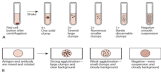
4+
3+
2+
1+
NEGATIVE
__ - one solid clump
__ - severaral large clumps
__ - intended for numerous smaller clots
__ - barely discernible clumps
________ – smooth suspension
HEMOLYSIS
NO HEMOLYSIS
COMPLETE HEMOLYSIS
PARTIAL HEMOLYSIS
Need to compare to (a)___________. (a)____________ is considered as a positive reaction.
(b) ___ ____________ – intact cell button with clear supernatant.
(c) ___________ ____________– absent cell button with red supernatant.
(d) ___________ ____________ – present cell button, supernatant is pink in color
WIDAL TEST
SOMATIC ANTIGEN (O)
FLAGELLAR ANTIGEN (H)
(a)_______ _______ - a rapid screening test to help determine the possibilityof salmonellosis or typhoid fever
The antigens used in this procedure include Salmonella (b)__________ _________ ___ and the (c)___________ _________ ___ of S.typhi serovar typhi.
WEIL-FELIX TEST
PROTEUS SPP.
(a)_____-______ _____ - intended for Rickettsial disease
(b)_________ ____ – same antigenic determinants to Rickettsial diseases (cross reaction mechanism)
OX-2, OX-19 OX-K
PASSIVE AGGLUTINATION
Also known as Indirect Agglutination
Employs particles that are coated with antigens not normally found on their surfaces
ANTIBODY
ANTIGENS
Detects: (a) __________
Reagant: (b) __________ attached to a carrier particle
ERYTHROCYTES
LATEX PARTICLES
GELATIN
SILICATES
BENTONITE
CHARCOAL
Carrier particles:
___________ - Always cross react with heterophile antibodies
______ __________ (common)
__________
_______
________
_________
ANTISTREPTOLYSIN O (ASO) LATEX AGGLUTINATION
The chemical particle that we have here is the latex particle, so the patient serum that contains antibodies will react with the latex particle then visible agglutination will occur.
That means there is a particular antibody that could be present on the serum of the patient against Streptolysin O.
RHEUMATOID FACTOR (RF)
Seen in autoimmune disorder: Rheumatoid Arthritis
ANTINUCLEAR ANTIBODY (ANA) TEST
Screening test for Systemic Lupus Erythematosus
REVERSE PASSIVE AGGLUTINATION
ANTIGEN
ANTIBODY
(a)_________ __________ _____________
Antibody is attached to a carrier particle
Detects: (b)_________
Reagent: (c)_________ attached to a carrier particle
REACTIVE
OUTWARD
The antibody must still be (a) _______ and is joined in such a manner that the active sites are facing (b)__________.
Fc
Fab
Carrier particles should have the ability to absorb the (a)___ region of the antibody so that the (b)____ region is exposed to the environment finding specific antigen.
C-REACTIVE PROTEIN (CRP) LATEX AGGLUTINATION TEST
Generarally a marker for acute inflammation.
AGGLUTINATION INHIBITION
PARTICULATE
SOLUBLE ANTIGENS
LIMITED ANTIBODY COMBINING SITES
AGGLUTINATION
POSITIVE
(a)____________ _________ reactions are based on competition between (b)__________ (1st reagent) and (c)_______ ___________ (patient sample) for (d)________ __________ _________ ______ (2nd reagent), and a lack of (e)__________ is an indicator of a (f)__________ reaction.
ANTIGEN
ANTIBODY
Either (a) __________ or (b) ___________ can be attached to the particles
CLASSIC PREGNANCY TEST
POSITIVE RESULT
NEGATIVE RESULT
(a) __________ ____________ _____
Antibody reagent and the patient antigen.
(b) ___________ ________ in pt using the classic pt
- The reagent antibody will be bind to the patient antigen, they will be no attachment to the indicator cells therefore no agglutination reaction will be formed.
(c) _________ _________
- The reagent antibody will not bind to the patient antigen, and the indicator cells will attach to the patient antibody which will form an agglutination reaction.
ABO TYPING USING SALIVA
____ __________ _______ ________
a. Specimen: Saliva
b. Principle: Hemagglutination Reaction
ANTI-SERA
PX SALIVA
KNOWN CELLS
(a)_____ ______ + (b)____ _____ (containing soluble antigens) + (c)_____ _______ (indicator cells)
POSITIVE
NEGATIVE
(a) ____ - No agglutination
(b) ____ - Agglutination
SECRETOR STATUS
Incorporated in some of the tests like the detector of (a) _________ __________.
(a)__________ _________ – how we able to identify the blood type of the specific individual using secretion using the saliva.
COAGGLUTINATION
__________________ detects antigen.
Reverse passive agglutination but uses bacteria (Staphylococcus aureus) as the carrier particle.
It is also the active site that faces outward and will have the capability to react with the specific antigen.
S. AUREUS
______________ is most frequently used, because it has a protein on its outer surface, Protein A.
PROTEIN A
________ - it naturally absorbs the Fragment crystallizable (FC portion) of the antibody molecule.
AHG-MEDIATED AGGLUTINATION
____-______________ ______________________
Also known as Coomb’s Test
Detects non agglutinating antibodies by means of coupling with a second antibody.
HYBRIDOMA TECHNIQUES
The key component of the test is antibody to human globulin that is made in animals (rabbit/mouse) or by means of __________ ______________.
RBC
Reason this process is performed: Is to detect if the RBC is sensitized with IgG or complement. We are dealing with sensitization of the _____ (in vivo/In vitro).
IgM ANTIBODIES
____ ____________ can bind to the corresponding antigen and it directly agglutinates.
DIRECT
INDIRECT
The Coombs’ test can be divided into two different types, _________ and ____________, each of which has a different purpose.
DIRECT
VIVO ATTACHMENT
(a)__________
Used to demonstrarate direct in (b)______ ____________ of the antibody, usually IgG or complement to to an individual’s RBC.
it is called “(a)________” because we are referring to the sensitization of the red cells that are tested directly as they come (directly) from the body.
INDIRECT
(a)____________
In-Vitro
Used to determine the presence of a particular antibody in a patient.
Part of pre-transfusion protocols.