Chinese Landscapes Wks 5-8
 Call Kai
 Learn
Learn Practice Test
 Spaced Repetition
 Match
Match Flashcards
 Knowt Play
1/85

There's no tags or description
Looks like no tags are added yet.
Name | Mastery | Learn | Test | Matching | Spaced | Call with Kai |
|---|
No analytics yet
Send a link to your students to track their progress
86 Terms
b. The Literati responded as follows: It is our humble opinion that the principle of ruling men lies in nipping in the bud wantonness and frivolity, in extending wide the elementals of virtue, in discouraging mercantile pursuits, and in displaying benevolence and righteousness. Let lucre never be paraded before the eyes of the people; only then will enlightenment flourish and folkways improve.
c. But now, with the system of the salt and iron monopolies, the liquor excise, and equable marketing, established in the provinces and the demesnes, the Government has entered into financial competition with the people, dissipating primordial candor and simplicity and sanctioning propensities to selfishness and greed. As a result few among our people take up the fundamental pursuits of life, while many flock to the non-essential. Now sturdy natural qualities decay as artificiality thrives, and rural values decline when industrialism flourishes. When industrialism is cultivated, the people become frivolous; when the values of rural life are developed, the people are simple and unsophisticated. The people being unsophisticated, wealth will abound; when the people are extravagant, cold and hunger will follow. We pray that the salt, iron and liquor monopolies and the system of equable marketing be abolished so that the rural pursuits may be encouraged, people be deterred from entering the secondary occupations, and national agriculture be materially and financially benefited.
Huan, Kuan. "Chapter I: The Basic Argument,” In Discourses on Salt and Iron, Han Dynasty (debated held at 81 BC). Literati’s main argument and why they believe the government’s monopoly of salt and iron are not good for the people
The Lord Grand Secretary said: When the [Xiongnu] rebelled against our authority and frequently raided and devastated the frontier settlements, to be constantly on the watch for them was a great strain upon the soldiery of the Middle Kingdom; but without measures of precaution being taken, these forays and depredations would never cease. The late Emperor, grieving at the long suffering of the denizens of the marches who live in fear of capture by the barbarians, caused consequently forts and series signal stations to be built, where garrisons were held ready against the nomads. When the revenue for the defence of the frontier fell short, the salt and iron monopoly was established, the liquor excise and the system of equable marketing introduced; goods were multiplied and wealth increased so as to furnish the frontier expenses.
e. Now our critics here, who demand that these measures be abolished, at home would have the hoard of the treasury entirely depleted, and abroad would deprive the border of provision for its defense; they would expose our soldiers who defend the barriers and mount the walls to all the hunger and cold of the borderland. How else do they expect to provide for them? It is not expedient to abolish these measures!
Huan, Kuan. "Chapter I: The Basic Argument,” In Discourses on Salt and Iron, Han Dynasty (debated held at 81 BC). The Lord Grand Secretary’s argument about why it is crucial for the government to have monopoly on salt and iron:
The Literati: Lead the people with virtue and the people will return to honest simplicity; entice the people with gain, and they will become vicious. Vicious habits would lead them away from righteousness to follow after gain, with the result that people will swarm on the road and throng at the markets. A poor country may appear plentiful, not because it possesses abundant wealth, but because wants multiply and people become reckless, said [Laozi] Hence the true King promotes rural pursuits and discourages branch industries; he checks the people's desires through the principles of propriety and righteousness and provides a market for grain in exchange for other commodities, where there is no place for merchants to circulate useless goods, and for artisans to make useless implements. Thus merchants are for the purpose of draining stagnation and the artisans for providing tools; they should not become the principal concern of the government.
Huan, Kuan. "Chapter I: The Basic Argument,” In Discourses on Salt and Iron, Han Dynasty (debated held at 81 BC). The literati’s moral argument, urging the emperor to lead the people to return to simplicity rather than greed.
“The Lord Grand Secretary: With restrictions upon the mountains and the seas, the people are not subverted. With the establishment of equilibrium in prices, the people are not suspicious. When the magistrates set up standard weights and measures, the people obtain what they desire. Even a lad only five feet tall may be sent to the market and no one could cheat him. If now the monopolies be removed, then aggressive persons would control the use and engross the profits. They would dominate the market; prices would be raised or lowered at a word; there would be no stability in prices, dear or cheap. These people would be sitting firmly and would grow more aggressive. This would serve to nourish the powerful and depress the weak, and the nation's wealth would be hoarded by thieves. Nourish the powerful and depress the weak and the rank and file of law-abiding people will dwindle away. It would be like letting the weeds flourish and spoiling the grain. One family harms a hundred families, forsooth, if this does not apply to such as Bing of Chu, what does it mean?”
Huan, Kuan. "Chapter V. Hindrance to Farming,” In Discourses on Salt and Iron, Han Dynasty (debated held at 81 BC). Arguments for the government’s role in equalizing prices.
Huan, Kuan. "Chapter VIII: Parks and Ponds ,” In Discourses on Salt and Iron, 81 BCE. Grand Secretary talks about why it is crucial for the government to open up the parks and ponds, and to secure profit from it.
The Grand Secretary: …
The Emperor, whose domain has as its boundaries the Eight Extremities, has concerns extending far and wide. It is clear that under the small manorial roof the expenses are trifling, in comparison with the great expenditure necessitated by the immense undertaking [of ruling the Empire]. Herein lies the reason for the Government's opening up of parks and ponds, and its concentrating under one hand the mountains and the seas, to secure profits that could be used to supplement tribute and levies.
b. We improve canals and sluices, promote various kinds of agriculture, extend farm and pasture lands, and develop national reservations. The offices of the [taipu], the [shuiheng], the [shaofu], and the [danung],4 compute annually the revenue derived from farm and pasture, and the rentals from farming out pond and weir. Up to the limits of the Empire in the north, supervisors of fields have been appointed; and yet with all these efforts to provide for the different items of expenditure, there is still a deficit. Now you desire to abolish all these measures, to stop the fountain of income and the source of revenue, with the result that the people, both high and low, will be in dire need, devoid of means of subsistence. Even though we would like to save effort and cut down expenditure, how can we do it?
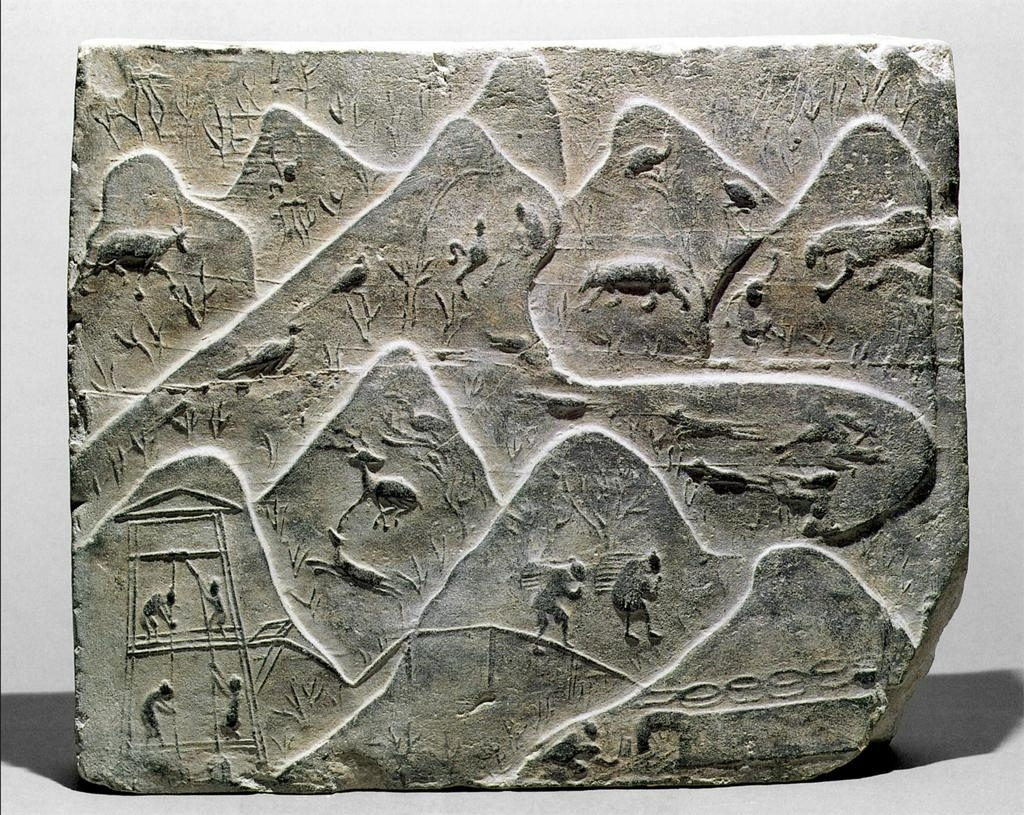
Salt Mining, pottery relief. Eastern Han Dynasty (25-220 AD). Sichuan Province, China.
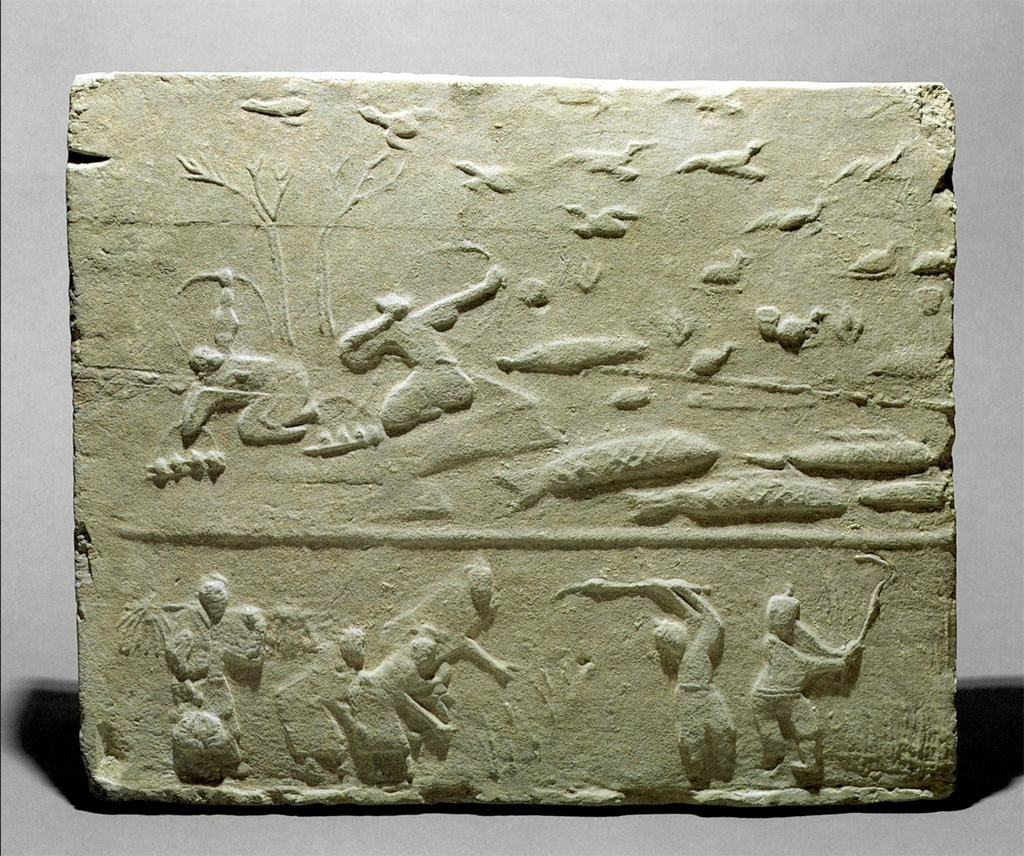
Brick Decorated with Hunting and Harvesting scenes. Ceramic. 2nd c. AD. Tomb 2 of Zengjiabao, Sichuan, China.
“Moreover, in your discourses both of you gentlemen do not strive to elucidate the duties of ruler and subject or to correct the ritual behavior of the vassal lords. You merely devote yourselves to competing over the joys of excursions and sports, the size of parks and preserves, wishing to overwhelm each other with wasteful ostentation and surpass one another in wild excesses. These things cannot serve to spread fame or enhance a reputation, but are enough to defame your rulers and do injury to yourselves. Furthermore, how are the affairs of Qi and Chu worth mentioning? Have you not seen what is truly great and beautiful? Have you alone not heard of the Imperial Park of the Son of Heaven?” (Knechtges: 60)
Sima Xiangu, “Rhapsody of Sir Vacuous” Western Han (2nd c. BC) . Preserved in 6th c. AD anthology, Selections of Refined Literature
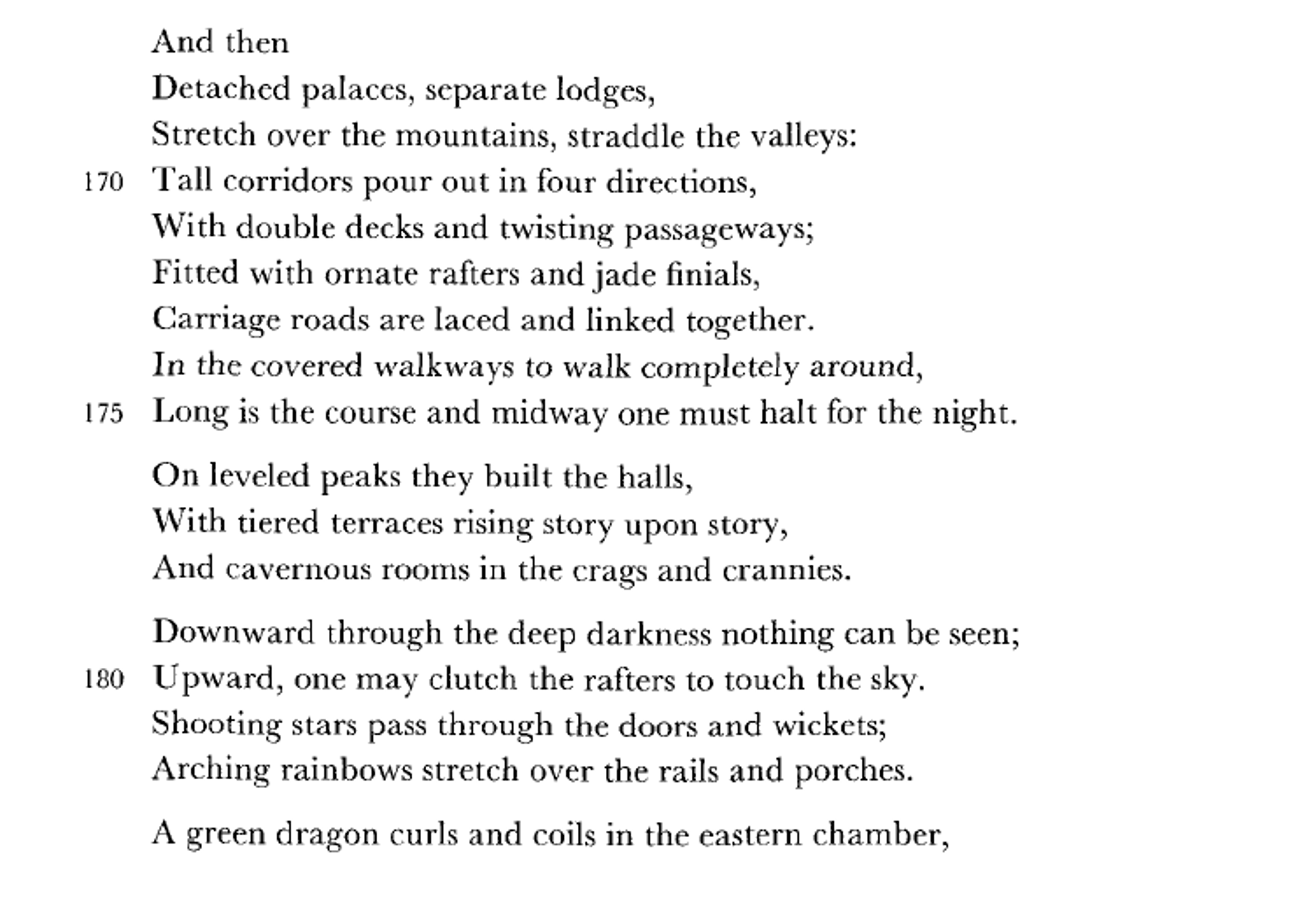
Sima Xiangru (c. 179 – 117 BC/ Western Han dynasty)“Rhapsody on Imperial Park.” Preserved in 6th c. AD anthology, Selections of Refined Literature
Look at it [Supreme Forest Park] and it has no beginning;
Examine it and it has no end.
The sun rises from its eastern pond,
Sets at its western dike.
To the south
In deepest winter there are germination and growth,
Bubbling waters and surging waves.
Its animals are:
The zebu, hairy yak, tapir, grunting ox,
Plunging bull, sambar, elephure,
Redhead, roundhoof,
Extreme extraordinaire, elephant, and rhinoceros.
To the north
In full summer it is enveloped in a freezing cold that cleaves the ground;
One just lifts his skirt to cross the iced-over streams.
Its animals are:
The unicorn, horn-snout,
Tarpan, camel,
Chigetai, kulan,
Hinny, ass, and mule.
Sima Xiangru (c. 179 – 117 BC), “Rhapsody on Imperial Park,” ), Western Han Dynasty (202 BC-9 AD). Preserved in 6th c. AD anthology, Selections of Refined Literature.
In front is Middle Path, behind is Grand Fluid,
Where one views the flooding flow of the emerald sea.
It dashes its waves against Jieshi [the easternmost rock in China],
Strikes the divine peaks with a tumultuous roar.
On it flat the Yingzhou and Fang-Hu isles
And Penglai rises from its center.
And then there are:
Magic herbs blooming in winter,
Sacred trees growing in groves,
Precipitous and steep, peaked and sharp,
Rugged hills of gold and precious stones.
They hoisted immortals’ palms to receive the dew,
Jutting forth from metal columns standing in pairs.
Having transcended the turbidity of dust and sirt,
They were refreshed by the clear essence of white vapors.
Emperor Wu gave free rein to Civilized Accomplishment’s pompous boasts,
Was carried away by Five Profits’ wonderous techniques.
He hoped men like Song and Qiao
Would often sport with him in this court.
Ban Gu (32 AD-92 AD), “Western Capitol Rhapsody,” Eastern Han Dynasty. Preserved in the 6th c. anthology, Selections of Refined Literature. Description of the Grand Fluid and the three immortal isles in the midst of this large lake inside palace garden, representing a Daoist paradise.
Poem #1: The Luminous Hall Poem
Oh radiant Luminous Hall!
The Luminous Hall is extremely bright.
The Sage Emperor's ancestral sacrifice—
August and resplendent!
The Supreme Lords are banqueted and feted,
The five positions each in proper sequence.
Who will be the coadjutor?
The Era Founder Guangwu.
Under vast Heaven, over the entire earth,
Each tributary comes according to his office.
Rich and ample, continuously bright!
Truly we shall garner many blessings!
Ban Gu (32 AD-92 AD/ Eastern Han Dynasty), concluding section of the more modest “Eastern Capital Rhapsody,” poem
#1, describing the Luminous Hall, one of the most important structure in an imperial park. Preserved in the 6th c. anthology, Selections of Refined Literature.
Poem #2: The Circular Moat Poem
Here is the flowing Circular Moat—
The Circular Moat with water lapping and splashing
The Sage Emperor arrives,
And boats form his bridge.
The hoary-headed elders of state,
Are treated as father, as elder brother.
Beautiful the dignified demeanor!
Filial piety and fraternal devotion are shining and bright!
Oh resplendent the Great Supreme One!
He shows us the way of Han!
His grand influence is truly divine!
Long will we view his accomplishments.
Ban Gu (32 AD-92 AD/ Eastern Han Dynasty), concluding section of the more modest “Eastern Capital Rhapsody,” poem #2, describes the circular moat, which has become one of the elements in an imperial park construction. Preserved in the 6th c. anthology, Selections of Refined Literature.
Poem #3: The Divine Tower Poem
Then they build the Divine Tower.
The Divine Tower has risen high!
The emperor is careful to climb at the proper time,
And then he examines the good omens.
The three luminaries put forth their radiant essence,
The Five Phases are arranged in sequence.
Gently blows the auspicious breeze;
Slowly falls the sweet rain.
All the grain is thick and plenteous;
The various plants are lush and luxuriant.
Frequent are the rich harvests.
How majestic and joyful!
Gu (32 AD-92 AD/ Eastern Han Dynasty), concluding section of the more modest “Eastern Capital Rhapsody,” poem #2,describes the divine tower, one of the crucial elements in an imperial park construction, used for gazing at skies, examining omens and weather, important for farming. Preserved in the 6th c. anthology, Selections of Refined Literature.
Poem #5 The White Pheasant Poem
They opened the numinous tablets, unfolded the auspicious diagrams.
They caught a white pheasant, presented an ecru crow.
They spread their hoary wings, ruffle their nephrite tail feathers.
Their appearance is unsullied and bright, a pure essence!
The imperial virtue they symbolize equals that of King Cheng of Zhou
Our rule will last forever—it receives Heaven's blessing!
Ban Gu (32 AD-92 AD/ Eastern Han Dynasty), concluding section of the more modest “Eastern Capital Rhapsody,” poem #2, describes the auspicious omen of the capturing of a white pheasant – why is it significant? Preserved in the 6th c. anthology, Selections of Refined Literature.
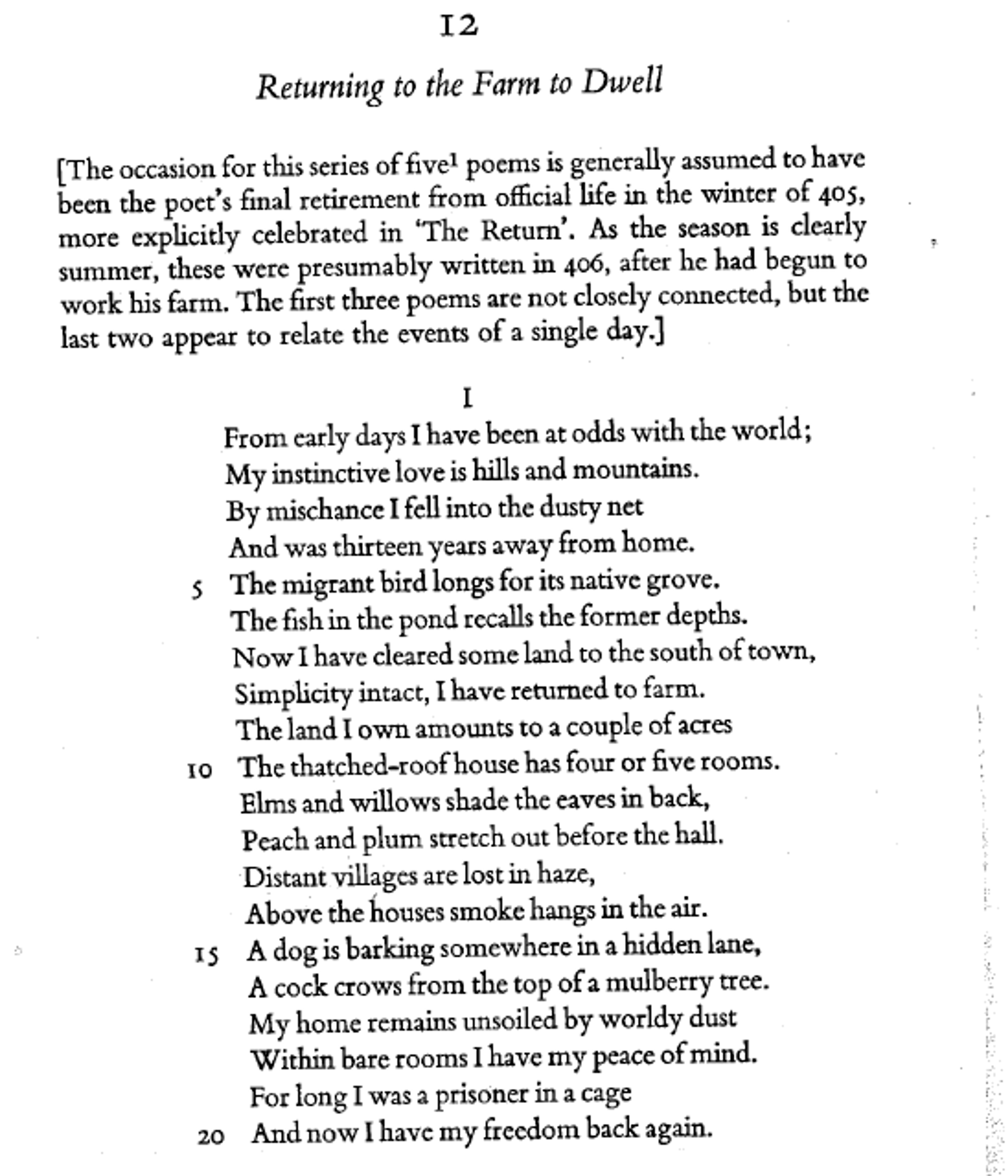
Tao Qian (365-427AD), “Returning to the Farm to Dwell” Poem #1. Six Dynasties period (4th c AD)
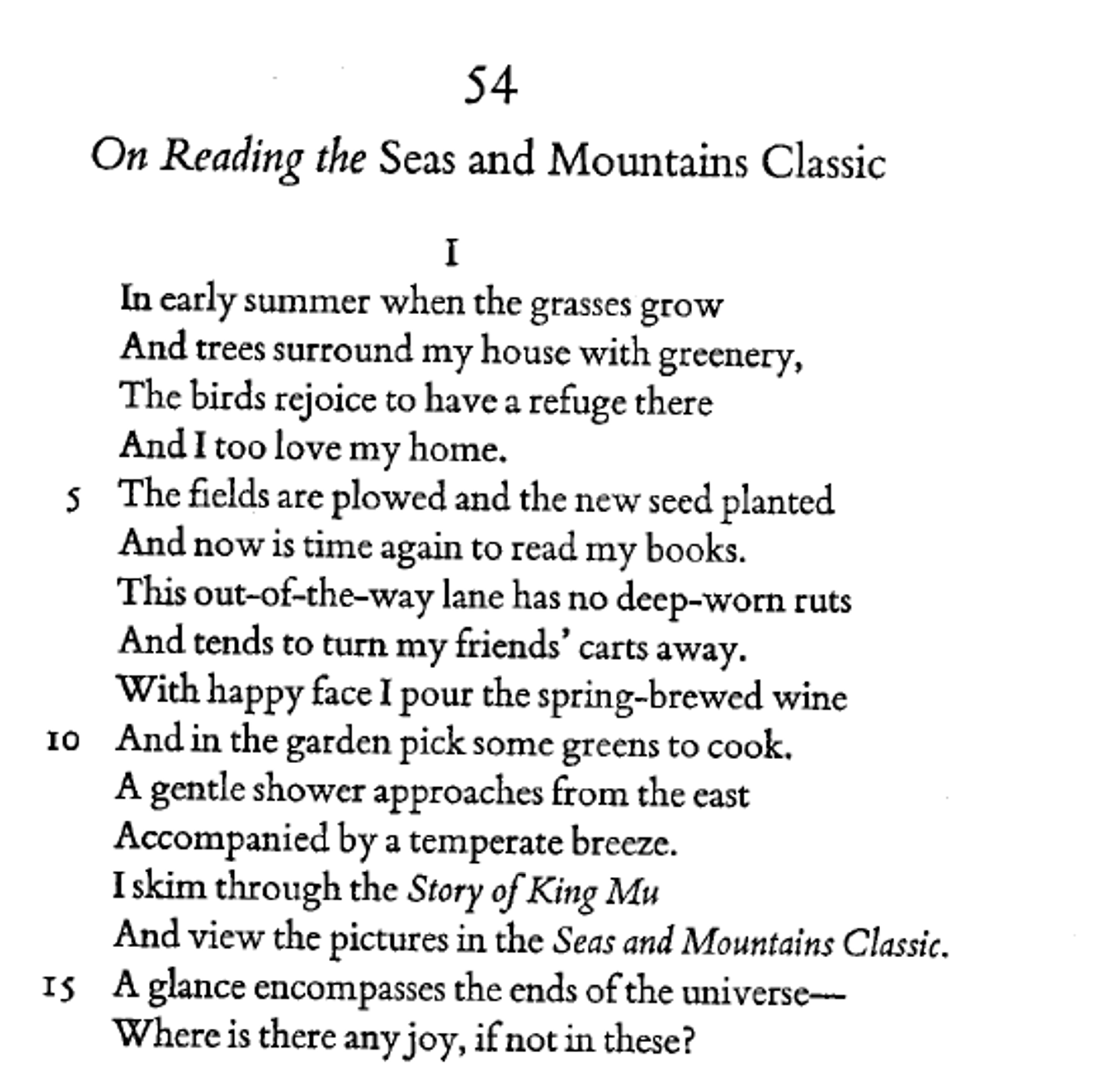
Tao Qian (365-427AD), the first of the series “On Reading the Seas and Mountains Classic,” Poem #1. Six Dynasties (4th c AD).
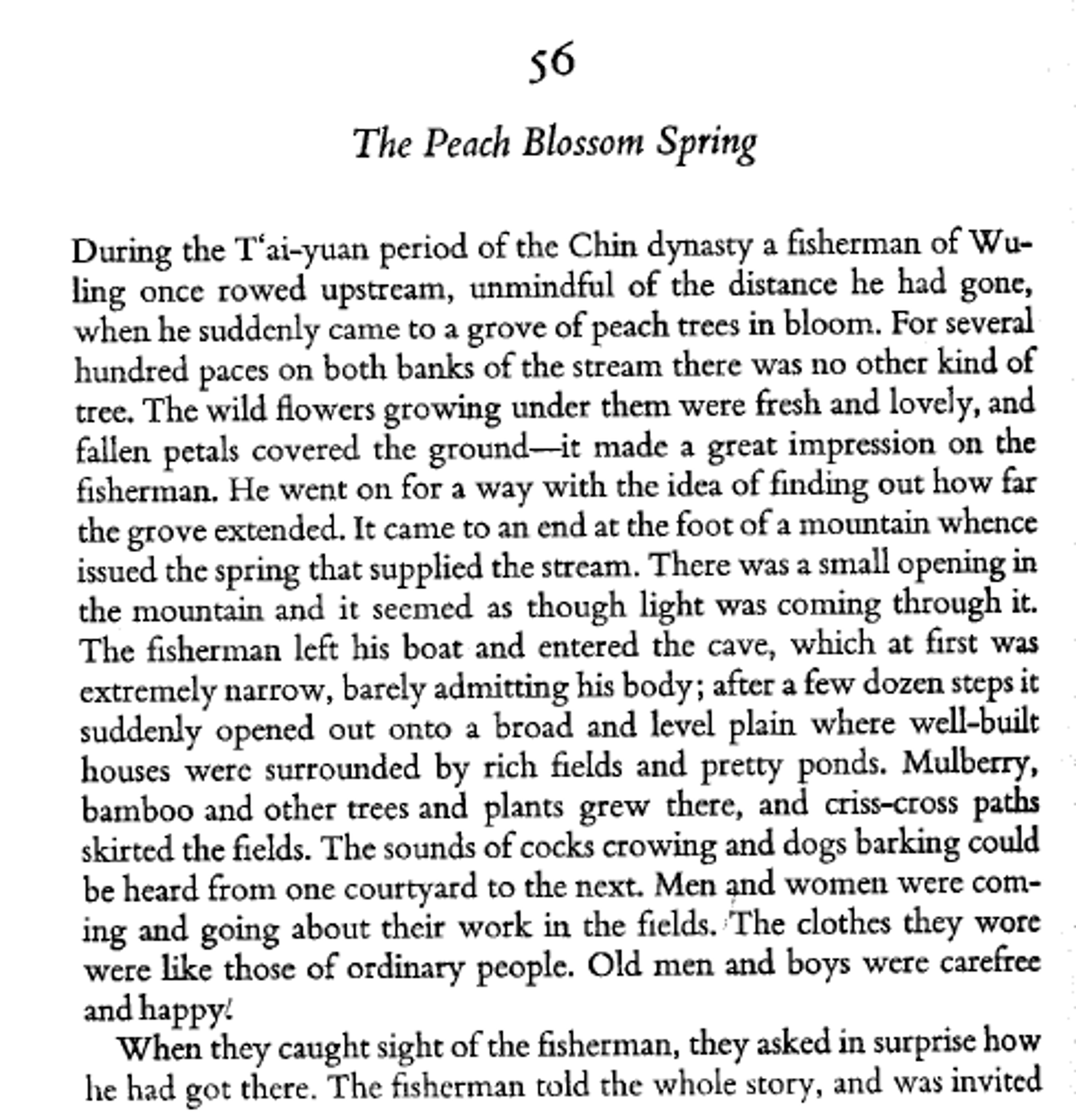
Tao Qian (365-427AD/ Six Dynasties), section of the agrarian Utopia from “The Preface to Peach Blossom Spring.”
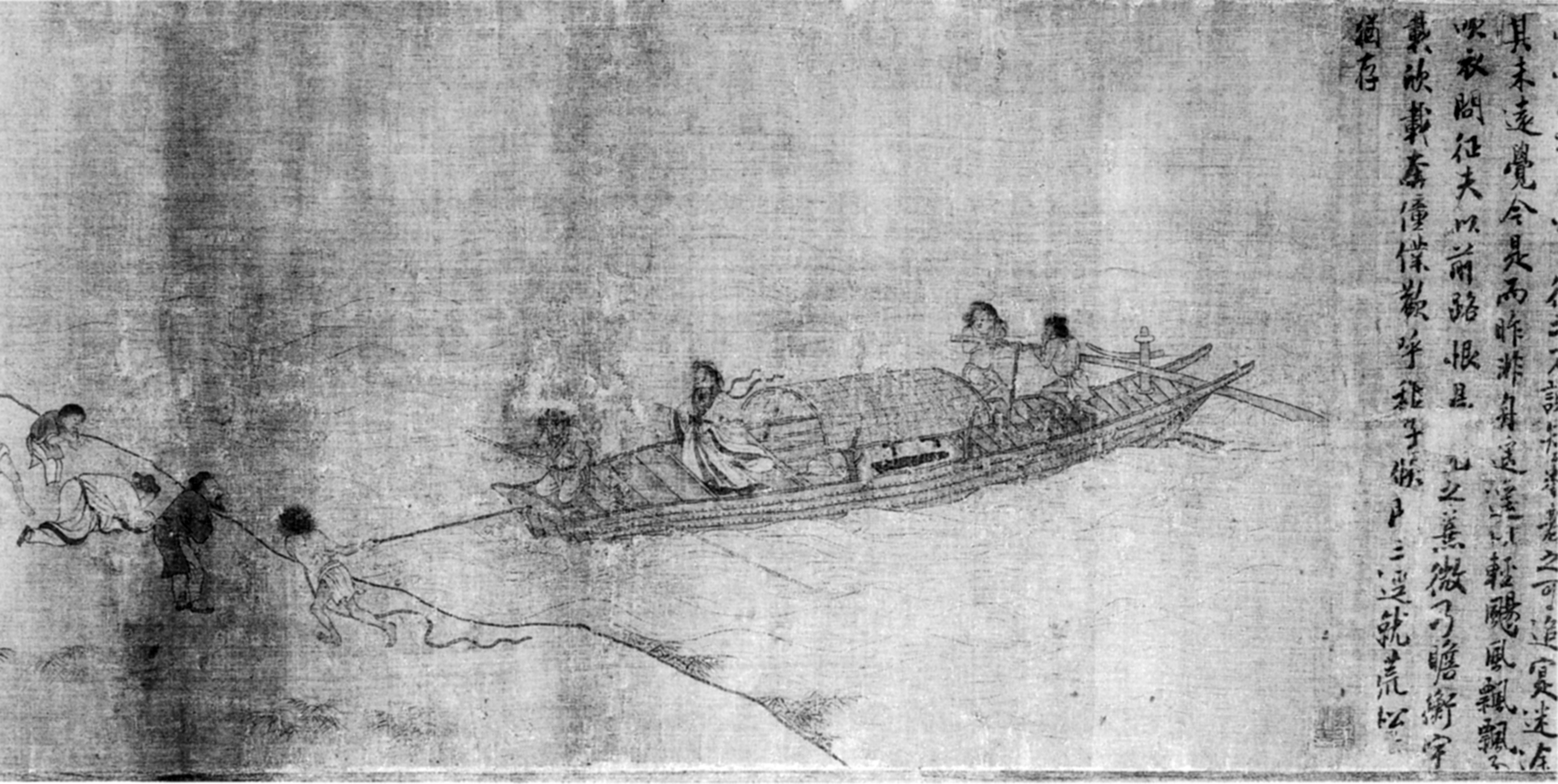
Anon. (copy after Li Gonglin’s painting), Tao Yuanming Returning to Seclusion, 12th c (Song dyn.) handscroll. Freer Gallery of Art. Section I – Illustrating Tao Qian returning home in a boat, his sashes fluttering in the wind (iconography of a recluse). Calligraphy on the right is the text of the poem “The Return” that the image is illustrating.
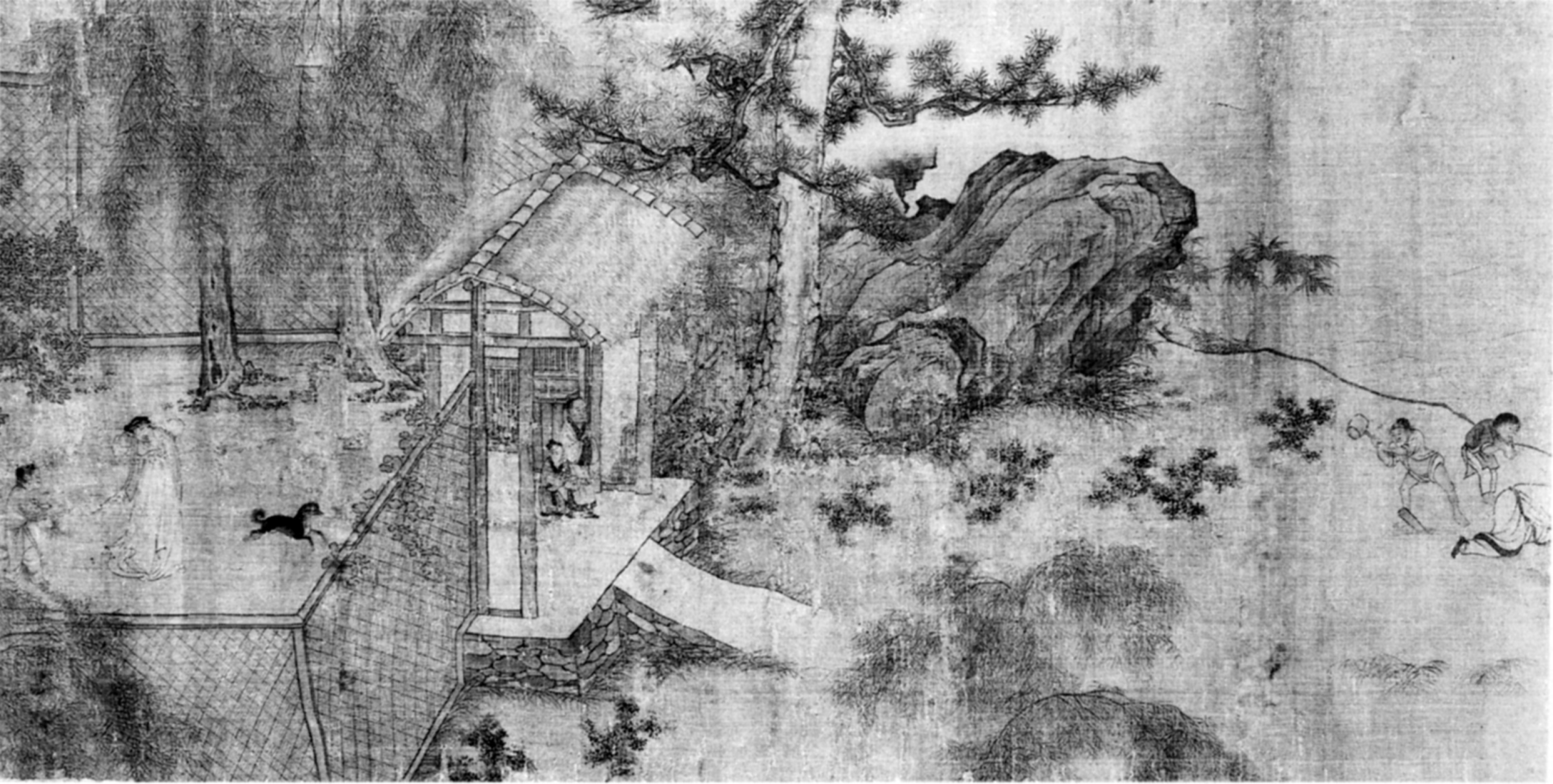
Anon. (copy after Li Gonglin), Tao Yuanming Returning to Seclusion, 12th c. (Song dyn.) handscroll. Freer Gallery of Art. Section II: his wife and children awaiting his return, with wife fixing her hair in the courtyard.
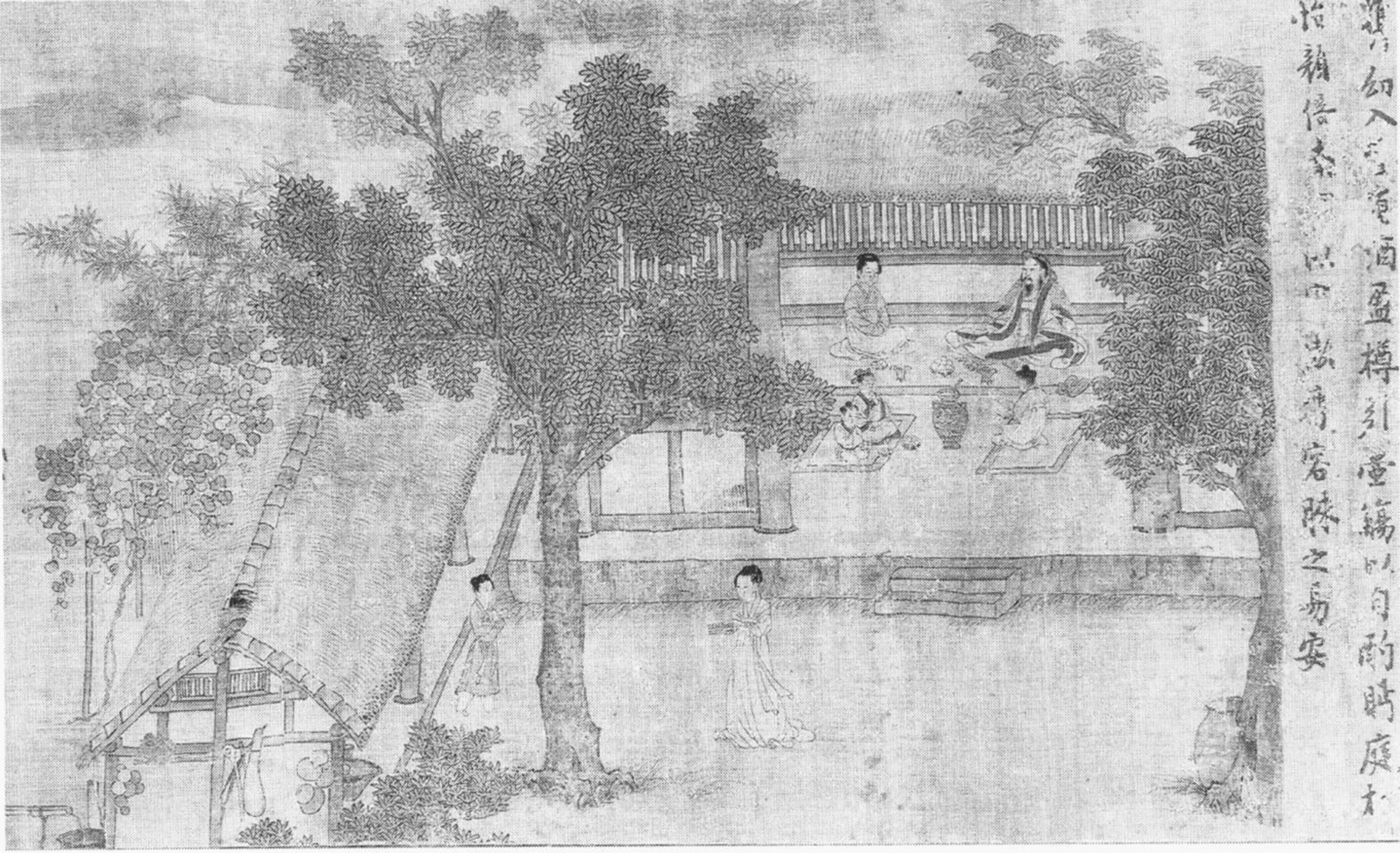
Anon. (copy after Li Gonglin), Tao Yuanming Returning to Seclusion, 12th c. (Song dyn.) handscroll. Freer Gallery of Art. Section III: Tao Qian seen at home in his hall, enjoying the company of his wife and children.
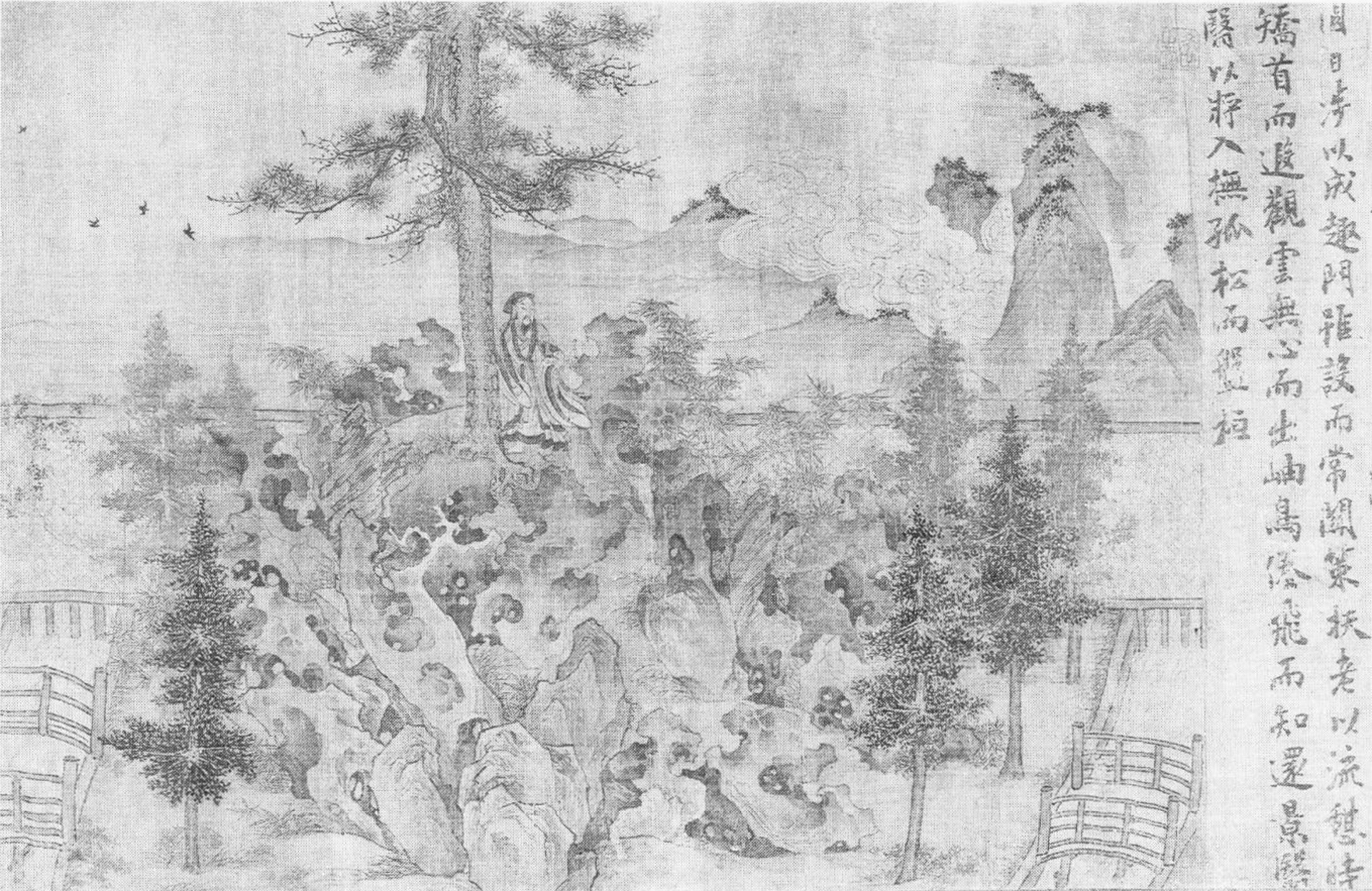
Anon. (copy after Li Gonglin), Tao Yuanming Returning to Seclusion, 12th c. (Song dyn.) handscroll. Freer Gallery of Art. Section IV: Tao Qian appearing in his garden (a recreation of a later, 12th c imagining of an early garden), with the poet standing on large rockery in a private garden, with fence, bridges, and trees. Pine tree symbolize his steadfastness (leaves of pines do not wither in winter); homing birds and white clouds echo motifs found in Tao’s poetry (what do they represent?).
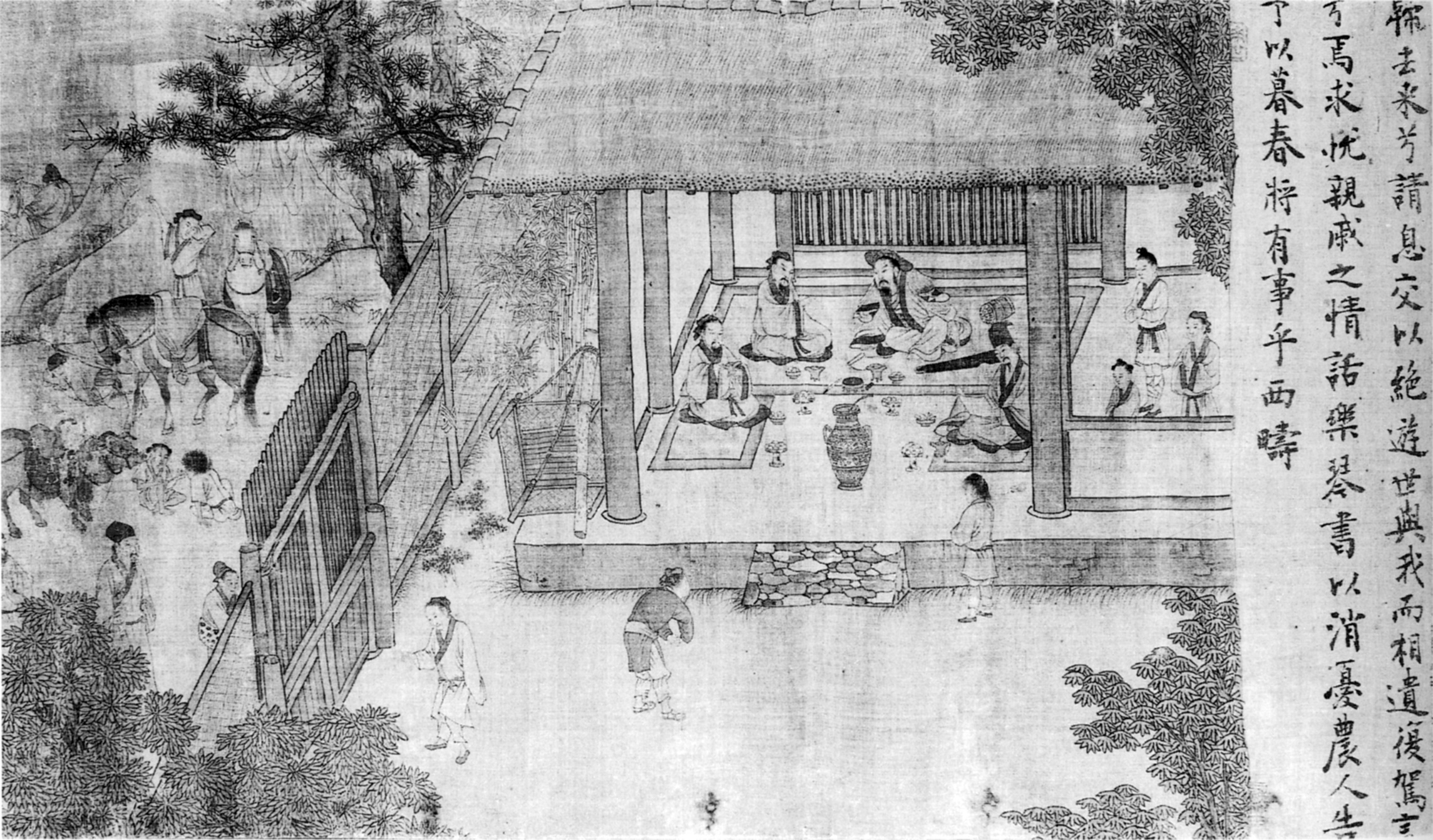
copy after Li Gonglin), Tao Yuanming Returning to Seclusion, 12th c. (Song dyn.) handscroll. Freer Gallery of Art. Section V: showing Tao at home drinking wine with farmers, while officials on horses (who are here to invite him back to service) are blocked by the thatched gate (rustic gate symbol of home of recluses) to the left of the pictorial space, symbolizing the poet’s rejection of the official life.
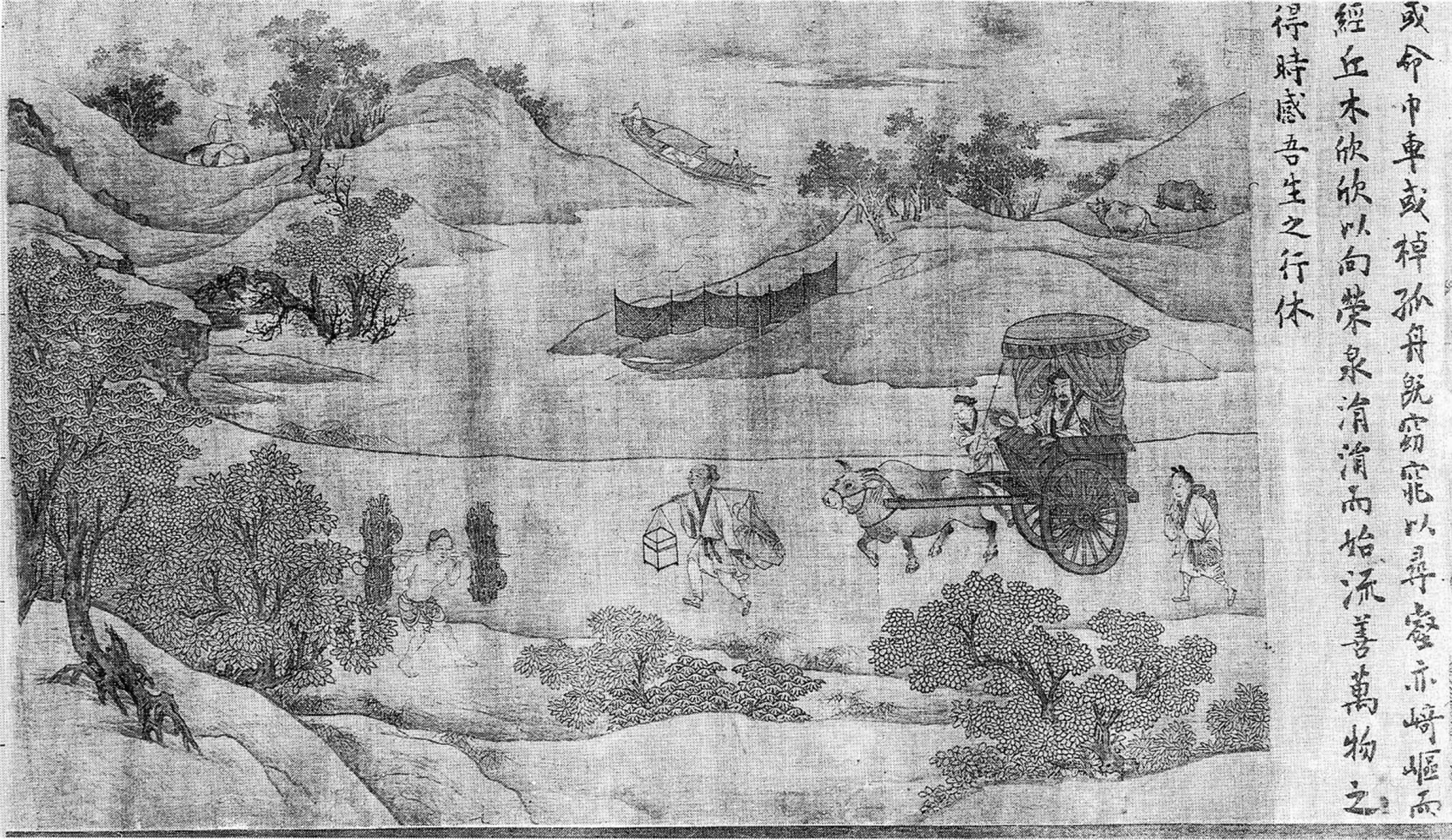
Anon (copy after Li Gonglin), Tao Yuanming Returning to Seclusion, 12th c. (Song dyn.) handscroll. Freer Gallery of Art. Section VI: showing Tao wandering in nature (in carriage, here depicted as a gentleman farmer with servants), encountering a woodcutter and a fishermen – both symbols of recluses.
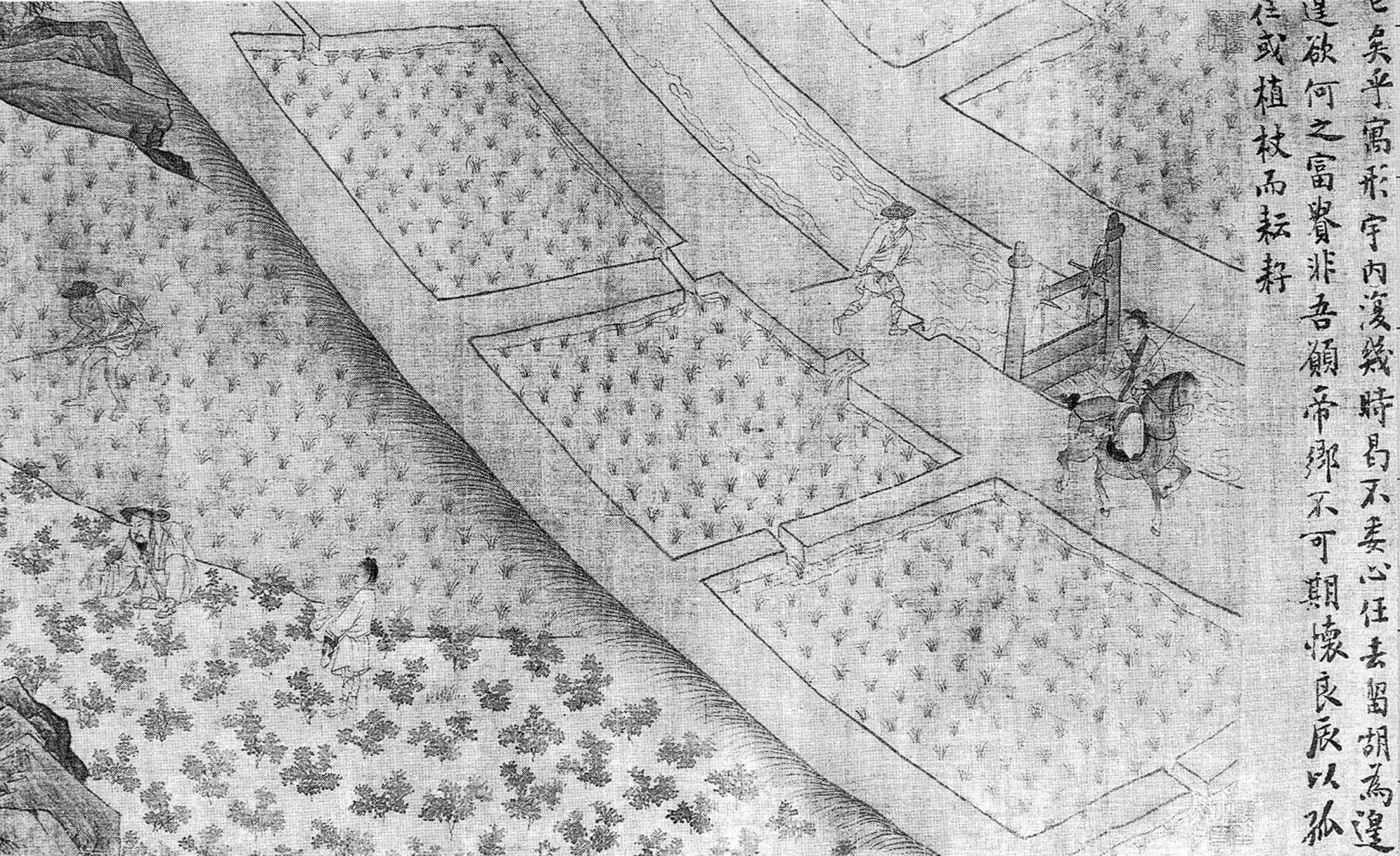
Anon. (copy after Li Gonglin), Tao Yuanming Returning to Seclusion, 12th c. (Song dyn.) handscroll. Freer Gallery of Art. Section VII: shows Tao Qian at bottom right corner, farming (with an attendant waiting on him), and an official, on horse back, coming to seek him for office.
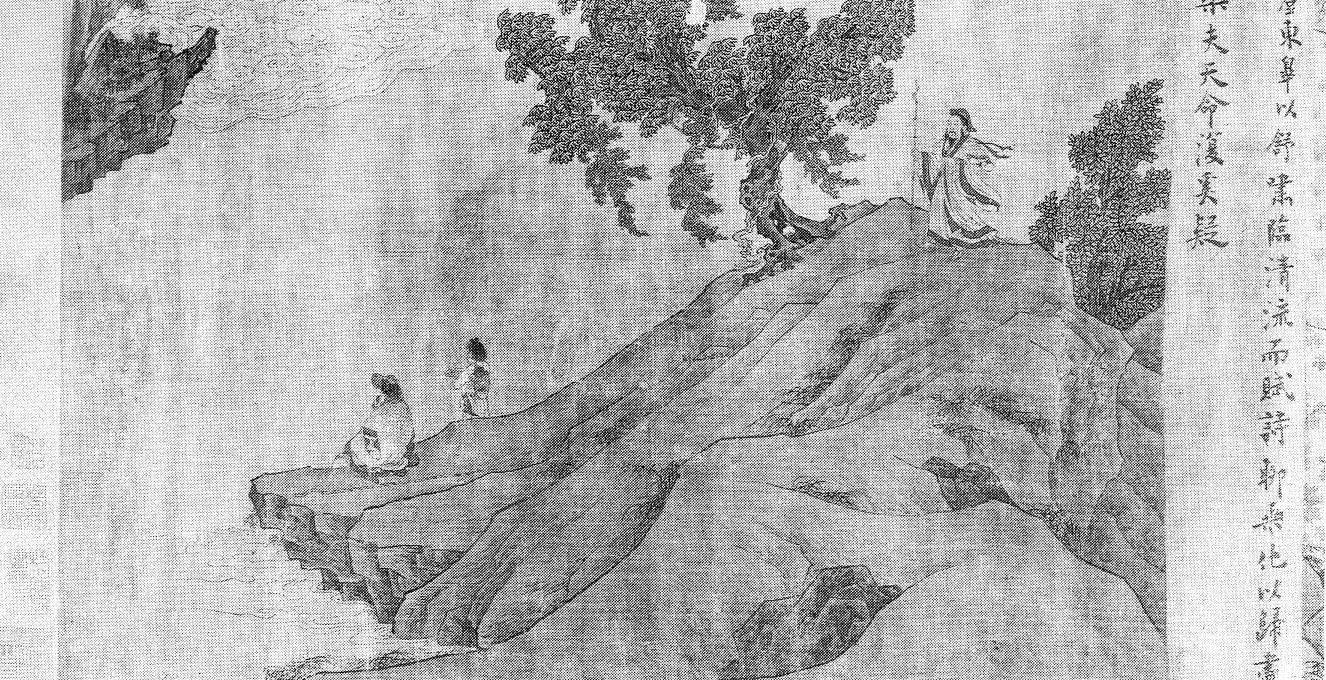
Anon. (copy after Li Gonglin), Tao Yuanming Returning to Seclusion, 12th c. (Song dyn.) handscroll. Freer Gallery of Art. Section VIII: illustrating end of rhapsody, where Tao Qian concludes by saying he would spend his days in retirement ascending to Eastern hills to let out a long whistle, or to sit by a clear stream composing poetry. In the scene, we see Tao Qian on top of a hill facing us, and then him again with his back to us, while sitting by a stream, with the white clouds (representing purity of ancient times), rolling in .

Li Gonglin, 11th c. Five Tribute Horses. Northern Song dynasty handscroll, finely controlled, supple-ink outline drawing without color on paper. (baimiao technique) [26.9cm h, 204.5cm w. National Palace Museum, Taipei.] Most accurate representation of Li Gonglin style to date.
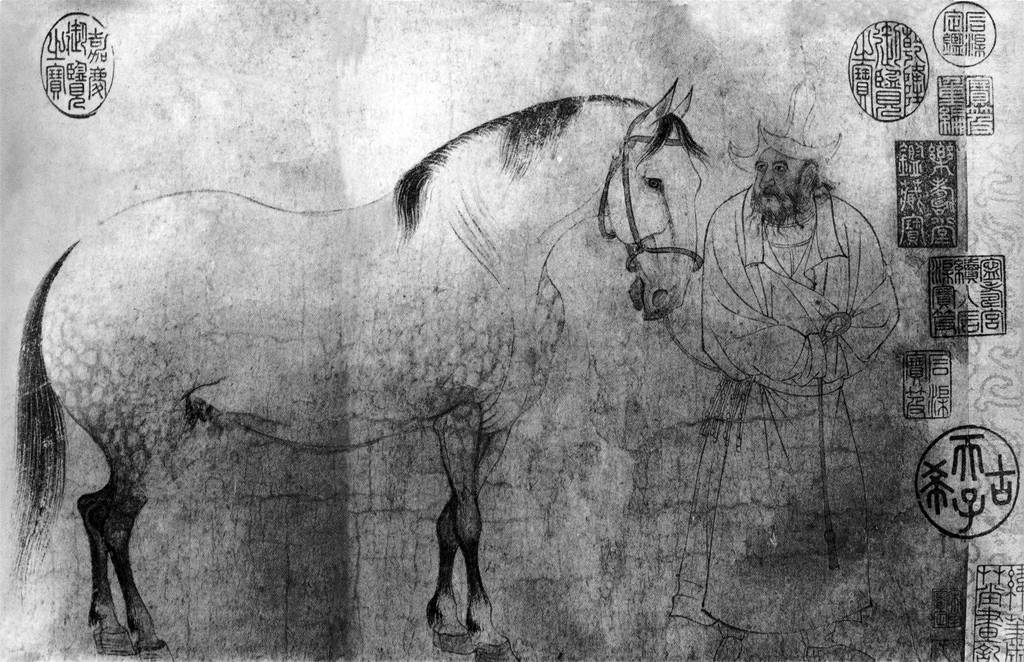
Li Gonglin, (11th c) Five Tribute Horses. Section I. Northern Song dynasty. Handscroll, outline drawing without colour on paper.
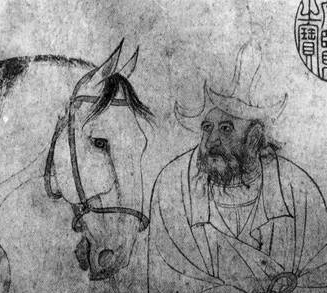
Detail of faces in section I, Li Gonglin, (11th c) Five Tribute Horses. Section I. Northern Song dynasty. Handscroll, outline drawing without color on paper (baimiao technique). Note the fine, controlled outline, using softness of brush to convey texture, and most importantly, one finds an ability to convey the spirit of the horse and the groom. This man seems to be non-Chinese.
Detail of Li Gonglin, 11th c. Five Tribute Horses.
Northern Song dynasty handscroll, outlinedrawing without colour on paper. Notice how the horse seems to mirror the personality of its groom. (The spirits of both the groomsman and the horse are conveyed so well!) The calligraphy on the right refers to the horse before to its rght, stating when the horse was presented to the court, what type of hose it was, its age, and height.
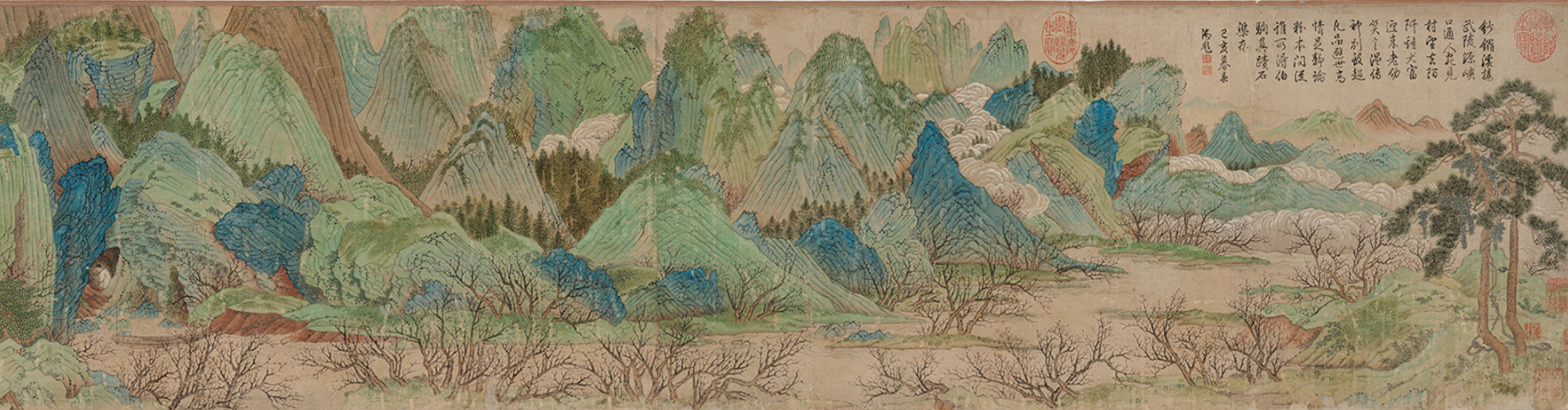
Qiu Ying (仇英, ca. 1494-1552). Peach Blossom Spring (桃花源圖), section I. (Depicting fisherman leaving his boat and entering the cave to the left of this scene). Ming Dynasty (1368-1644). Handscroll, ink and color on paper. The painting is painted in the blue and green style of court painting, also the colors of Daoist immortal realm. River and paths will lead us in and out of the handscroll. 3
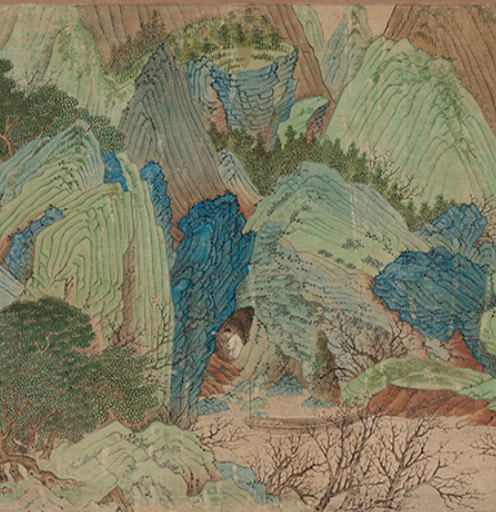
Detail of scene 1, Peach Blossom Spring (桃花源圖), section I, as the fisherman is about to enter the small opening in the mountain. (Attributed to) to Qiu Ying (仇英, ca. 1494-1552) Ming Dynasty (1368-1644). Handscroll, ink and color on paper. The painting is painted in the blue and green style of court painting, also the colors used to paint the Daoist immortal realm.
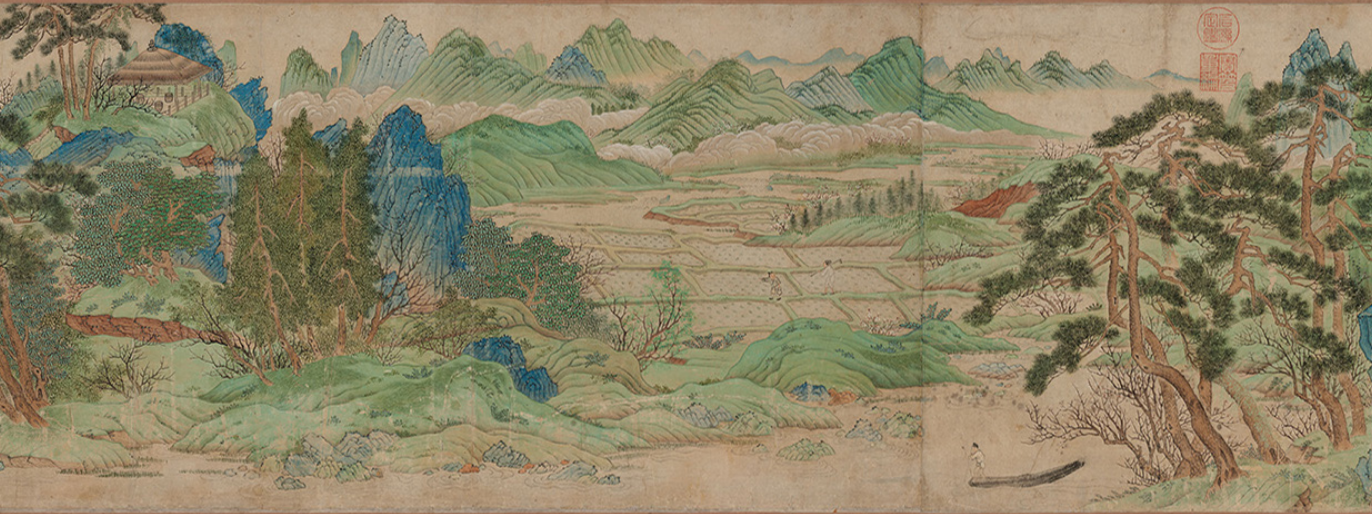
Qiu Ying (仇英, ca. 1494-1552. Peach Blossom Spring (桃花源圖), section II (Depicting fisherman entering the agrarian utopia, with orderly fields and crisscrossing paths. This space is encircled by mountains and white clouds, symbolizing a pure realm; the mountains are painted in the blue and green (court paintings and often used to depict Daoist immortal realms)). Ming Dynasty (1368-1644).
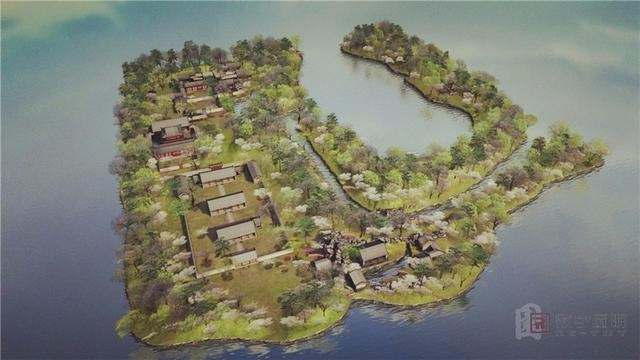
Digital Reconstruction of “ Spring Scenes from Wuling,” one of the sites in the Imperial Garden of Perfect Brilliance, Qing Dynasty/ 17th c. Beijing, China.
Note: the fisherman in Tao Qian’s “Peach Blossom Spring” was a man from Wuling. So this site alluded to the peach blossom spring utopia. One can only enter by boat, as you can see the canal to the east, leading one to the main compound (an imperial study/ library with a courtyard to the south, leading to smaller buildings (studies) in the north –
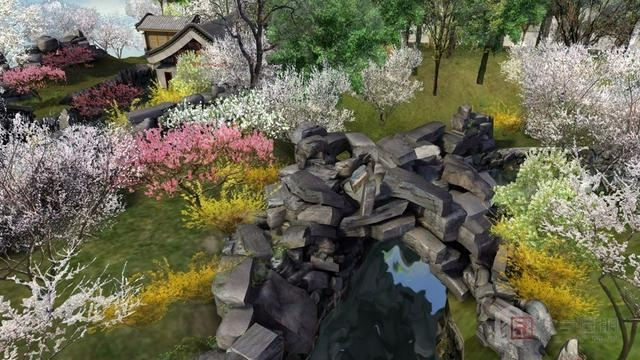
Digitally reconstructed cave entrance to the site of “Spring Colors in Wuling,” Imperial Garden of Perfect Brilliance, Qing Dynasty/ 17th c. Beijing, China. Entrance– narrow opening that opens up to a open vista. It is the only way to reach this compound.
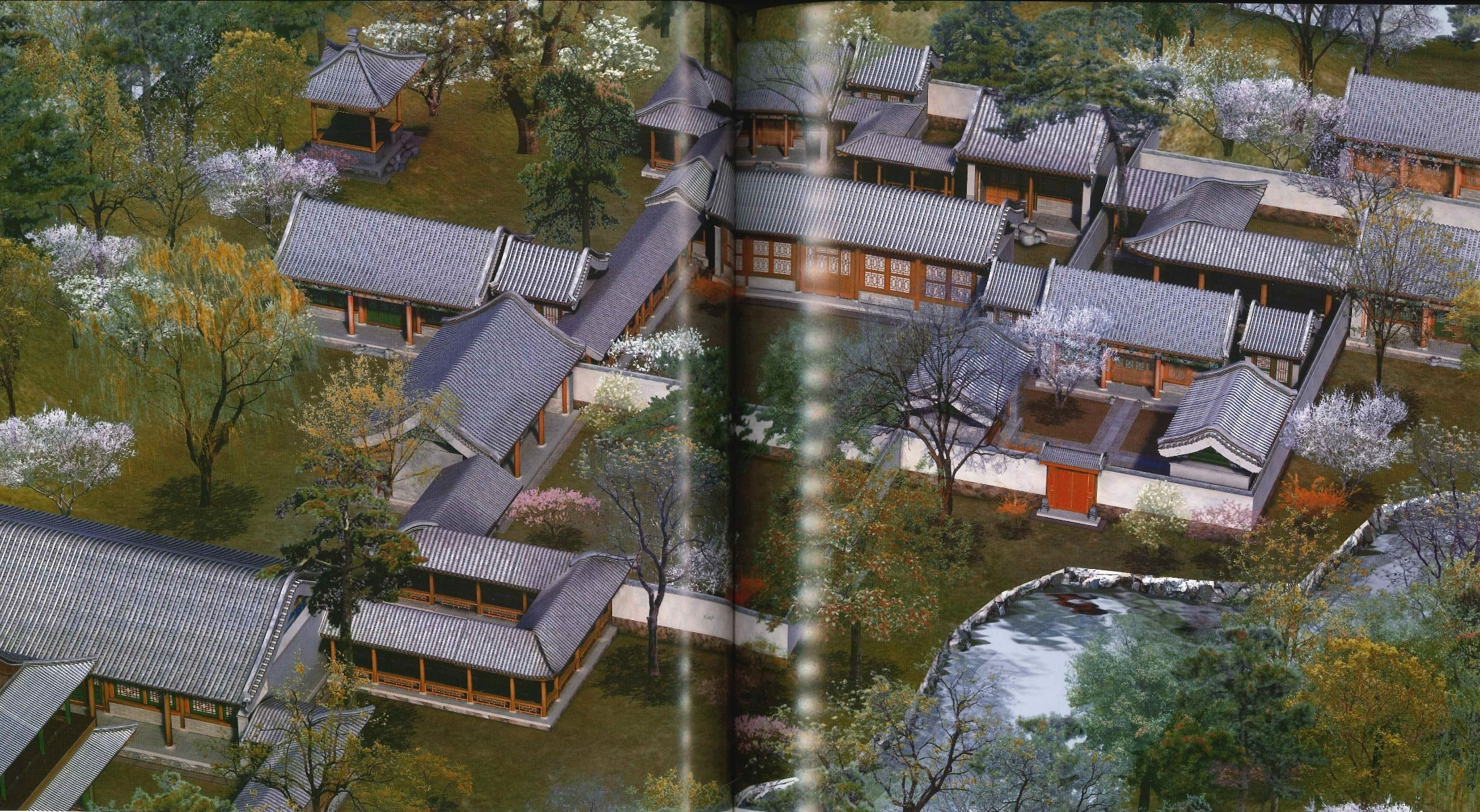
Digital Reconstruction of the courtyard from“ Spring Scenes from Wuling,” one of the sites in the Imperial Garden of Perfect Brilliance,
Qing Dynasty/ 17th c. Beijing, China. This courtyard has studies which served as Emperor Qianlong’s study in his youth. The group of buildings in the north were all unpainted and uncarved, keeping the original color of the wood, evoking the simplicity of village life in Tao Qian’s Peach Blossom Utopia.
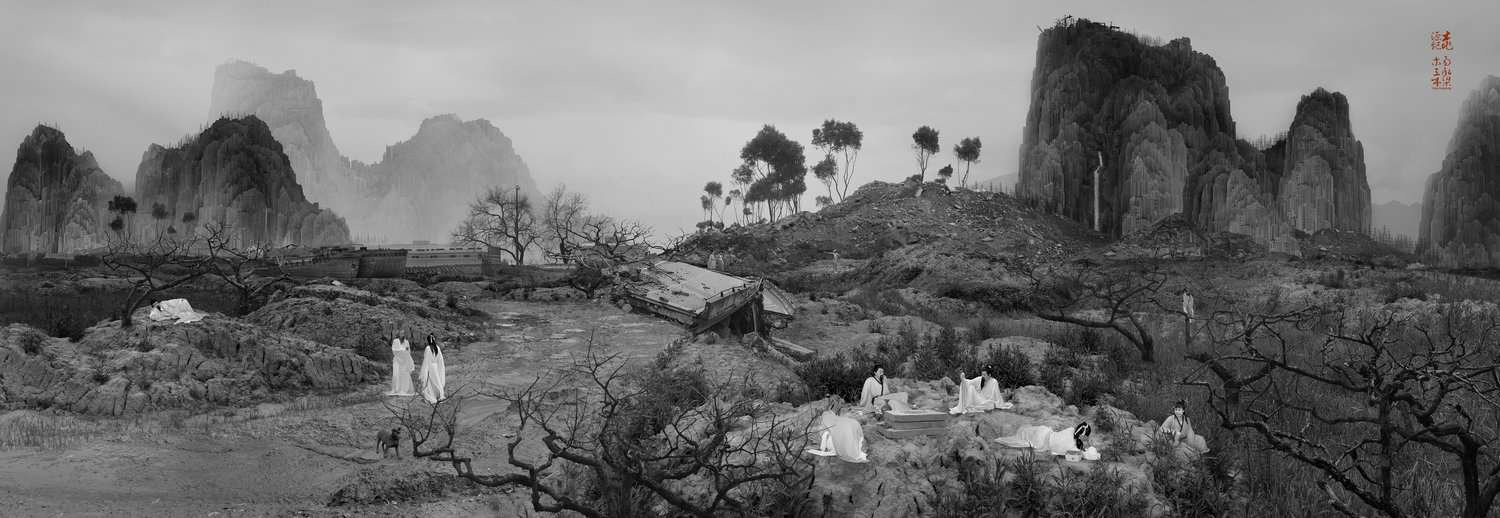
From Artist’s website: “Peach Blossom Colony continues further in style, from a far look, the scene and the people seem to be peaceful, yet when the audience look closer, they will find much more metaphorical elements that signify a post- industrialization modern world we live in.”
Yang Yongliang (b. 1980 ) . Peach Blossom Colony, section 1. 2011. Inkjet print. 58 x 160 cm. (22.8 x 63 in.) Detail of section of fisherman entering peach blossom utopia
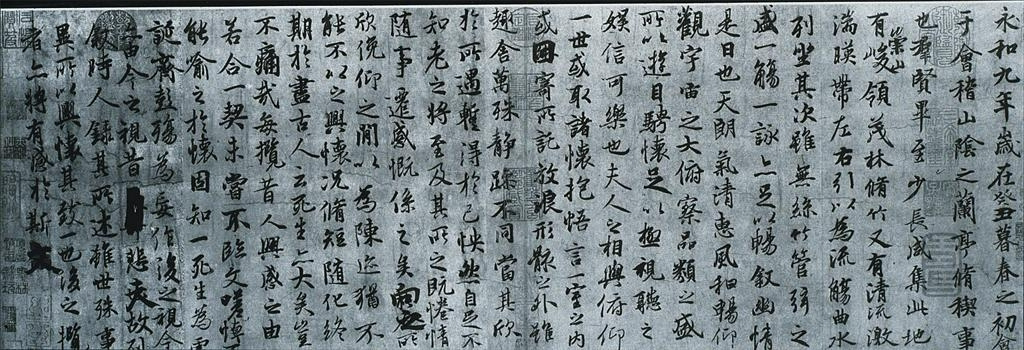
Wang Xizhi, 321-379/ Six Dynasties, “Preface to the Gathering at Orchid Pavilion.“ Tang dynasty (618-906 AD) copy of the Shenlong version (353AD), where Wang wrote the preface to the poetry collected during the outing. Beijing Palace Museum. One of the most famous piece of calligraphy in Chinese art history.
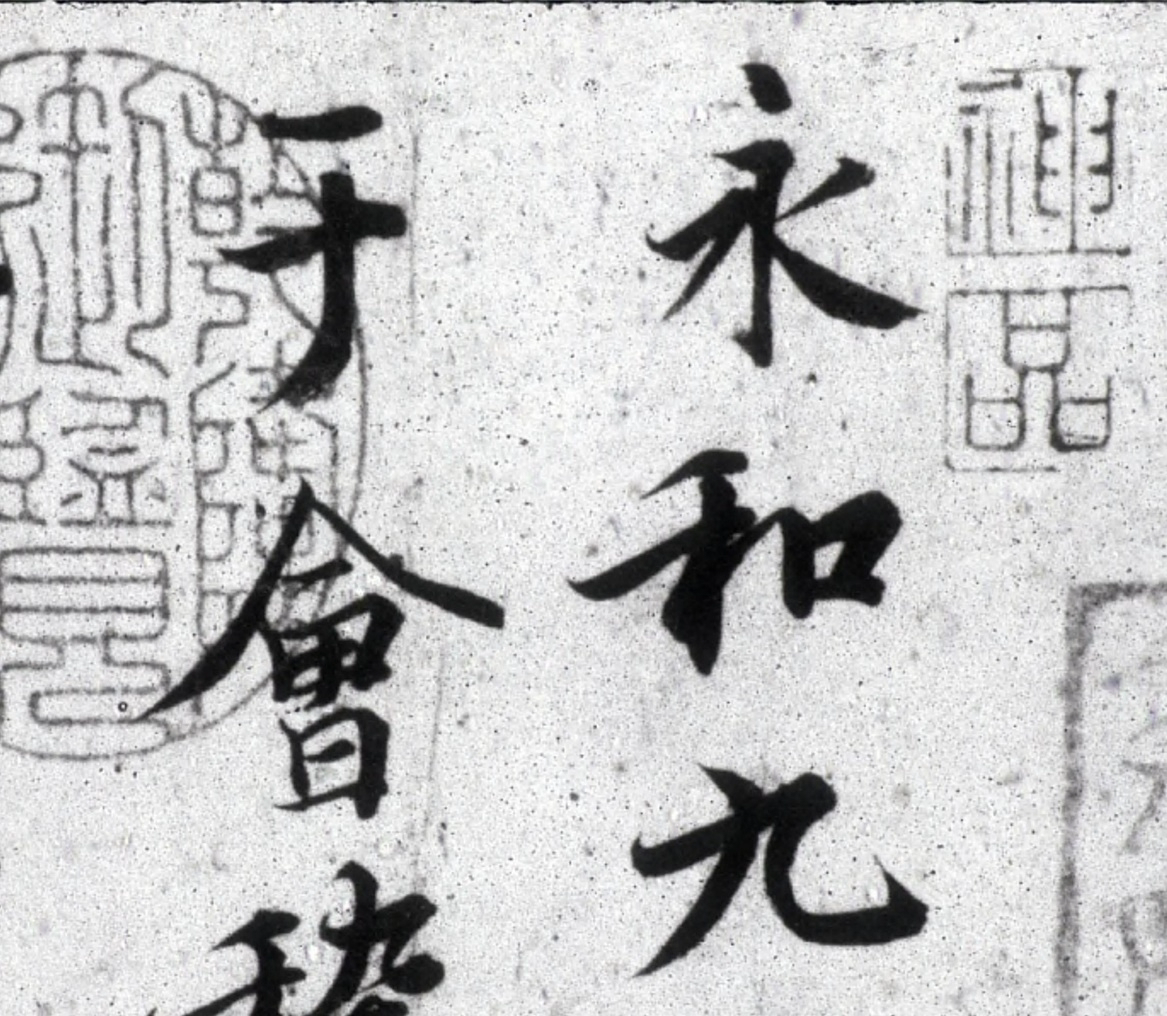
Wang Xizhi (321-379), detail of first section (R) from “Preface to the Gathering at Orchid Pavilion.“ Tang dynasty (618-906 AD) copy of the Shenlong version (353AD). Beijing Palace Museum. Note the calmand elegance of the characters in the opening, epsecially the first two lines that reflect the serenity expressed in the text. The first character, 永 (“everlasting”), shows smooth. elegant, brush-strokes that are balanced and serene, reflecting on the mood of the textual passage.
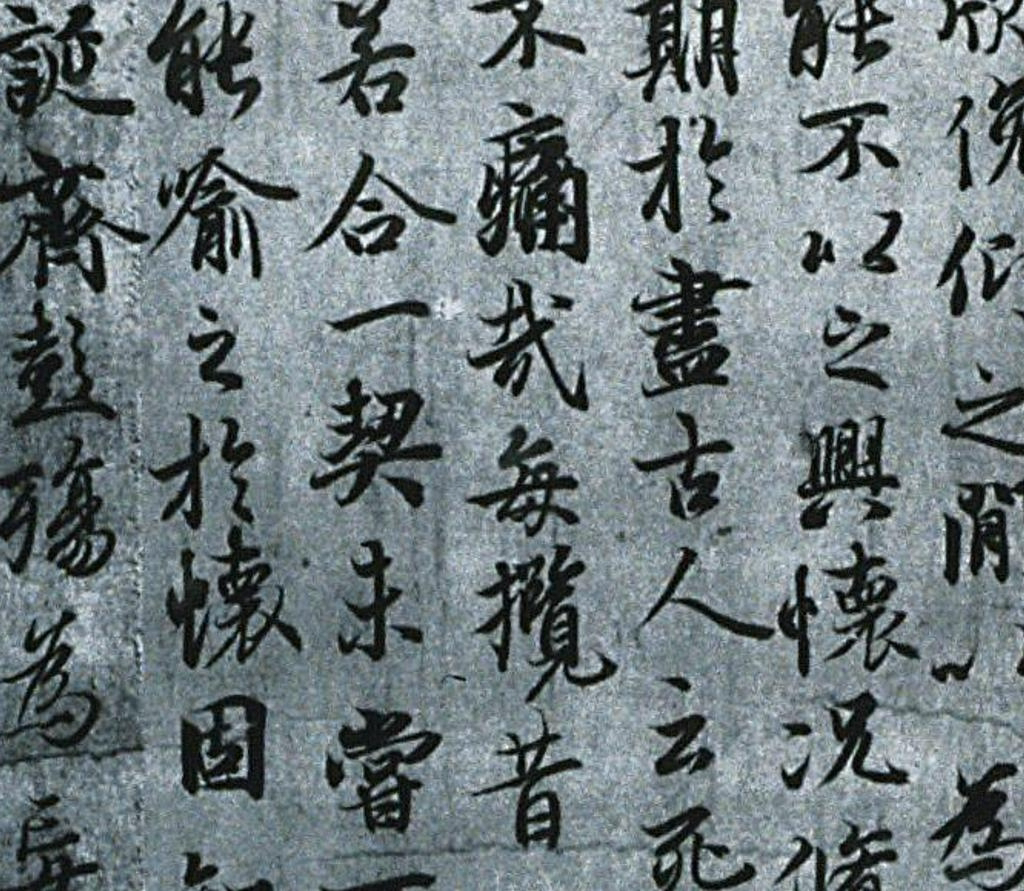
Wang Xizhi (321-379), detail of the latter section (L) from “Preface to the Gathering at Orchid Pavilion.“ Tang dynasty (618-906 AD) copy of the Shenlong version (353AD). Beijing Palace Museum. Note the extreme passion and pain and knarled brushstrokes with which the character “pain” (tong 痛) is written, reflecting on the sadness expressed in the content of the text.
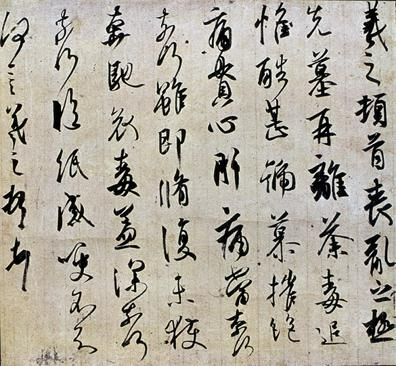
Ancestral tomb in north damaged and destroyed
- Felt Helpless: cannot go see it.
- Hopelessness and grief.
- Emotions reflected in wild and bold strokes.
- Circled character, “pain” (tong4) is similar to one in the “Preface to the Orchid Pavilion.”
The Letter of Loss and Confusion 王羲之《丧乱帖》 Original: by Wang Xizhi, Copied in Tang dynasty, 7th–8th century.
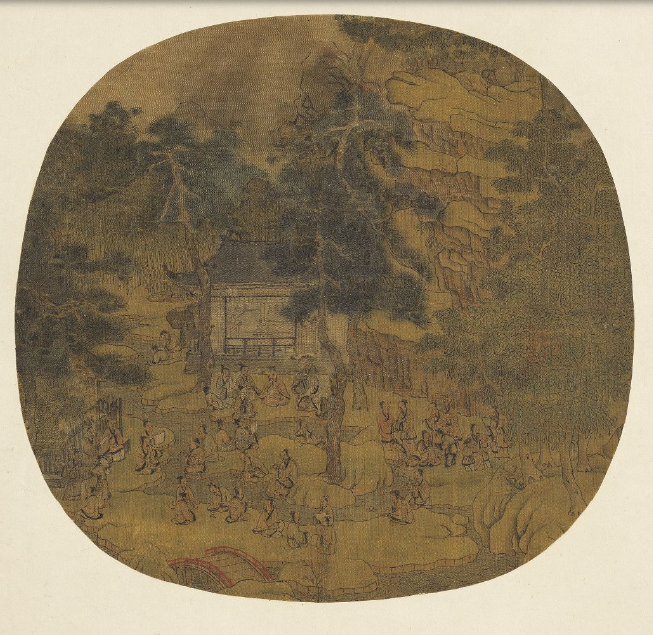
(Attrib. to) Guo Zhongshu, an artist known for his architectural paintings (910-977/ Five Dynasties). Orchid Pavilion and Meandering Stream. Five Dynasties (10th c.) National Palace Museum, Taiwan. Shows a group of men seated by a meandering stream in a fan format.
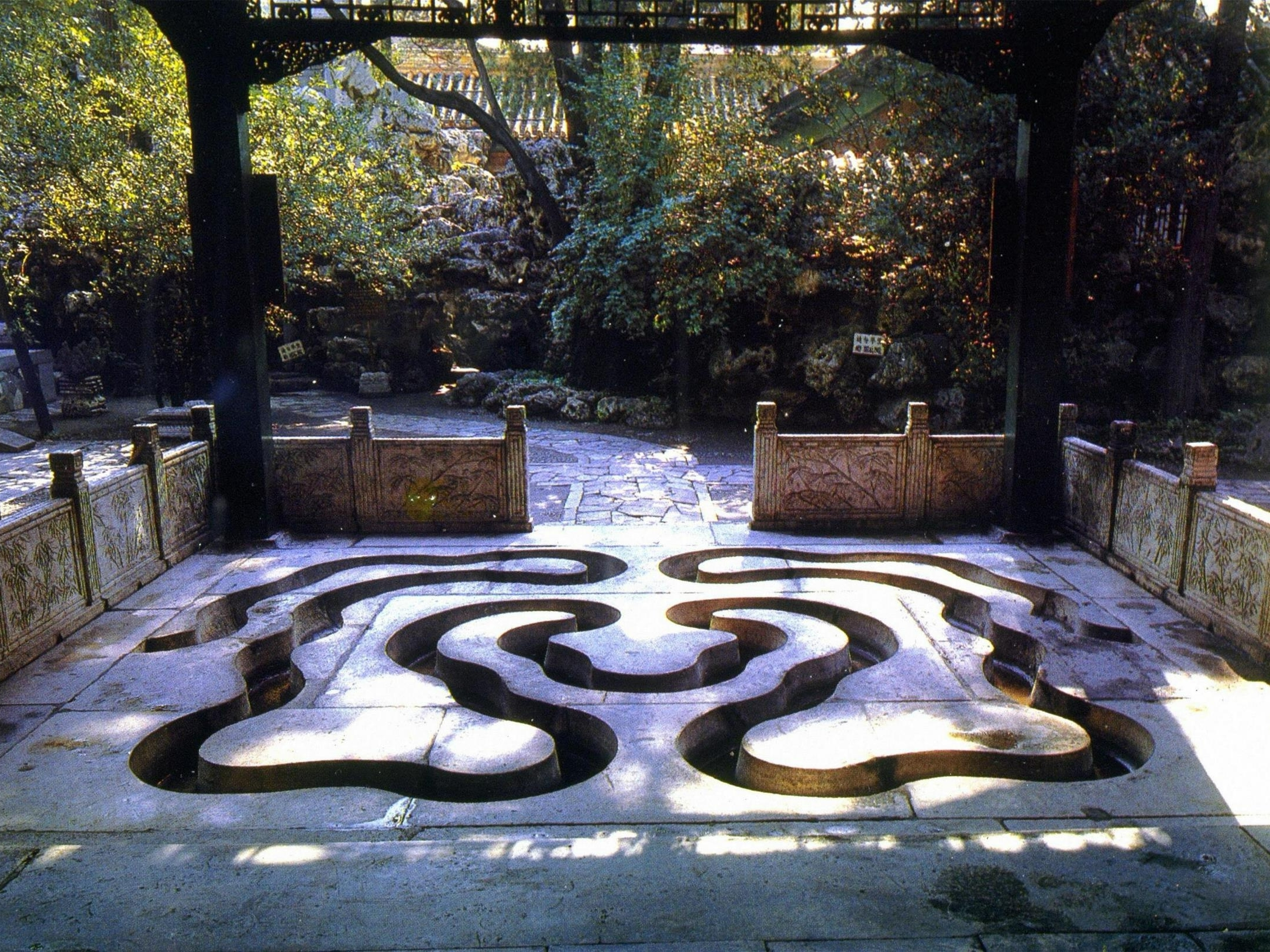
Pavilion of Spring Purification, in the first courtyard of Emperor Qianlong’s Retirement Garden (Spring section). Forbidden City, Beijing. 17th-18th c. (Qing dyn.) Alluding to the spring purification festival mentioned in the “Preface of Orchid Pavilion.” The incised curving pattern is to be filled with water and float wine cups, alluding to this ritual that takes place during the spring purification festival. This has become an important element in Chinese garden construction.
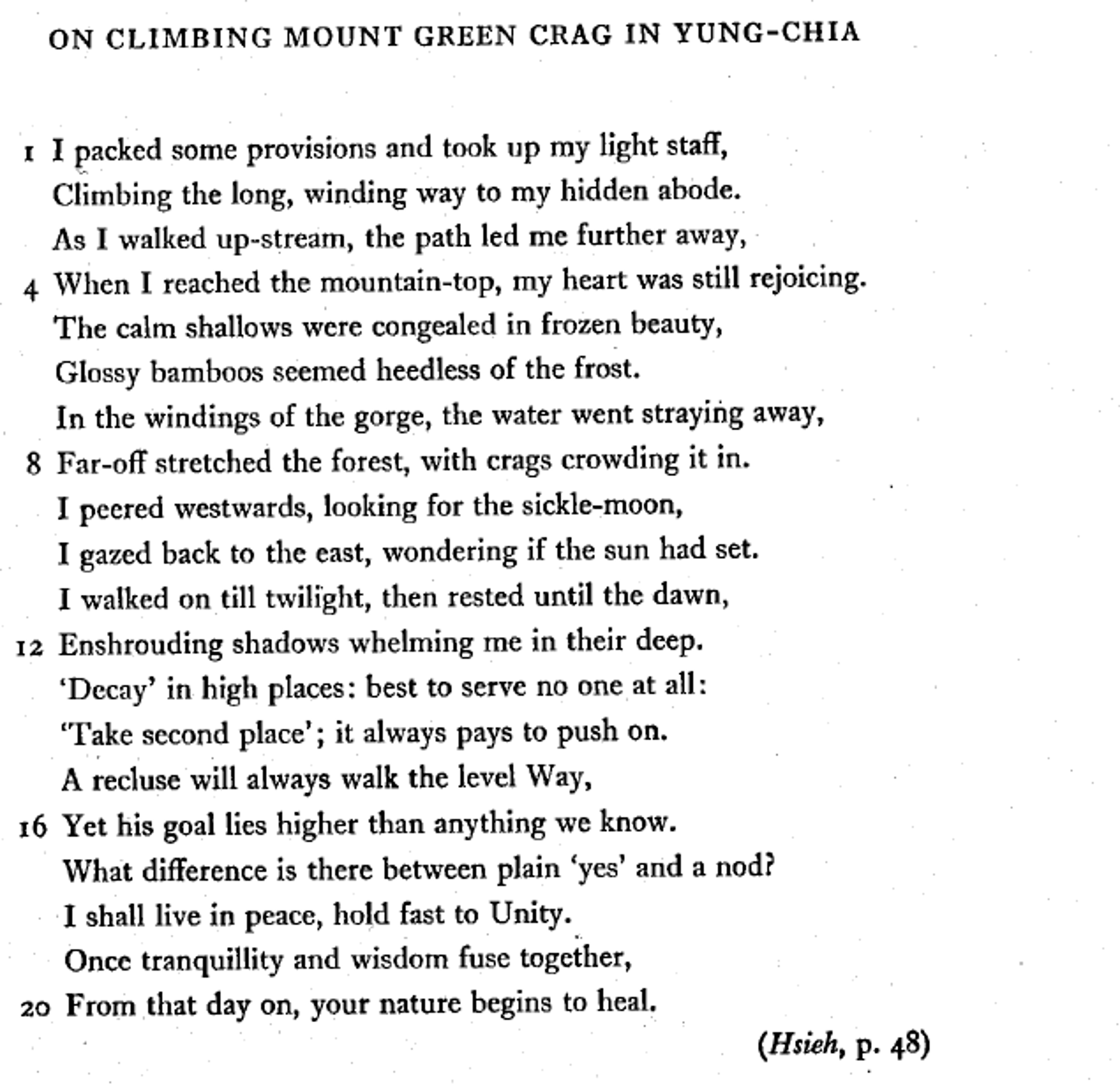
Xie Lingyun (385-433 AD), “On Climbing Mount Green Crag in Yung-chia.” Six Dynasties.
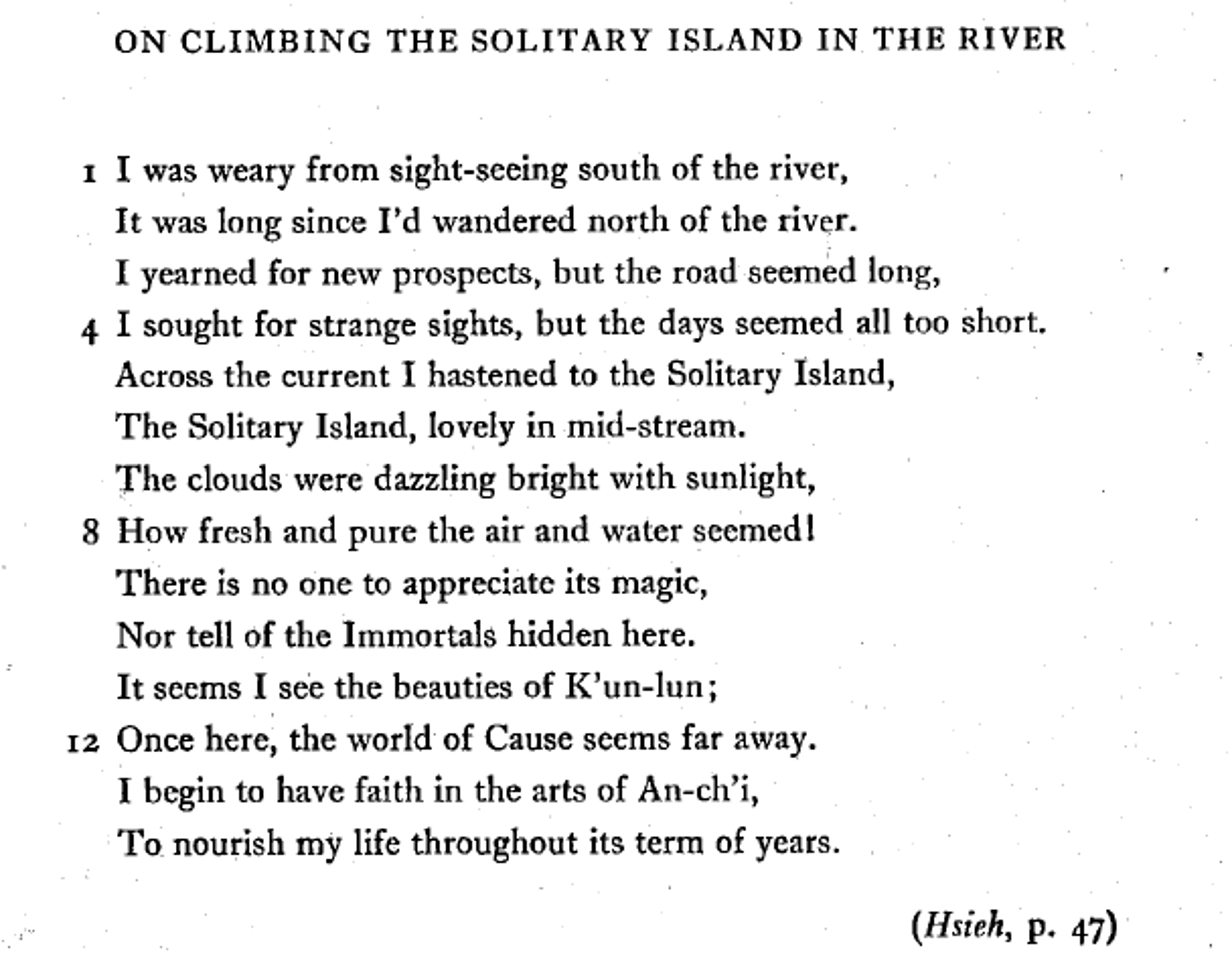
Xie Lingyun (385-433 AD) , “On Climbing the Solitary Island in the River.” Six Dynasties. Note the poet opens with an itinerary of his trip, voices his desire for “new prospects” and “strange sights.” He then finds this Solitary Island, dazzling like an isle of Kunlun.
“Thus, I live at leisure, regulating my vital breath, brandishing the wine cup, and sounding the lute. As I unroll paintings and face them in solitude, while seated I plumb the ends of the earth. Without resisting a multitude of dangers, I simply respond to the uninhabited wilderness, where grottoed peaks tower on high and cloudy forests mass in depth. The sages and virtuous men shed reflected light from the distant past, and a myriad delights are fused into their spirits and thoughts. What then should I do? Freely expand my spirit, that is all. What could be placed above that which expands the spirit?”
Zong Bing 宗炳 (375-443 AD/ Six Dynasties), section from “Introduction to Painting Landscape.”
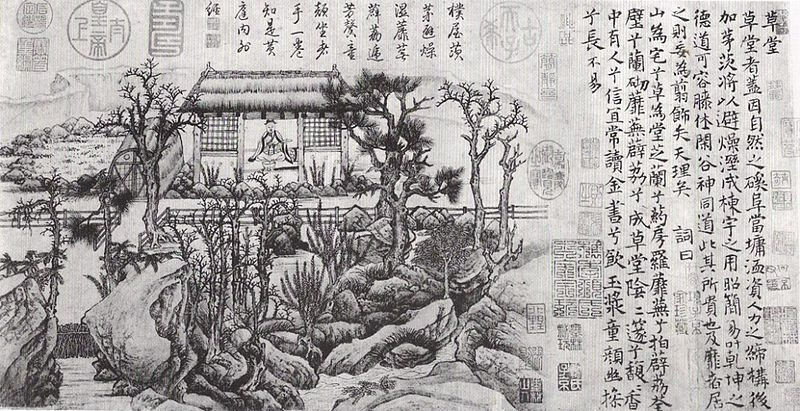
Lu Hong (fl. ca. 7th-8th c.), Ten Views from a Thatched Lodge, Leaf 1: Thatched Hall. Tang dynasty. Handscroll, black ink on paper, 29.4 x 600 cm . National Palace Museum, Taiwan. Copy of a 9th c. original. An archaic depiction of a scholar in his garden (frontal pose), facing an archaic style garden, where large trees sit on smaller hills. These activities become those enjoyed by scholar-officials in retirement, relating to nature.
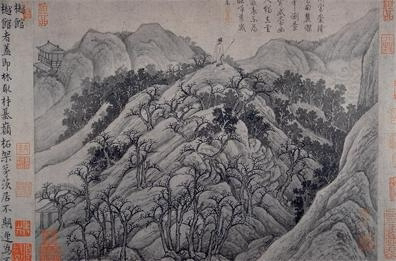
Lu Hong (fl. ca. 7th-8th c.), Ten Views from a Thatched Lodge, Leaf 2. Tang dynasty. Handscroll, ink on paper, 29.4 x 600 cm . National Palace Museum, Taiwan. Copy of a 9th c. original.
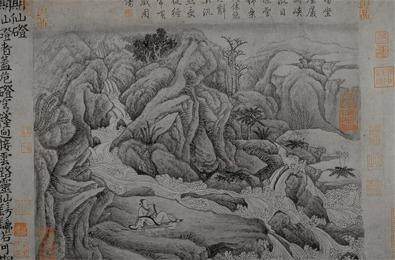
Lu Hong (fl. ca. 7th-8th c.), Ten Views from a Thatched Lodge, Leaf 5: Scholar sitting on a rock by a creek, whistling. Tang dynasty. Handscroll, ink on paper, 29.4 x 600 cm . National Palace Museum, Taiwan. Copy of a 9th c. original.
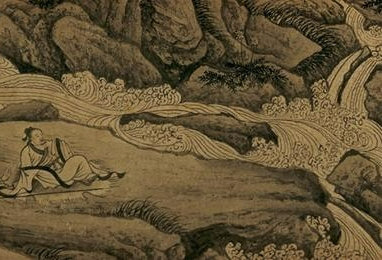
Detail of Scene 5: Scholar sitting by water, whistling. Lu Hong (fl. ca. 7th-8th c.), Ten Views from a Thatched Lodge. Tang dynasty. Handscroll, ink on paper, 29.4 x 600 cm . National Palace Museum, Taiwan. Copy of a 9th c. original
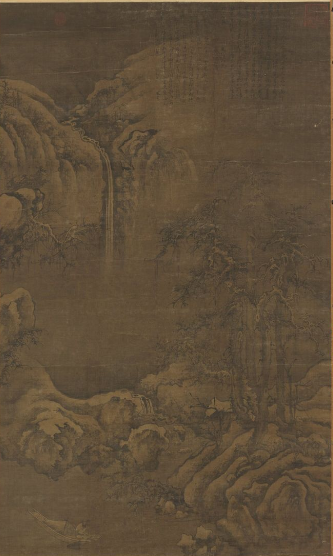
Li Cheng (919-967), Five Dynasties. Fishing Boat on a Wintry River. Ink on silk. 170x101.9 cm. National Palace Museum, Taipei. This was probably done from a later painter imitating Li Cheng’s style.
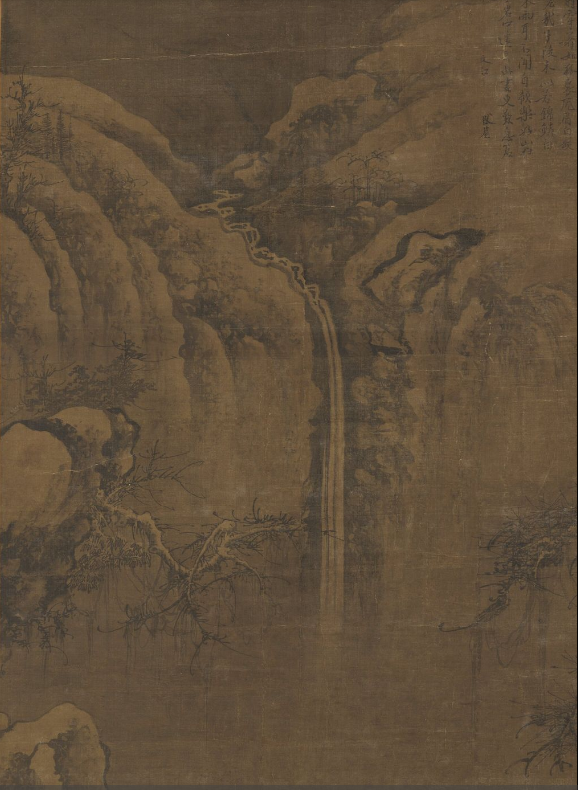
Li Cheng (919-967), Five Dynasties. Detail of the high mountains and the cold waterfall, from Fishing Boat on a Wintry River. Ink on silk. 170x101.9 cm. National Palace Museum, Taipei. The waterfall leads our eyes through the snow covered peaks and downward to the mid and foreground; the thin, pale stream creates a quiet, cold stream that pierces through the snow. Note how the painter renders snow on the mountains and the pines through monochrome ink.
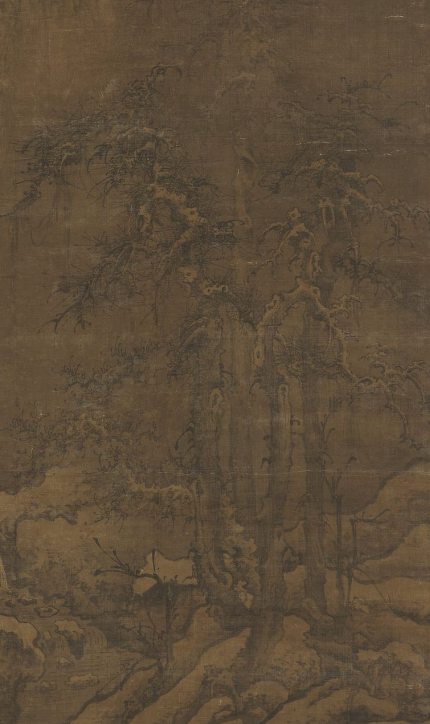
These elegant trees with “crab-claw branches” are typical of Li Cheng-style trees: the trunks are long and elegant, painted with lighter wash, but the branches are thin and knarled, drawn with fast, drier ink in angular strokes, resembling “crab-claws.” (see detail above, not required for midterm) The trees’ bare, brittle look and the angular branches reinforces a sense of coldness and desolation. Later Guo Xi is said to have imitated Li Cheng’s trees.
Details of the pine trees in the foreground in Fishing Boat on a Wintry River, attributed to Li Cheng (919-967), Five Dynasties. Ink on silk. 170x101.9 cm. National Palace Museum, Taipei.
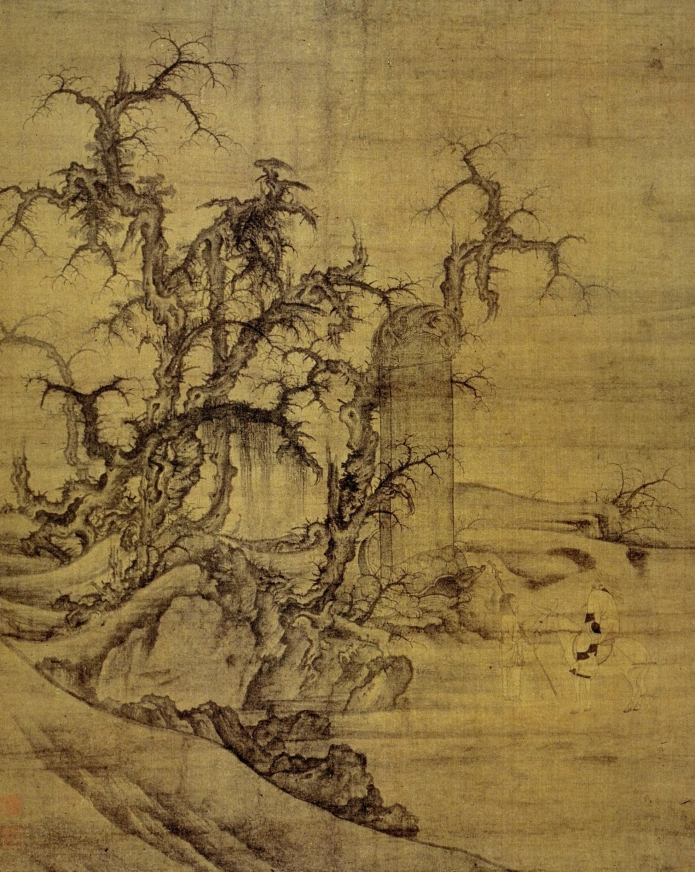
Side of the stele has is inscribed with the text, “Wang Xiao figures, Li Cheng trees and rocks.” Thus we know that Li Cheng was responsible for the trees and the landscape, while Wang Xiao painted the figure on the mule. This scene illustrated the historical tale of Cao Cao and his advisor Yang Xiu of the Wei dynasty encountering a memorial stele for Cao E of the Han dynasty. While Yang immediately understood the stele, Cao Cao had to reread it again. Idea of the man reading about the life of a person passed in a wintry landscape. Note the trees painted in Li Cheng style.
Li Cheng and Wang Xiao, Reading the Memorial Stele. Five Dynasties, mid 10th century
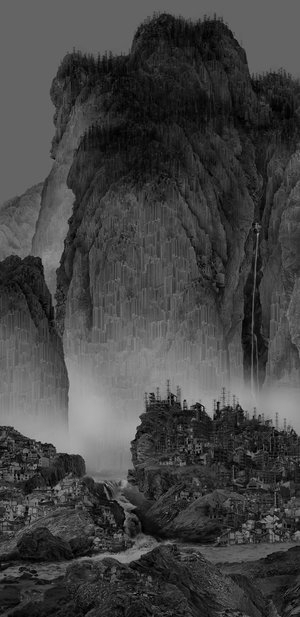
From Yan’s website: “In Artificial Wonderland II (2014), there are digital replicas of two Song Dynasty master paintings, namely Travelers Among Mountains and Steams (Fan Kuan) and Wintery Forest in the Snow (anonymous). . . . The 2014 series marks a step forward in terms of digital technique--the piece is larger than ever and enriched with tremendous detail images. Also, Yang constructed natural mountain rocks into the signature artificial landscape for the first time. Images of the mountain rocks are mostly taken in Iceland and Norway.”
Yang Yongliang (b. 1980), Travelers Among Mountains and Streams, from the series Artificial Wonderland II.
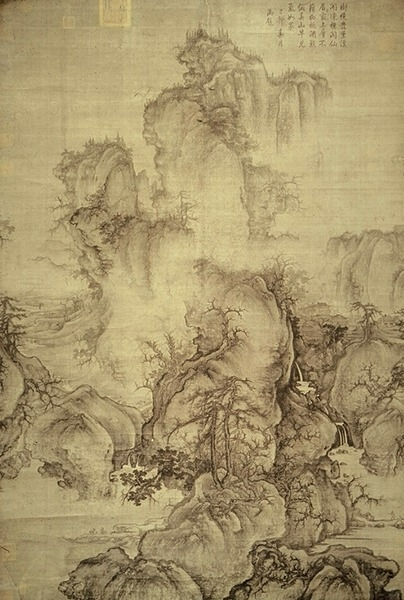
Guo Xi (1001-1090). Early Spring. Song Dynasty (dated 1072).
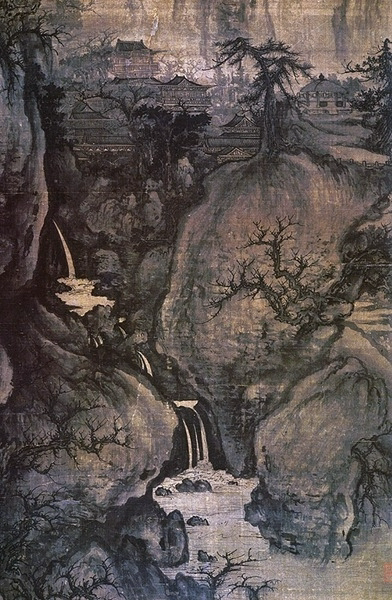
Guo Xi (1001-1090). Early Spring. Detail of right side of painting, with palaces and a pavilions in midst of landscape and beautiful waterfalls
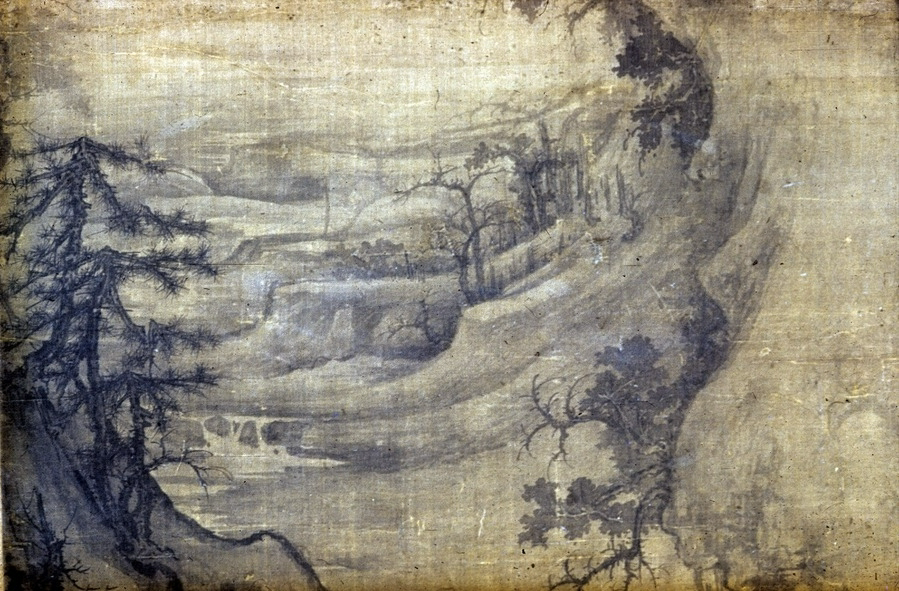
Guo Xi (1001-1090). Early Spring. Detail of the empty valley (level distance) that extends beyond pictorial space on the left section of the painting. Song Dynasty
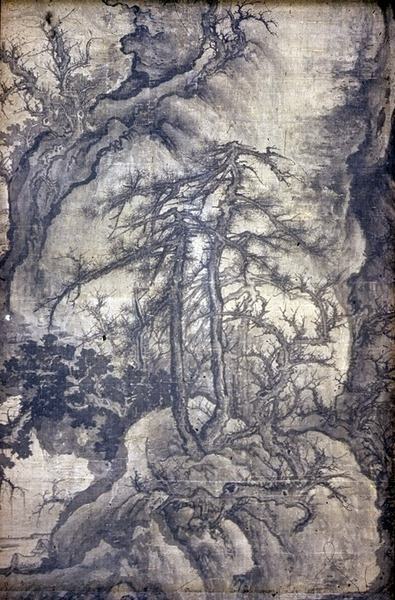
Detail of the twin pines in foreground of the painting. Guo Xi (1001-1090). Early Spring. Song Dynasty
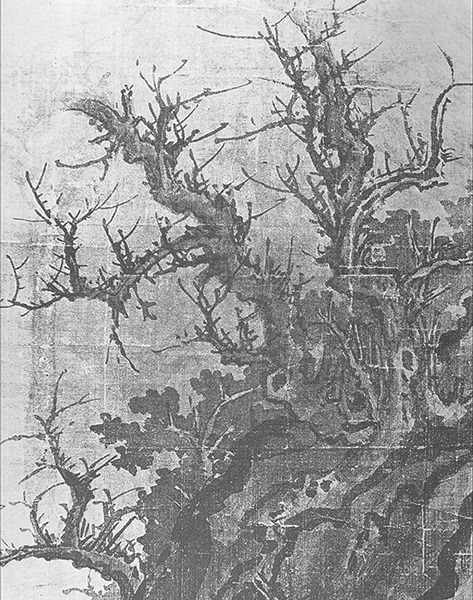
brushwork and use of ink in Guo Xi’s depiction of his trees. Guo Xi (1001-1090). Early Spring. Song Dynasty
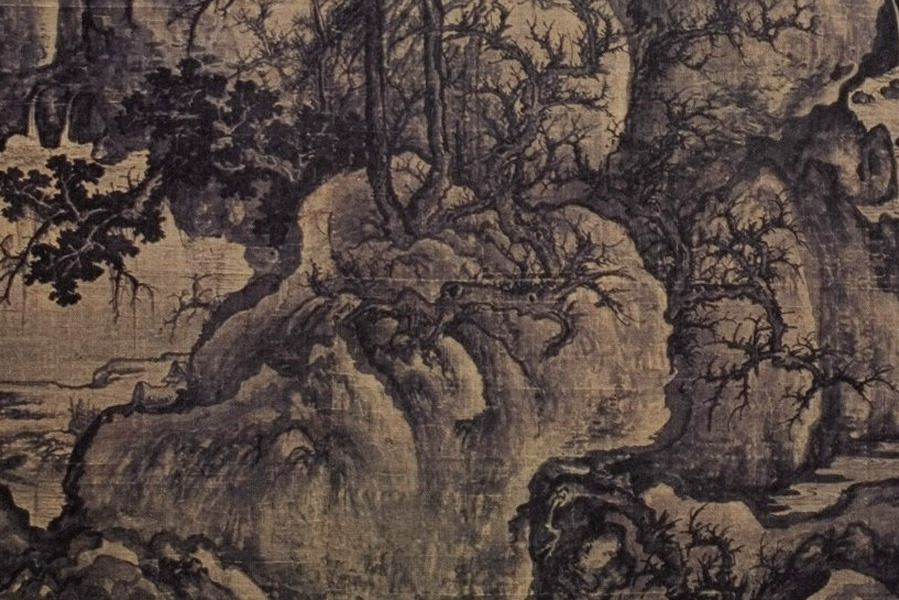
brushwork Guo Xi’s depiction of boulders. Guo Xi (1001-1090). Early Spring. Song Dynasty (dated 1072).
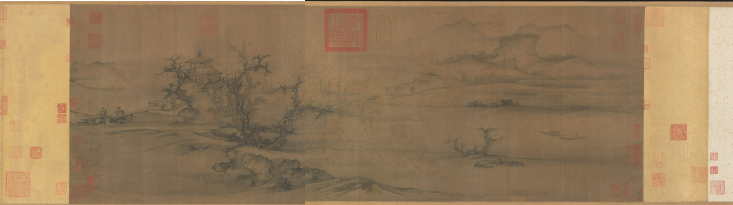
A handscroll that evokes the mood of a mid-autumn evening before one of man leaves for retirement. Mist-filled expanse, painted in ink washes, conveys a mood of desolation and expansion. Leveled landscape, with empty spaces, in contrast to the monumental landscapes – invites our imagination to fill in the negative spaces. Transforming to the Southern Song one-corner landscape art. Emphasizing emotional aspect of the moment. See Ping Foong’s article for more detailed reading and interpretation of this painting.
Guo Xi 郭熙 Old Trees, Level Distance 樹色平遠圖. Song Dynasty
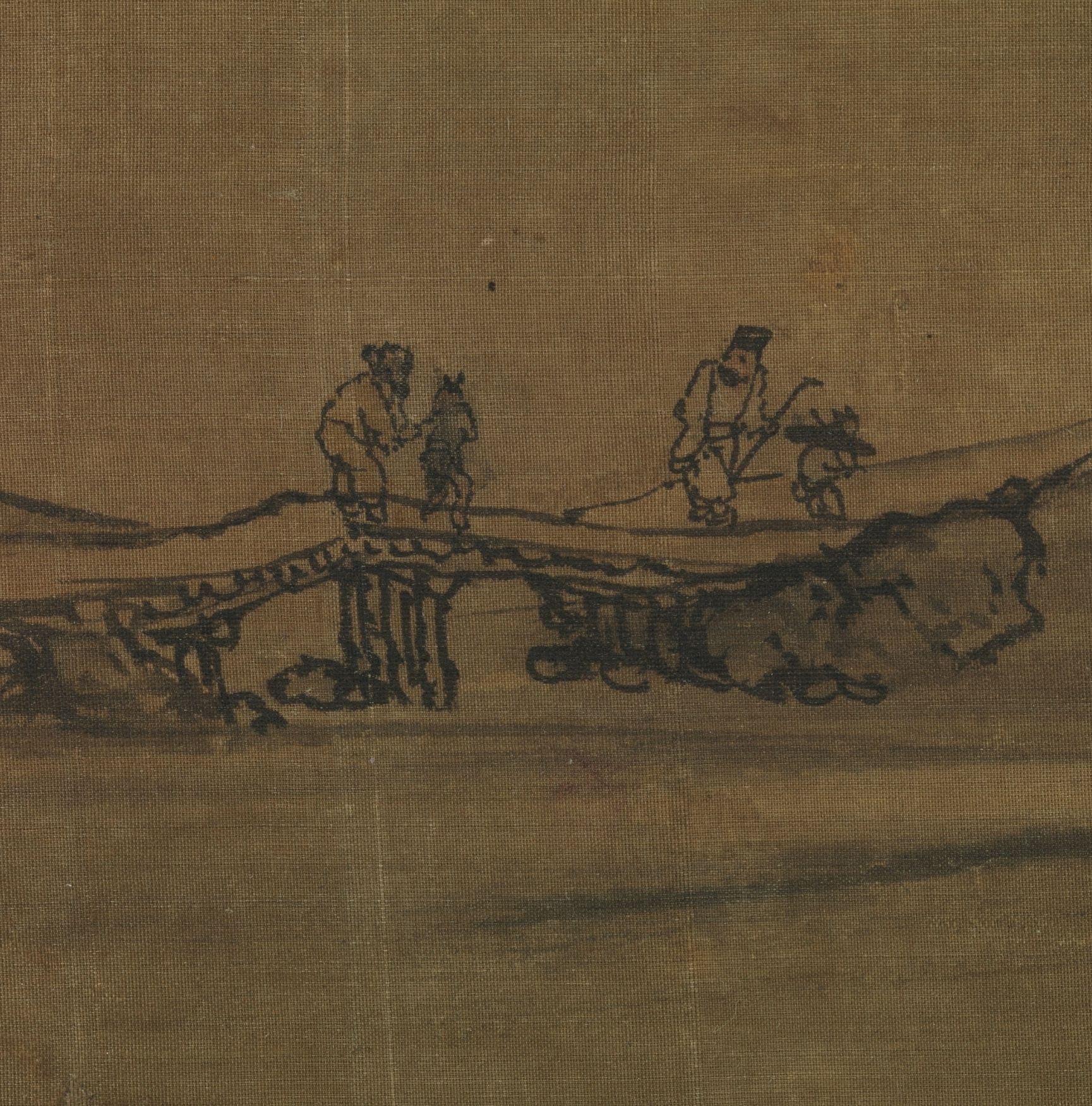
One of the old man has his back to us (perhaps indicating a turning away from a life of service?). Passing by the bridge – a space of parting. Throughout the painting, the figures often come in pairs – two fishermen, two woodcutters (both symbolize figures of reclusion). The one exception is the man in the pavilion, perhaps preparing food for the parting feast.
Detail of the two old men with their servants. Guo Xi 郭熙 Old Trees, Level Distance 樹色平遠圖. Song Dyn.asty
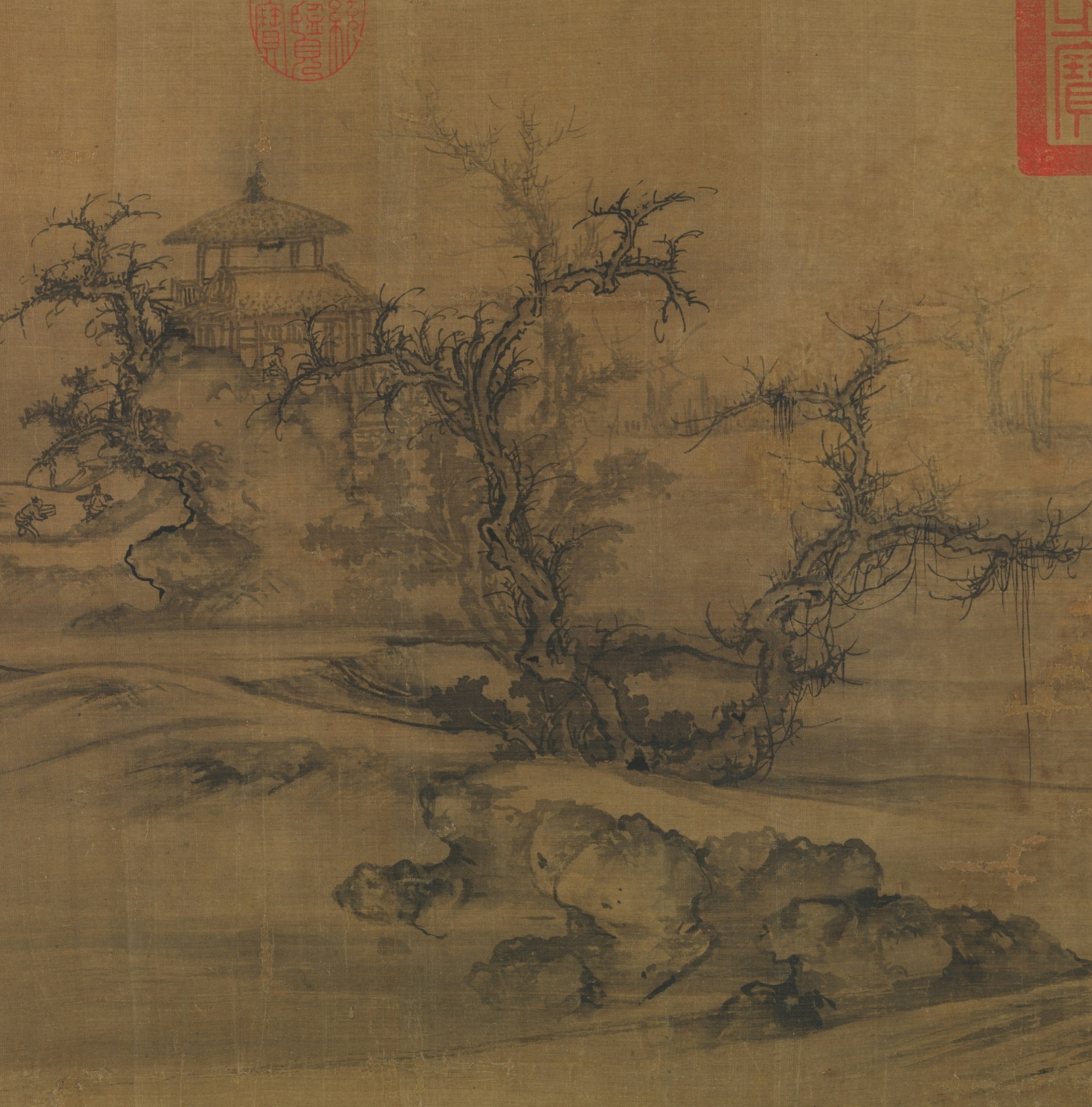
Detail of the pavilion (with a man inside preparing a farewell meal??), the trees and boulders in front. Guo Xi 郭熙 Old Trees, Level Distance 樹色平遠圖. Song Dyn.asty

Only four scenes remain of the original 12 scenes that depict views of the Xiao and Xiang river, with accompanying poetic lines. Here, we have the first three scenes, though they do not seem complete, as you see the first scene does not lead to the second smoothly. 1-Distant mountain and wild geese, 2-Mist over the village, the ferry returns, 3-Fishermen play their flutes in the quiet dusk, 4-Anchoring at evening on the misty bank.This shows the Southern Song one-corner system, where image is located on one section of the pictorial space, with a large proportion remaining empty, either evoking mist or clouds.
(Attrib to) Xia Gui (Chinese, active 1180 - 1224), first three scenes from Twelve Views of Landscape. [Southern] Song dynasty (1127-1279)
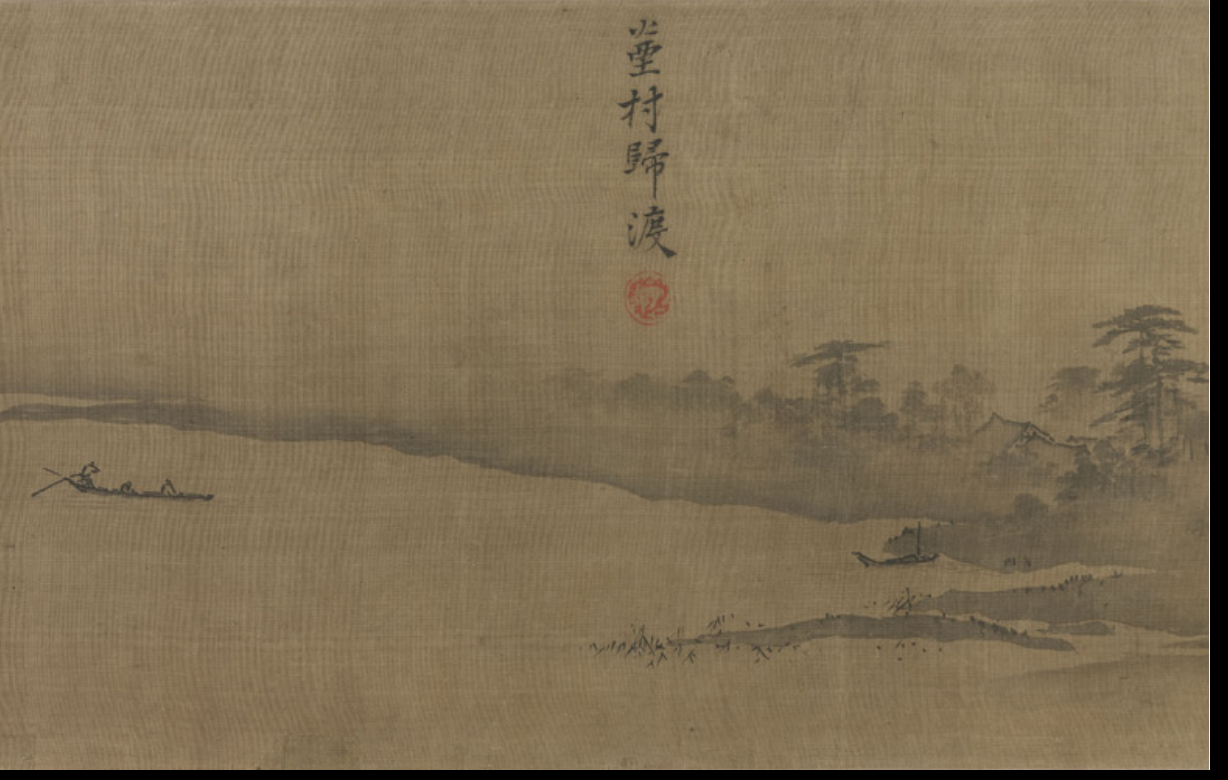
Note the play on ink, with different gradations of washes, and dryer brush for the boat.
Detail of “Returning Sails to the Misty Village,” from Twelve Views of Landscape,(attrib to) Xia Gui (Chinese, active (1180 - 1224), [Southern] Song dynasty
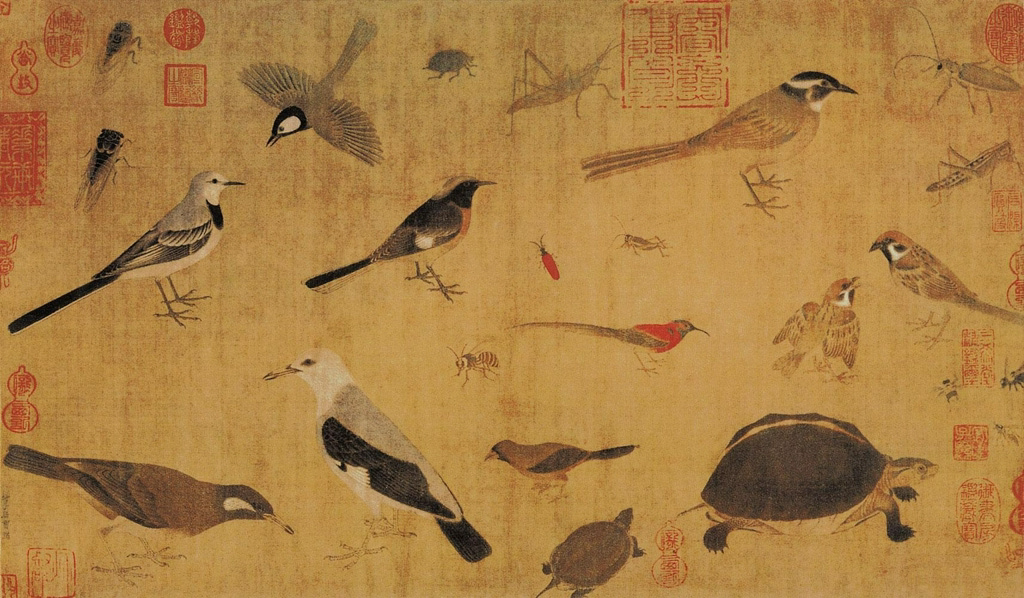
Huang Quan 黄荃 (903-968). Studies of Birds, Insects, and Turtles 寫生珍禽圖. Five Dynasties
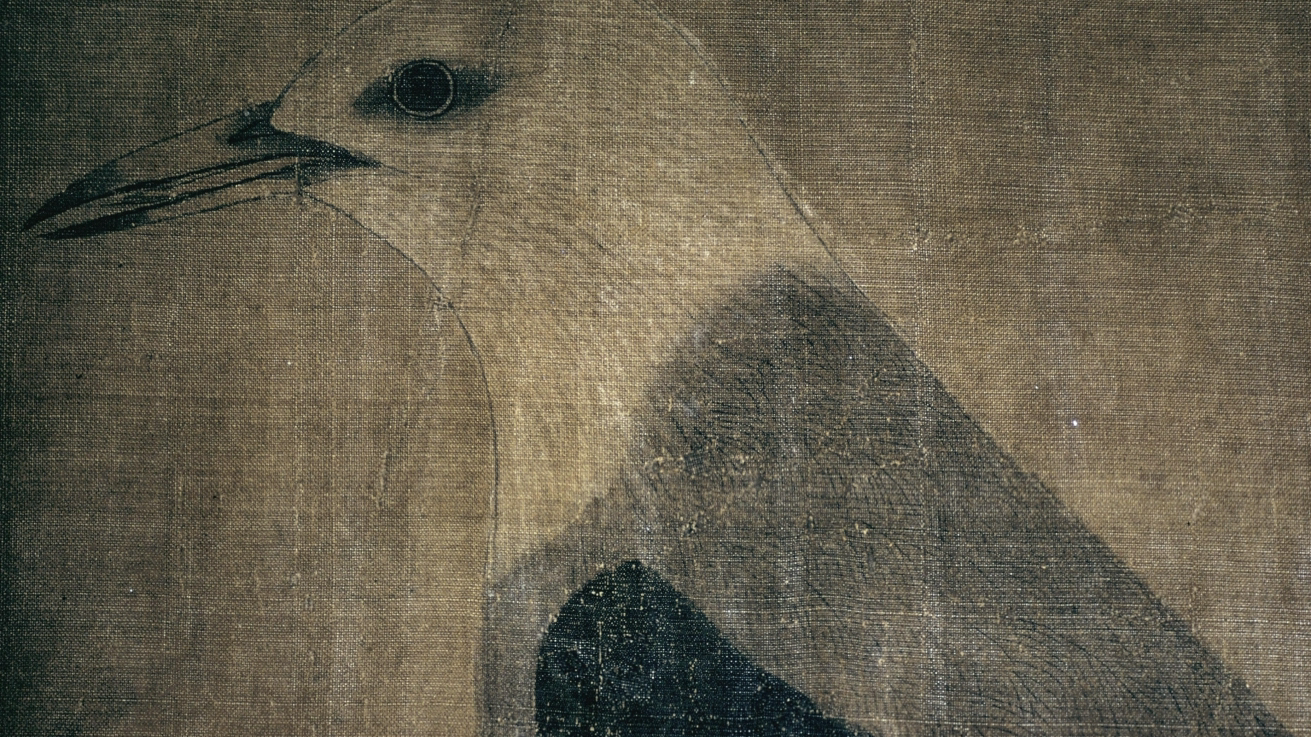
Detail of a bird in Huang Quan’s 黄荃, (903-968) Studies of Birds, Insects, and Turtles 寫生珍禽圖. Five Dynasties (10th c). Note the fine brushwork and lightly applied colors. Attempts to paint from life – verisimilitude.
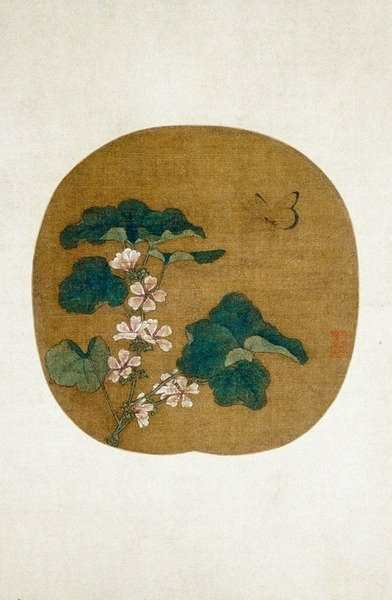
Attrib to Xu Xi/ Hsu Hsi (ca. 961-975). Flowers and Butterfly. Five Dynasties
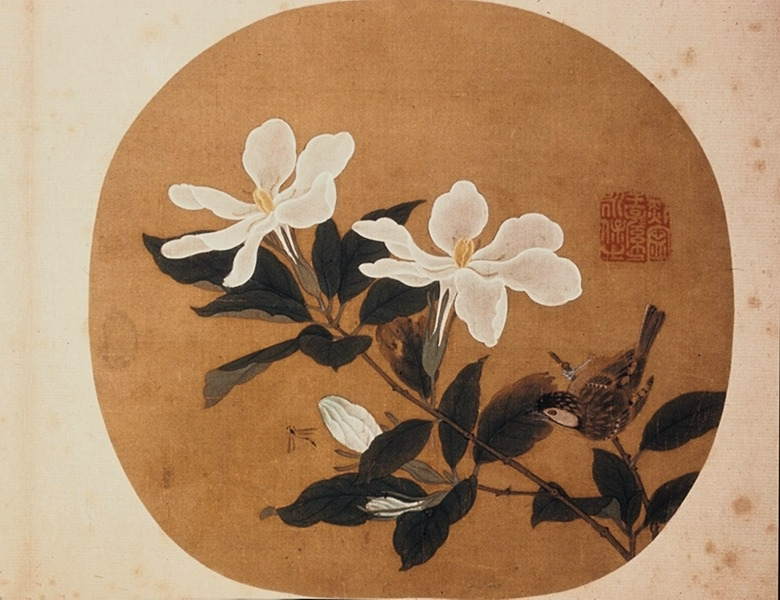
Xu Xi/ Hsu Hsi (ca. 961-975) Gardenia Branch. Five Dynasties. Album Leaf. Delicate wash of the flower petals, and the liveliness with which the bird and the insects are drawn, capturing their spirits.
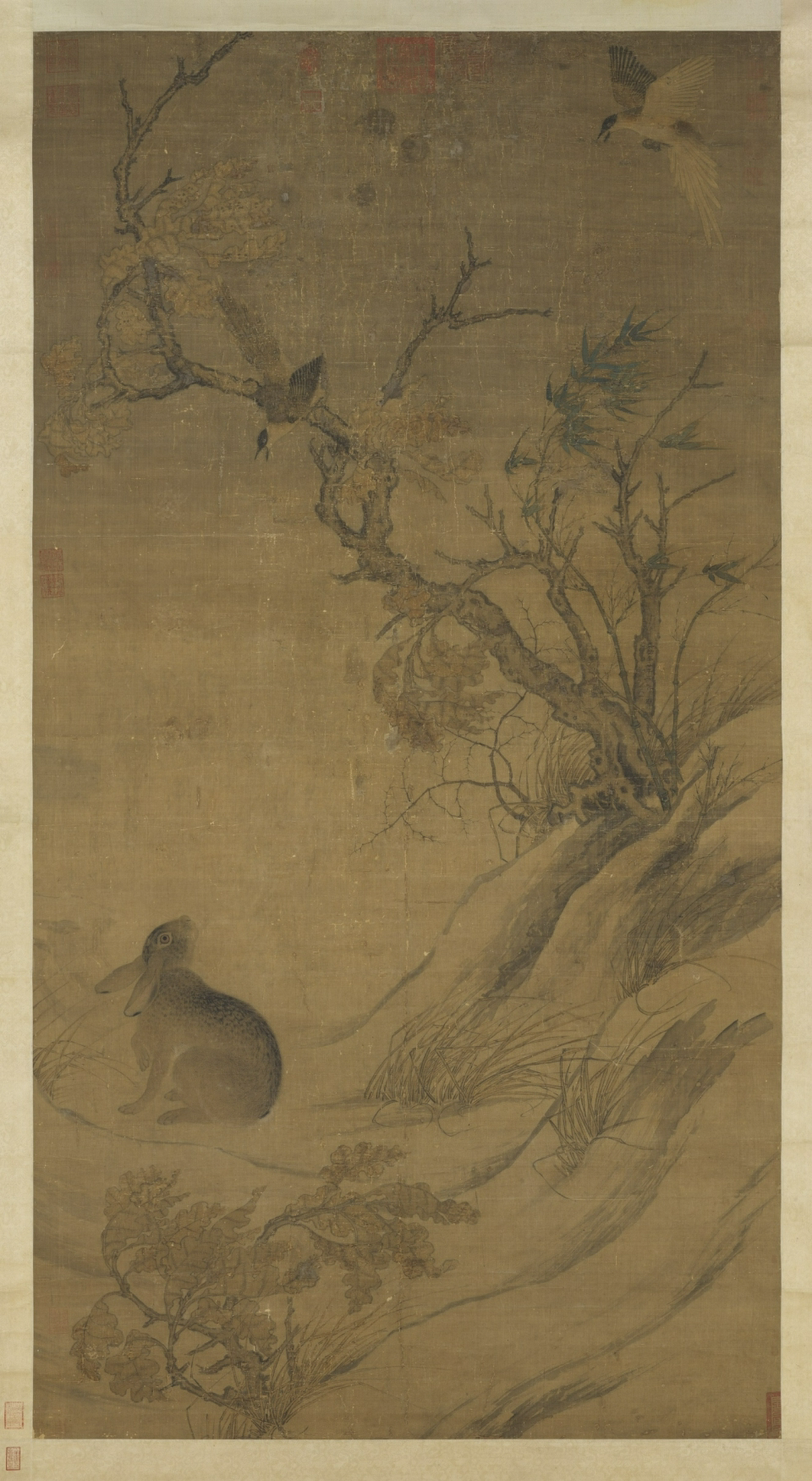
“double happiness,” a painting to be given to a happy occasion, such as a wedding. Alfreda Murk’s political interpretation: mood is desolate, in stormy setting with winds blowing on bare trees and bamboos. Two magpies, the lighter one in flight representing
Princess Yuan Guo (1038–1070), who is fond of her eunuch (represented by the crafty hare); and the darker one screeching at the hare, representing the husband of Yuan Guo princess, Li Wei, who is weary of her eunuch encroaching onto their marriage. The painting is, according to Murk, a critique of Emperor Renzhong who was unable to keep his daughter from excessively relying on the eunuch's influences.
Another political interpretation of the painting has the magpies represent the literati (the prime minister Sima Guang’s conservative faction), who are situated near the bamboos that represent moral upright. They are screeching at the crafty hare, near the thorny weeds, representing the reformist Wang Anshi’s faction, who are about to encroach onto their territories with his New Policies (that emphasize strong state control).
Cui Bo/ Tsui Po (fl.. 1050–1080) Magpie and Hare. Song Dynasty
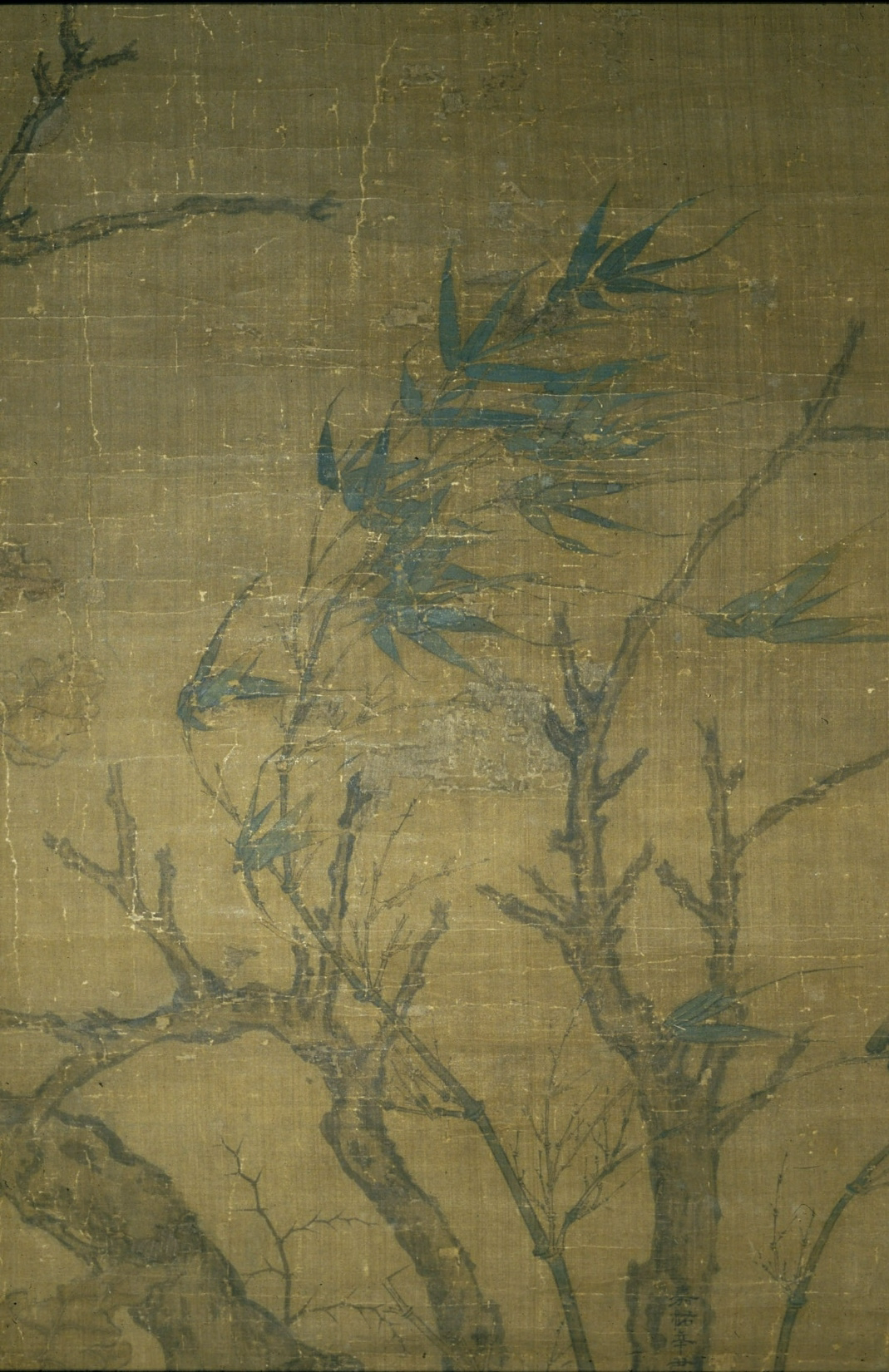
Detail of the bamboos being blown by gust. Note: Bamboos are generally thought to represent moral, upright character of a gentleman, but here, the leaves are blown by a gust, hinting at a storm they are about to endure.
Cui Bo/ Tsui Po (fl.. 1050–1080) Magpie and Hare. Song Dynasty
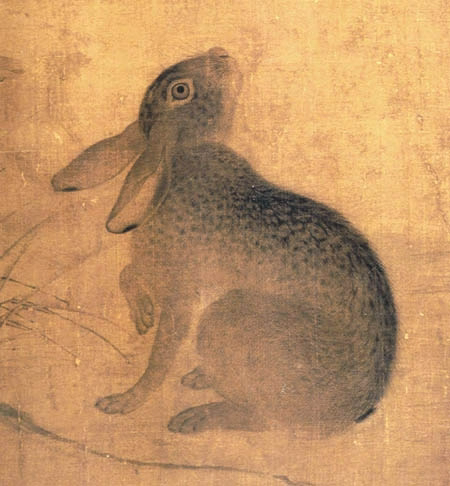
Note the fine and brushwork on the rabbit, in contrast to the weeds pointing to it. Crafty hare is gazing up at the magpie as it attempts to go into its territory.
Cui Bo/ Tsui Po (fl. 1050–1080) Magpie and Hare. Song Dynasty
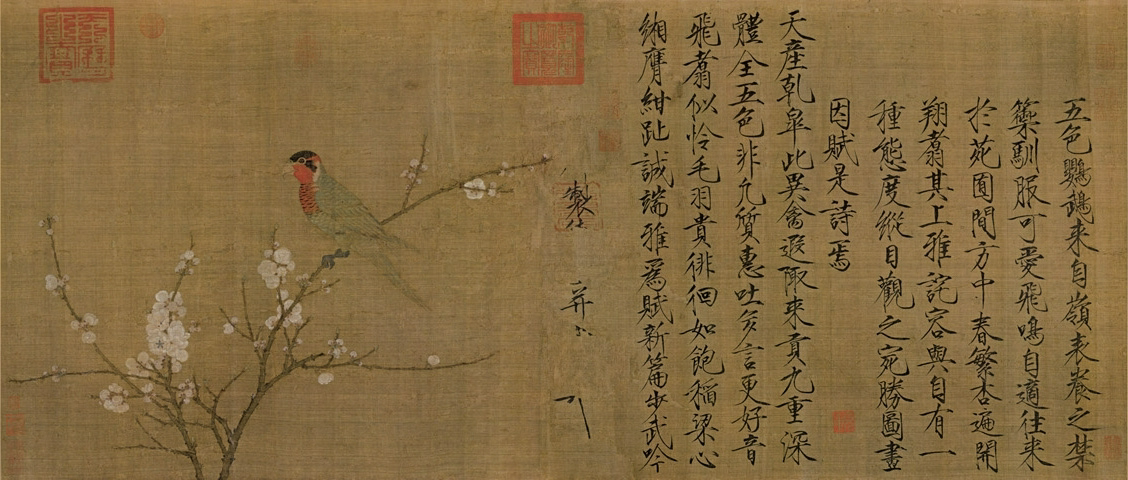
Emperor Huizong. Five Colored Parakeet. Song Dynasty,
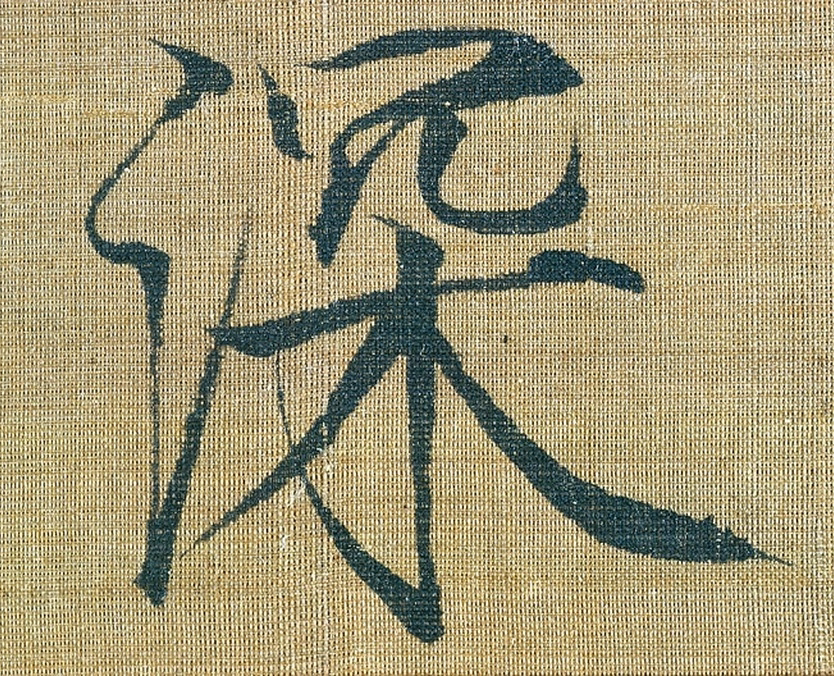
Emperor Huizong. Five Colored Parakeet. Song Dynasty, datable to 1110s. Detail of a character (“deep”) on left, exhibiting Huizong’s “Slender Gold” (瘦金體) style of calligraphy: elongated, strong characters written with strength and extreme thinness, “bamboo quality,” with a sharpe angular terminations, and radiant spacing. Gold Calligraphy (gold filament, twisted and turned).
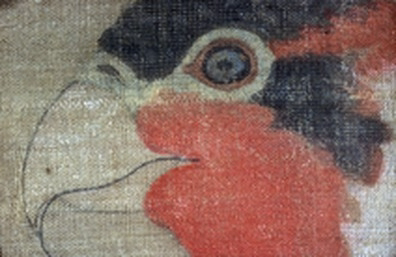
The parakeet is rendered in layers of color, with very
fine brush, then crucial sections – such as the eyes
and the beak -- outlined with extraordinarily precise, dry brush.
Emperor Huizong. Five Colored Parakeet. Song Dynasty, datable to 1110s. Detail of parakeet’s face. Ink and color on silk.
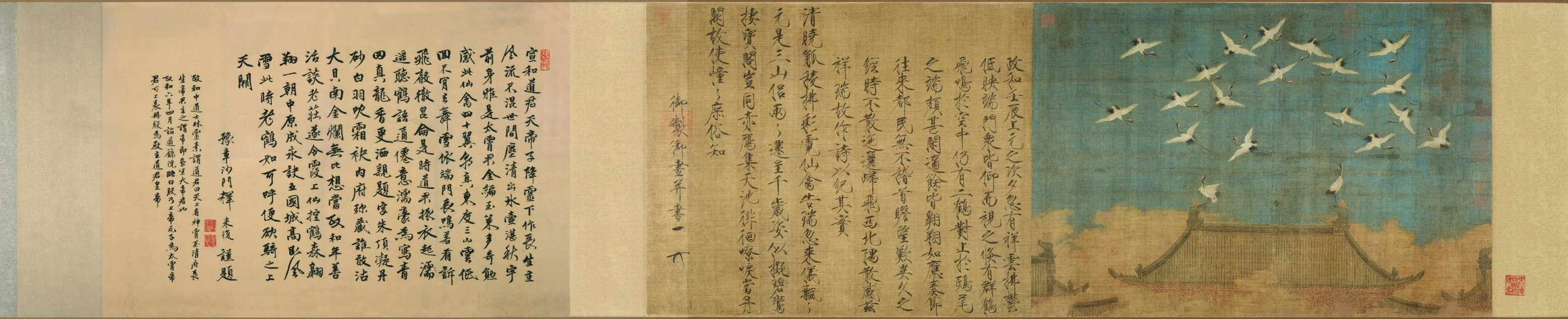
Emperor Huizong, Auspicious Cranes. Ca. 1112 (Song Dynasty, 12th c). Notice each of the 20
cranes is shown in a different, elegant posture, each painted delicately in fine brush, with careful attention to details and surface patterns. This represent Song court taste for beauty, patterns, and delicate brushwork.
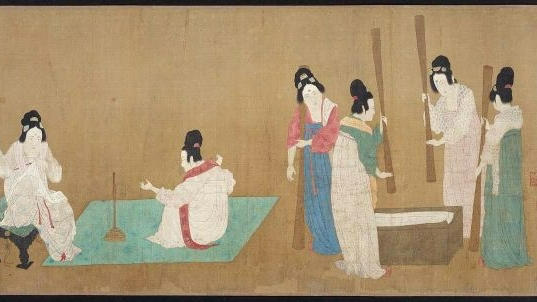
Emperor Huizong 宋徽宗 (Chinese, 1082–1135, ruled 1100–1125), Court Ladies Preparing Newly Woven Silk
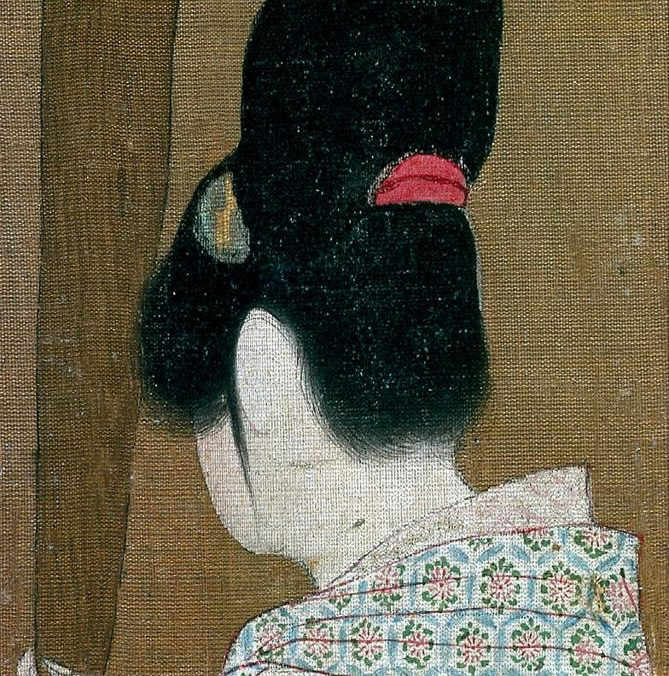
Detail of the back of a court ladie’s head and robe, from section 1 of Court Ladies Preparing Newly Woven Silk 搗練圖卷, attributed to Emperor Huizong
Note realistic way in which the entire painting is executed: the soft brushes of her hair painted with very fine brush and layers of colors, and the delicate patterned surfaces of her robe. This is an example of the kind of aesthetic that Huizong is drawn to – art of beautiful surface patterns.
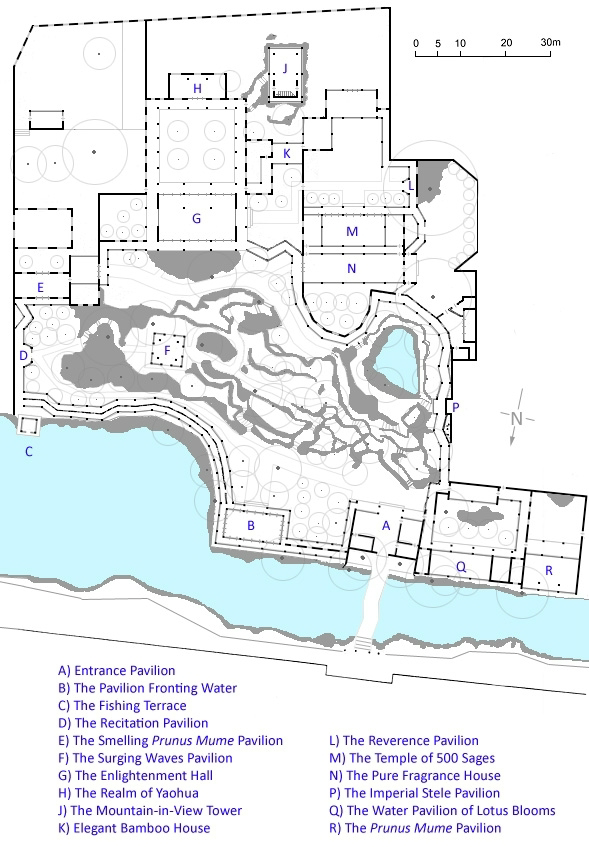
Plan, Surging Wave Pavilion. Suzhou, China. First built in 1040 AD / Song Dynasty.
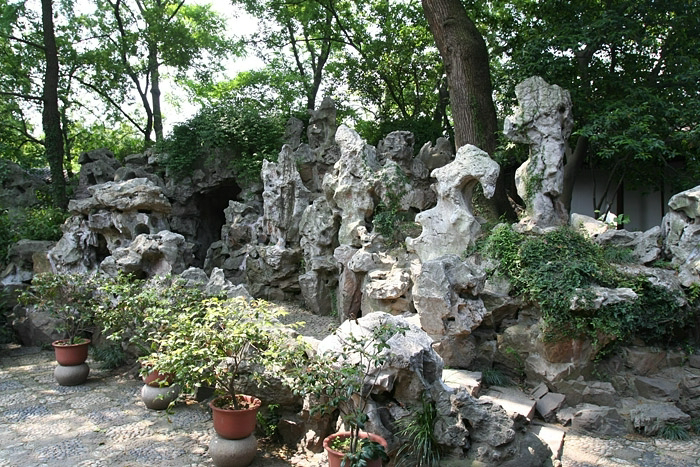
Fantastic rockery from Surging
Waves Pavilion. First built in 1040 AD. One sees it as one first enters the garden. It leads to a stone chamber inside the rock and forms a rockery hill. Song Dynasty
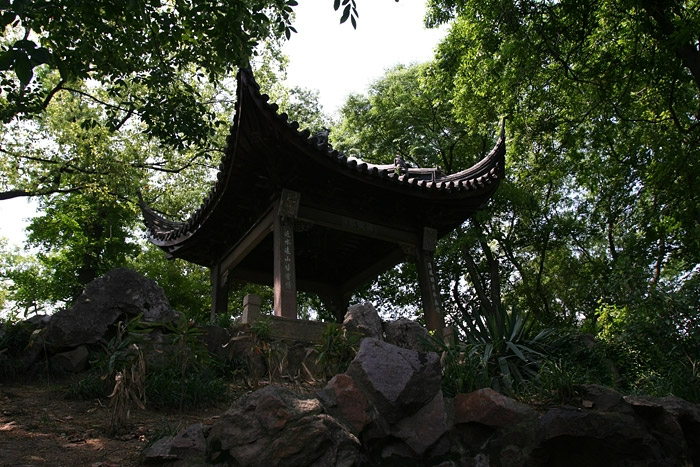
The calligraphy on the pillars reading something like this: “Gentle breeze and bright moon priced at naught,/ Oh! How precious the streams and the distant hills nearby!”
Surging Wave Pavilion (for which the garden is named), in Surging Wave Pavilion. On top of the hill. Built 1040 AD onward/ Song Dynasty. Suzhou,
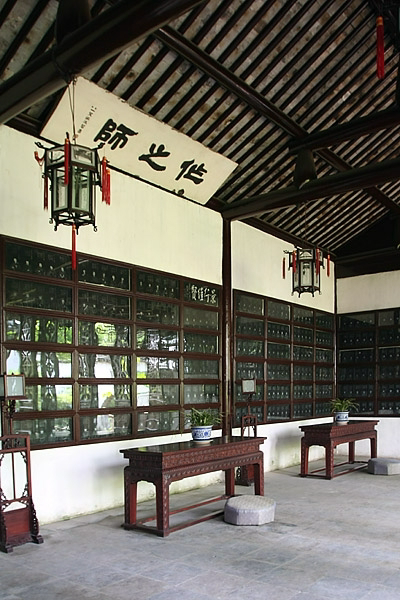
Our path through the garden reaches this library section--after ascending the rockery, and going down through the pond--where the mind can become enlightened (through the process of going through nature, and through reading of books and sutras where one can access wisdom passed down by the ancient sages)
Interior of the Temple of Five Hundred Sages, a library located at the inner northern section of the Surging Waves Pavilion (see the boxed books inside the shelves). Surging Waves Pavilion. First constructed in 1040 AD/ Song Dynasty.
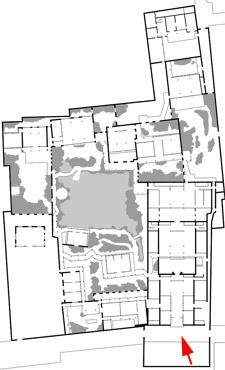
Red arrow points to the original entrance. Consider the plan of the residential garden in two sections: the square, central axes of the courtyards to the east, and the more circum-ambulatory (circular) path around the waters. Consider, also, the ways in which the design expands the perceived spaces of the garden.
Plan of the Garden of Master of Nets. First constructed in the Song Dynasty (960-1279), Later abandoned and reconstructed in the 18th c. Suzhou, China.
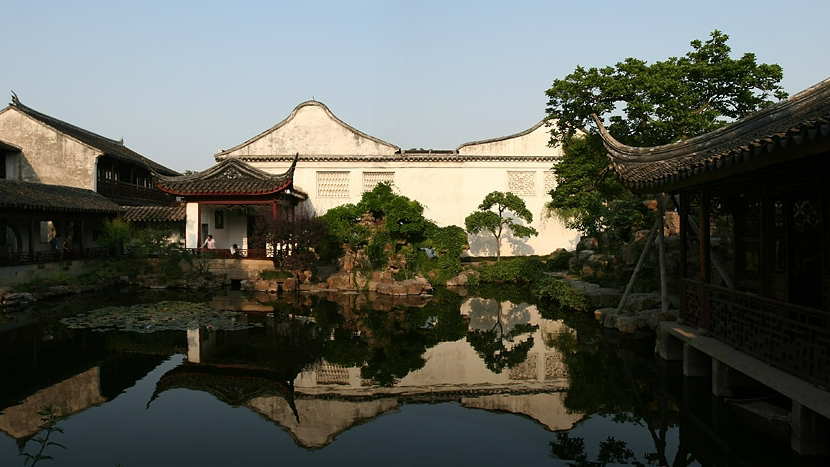
View of the lake, and the white walls of the residential area, on the east side of the residential compound. The white walls are canvas against which carefully pruned trees are shown, like a carefully crafted landscape painting. From Garden of Master of Nets. First constructed in the Song Dynasty (960-1279), Later abandoned and reconstructed in the 18th c. Suzhou, China.
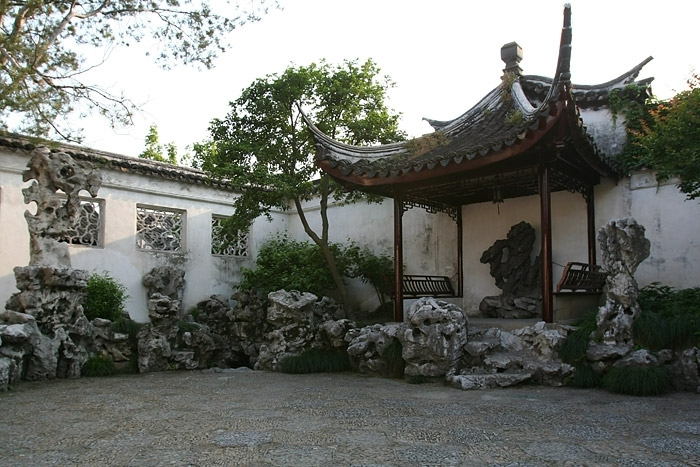
The Cold Spring Pavilion and the rockery in the northwestern most courtyard of the compound (innermost section of the residence, most private of the residential spaces). It is lined with fantastic rockery along the sides. This courtyard is next to the study to its north, which opens to the courtyard. Garden of Master of Nets. The Astor Court in the Metropolitan Museum of Art, NY, is modelled after this courtyard and the study. First constructed in the Song Dynasty (960-1279), Later abandoned and reconstructed in the 18th c. Suzhou, China.