CHEM 1302 3.3 & 3.4 Questions with 100% accurate solutions (A+ GRADED )
 Call Kai
 Learn
Learn Practice Test
 Spaced Repetition
 Match
Match Flashcards
1/33

There's no tags or description
Looks like no tags are added yet.
Name | Mastery | Learn | Test | Matching | Spaced | Call with Kai |
|---|
No analytics yet
Send a link to your students to track their progress
34 Terms
Arrhenius Acid
Substance that dissociates in water to produce H3O+ (release H+ ions).
Arrhenius Base
Substance that dissociates in water to produce/release OH- ions.
Bronsted-Lowry Acid
Proton (H+) donor.
Bronsted-Lowry Base
Proton (H+) acceptor.
Lewis Acid
Electron pair acceptor to form a bond.
Lewis Base
Electron pair donor to form a bond.
Strong Acids
Completely ionize in solution to increase hydrogen ion concentration in solution.
HCl, HBr, HI, HNO3, HClO4, H2SO4
Strong Bases
Completely ionize in solution to increase hydroxide ion concentration in solution.
NaOH, KOH, Mg(OH)2, Ca(OH)2
Weak Acids and Bases
Do not ionize completely in solution, but proceed until an equilibrium is achieved between reactants and products.
What does a weaker weak acid mean for Ka and pKa?
Lower Ka but higher pKa.
What does a stronger weak acid mean for Ka and pKa?
Higher Ka but lower pKa.
Formula for percent ionization for weak acids/bases?
α = (x/c) * 100%
where x is the solubility (also often [H+] or [OH-], and c is the original acid/base concentration.
When can the c-x = c approximation be made for pH and % ionization calculations?
1. If (c/Ka) > 400
2. If α < 5% (less useful)
If x is known, you cannot ever neglect it!
Conjugate base (of an acid)
Formed when an acid has donated a proton, and behaves as a weak base (Kb) in solution to make a basic solution.
Conjugate acid (of a base)
Formed when a base has accepted a proton, and behaves as a weak acid (Ka) in solution to make am acidic solution.
Autoionization of water
Kw = Ka*Kb = 1.0 x 10^-14 at 25°C
Spectator Ions
Conjugate bases of strong acids; so weak that they don't affect pH or react with water. Cations and anions.
Salt
Ionic solid composed of cations and anions which separate from each other when the salt is dissolved.
Amphoteric species
Species that can act as both an acid or a base (can lose or gain a proton).
Determine whether Ka or Kb dominates in hydrolysis to determine if the solution is acidic or basic.
Polyprotic weak acids
Weak acids with >1 ionizable hydrogen atom, where all steps have different Ka values. The product from the first step is a rectant of the 2nd step, and the eq'm concentrations become initial concentrations.
Ka1 is always the highest and contributes to pH.
Buffer solution
Solution containing both acid and base in significant amounts (that must not react), with the ability to withstand changes in pH when small amounts of strong acid/base are added to it. Both components should ideally be in a 1:1 ratio, but 1:10 minimum.
What are the two types of buffers and their compositions?
Acid buffer (weak acid + its conjugate base)
Base buffer (weak base + its conjugate acid)
How do you make a buffer?
1. Start with a solution of weak acid/base and add a salt that contains its conjugate partner.
2. Start with one of the 2 ingredients, and use the correct amount of strong acid/base, such that roughly half of the weak species is converted to its conjugate partner.
Why can moles be used in buffer calculations?
Moles can be used for the parent/conjugate species, since the units cancel and the value of x (shift) is negligible.
For a weak acid buffer,
Ka = ([H+] * moles of conj. base) / moles of weak acid
What happens in an acid buffer if a strong acid is added?
The SA will react with the conjugate base to make more weak acid, slightly dropping the pH.
What happens in an acid buffer if a strong base is added?
The SB will react with the weak acid to make more conjugate base, slightly increasing the pH.
What happens in a base buffer if a strong acid is added?
The SA will react with the weak base to make more conjugate acid, slightly dropping the pH.
What happens in an base buffer if a strong base is added?
The SB will react with the conjugate acid to make more weak base, slightly increasing the pH.
Equivalence point
When stoichiometrically equivalent amounts of acid and base have been combined.
Acid-Base Indicators
Weak organic acid added to solution that changes colour at the equivalence point of a titration. Dilute and no effect on pH.
Exists mostly in its acid form (HI) in an acid solution, and exists in its basic form (I-) in a basic solution, which have different colours.
Endpoint
Point in titration when the indicator changes colour.
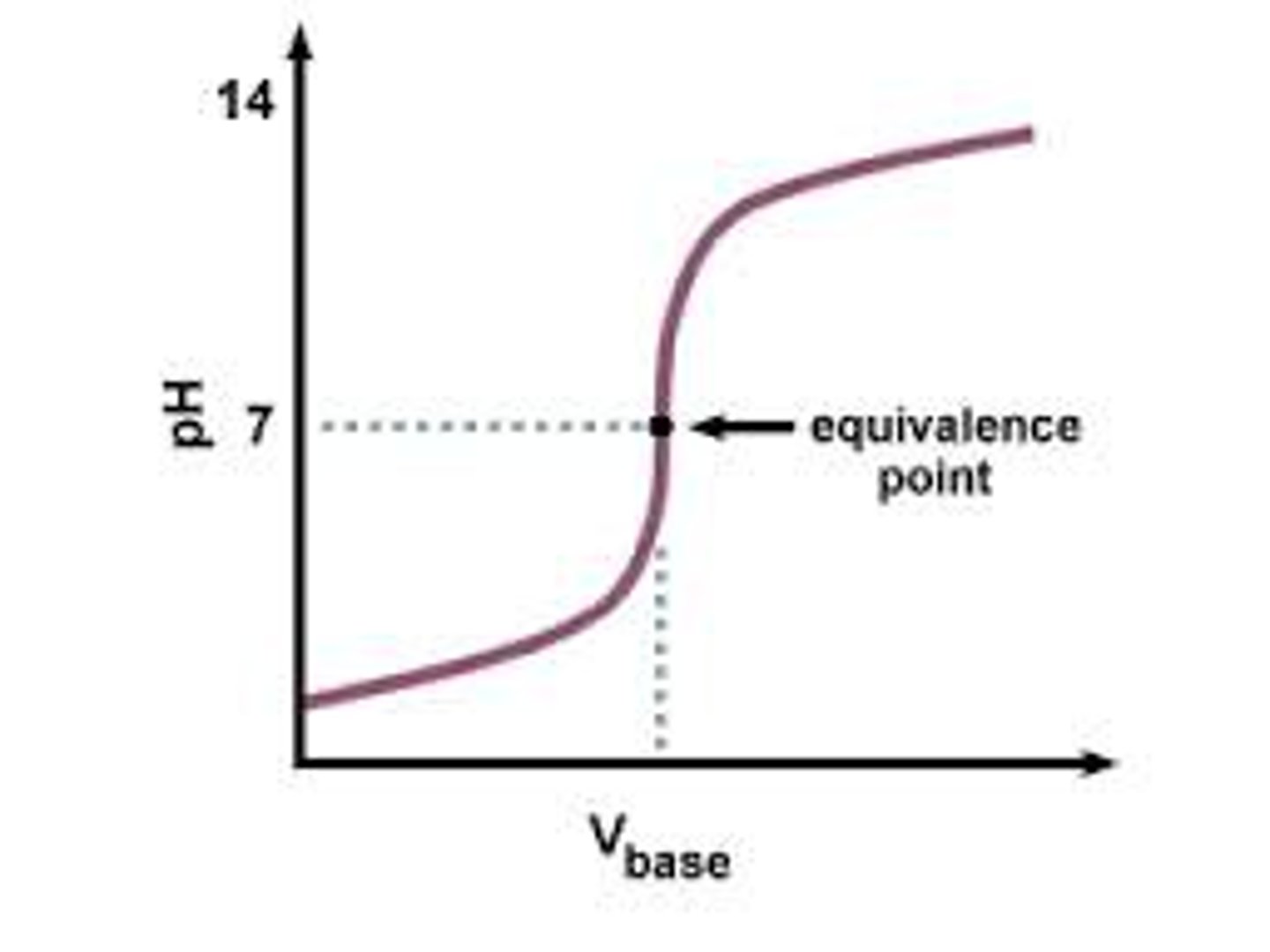
Strong Acid-Strong Base Titration Graph
Equivalence point pH = 7; nearly any indicator can be used because pH change is large near the equivalence point.
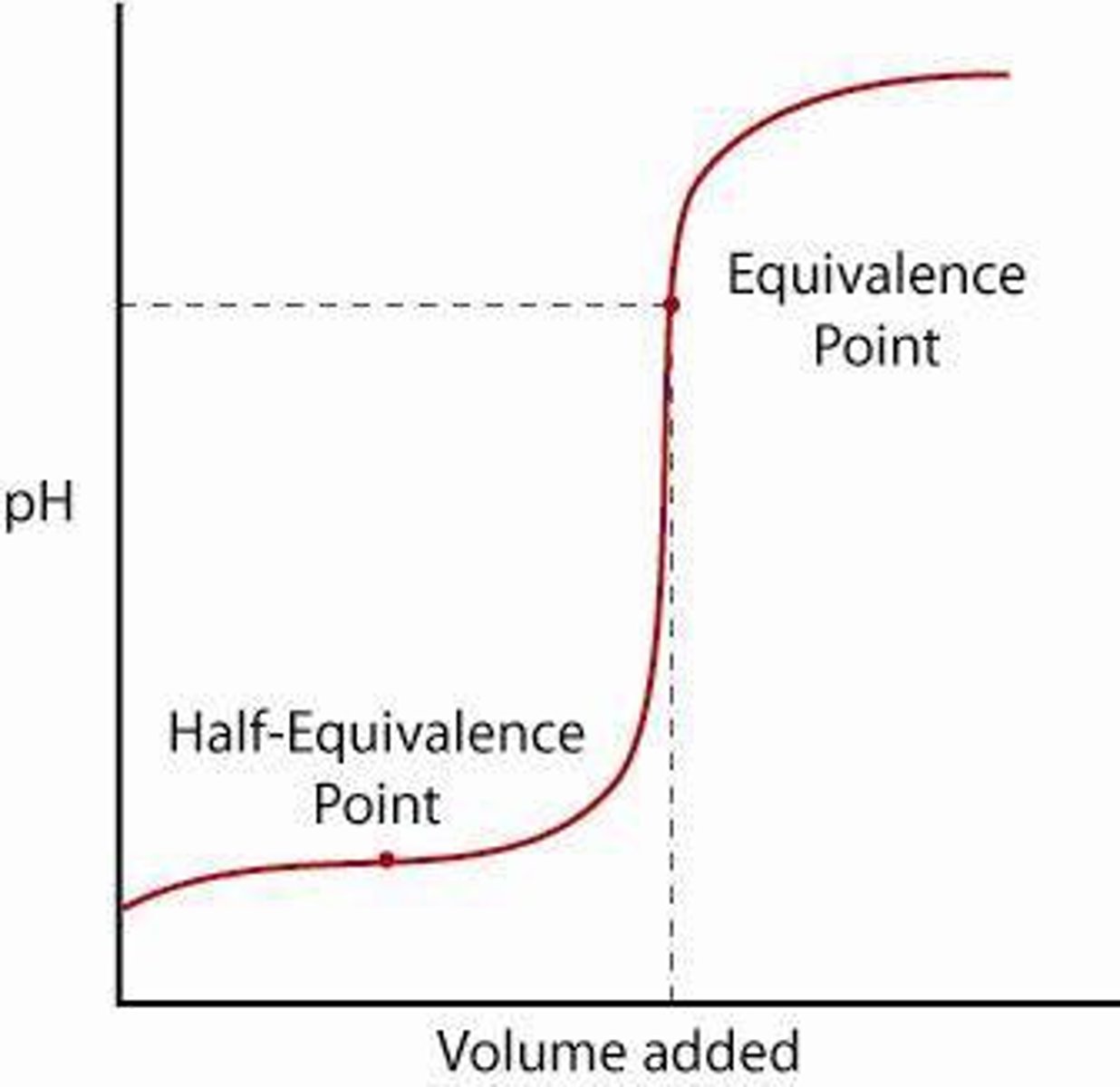
Weak Acid-Strong Base Titration Graph
Equivalence point pH > 7 (8-10); phenolphthalein indicator w/ pKa = 9
Strong Acid-Weak Base Titration Graph
Equivalence point pH < 7 (4-6); methyl red indicator w/ pKa = 5