4.1 DNA, RNA & Protein synthesis
 Call Kai
 Learn
Learn Practice Test
 Spaced Repetition
 Match
Match Flashcards
 Knowt Play
1/85

There's no tags or description
Looks like no tags are added yet.
Name | Mastery | Learn | Test | Matching | Spaced | Call with Kai |
|---|
No analytics yet
Send a link to your students to track their progress
86 Terms
Describe DNA in eukaryotic cells.
● Long and linear molecule associated with histone proteins. DNA is coiled around the histone proteins into a chromosome.
● Coiled up tightly to fit in nucleus.
● Contains both introns + exons.
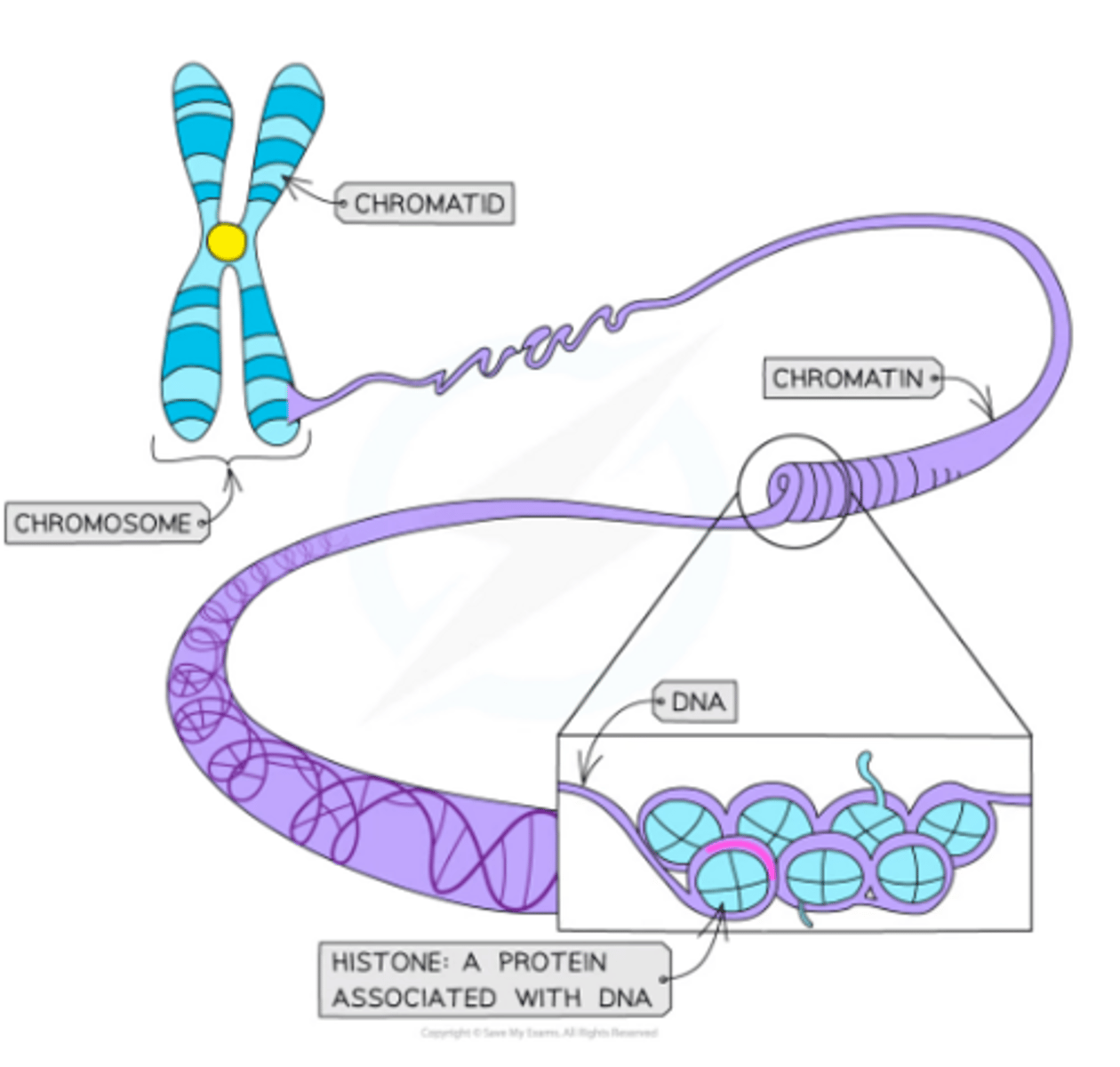
How are chromosomes formed?
● DNA condensed into chromatin, by wrapping tightly around the histones, enabling it to fit into the nucleus
● Chromatin folds to form chromatid
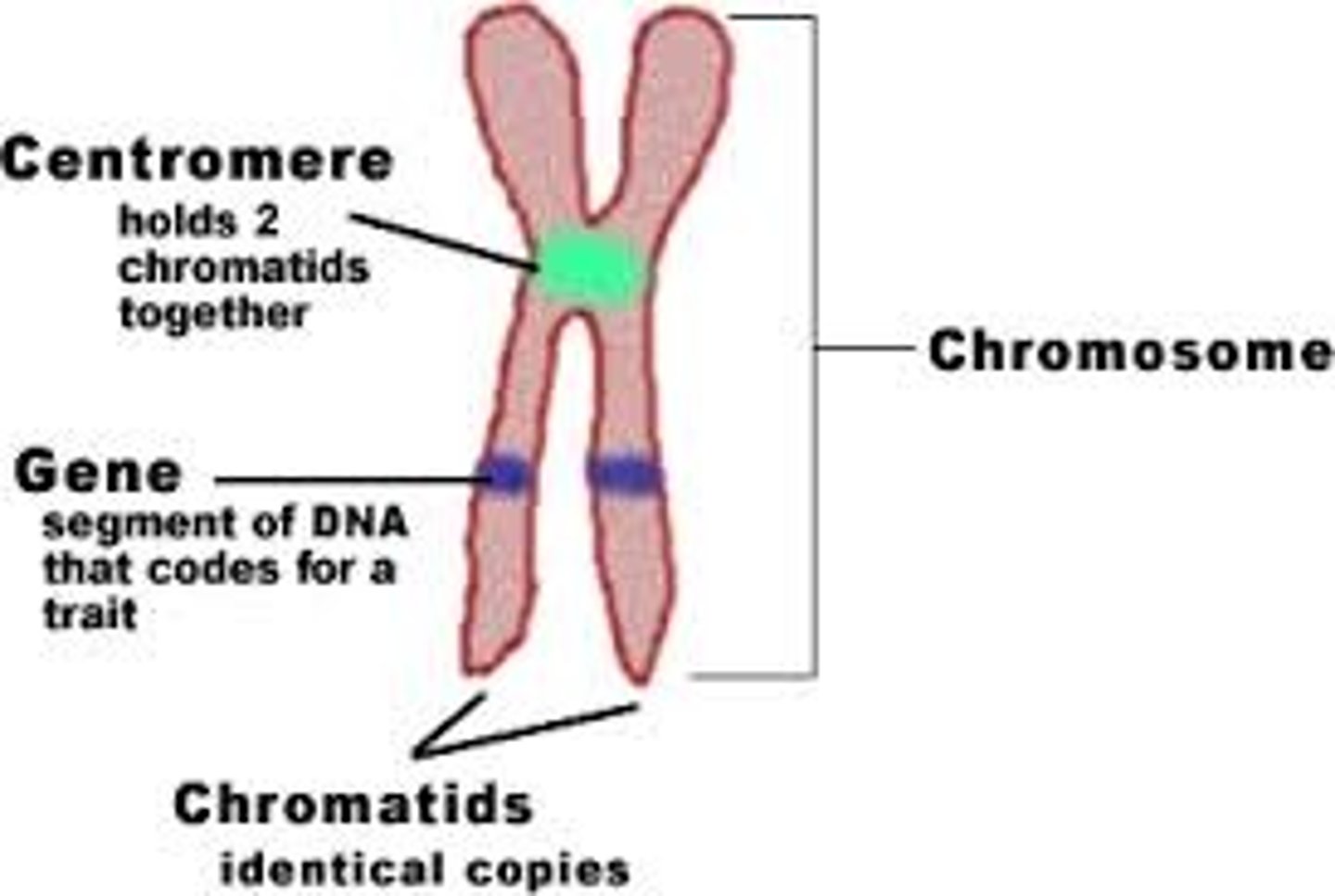
● 2 arms of chromatids = sister chromatids, joined by centromere
Describe DNA in prokaryotic cells.
● Single, short, circular chromosomal DNA molecule found freely in the cytoplasm
● Variable number of plasmids
● NOT associated with histone proteins
● Supercoiled up tightly
Nucleic acid
Molecule made up of 1 or more polynucleotide chains (RNA or DNA)
● Molecule that carries the genetic code for the production of proteins.
● Made up of nucleotides.
What are plasmids?
● Small circular DNA molecules
● Usually only contain a few genes.
● Plasmids are more accessible for proteins required for gene expression and therefore contain genes that are required often, quickly and/or in emergencies.
● Contain genes for antibiotic resistance
Describe DNA in ORGANELLES such as chloroplasts and mitochondria.
scientists think it evolved from prokaryotes as it is like prokaryotic DNA:
● short
● circular
● not membrane bound in a nucleus
● not associated with histone proteins.
What is a chromosome?
● Long, linear DNA + its associated histone proteins
● In the nucleus of eukaryotic cells
Describe the structure of chromosomes when NOT/CONDENSED 🟥
● (When visible) appear as 2 threads joined at a point - a chromatid. DNA has already replicated to give 2 identical DNA molecules.
● Only visible when a cell is dividing. For the rest of the time they are widely dispersed throughout the cell.
● The DNA is held in position by histone proteins.
DNA is around 2m in every human cell and is tightly coiled and folded.
🟥
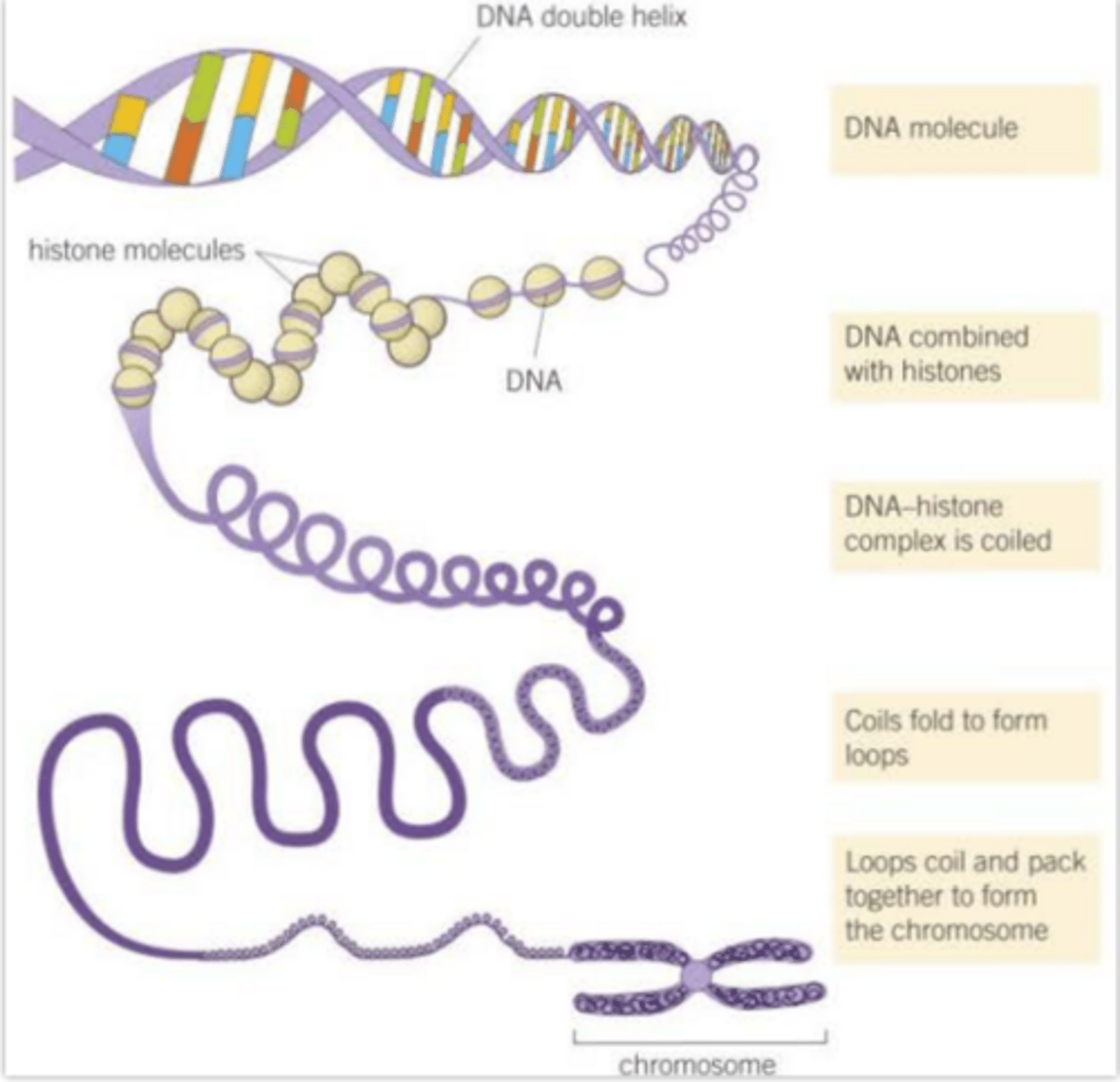
Describe a chromasomes structurally/ in biological terms ❓
● DNA double helix molecule combined with histone proteins, DNA wound around it to fix it in position
● DNA-protein complex is coiled to form loops
● Loops coil and pack together, condensing into a single chromosome
❓
Which cells contain chromosomes?
● Most somatic (body) cells (skin, muscle, liver cells) contain the full 46 chromosomes.
● However, RBC have no nucleus so no chromosomes, gametes are haploid.
What is a gene?
A section of DNA bases that codes for:
● The amino acid sequence of a polypeptide
● Or a functional RNA (e.g. ribosomal RNA or tRNA)
What is functional RNA?
● Genes that don't code for a polypeptide code BUT for functional RNA instead.
● RNA that doesn't get translated, but performs special tasks during protein synthesis (e.g. tRNA, rRNA)
Locus
Specific/fixed location of a gene on a chromosome
Genetic code in DNA molecules.🥎
● Specific sequence of bases along the DNA molecule
● Different polypeptides have different number and order of amino acids.
● The order of bases in a gene determines the order of amino acids in a particular polypeptide.
● Each specific amino acid is coded for by a codon; a sequence of 3 DNA bases in a gene. 🥎
Allele
● Different forms of a gene
● One of two (usually dominant or recessive) or more DNA sequences occurring at a particular gene locus
● Inherit 1 allele for each gene from each parent
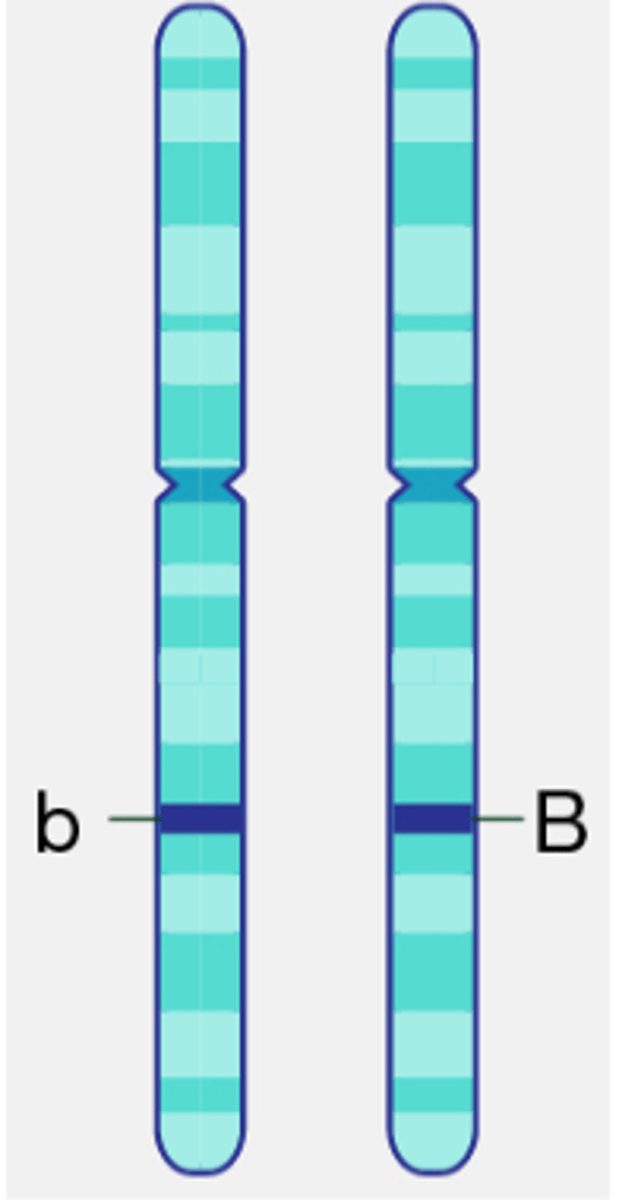
How do changes to alleles affect gene expression
● Different alleles code for different polypeptides.
The order of bases is different → code for different amino acids → different polypeptide → different protein.
Describe the alleles in an individual in tems of inheritence and why that makes us all genetically different
Each individual inherits one allele from each of parent, can be the same allele or different.
Different alleles code for a different polypeptide.
The order of bases in each allele is slightly different, so they code for different amino acids and therefore a different polypeptide and different protein.
What is a mutation?
A change in the base sequence of DNA
What do mutations cause?
● Produces a new allele of that gene
● Results in a different sequence of amino acids being coded for.
● So different polypeptide coded for.
What does it mean if there are different alleles on the same point on a chromosome?
Just a different form of the same gene.
What do genes and alleles actually do? Give an example.
Determine how a gene is expressed. e.g. eye colour.
Brown (B) dominant, Blue (b) recessive
BB → brown eyes
Bb → brown eyes
bb → blue eyes
So a gene is like a blueprint for a trait (eg eye colour), and alleles are different versions of that blueprint.
Homozygous
Having 2 identical alleles for a particular gene
Heterozygous
having 2 different alleles for a trait
Genome
The complete set of DNA (genetic material) in an organism.
● The full genome is present within every cell of an organism, but not every gene is expressed in every cell.
● Which genes are expressed depends on the cell type
Proteome
The full range of proteins that a cell is able to produce / DNA is able to code for/ made by an organism.
Is the genome or proteome usually larger? Why?
The proteome.
● Due to the large amount of post-translational modification of proteins (often in the Golgi apparatus)
● and each gene is also capable of producing multiple different proteins via alternative splicing.
What is the genetic code?
The sequence of base triplets (codons) in mRNA which code for specific amino acids.
State the terms used to describe the nature of the genetic code.
1. Triplet code
2. Non-overlapping
3. Degenerate
4. Universal
Non-overlapping
Base triplets don't share their bases. Each triplet is read in sequence (3's) and is separate from the triplet before and after.
Degenerate
Several triplets code for the same amino acid
(20 amino acids but 64 possible triplets as 4³ is 64 and there are 4 bases each read as a triplet).
This means that some amino acids are coded for by more than one base triplet, e.g. tyrosine can be coded for by UAU or UAC. Not all triplets code for amino acids though:
What are 'non-coding base sequences' and where are they found?
DNA that does not code for amino acid sequences / polypeptides:
1. Between genes - e.g. non-coding multiple repeats
2. Within genes - introns
What do some triplets do?
● Some triplets are used to tell the cell when to stop production of a protein - stop signals.
● Found at the end of the mRNA. e.g. UAG is a stop signal.
● Start signals at start of the mRNA tell the cell when to start protein production, these code for a specific amino acid called methionine.
Universal
The same specific base triplets code for the same amino acids in all living things. E.g. UAU codes for tyrosine in all organisms (e.g. in both an aye aye and a blobfish)
What is non-coding DNA?
● Between genes in eukaryotes, there are non-coding sequences made up of multiple repeats of base sequences.
● Doesn't code for polypeptides
Introns
Section of genes within DNA that do not code for amino acids. (intruders)
Exons
Triplet/base sequence of a gene that do code for amino acids.
Do genes that do code for polypeptides only contain exons (coding sequences) ?
No. Can contain sections that don't code for amino acids (introns)
There can be several introns within a gene and their purpose isn't known for sure.
Do eukaryotes or prokaryotes contain introns?
● Eukaryotic DNA only
● Eukaryotic DNA also contains regions of multiple repeats outside of genes - DNA sequences that repeat over and over.
What are homologous chromosomes?
A pair of matching chromosomes, one maternal and one paternal.
● Humans have 23 pairs of chromosomes, 46 in total — two number 1s, two number 2s, two number 3s etc.
● 46 is the diploid number
(can be double or single armed)
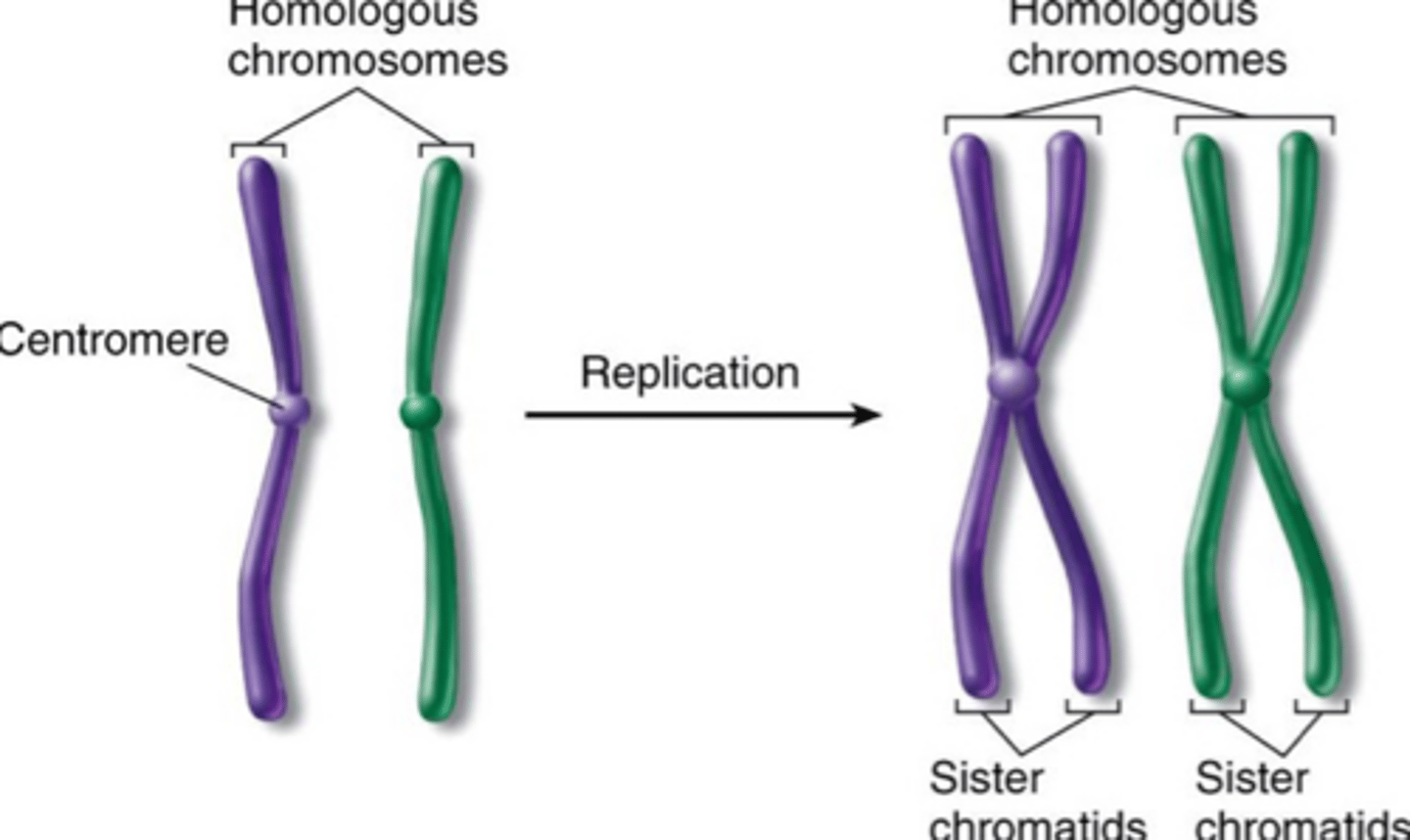
Describe chromosomes in a homologous pair. What is their role?
● Both the same size and have the same genes, determining the same genetic characteristic, but could have different alleles.
● Determining the same genetic characteristics is NOT the same as being identical.
● Can be double or single armed
Where do chromosomes in a homologous pair come from?
One chromosome is derived from the chromosomes provided from the mother in the egg and one from the father in the sperm.
Describe human sex cells.
Haploid cells: have 23 chromosomes in total.
Are homologous pairs joined or single?
They are not joined, just the same as each other with different alleles.
Alleles at the same locus on each chromosome in a homologous pair..
Alleles coding for the same characteristic will be found at the same fixed position (locus) on each chromosome in a homologous pair.
RNA
● A single polynucleotide strand
● Contains uracil as a base instead of thymine.
● U-A always pairs during protein synthesis.
● Different types of RNA: mRNA, tRNA, rRNA
Describe the structure of mRNA.
● Single stranded polynucleotide
● Copy of a gene (made in transcription)
● Has groups of 3 adjacent bases called codons (triplets).
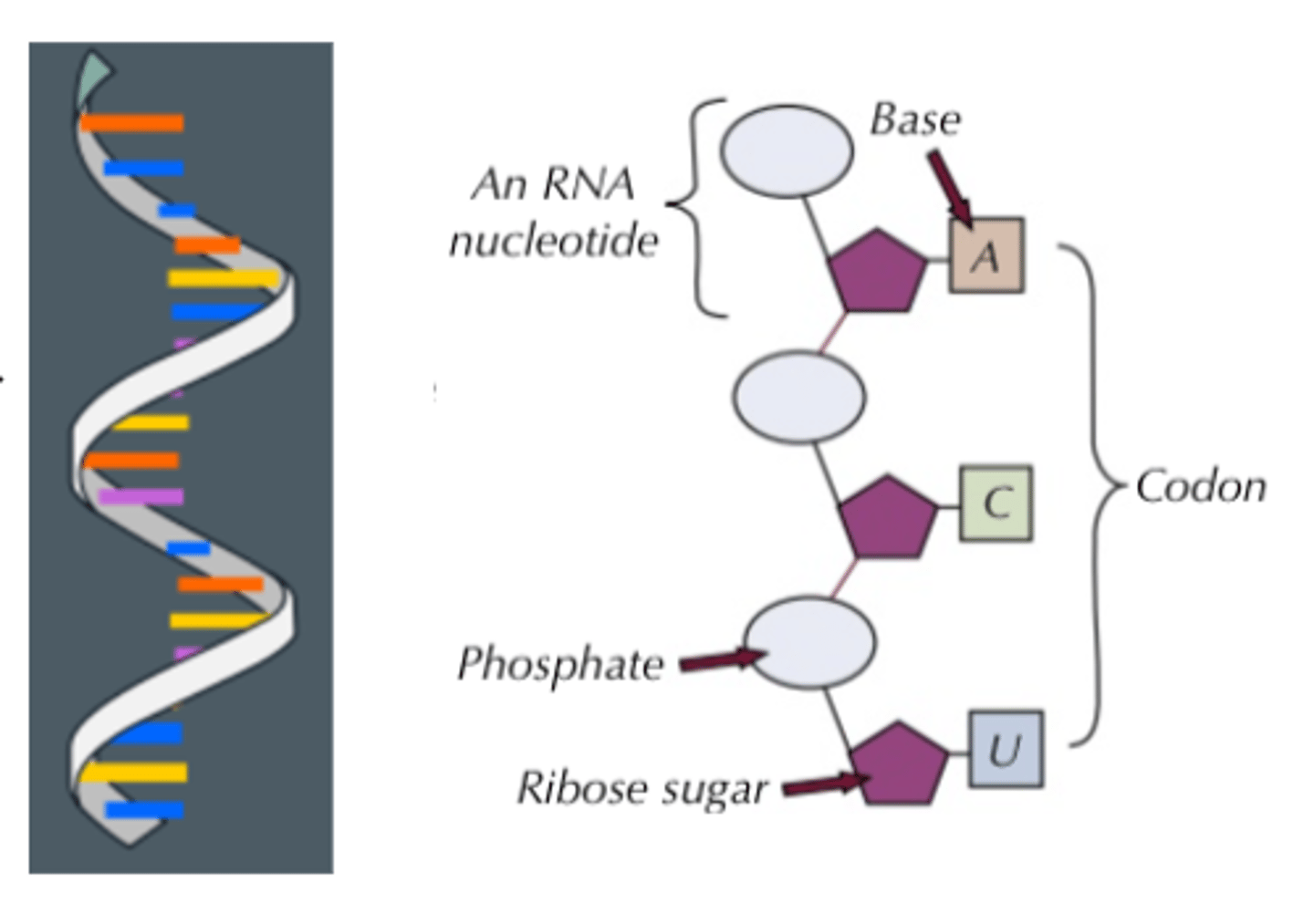
Describe the role of mRNA.
● Messenger RNA; carries the genetic code from the DNA in the nucleus to the ribosomes, where it's used to make a protein during translation.
● Copy of a gene
tRNA
● Single stranded polynucleotide.
● Found in cytoplasm only
● Fewer nucleotides than mRNA.
● Folded into a clover shape;
Hydrogen bonds between specific base pairs hold the molecule in this shape.
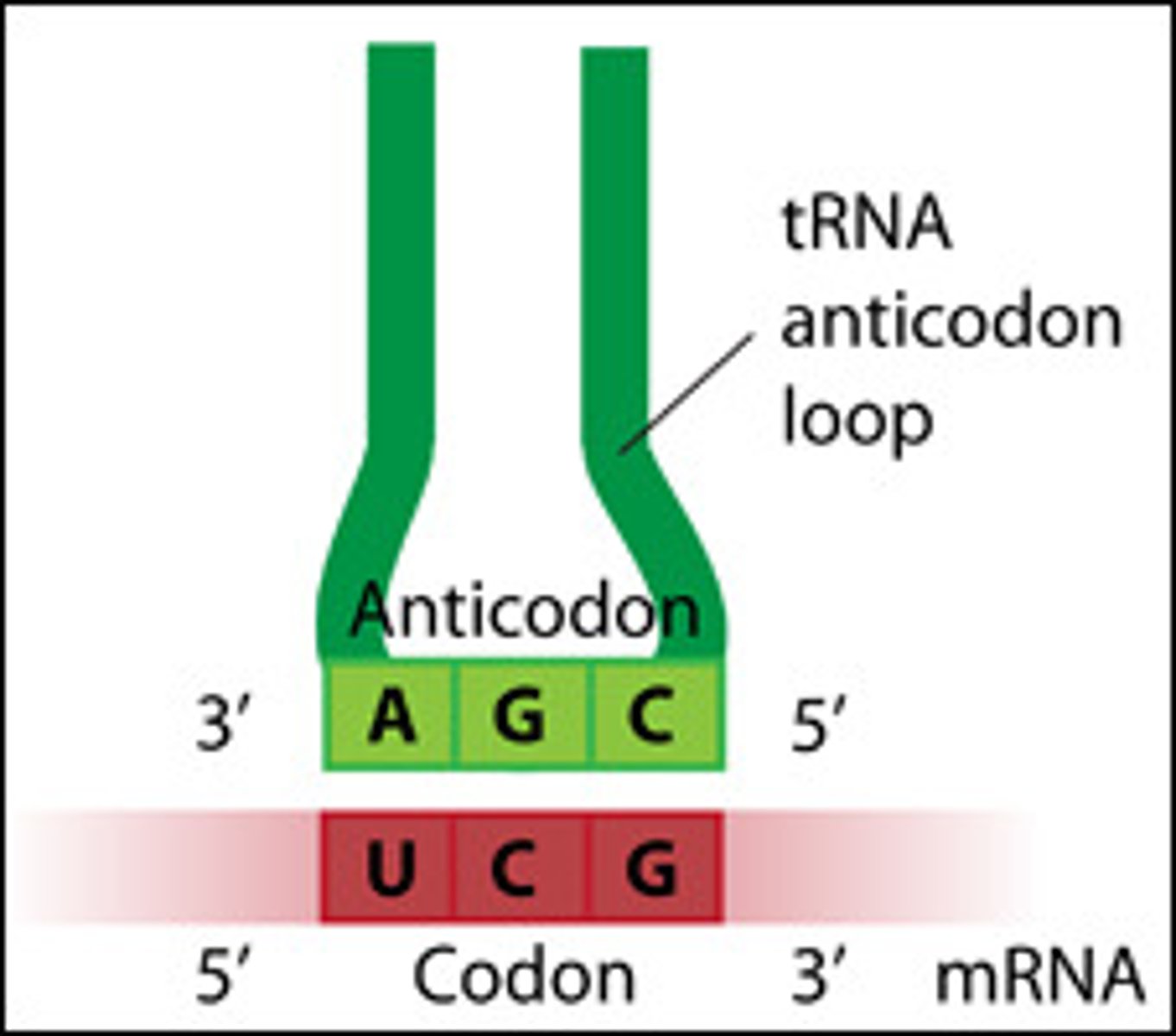
● Anticodon on one end: specific sequence of 3 bases
● Amino acid binding site at the other end.
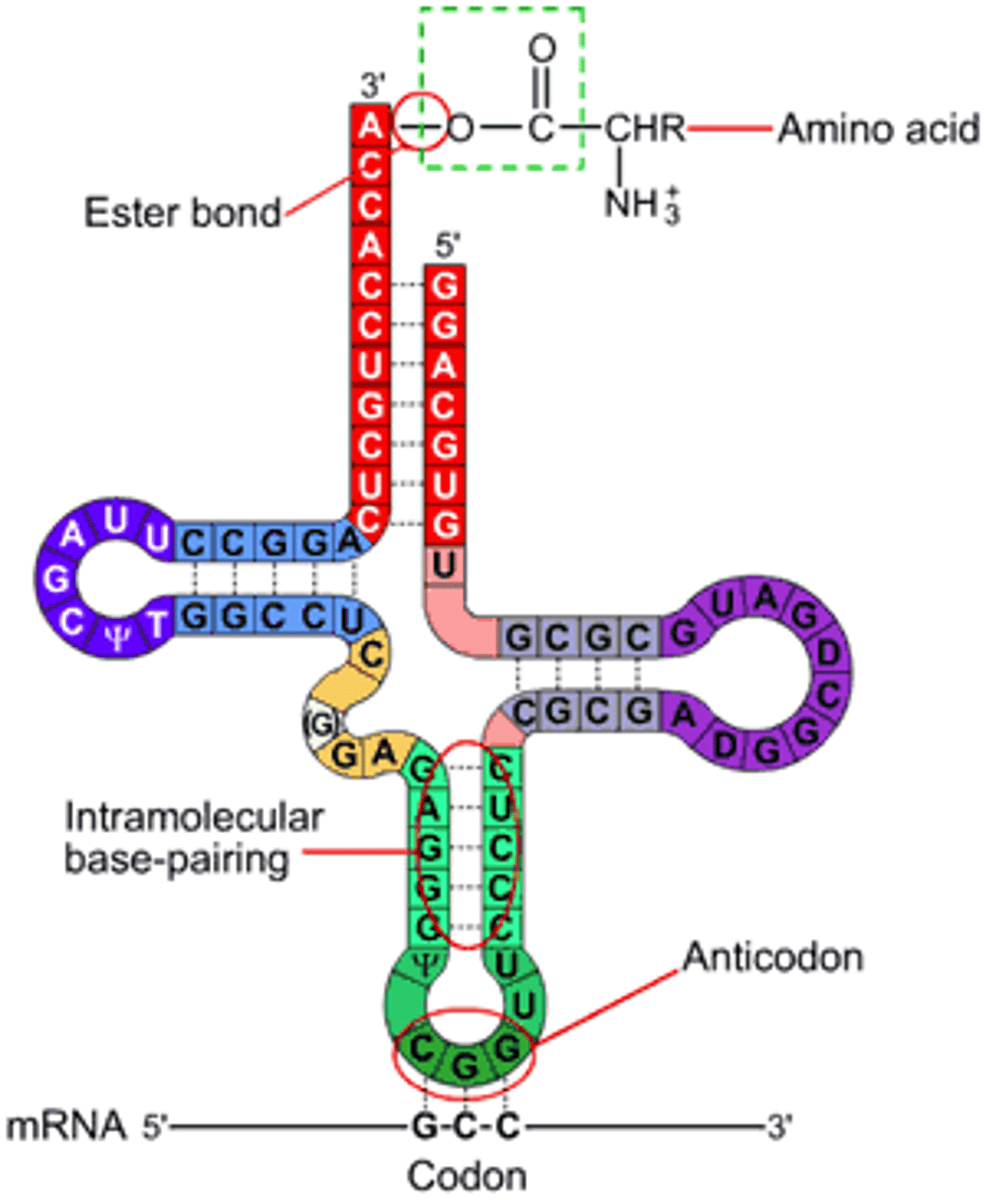
Describe the role of tRNA.
● Anticodon on one end: specific sequence of 3 bases
● Amino acid binding site at the other end.
● Each tRNA is specific to one amino acid and has an anticodon that is specific to that amino acid.
● Anti-codon base pairs with a complementary codon on mRNA
● tRNA involved in translation. Carries the amino acids that are used to make proteins to the ribosomes.
Is the anticodon actually made up of bases?
Yes. It is made up of 3 bases which are complementary to the codon on mRNA.
E.g. if mRNA codon = AUG
Then complementary tRNA codon = UAC
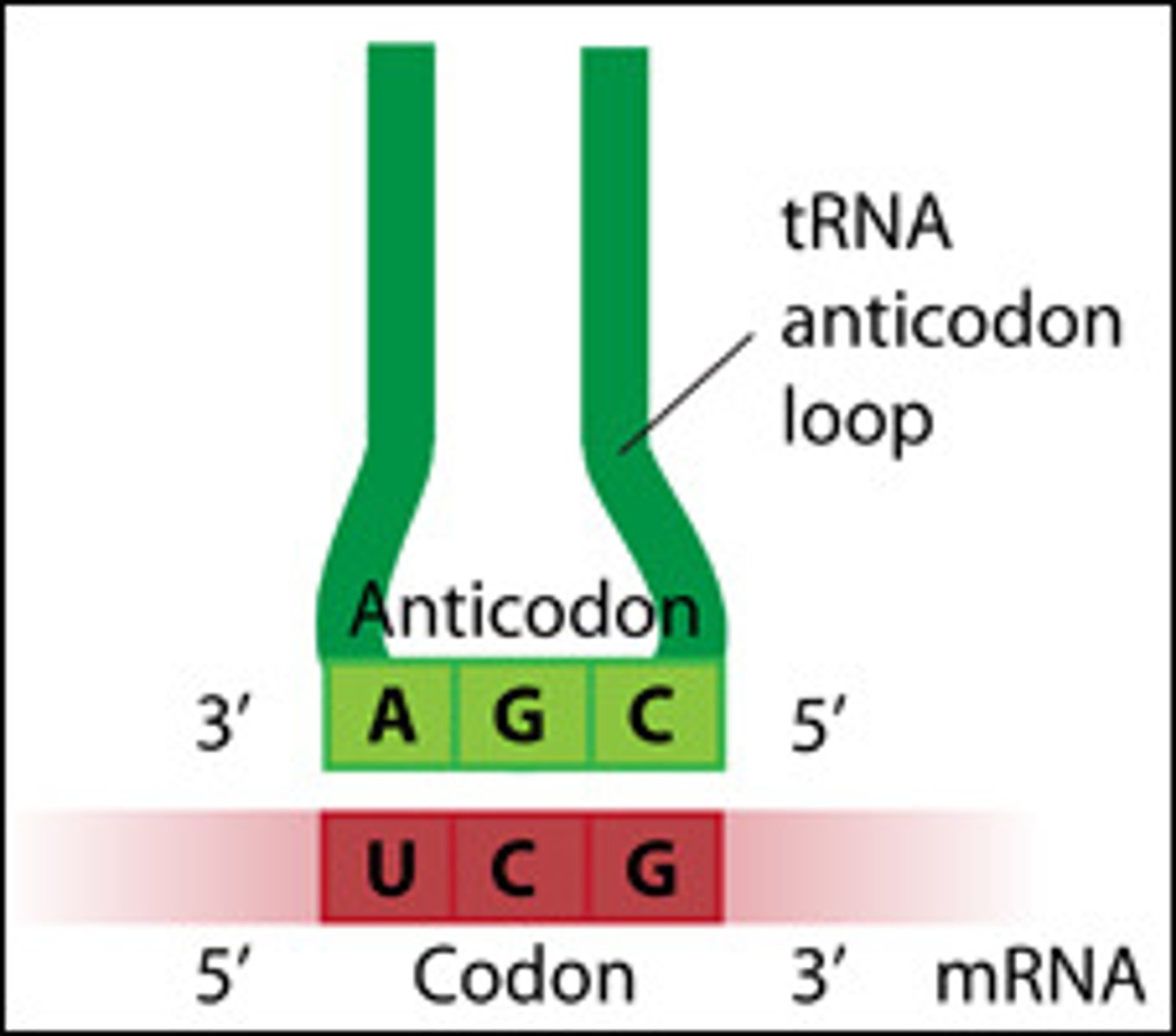
Compare and contrast the structure of tRNA and mRNA
Similarities:
● Both single polynucleotide strand
● Uracil base
Differences:
● tRNA is folded into a 'clover leaf shape', whereas mRNA is linear / straight
● tRNA has hydrogen bonds between paired bases, mRNA doesn't
● tRNA is a shorter, fixed length, whereas mRNA is a longer, variable length (more nucleotides)
● tRNA has an anticodon, mRNA has codons
● tRNA has an amino acid binding site, mRNA doesn't
Order DNA, mRNA and tRNA according to increasing length.
1. tRNA
2. mRNA
3. DNA
Which RNA do genes code for?
mRNA
tRNA
rRNA
rRNA
Ribosomal RNA: rRNA combines with proteins to form ribosomes
Functional RNA
● An RNA molecule that plays a role without being translated.
● Instead performs various cellular tasks
E.g. tRNA or rRNA
How do you calculate the number of different codon combinations?
Different codon possibilities = Number of different basesⁿᵘᵐᵇᵉʳ ᵒᶠ ⁿᵘᶜˡᵉᵒᵗⁱᵈᵉˢ ⁱⁿ ¹ ᶜʰᵃⁱⁿ
What is protein synthesis?
The production of proteins (polypeptides) from the information contained within a cell's DNA.
Outline protein synthesis.
●Transcription - DNA code is copied with mRNA.
● Translation - mRNA joins with a ribosome and the code it carries is used to synthesise a protein.
Give a basic overview of protein synthesis.
● DNA provides the instructions in the form of a long sequence of bases.
● A complementary section of part of this sequence is made in the form of a molecule called pre-mRNA - a process called transcription.
● The pre-mRNA is spliced to form mRNA.
● The mRNA is used as a template to which complementary tRNA molecules attach and the amino acids they carry are linked to form a polypeptide - a process called translation.
Codon
A set of 3 bases on mRNA that codes for an amino acid.
Describe transcription.
1. DNA helicase breaks hydrogen bonds between DNA bases on 2 strands
2. Only one DNA strand acts as a template
3. Free RNA nucleotides attracted to exposed complementary bases on the template strand
○ In RNA, U not T (pairs with A in DNA)
4. RNA polymerase joins adjacent RNA nucleotides
5. This forms phosphodiester bonds via condensation reactions, between phosphate of one nucleotide and ribose of another, forms sugar-phosphate backbone.
6. Pre-mRNA is formed, and this is spliced to remove introns, forming (mature) mRNA
Describe the DNA after transcription.
It is the same.
When does transcription stop?
When the RNA polymerase reaches the terminator sequence: a particular sequence of bases on the DNA that it recognises as a 'stop' codon, it detaches.
(the production of pre-mRNA is then complete.)
Describe pre-mRNA in relation to the DNA strands.
● The pre-mRNA is complementary to the DNA strand being transcribed.
● The pre-mRNA strand is a copy of the non-template DNA strand, with uracil replacing thymine.
Describe how production of messenger RNA (mRNA) in a eukaryotic cell is different from the production of mRNA in a prokaryotic cell.
● Pre-mRNA produced in eukaryotic cells whereas mRNA is produced directly in prokaryotic cells.
● Because genes in prokaryotic cells don't contain introns so no splicing in prokaryotic cells.
Why can't the DNA leave the nucleus?
● It's too large
● Enzymes in the cytoplasm which could damage the DNA
What happens to the DNA strand as the RNA polymerase adds the nucleotides one at a time to build the pre-mRNA strand?
● The DNA strands rejoin behind.
● So only about 12 base pairs on the DNA are exposed at any one time
Splicing of pre-mRNA
● Pre-mRNA is spliced to remove introns, leaving only exons behind.
● Mature mRNA is formed.
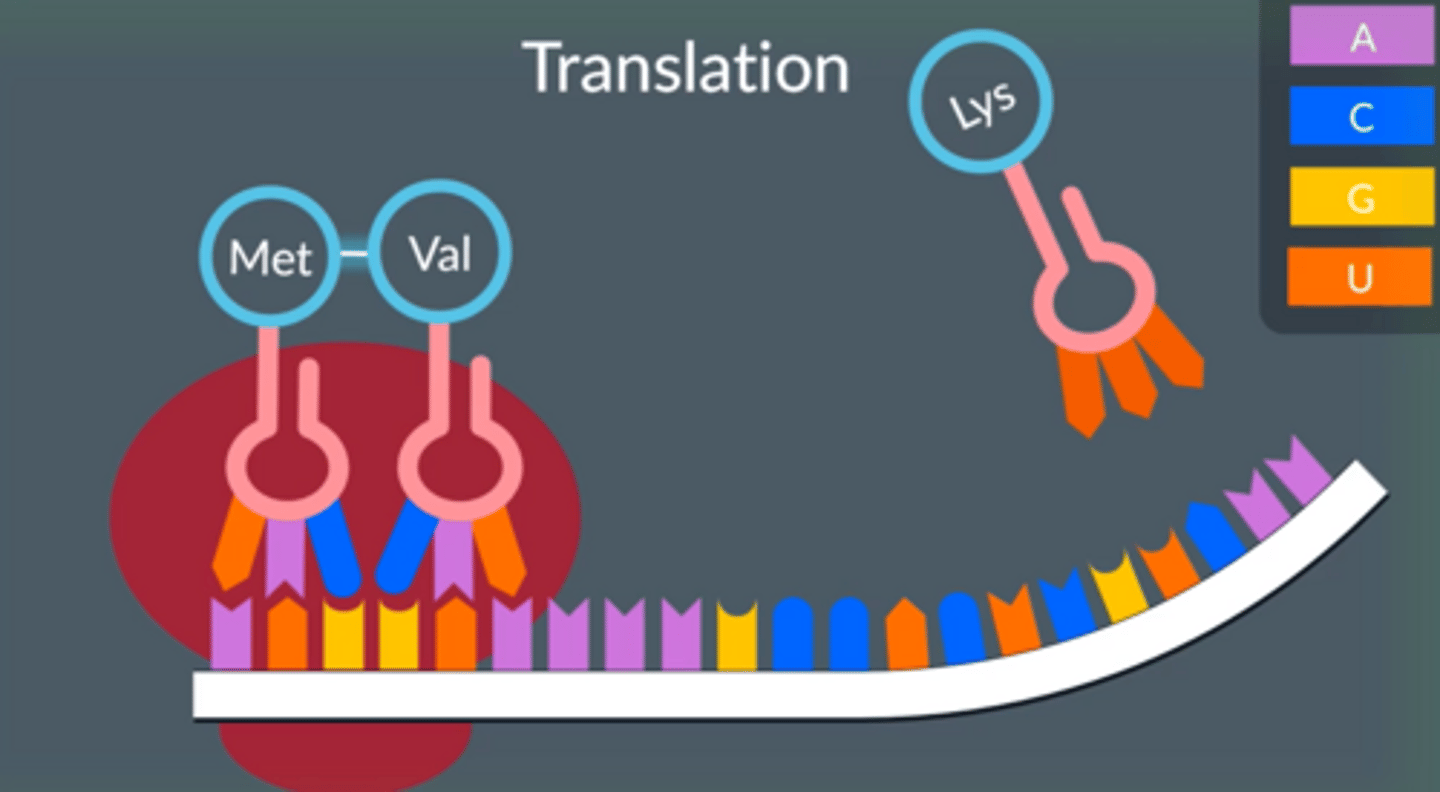
Describe how translation leads to the production of a polypeptide.
1. mRNA attaches to a ribosome and the ribosome moves to a start codon
2. tRNA anticodon at one end binds to complementary mRNA codon
3. tRNA brings a specific amino acid on other end of tRNA
4. Ribosome moves along to next codon and another tRNA binds so 2 amino acids can be joined by a condensation reaction forming a peptide bond
○ Using an enzyme and energy from hydrolysis of ATP
5. tRNA released after amino acid joined polypeptide
6. Ribosome moves along mRNA to form the polypeptide, until a stop codon is reached
Anticodon
A set of 3 bases on tRNA that are complementary to a codon on mRNA.
It is attached to a molecule carrying an amino acid
Summarise translation.
● mRNA is 'read' and 'translated' into a protein
● Occurs on ribosomes
● Involves tRNA
● Trying to make primary structure of protein (polypeptide)
Describe translation.
1. After splicing, mRNA goes to RER, a ribosome attaches at the start codon. It moves along one codon at a time.
2. There are around 60 different tRNA molecules which attach to an amino acid at one end and have an anticodon on the other end which is complementary to a specific codon.
3. When the ribosome moves to a codon, the tRNA with a complementary anticodon moves to it bringing in the correct amino acid.
4. As the ribosome moves along, more amino acids are brought in to place by the complementary tRNA. The ribosome joins the amino acids together to form peptide bonds (via cond) using an enzyme and ATP (for energy)
5. This occurs until the ribosome reaches a stop codon, causing it to separate from the mRNA and release the polypeptide.
Describe the role of the ribosome in translation.
1. Assemble amino acids into specific proteins (using enzyme + ATP)
2. By facilitating tRNA binding
What happens to the polypeptide chain created?
Sometimes a single polypeptide chain is a functional protein. What happens to the polypeptide next depends upon the protein being made:
● The polypeptide is coiled or folded, producing its secondary structure.
● The secondary structure is folded, producing the tertiary structure.
● Different polypeptide chains, along with any non-protein groups, are linked to form the quaternary structure.
What is the analogy used for translation?
Chefs in a kitchen.
mRNA is the recipe
tRNA are the sous-chefs which bring the correct ingredients (amino acids)
Ribosome is the head chef
Describe the role of ATP in translation.
● Hydrolysis of ATP to ADP + Pi releases energy
● So amino acids join to tRNA's and peptide bonds form between amino acids
Describe the role of tRNA translation.
● Attaches to / transports a specific amino acid, in relation to its anticodon
● tRNA anticodon complementary base pairs to mRNA codon, forming hydrogen bonds
● 2 tRNA's bring amino acids together so peptide bond can form
Describe the role of ribosomes in translation.
● mRNA binds to ribosome, with space for 2 codons
● Allows tRNA with anticodons to bind
● Catalyses formation of peptide bond between amino acids (held by tRNA molecules)
● Moves along (mRNA to the next codon) / translocation
Where do the tRNA go after bringing the correct amino acid?
'Empty' tRNA leaves to go pick up another amino acid to bring to the polypeptide chain.
Describe how the base sequence of nucleic acids can be related to the amino acid sequence of polypeptides when provided with suitable data.
● You may be provided with a genetic code to identify which triplets / codons produce which amino acids (example shown)
● tRNA anticodons are complementary to mRNA codons
○ Eg. mRNA codon = ACG → tRNA anticodon = UGC
● Sequence of codons on mRNA are complementary to sequence of triplets on DNA template strand
○ Eg. mRNA base sequence = ACG UAG AAC
→ DNA base sequence = TGC ATC TTG
● In RNA, uracil replaces thymine
The amino acid leucine is coded by the base triplet GAA.
Identify the codon and anticodon.
Codon: CUU
Anti-codon: GAA
Where does translation begin?
● At the start codon.
● Always AUG which means it always codes for the same amino acid, methionine.
Where does translation end?
● When the ribosome reaches a stop codon: a set of 3 bases which stops translation but doesn't actually code for an amino acid.
● AKA termination / nonsense codons
An mRNA strand has the codon GCU.
a) What is the DNA triplet complementary to this codon?
b) What is the complementary tRNA anticodon?
a) CGA
b) The tRNA anticodon is usually identical to the original DNA base triplet (except where T is replaced by U in the anticodon).
CGA
Give 3 ways in which the DNA in a chloroplast is different from the DNA in the nucleus. (3)
In chloroplasts:
1. DNA shorter
2. Fewer genes
3. DNA circular not linear
4. Not associated with proteins/histones, unlike nuclear DNA
5. Introns absent but present in nuclear DNA
Scientists produced a short, single-stranded, artificial nucleic acid, called PNA. The PNA binds to a small section of DNA.
The scientists introduced PNA into cells and discovered that these cells produced less mRNA than cells that did not contain PNA.
Suggest how PNA affected the transcription of the section of DNA.
● PNA is complementary to DNA / forms base pairs with DNA
● Preventing/reducing RNA polymerase activity/binding. RNA nucleotides can't bind.