Chapter 7: (7.1-7.3) Serious Mental Illness
 Call Kai
 Learn
Learn Practice Test
 Spaced Repetition
 Match
Match Flashcards
 Knowt Play
1/46

There's no tags or description
Looks like no tags are added yet.
Name | Mastery | Learn | Test | Matching | Spaced | Call with Kai |
|---|
No analytics yet
Send a link to your students to track their progress
47 Terms
precision faster side effects
Identifying genetic variants that increase risk for the development of a psychiatric disorder may: increase ___________ in diagnosis and treatment and aid in the development of treatments that work _______ and have fewer ______ _________ in medicines.
mental illness
Patterns of thinking, emotion, or behavior (or a combination) that interfere with social relationships, occupations, or other important areas of life, and which persist for an extended time and cause substantial problems and/or distress.
thinking emotion behavior
Mental illness is when people experience patterns of ________, _________, and/or ___________ that interfere with social relationships, occupations, or other important areas of life, and which persist for an extended time and cause substantial problems and/or distress.
interfere with important areas of life
Patterns of thinking, emotion, or behavior (or a combination) that ___________ ________ _________ __________ __________ __________, and which persist for an extended time and cause substantial problems and/or distress.
extended time problems distress
Mental illness is when people experience patterns of thinking, emotion, or behavior (or a combination of these) that interfere with social relationships, occupations, or other important areas of life, and which persist for an ___________ _______ and cause substantial ____________ and/or _________.
comorbidity
The simultaneous presence of multiple disorders in a person.
10 15
In 2017 it was estimated that between __ percent and
__ percent of people worldwide experienced one or more mental illness
Disability-Adjusted Life Years
(DALYs) A measure of disease burden that estimates the number of years lost to illness, disability, or premature death. Mental illnesses account for approximately 7 percent of DALYs worldwide
no
Is it necessary to qualify for a diagnosis of mental illness to experience negative impacts of poor mental health?
half
Even though mental illness can have dramatic impacts on people's lives, it is estimated that
fewer than _____ of those who have a mental illness receive mental health services
mental health services
Typically consist of talk therapies, medications, and social services, and may take place in a residential facility, or in the context of outpatient visits.
precision medicine
an approach to disease treatment and prevention that accounts for individual variation in genes and environment; not successful or common in Mental health yet
risk alleles
gene variants that confer increased risk for a particular trait or disorder
protective alleles
Genetic variants that are associated with decreased risk for a disorder.
genetic risk
The sum of alleles that increase the probability of developing a disorder (i.e., risk alleles) and those that decrease the probability (i.e., protective alleles)
environmental risk
Non-genetic risk factors such as childhood trauma, exposure to substances like cannabis, or social factors such as insecure parental attachment, or discrimination.
diathesis-stress model
A model of disease risk whereby an individual's vulnerability to develop a mental illness is a function of their genetic risk (i.e., diathesis) and exposure to adverse life events (i.e., stress).
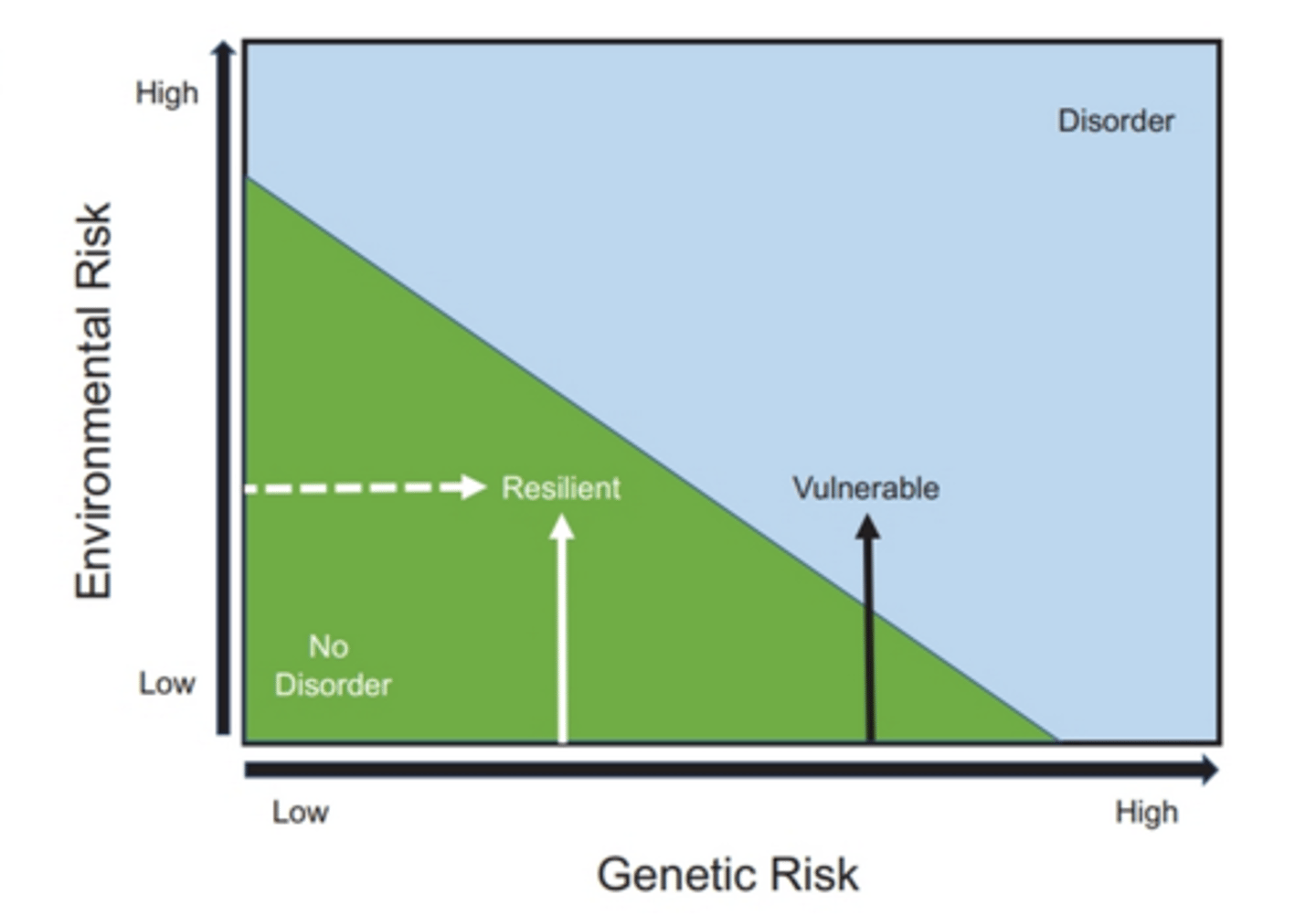
differential sensitivity hypothesis
A model of disease risk in which people carrying certain genotypes are more sensitive to both negative and positive environmental exposure than are those carrying other genotypes.
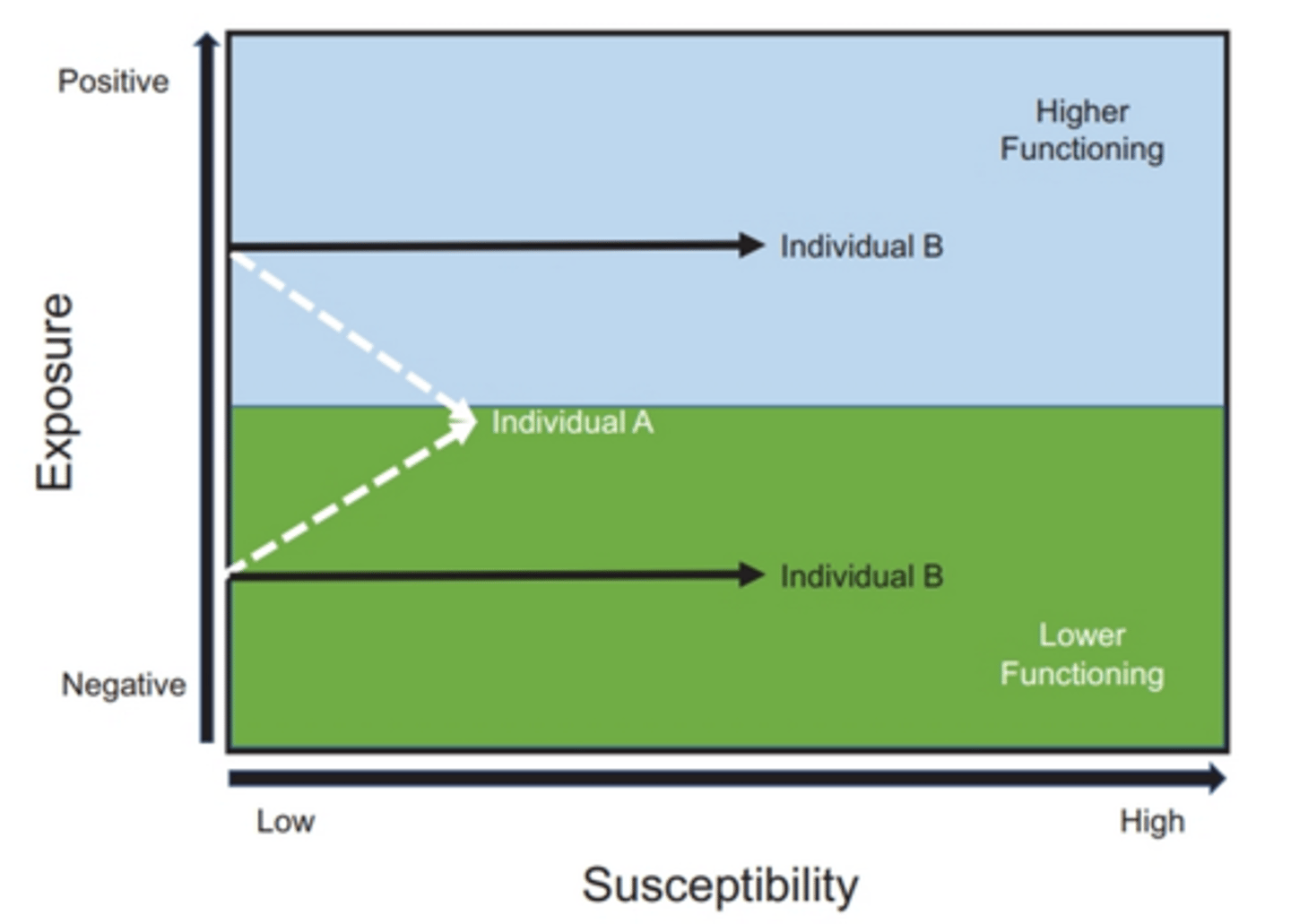
differential sensitivity hypothesis
Which model explains why risk alleles are still prevalent in the population, despite possibly disadvantaging those that have them?
sensitivity alleles
Proposed by differential sensitivity hypothesis to be genetic variants that are responsive to both negative and positive exposures; they might be neutral with respect to selection overall and therefore found to have intermediate frequencies.
Qualitative quantitative
_____________ traits are likely determined by few genetic variants, whereas _____________ traits are likely determined by many genetic variants in combination with environmental influence.
Diagnostic and Statistical Manual of Mental Disorders
DSM Handbook used primarily in the US as a guide for diagnosing mental illness
International Classification of Diseases
ICD; Handbook used worldwide as a guide for diagnosing mental illness. Used in this Book; on its 11th revision
heterogeneity
Diagnostic systems may be good for treatment and diagnosis, but they may not reflect the ____________ of the underlying causal structures of mental illnesses.
reification
an error of treating an abstract concept as though it has a real, material, biological existence; doesn't account for the fact that phenotypes may just be artifacts of the diagnostic system
levels of analysis
Pathways from genes to behaviors involve molecules, cells, circuits, physiology, and are impacted by social and cultural factors. Each of these levels can be studied using techniques and methods suited for that level, which may not translate across levels. Such complexity presents serious challenges to understanding causal heredity-behavior relations.
genes molecules cells circuits physiology behavior
Behavior genetics general levels of analysis (smallest to largest, each one builds into the next, each one is influenced by environment and may change across development)
indirect
Any association between genetic variation and individual differences in behavior must be _________. To cause individual differences in behavior, genetic variants must affect biology at some level of analysis.
Research Domain Criteria
(RDoC) The National Institute of Mental Health effort to understand mental illness risk by studying endophenotypes; Consists of 6 domains of function; developed because current diagnostic categories do not well reflect underlying biology
endophenotypes
The general idea is that there are internal (i.e., not immediately visible) phenotypes that may be considered risk factors for developing the disorder, and that these so-called _____________ are influenced by fewer genes, and therefore may be simpler genetically than the disorder.
risk indicators
Traits that are predictors of a disorder.
closer
It is possible for two people with completely different symptoms to meet criteria for the same diagnosis. Therefore, focusing on traits (endophenotypes) that are some number of levels of analysis "________" to the genes, rather than on the diagnosis, may be a more fruitful approach to genetic analysis
intermediate phenotype
A term that is sometimes used as a synonym for endophenotypes, but because it is less precise, it should be avoided.
causal correlated
a risk factor is ________ while a risk indicator is __________. An endophenotype can be either, and it is difficult to distinguish in human subjects.
additive function
Qualitative diagnoses can be an ________ __________ of the number of quantitative endophenotypes (traits) meet diagnostic threshold. Insufficient number/variety of traits or insufficient severity in enough traits can prevent diagnosis.
RDoC domains
1. negative valence systems
2. positive valence systems
3. cognitive systems
4. systems for social processes
5. arousal/regulatory systems
6. sensorimotor systems
units of analysis
methods that can be used to assess constructs across levels of analysis
no definitive
In other words, there appears to be __ __________ answer to the question of whether mental illnesses are qualitative or quantitative traits.
dysfunction, distress, deviance
The 3 D's of clinical psychology
copes
That's all a symptom is. It's a way, a common way that someone _______ with whatever they're feeling, thinking, or is happening inside of them.
pleiotropy
What does high comorbidity (e.g being more likely to have 2 diagnoses than 1) mean genetically? likely ____________
an unlit bomb
What is the metaphor for the diathesis stress model?
dandelions and orchids
What is the differential sensitivity hypothesis metaphor?
disordered functioning
Psychology has a bias, and it is that we study ________ _____________. We study half of the graph and generalize to the rest.
dandelions
Grows equally well in a perfect garden as in a crack in some concrete. The idea here is that this is a person who is not remarkably susceptible to the environment.
orchids
A risk-reward type of flower. In perfect conditions, you get a beautiful bloom. But if conditions are bad, you're gonna get crap. They're more influenced by the environment, for better or for worse.
draw a line second standard deviation
What do diagnostic manuals do to determine diagnosis? they _______ ___ ________ on the normal distribution of symptoms, often at the _______ __________ _________