essay 14 - class V cavity prepartion for amalgam and indirect restorations - indications, stages of preparation, retentions
 Call Kai
 Learn
Learn Practice Test
 Spaced Repetition
 Match
Match Flashcards
 Knowt Play
1/5

There's no tags or description
Looks like no tags are added yet.
Name | Mastery | Learn | Test | Matching | Spaced | Call with Kai |
|---|
No analytics yet
Send a link to your students to track their progress
6 Terms
what is class V prepartion?
restoration on gingival third of facial or lingual surfaces of all teeth
Indications for class V preparations for amalgam and indirect restorations
cervical caries in non-aesthetic areas
deep gingival lesions where moisture control is difficult
abutment teeth for partial dentures (due to wear resistance)
root surface lesions requiring strong, durable material
Lesions needing long term restorations
contraindications for class V preparations for amalgam and indirect restorations
aesthetically sensitive areas (visible in speech or smiling)
Highly demanding aesthetic patients
stages of class V preparation for amalgam
Initial stage
enter with tapered fissure bur to depth:
— 0.5 mm inside DEJ (enamel)
— 0.75 mm in cementum (root)
follow facial surface curvature → convex axial wall
Margins extended to sound tooth structure
external walls perpendicular to the surface and parallel to enamel rods
Final tooth preparation
Remove infected dentin
apply liner/base only is needed
prepare retention grooves:
— along gingivo axial and inciso axial line angles
— 0.25mm deep, 0.2 mm inside DEJ (or root)
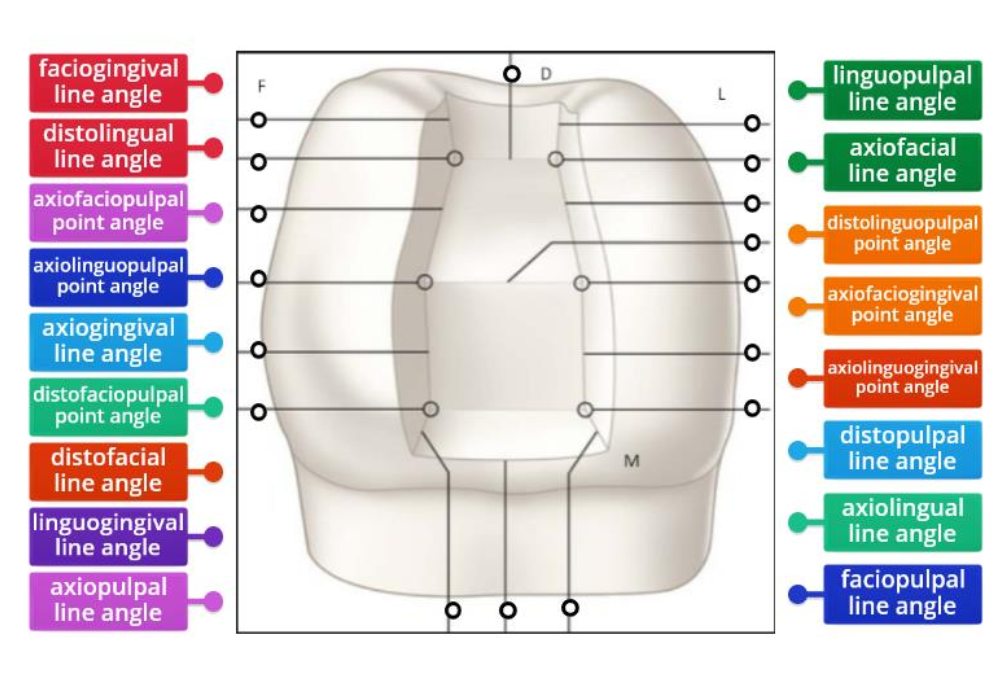
retention features for class V preparations for amalgam
macromechanical retention (retention grooves) + (occlusal wall is given a slight undercut toward the axial wall. helps resist dislodgement toward the occlusal direction)
requires gingival and incisal grooves
diverging external walls → grooves are essential
Class V preparations for indirect restorations (e.g lab-made inlays/onlays)
similar to prep as amalgam but often more conservative
Indicated for extensive lesions, aesthetic demands or when a composite restoration failed
Requires 90 degree butt joints, rounded internal line angles, and passive insertion path
Retention is bonding-based, sometimes reinforced with box form or slots