Brooke’s HOSA Clinical Nursing Flashcard set
 Call Kai
 Learn
Learn Practice Test
 Spaced Repetition
 Match
Match Flashcards
 Knowt Play
1/126

Earn XP
Name | Mastery | Learn | Test | Matching | Spaced | Call with Kai | Chat |
|---|
No analytics yet
Send a link to your students to track their progress
127 Terms
Abd
Abdomen
Where is the abdomen?
Between the chest and pelvic bone
Ac
Before meals
Bioavailability
The percentage of the drug or vitamin gets to the blood stream and has gone through the liver.
What part does the liver play in medications?
It destroys some of the oral medication in the first-pass effect and decreases its bioavailability.
First-pass effect
When a pill enters the body, it goes to the liver where part of it is destroyed
What is the liver’s function in the first pass effect?
It destroys part of the pill before it gets to the blood stream
Does an oral dose of a medication typically higher than dose than an intravenous one?
Yes. It takes more oral medication because it has lower bioavailability than an intravenous medication
Why would you take certain medications before a meal?
Food can decrease the drug's bioavailability
What route has 100% bioavailability?
IV, the medication skips the first pass effect
How does a subcutaneous medication work?
The needle enters the fatty tissue where there are fewer blood vessels so the medication releases slower
Why would you need to have a subcutaneous medication?
Because it releases slower and is less invasive than an IV or IM
How does a topical medication work?
The medication is applied to treat a local spot
Why would you use a topical medication over other medications?
Because most of the medication will stay in the area it was applied to
What body changes lower a pill’s bioavailability?
Increased pH, changes in microflora, altered GI motility
Ad lib
As desired
What is diabetes mellitus?
A disease where blood glucose/suger is too high
What is glucose?
It is the body’s main source of energy
How does the body get glucose?
The body can get it from food or can make it through the process of gluconeogenesis
What is gluconeogenesis?
What is Insulin?
A hormone that is made by the pancreas
How does insulin relate to glucose?
Insulin helps
What is the pancreas?
What does diabetes increase the risk of?
Damage to the eyes, kidneys, nerves and the heart
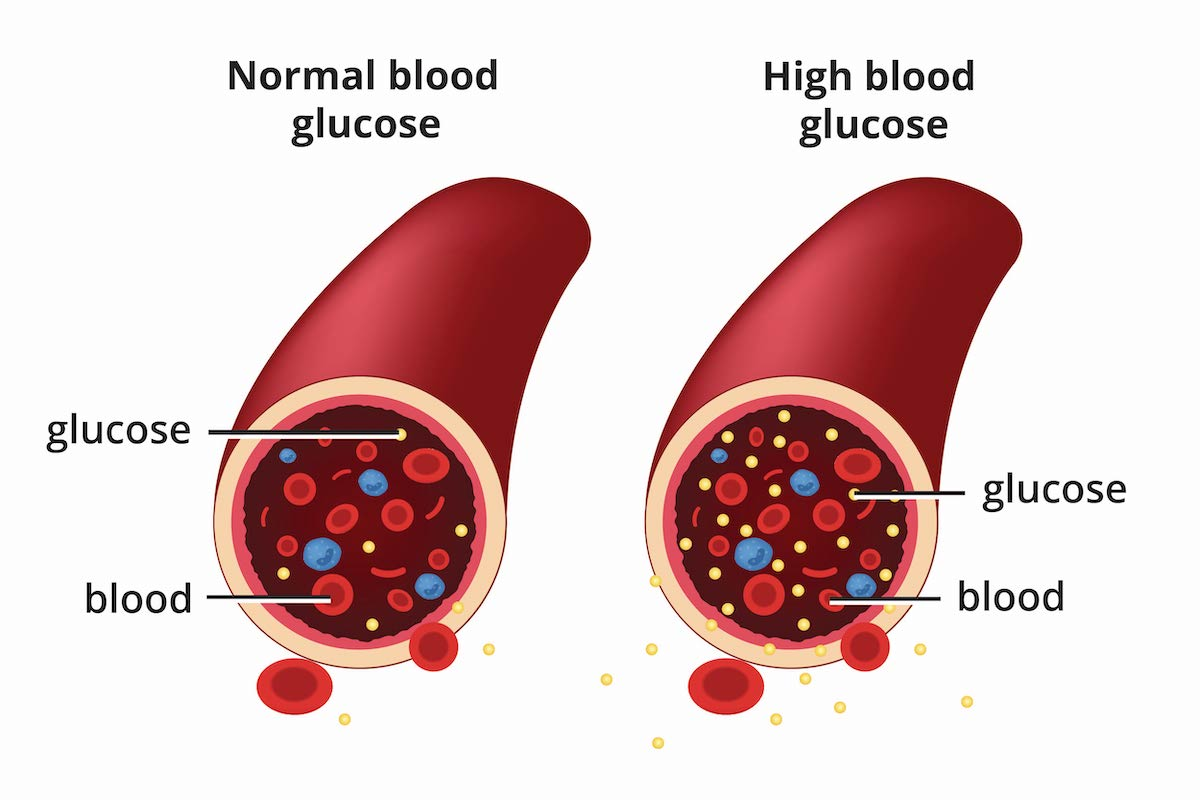
What is this a picture of?
What is hypoglycemia
HCT
hematocrit
HEENT
Head, eye, ear, nose, throat
Hob, hob
Head of bed
h/o
History of
HR
Heart Rate
hs
Bedtime; hour of sleep
HTN
Hypertension
hx
History
I & O
Intake and Output
IM
Intramuscular
IS
Incentive Spirometer
IV
Intravenous
IVP
Intravenous push
IVPB
Intravenous piggyback
KCI
Potassium Chloride
kg
Kilogram
KUB
Kidney, ureters and bladder
KVO
Keep Vein open
LB/lb
Pound
LOC
Level of consciousness
LR
Lactated ringer’s
MAP
Mean Arterial Pressure
MAR
Medication Administration Record
mcg
Microgram
MDI
Metered Dose Inhaler
m Eq
Milliequivalent
mm HG
Millimeters of mercury
mg
Milligram
MRI
Magnetic resonance imaging
MVA
Motor vehicle accident
Na Cl
Sodium chloride
neb
Nebulizer
N/V
Nausea and Vomiting
NG
Nasogastric
NKA
No known allergies
NKDA
No known drug allergies
NPO
Nothing by mouth
NSAID
Nonsteroidal anti-inflammatory drug
OOB
Out of bed
OTC
Over the counter
oz
ounce
p̄
After
p̄c
After meals
PCA
Patient-controlled analgesia
PERRLA
Pupils equal, round, reactive to light and accommodation
PMH
Past medical history
PMI
Point of Maximum impulse
PO
By mouth
PRN
As needed
pt
patient
PT
Prothrombin time or physical therapy
PPT
Partial thromboplastin time
q
every
qh
Every hour
qid
four times per day
RBC
Red blood cell count
R/O
Rule out
ROM
Range of motion
ROS
Review of systems
RR
Respiratory rate
R/T
Related to
RX, Rx
Prescription
s̄
Without
S & S, s/s
Signs and Symptoms
SCD
Sequential compression device
SL
Sublingual
SOB
Shortness of breath
S/P, s/p
Status post
stat
Immediately
Sx
symptoms
T
Temperature
tid
Three times per day
TPN
Total parenteral nutrition
TPR
Temperature, pulse, respiration