Spectroscopy
 Call Kai
 Learn
Learn Practice Test
 Spaced Repetition
 Match
Match Flashcards
 Knowt Play
1/33

There's no tags or description
Looks like no tags are added yet.
Name | Mastery | Learn | Test | Matching | Spaced | Call with Kai |
|---|
No analytics yet
Send a link to your students to track their progress
34 Terms
What class of substances are a) attracted and b) repelled by a magnetic field
a) paramagnetic (at least 1 unpaired electron)
b) diamagnetic (no unpaired electrons)
Electrons pairs in diamagnetic materials (contribute to/oppose) homogenous magnetic field H0
Electrons pairs in diamagnetic materials (contribute to/oppose) homogenous magnetic field H0
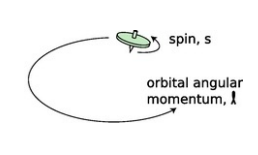
What are the two forces that paramagnetism/effective magnetic moment arises from?
spin angular momentum
orbital angular momentum= movement between orbitals
Spin only formula
μeff = √n(n+2) μB
where n= number of unpaired electrons
What causes deviations from the spin only formula?
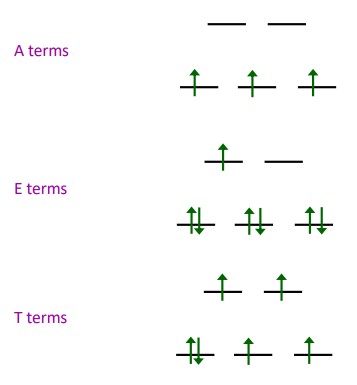
when the number of electrons in the dyx, dxz and dyz orbitals is not the same
only significant for T terms where electrons can be arranged in 3 ways
What causes Zeeman splitting?
in an applied magnetic field the electrons with spin in the same direction as the field raise in energy and the electrons with opposite spin direction lower in energy
When is orbital contribution (L) to μeff relevant?
unequal occupancy of octahedral t2g orbitals causing ability of electrons to transfer between dyx, dxz and dyz, increasing magnetism
Curie Law
XM= C/T
where C is the Curie constant
stipulates that thermal motion disrupts alignment of spin with H0 causing decreased magnetism
If the Curie Constant is not known, what is an approximation of the Curie Law' magnetic sisceptibility?
XMT≈ s(s+1)/2
A change in physical environment can trigger a switch between high and low spin configurations in complexes with how many d electrons?
4, 5, 6, 7
Curie-Weiss Paramagnets: formula and what the components mean
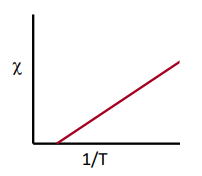
XM= C/(T-θ)
where θ is the Curie-Weiss constant
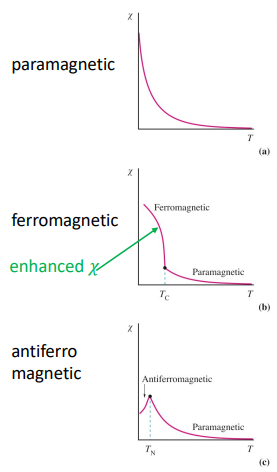
0>θ= ferromagnetic (image; -c)
θ<: antiferromagnetic (+c)
What kind of spins is a a) Curie and b) Curie-Weiss law applicable to?
a) isolated/ dilute spins with no orbital contribution to the magnetic moment
b) interactions between spins
The four types of magnetism arising from different electron spin alignments
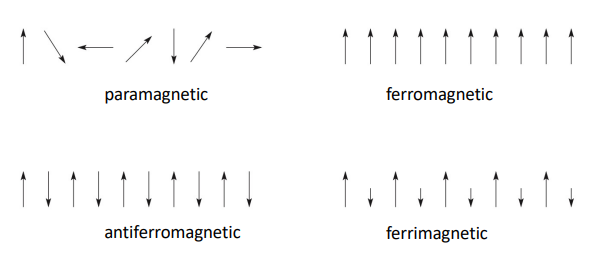
What does the trend look like for magnetism of a) para b) ferro and c) antiferromagnetic compounds with increasing temperature (vs. XM)?
magnetic orbital
orbital containing an unpaired e–; SOMO
exchange interactions: a) definition and b) types (2)
a) interaction between different spin (metal) centres with unpaired e—
b) direct interaction: overlap of magnetic orbitals
superexchange: magnetic orbitals overlap interact through the filled orbitals of bridging ligands
What does it mean if a compound is colourless or white?
No absorbtions/transmissions are possible between the energy levels corresponding to visible light
What are the rules governing the UV excitation of electrons? (2)
spin selection: cannot change spin multiplicity of the system
Laporte allowed: no transitions between energy levels of the same symmetry
Why are UV peaks broad?
The beam of light can hit any atom that possesses any energy state that can absorb a given photon; molecules are not the exact same
What is ε for a) symmetry allowed/ charge transfer, b) Laporte allowed, c) Laporte forbidden and d) spin forbidden transitions?
a) >1000
b) ~250
c) 20-100
d) <1
Ligand to Metal Charge Transfer transition
promoting an electron from an orbital that is mainly ligand in character to one of the d orbital on the metal
What are the features of a) metals and b) ligands that support LMCT?
a) higher oxidation states
b) anionic, with non-bonding lone pairs
*raise the ligand orbitals and lower the metal orbitals so they can be closer
What trend is observed for LMCT?
decreases moving left to a period and down a group
LMCT bands can be identified experimentally by…
demonstrating that in different solvents different wavelengths are observed, because the transition involves a change in dipole moment
MLCT ligands (3)
conjugated aromatic systems
CO
CN
TRUE OR FALSE: excited states involve moving an electron to a higher energy level
TRUE, BUT flipping the spin of an electron and moving it down is also an excited state!
What selection rule(s) does a LMCT obey?
both Laporte and spin selection rules
Where do LMCT bands appear?
in visible or near UV range (400-800 nm)
What is the relationship between wavenumber and wavelength?
Inversely proportional?
What effect on the wavelength of absorption (inverse to energy) does a) increasing electronegativity of metal (→↑), b) increasing electronegativity of ligand and c) increasing oxidation state have?
a) increase
b) decrease
c) increase
When does MLCT happen; what ligands is it common for?
low metal oxidation states
ligands with low lying pi orbitals eg. aromatic systems, CN, CO
Intervalence charge transfer (IVCT) can occur for…
polynuclear compounds with metals in different O.S.
Moving to lower symmetry generally results in observation of (__) spectral features
more (callback to x-ray crystallography)
TRUE OR FALSE: Jahn-Teller distortion results in more peaks
TRUE