Bio Final Note Cards 2026
 Call Kai
 Learn
Learn Practice Test
 Spaced Repetition
 Match
Match Flashcards
 Knowt Play
1/79

There's no tags or description
Looks like no tags are added yet.
Name | Mastery | Learn | Test | Matching | Spaced | Call with Kai |
|---|
No analytics yet
Send a link to your students to track their progress
80 Terms
Evolution
The change in allele Frequencies over time
Acquired traits can NOT be…
Inherited
What idea is supported by Darwin’s observation of local variation among tortoises in the Galápagos Islands?
Adaptation
What idea is supported by Darwin’s observation of local variation among tortoises in the Galápagos Islands?
Adaptation
Natural Selection is AKA…
Survival of the fittest
Fossils
Remains of Ancient Organisms
How does embryology support the Theory of Evolution?
It shows that embryos who develop similarly share a common ancestor
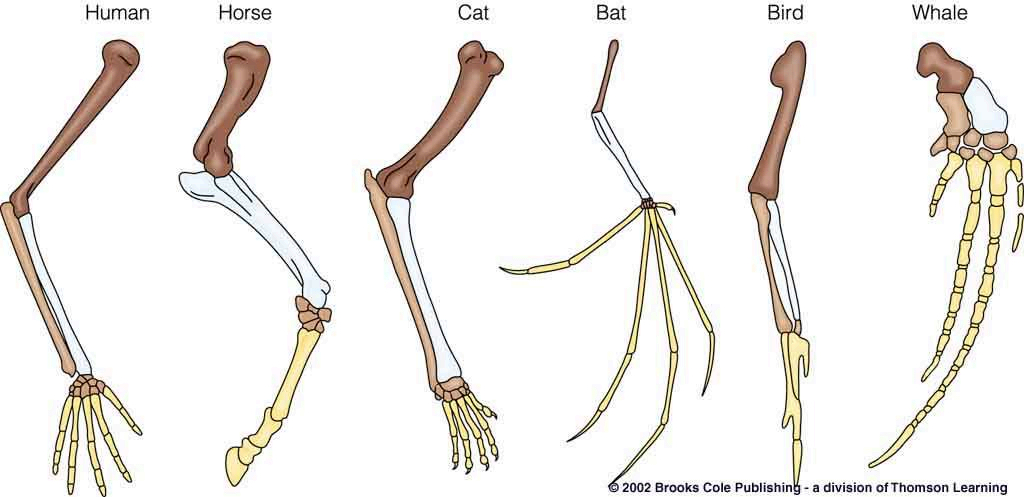
The similarities of the bones in the diagram provide evidence that…
The organisms may have developed from a common ancestor, making them homologous
Embryology
The study of Embryos and how they form.
Embryos
Unborn Babies
Species
A group of Organisms that can reproduce and have fertile offspring
Heritable Traits
Traits that are able to be passed on to another generation
Anatomy
The body structure of a living thing
Artificial Selection
Humans choose which traits we want animals to have and breed accordingly
Biogeography
The study of how living things are disturbed around the world
Variation
Differences between members of a population
Vestigial Structures
Inherited structures that are reduced in size (Overtime) and are no longer in use. Like the appendix or tailbone in humans.
Theory of Acquired Characteristics (Was proved to be wrong)
A theory that says that traits acquired in life (A tattoo for example) are passed down to future generations.
Gradualism
Slow processes that cause organisms to evolve over a very long period of time
Paleontology
The study of fossils or extinct organisms
Paleontologist
Someone who studies fossils
Natural Selection
A theory that says that individuals that have beneficial adaptations are more likely to mate and pass on those traits
Homologous
Structures found in different species that are similar in structure (Composition), but have different functions. (Ex. Cat and Human Arm)
Analogous
Structures that are similar in function, but are not similar in origin, meaning that they do not come from a common ancestor. (Ex. Whale and Shark Fins)
Recombination
The different ways chromosomes can match up
What 2 things must be true in order for organisms to be considered the same species?
They must have structural Similarities
They must be able to produce viable offspring
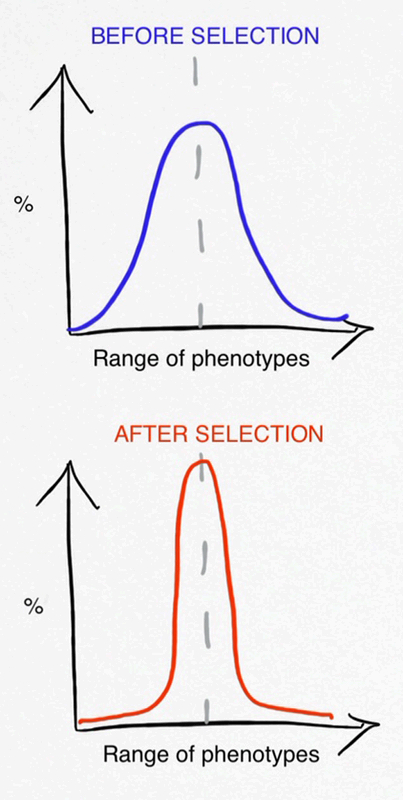
This distribution graph shows…
Stabilizing Selection
What does “p” represent in the Hardy-Weinberg equation?
The Frequency of the Dominant Allele
What is the formula for the frequency of Heterozygous individuals in a population?
2pq
If 16% of a population is unable to taste a certain chemical due to a recessive allele, what is the frequency of the recessive genotype?
0.16
If 16% of a population is unable to taste a certain chemical due to a recessive allele, what is the frequency of the recessive allele?
0.4
If 16% of a population is unable to taste a certain chemical due to a recessive allele, what is the frequency of the dominant allele?
0.6
If 16% of a population is unable to taste a certain chemical due to a recessive allele, what is the frequency of the dominant genotype?
0.36
If 16% of a population is unable to taste a certain chemical due to a recessive allele, what is the frequency of the heterozygous carriers?
0.48
Why is the Hardy-Weinberg useful in studying genetic disorders?
It helps in understanding the spread of disorders
It predicts the future genetic make-up of populations
It assists in calculating carrier probabilities
In the Hardy-Weinberg Equation, what does q² represent?
The recessive Genotype
What 5 conditions are NECESSARY for the Hardy-Weinberg equation to apply to a population?
Large Population size (No small size in population)
Random Mating (No Artificial Selection)
No Selection (Not one trait is better than the other/does not have any impact on reproductive fitness)
No Mutation (Every trait is going to be perfect)
No Migration (No animals leaving, No new animals joining)
Zone of Physiological Stress
Stress is found when the factor is too high or low, killing off the weaker members of the population
Optimal Range
The ideal amount of a factor that is best for the survival of a population
Zone of Intolerance
A zone that is significantly lacking in a factor for a population. Not survivable in the long term, causing the population to eventually die out.
This level of ecological organization includes both abiotic and biotic factors such as animals and water
Ecosystem
This occurs when more than one individual or population tries to use the same limited resource.
Competition
In order to reduce competition, some species will form a niche with other populations, even if they are similar in species, due to their abilities to do what?
Resource partition
Two raccoons fighting for dominance over a scrap of food is an example of what?
Intraspecific competition
Barnacles or animals that cannot move. In order to get food, they attach to whales and catch any floating plankton in the water. The whale is neither helped nor harmed in the interaction. What type of symbiosis is this?
Commensalism
A tapeworm lives in the intestines of a dog. It absorbs the food the dog has eaten and grows larger in the process. The dog becomes weaker from malnutrition. What type of symbiotic relationship is this?
parasitism
Starfish are probably the most important predator in the shallow ecosystem. This is because they eat basically anything that they can come across. Their feeding activities control the whole ecosystem. This is an example of the starfish’s…
Niche
Niche
An organism's role/responsibility in the ecosystem
The herbivore level in a food pyramid is also known as what?
Primary consumers
A rise in the population of prey is often followed by a ___ in the population of predators.
Rise
Decomposers
Recycles dead plants and animals and brings them back into the energy cycle
Detravores
Eat things that are already dead, but do not recycle them back into the energy cycle
How do mushrooms help plants?
Mushrooms decompose organic matter, which plants can then use from the soil.
Biotic
Living Things
Ecology
The study of living things and their interactions with the environment.
Specialists (In terms of animals)
Animals that only eat one thing
Carnivore
An animal that only eats meat
Herbivore
An animal that only eats plants
Omnivore
An animal that eats both meat and plants
Keystone species
Provides energy to all other organisms in an ecosystem
Abiotic
Non-Living things (air, water, soil)
Generalists
Animals that eat many things
Biodiversity
The variety of living things in an environment
A blizzard would be an example of what kind of limiting factor?
A density-independent limiting factor
carrying Capacity
The maximum number of individuals that the environment can support
Bottleneck Effect
A mechanism for evolution that is the result of a sudden decrease in population size (Normally a Natural disaster) that results in a decreased gene pool and inbreeding
Founder’s Effect
A mechanism for Evolution that occurs when a few individuals, from a large population, migrate to a new area (such as an island)
A duck’s webbed feet is an example of what kind of adaptation?
Structural/physical Adaptation
A snake’s venom, used to kill prey, is an example of what kind of adaptation?
Physiological Adaptaion
A bear hibernating for the winter is an example of what kind of adaptation?
Behavioral Adaptation
An Adaptaion
The actual thing that changes over time
Why do predators need plants in their ecosystem?
Plants provide food for the animals that the predators eat.
What organism is said to be the greatest number of diversity of species?
Insects
Convergent Evolution
The process by which unrelated or distinctly related organisms evolve similar traits or characteristics in response to similar environmental conditions.
Divergent Evolution
The process by which species that were once similar to an ancestral species, evolve and accumulate differences, resulting in the formation of a new species
Coevolution
The process in which two or more species reciprocally affect each other's evolution through natural selection
A spider is an example of what type of survivorship?
Type 3
A population of kangaroos that is stricken with disease is an example of what kind of limiting factor?
A density dependent limiting factor
What is the relationship between a hawk and a mouse?
Predation (Predator-Prey)