L4M1: Motivation, Self-Determination + Need Supportive Behaviour
 Call Kai
 Learn
Learn Practice Test
 Spaced Repetition
 Match
Match Flashcards
 Knowt Play
1/16

There's no tags or description
Looks like no tags are added yet.
Name | Mastery | Learn | Test | Matching | Spaced | Call with Kai |
|---|
No analytics yet
Send a link to your students to track their progress
17 Terms
Basic psychological needs theory (Self-Determination Theory (SDT)): what it is (1), what it’s concerned with (2), 3 types of motivation outlined
A macro theory of motivation
Quantity: level/strength of motivation
Quality: type of motivation
Intrinsic motivation
Extrinsic motivation
Amotivation
Central tenets of SDT (1, 1→2)
Humans desire to feel effective in their environment
Humans have innate tendency towards psychological growth
Self-actualisation (Maslow)
Eudaemonia (Aristotelian concept)
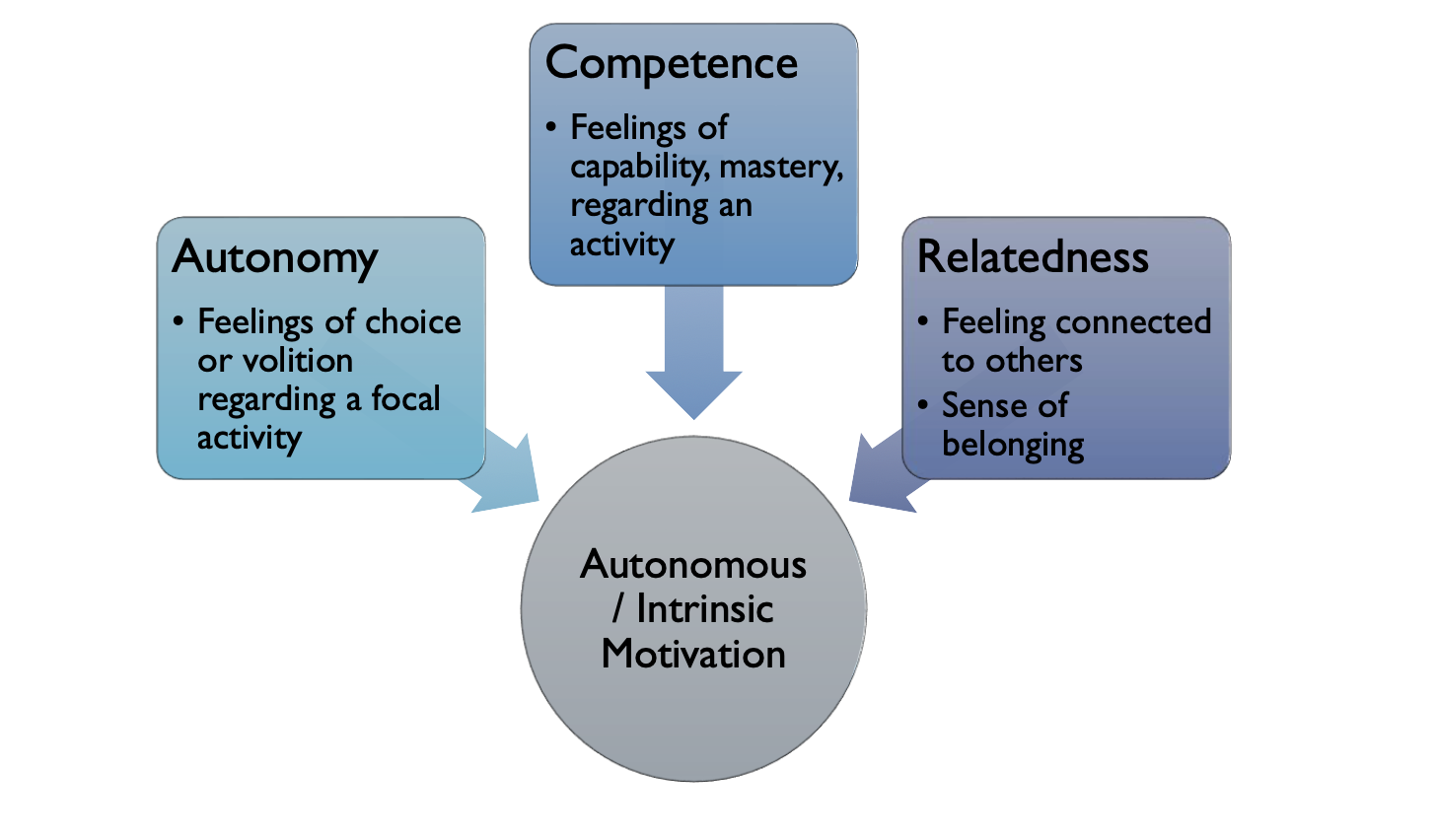
3 components of SDT that drive autonomous/intrinsic motivation
Autonomy: feeling of volition regarding choice/behaviour
Competence: feelings of adequate capability/mastery regarding activity
Relatedness: feeling connected to others, sense of belonging
Spectrum of motivation: types (+ subtypes for extrinsic (4))
Amotivation
Extrinsic motivation
External regulation
Introjected regulation
Identified regulation
Integrated regulation
Intrinsic motivation
Amotivation description, level of SD
Apathy, no sense of competence or control
Non-self-determined
External regulation description (1), conditioning type (1), effectiveness, example (1)
Behaviour performed to satisfy external demand/reward
Operant conditioning (Skinner): “If I do this, then [good / bad] thing happens to me”
Encourages behaviour short term but not long term (once demand/reward is removed)
E.g. practicing for MT so you don’t get in trouble from Edmunds
Introjected regulation: description (2), example (1)
Slightly internalised
To avoid guilt or gain some ego attainment (rather than explicit punishment/reward)
E.g. practicing for MT to fulfil expectation from Edmunds
Identified regulation description (1), example (1) + note (1)
Perform behaviour because you identify with value of behaviour
E.g. I will watch this boring lecture because I value being a diligent student.
Note: you don’t necessarily identify as a diligent student - rather you value the things that might be associated with it (e.g. being well-educated, organised, etc.).
Integrated regulation description (1), example, how it compares to identified regulation (1)
Behaviour is fully aligned with your values and needs
E.g. I will watch this lecture because I am a diligent student.
More identity based than identified regulation
Note on motivation types + behaviour (1)
Behaviour is often motivated by more than one type of motivation
Intrinsic motivation description + example
Perform behaviour because it is inherently enjoyable
E.g. “I exercise because it’s fun”
Linking SDT to exercise adherence (1)
Autonomous (identified + intrinsic motivation) → best adherence to exercise over time
Translating SDT to support autonomous motivation: need supportive behaviour 3 facets
Autonomy support
Structure
Interpersonal involvement
Autonomy supportive techniques (6), don’t need to know in detail probs not assessed
Provide meaningful rationale for session
Provide options
Use non-controlling, informational language
E.g. rather than “you should”, use If you want X, then I would recommend Y, but it’s up to you”
Explore participants goals + aspirations
Feedback: check that people have understood
Don’t give unsolicited advice
Structure (7), don’t need to know in detail probs not assessed
Provide clear and positively-framed feedback
Chances are, they’re doing something right. If they aren’t, it’s because they haven’t been taught correctly – that’s not on them
Provide reward (generally, verbal) not just for outcome, but for effort and progress
Provide individualised attention
Provide clear demonstrations
Provide an optimal challenge
Gauge competencies, and adapt to suit different people. Tailor sessions where possible.
Interpersonal involvement techniques (5), don’t need to know in detail probs not assessed
Empathise (esp. when difficult)
Show interest
Show unconditional regard
Encourage participants to ask questions
Congratulate + thank participants at end of session
How need-supportive instruction is assessed/evaluated (1)
Observer code