EXS 321 Final
 Call Kai
 Learn
Learn Practice Test
 Spaced Repetition
 Match
Match Flashcards
 Knowt Play
1/125

There's no tags or description
Looks like no tags are added yet.
Name | Mastery | Learn | Test | Matching | Spaced | Call with Kai |
|---|
No analytics yet
Send a link to your students to track their progress
126 Terms
rectilinear motion
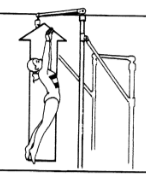
curvilinear motion
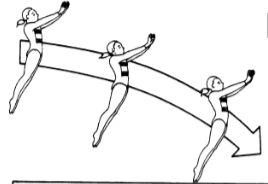
rotation
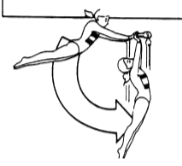
sagittal plane
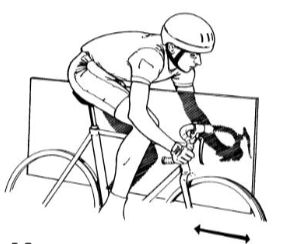
dorsiflexion
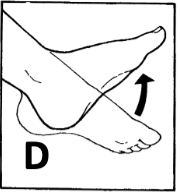
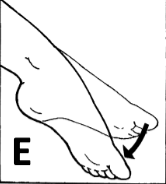
plantarflexion
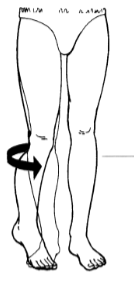
medial rotation of the leg
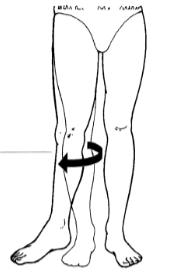
lateral rotation of the leg
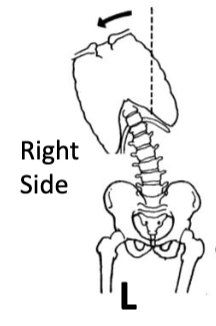
right lateral trunk flexion
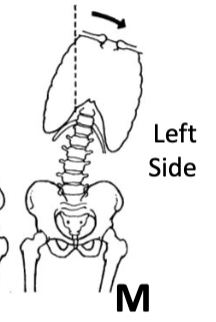
left lateral trunk flexion
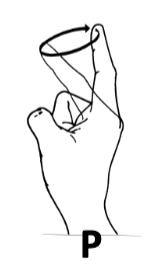
finger circumduction
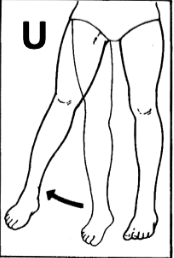
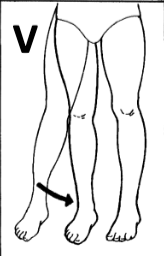
hip abduction
hip adduction
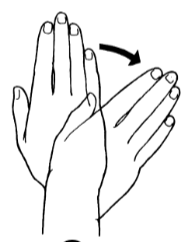
ulnar deviation
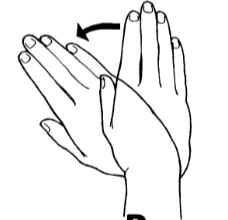
radial deviation
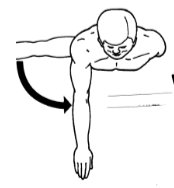
horizontal arm adduction
horizontal arm abduction
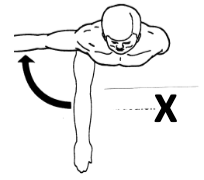
frontal plane
indicate the plane that splits body into front and back halves
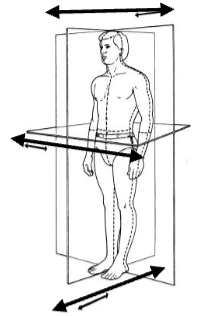
transverse plane
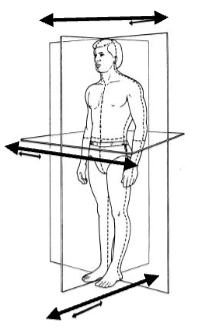
sagittal plane
splits the body into left and right halves
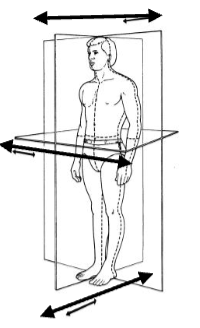
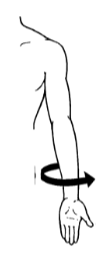
forearm pronation
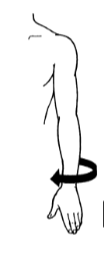
forearm supination
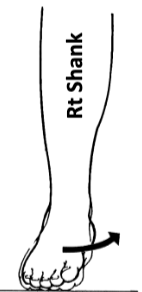
foot eversion
turns the sole of the foot laterally
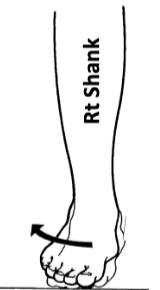
foot inversion
turns the sole of the foot medially
shoulder flexion
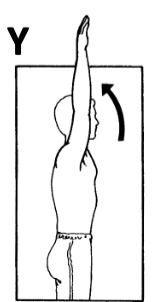
shoulder extension
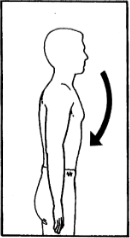
shoulder hyperextension
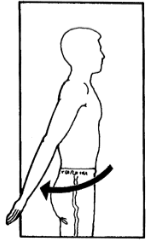
Define biomechanics.
Biomechanics is the study of biological systems from a mechanical perspective.
List five careers that utilize biomechanics.
Orthopedic surgeons
Athletic coaches
Kinesiologists
Therapists
Prosthetists
Define statics.
The study of systems that are in a state of constant motion that is, either at rest (no motion), or moving at a constant velocity
Define dynamics.
The study of bodies in motion
Define kinematics.
The description of motion without regard to its causes
Define kinetics.
The study of the courses of motion (primarily the study of forces)
List the kinematic quantities.
Distance/displacement
Speed/velocity
Acceleration
List the kinetic quantities.
Force
Movement
Work
Impulse
Power
Energy
Is this statement quantitative or qualitative: He jumped 5 meters.
Quantitative
Is this statement quantitative or qualitative: He jumped very high.
Qualitative
Is this statement quantitative or qualitative: The man walked very slowly, leaning to the left, and his gait was asymmetrical.
Qualitative
Superior
closer to the head
Inferior
farther away from the head
Anterior
toward the front of the body
Posterior
toward the back of the body
Medial
toward the midline of the body
Lateral
away from the midline
Proximal
closer to the trunk
Distal
away from the trunk
Superficial
toward the surface of the body
Deep
inside the body
Mechanical system
a body (or group of bodies) to be examined
Forms of motion
most human movement is a general motion a combination of both linear and angular motion components
Anatomical reference planes
three imaginary cardinal planes bisect the body in three dimensions
Sagittal plane
divides the body vertically into left and right halves (ex. cycling, walking)
Frontal plane
splits the body vertically into front and back halves (ex. side-to-side shuffle, jumping jacks)
Transverse plane
divides the body into top and bottom halves
Longitudinal axis (vertical)
transverse plane rotation (ex. pirouette)
Antero-posterior axis
frontal plane rotation (ex. cartwheel)
Medio-lateral axis
sagittal plane rotation (ex. somersault)
Hip extensors
extends the hip joint, pushing the thigh backward
Hip flexors
flexes the hip joint, bringing the thigh closer to the torso
Knee flexors
flexes the knee, bringing the heel toward the glutes
Knee extensors
extends or straightens the knee joint
Plantarflexors
plantarflexions, which means pushing the foot down (pointing toes), increasing the angle between the shin and foot
Dorsiflexors
dorsiflexions, which means pulling the top of the foot upward toward the shin
What are the main groups of movements found in the sagittal plane?
Flexion
Extension
Hyperextension
Dorsiflexion
Plantarflexion
Flexion
brings two body segments closer together, in the direction we expect them to move
Extension
opposite to flexion
Hyperextension
rotation beyond anatomical position in the direction opposite to flexion
Dorsiflexion
flexing the foot
Plantarflexion
pointing the point
What are the main groups of movements found in the frontal plane?
Abduction
Adduction
Abduction
move a segment away from the midline
Adduction
move a segment toward the midline
What are the main groups of movements found in the transverse plane?
Medial rotation of the leg
Lateral rotation of the leg
Forearm pronation
Forearm supination
Horizontal arm adduction
Horizontal arm abduction
Figner circumduction
What are the three forms of motion?
Linear motion (translation):
Rectilinear motion along a straight line
Curvilinear motion along a curved line
Angular motion/rotation: rotation around a central imaginary line known as the axis of rotation
General motion: a combination of linear and angular motion
1 dof
movement in one plane
2 dof
movement in two planes
3 dof
movement in three planes
What joints have 3 dof?
Hip and shoulder
Ipsilateral
refers to the same
Contralateral
refers to the opposite side
Discrete variable
a measure that has a single value
Continuous variable
a measure that is tracked over time, provides a time series
The Lokomat therapy robot allows knee flexion and extension. How many degrees of freedom is that?
1 dof
During gait the swing food position can be controlled by multiple joints. For example, on the ipsilateral limb, the toe height can be lowered by plantarflexing, by extending the knee joint, by extending the hip joint. Be familiar with these, and changes that could be made at the contralateral limb to modify the swing foot position. What is the total number of degrees of freedom available to change the swing foot position? *In this case, ipsilateral is the same limb as the swing foot limb; contralateral is the stance limb.
6 dof
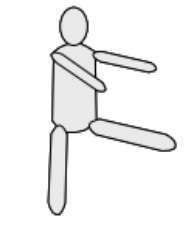
What is the center of mass in this image?
forward and downward (closer to the right hip/lower abdomen
What is a vector?
a quantity that possesses both magnitude and has direction
What is vector resolution?
breaking a single vector into two or more components
Define kinematics.
the description of motion without considering th cause
What are the concepts of kinematics?
Linear displacement (x)
Linear velocity (v)
Linear acceleration (a)
Angular displacement (θ)
Angular velocity (ω)
Angular acceleration (α)
What are the two kinematic concepts covered in class?
Motion analysis and gait variables
What are the gait variables?
Stride length
Step width
Gait speed
Toe clearance
Joint and segment angles
What information can be gained from a stick figure?
We can see the position of the body in space (linear displacement)
We can see the segment and joint angles (angular displacement)
To determine velocity, we must see more than one frame, or point in time
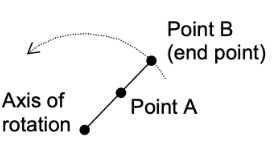
An object is swinging around in a circle (as in the picture below), where is the highest linear velocity observed, point A or point B? Where is the highest angular velocity observed, point A or point B?
Highest linear velocity: Point B
Highest angular velocity: Point A and B have the same
Is distance scalar or vector? What are the units?
Scalar; m
Is displacement scalar or vector? What are the units?
Vector; m
Is speed scalar or vector? What are the units?
Scalar; m/s
Is velocity scalar or vector? What are the units?
Vector; m/s
Is acceleration scalar or vector? What are the units?
Vector; m/s2
Is angular distance scalar or vector? What are the units?
Scalar; rad
Is angular displacement scalar or vector? What are the units?
Vector; ፀ