Genetics Exam 1
 Call Kai
 Learn
Learn Practice Test
 Spaced Repetition
 Match
Match Flashcards
 Knowt Play
1/23

There's no tags or description
Looks like no tags are added yet.
Name | Mastery | Learn | Test | Matching | Spaced | Call with Kai |
|---|
No analytics yet
Send a link to your students to track their progress
24 Terms
What happens if you look at more than 2 traits simultaneously
The alleles for each trait segregate independently AND
do not influence the inheritance (independent assortment) of the second trait
Forked-line diagram
determines the genotypes and frequencies
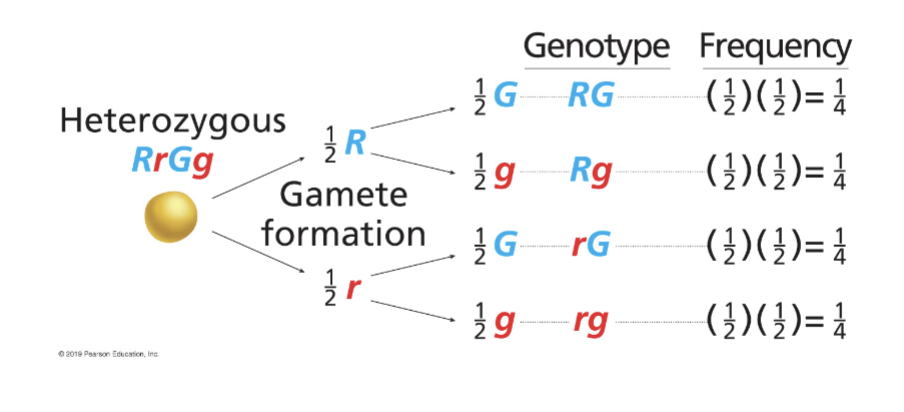
Progeny phenotypes
tend to occur in definite ratios based on the initial frequencies
Test Cross
used to verify independent assortment
display four phenotypes in equal frequencies as expected by application of Mendel’s laws
Conditional Probability
m The probability of an event (A), given that another (B) has already occurred
Binomial Probability
Predicting one event from many outcomes
the probability that a binomial experiment results in exactly X successes
Rules of Probability theory, Product Rule
if two or more events are independent of one another their joint probability is the product of the individual probabilities
Rules of Probability theory, Sum Rule
The joint probability of any of two or more mutually exclusive ( not independent ) events is the sum of the probabilities of each event
The probability of obtaining any heterozygote is equal to the sum of the probabilities of each possible heterozygote
Binomial Expansion
Two variables, each representing the frequency of one o flow alternative outcomes
P(outcome 1) = p; P(outcome 2) = q
if p and q are the only possible outcomes, p+p=1
expand the expression by n events; (p+q)n=1
Pascal’s triangle
1) binomial coefficentbgs (P+g) raised to the nth power where n= # of events
2) each line is total # outcomes (p+q)n n=2
Binomial Probability Definitions
P = n!/ s! t! (psqt)
p: probability to get to event x
q: probability to get to event y
s: times to get event x
t: times to get event y
n: s+t (total events)
Eukaryotic
more complex with membrane bound organelles
Prokaryotic
lack nuclear membrane and typically no membrane bound organelles
Gene
fundamental unit of heredity
come in multiple forms called alleles
determines phenotypes
defined DNA sequences
Chromosomes
are long molecules of double-stranded DNA and protein, which contains genes
Homologous pairs
carry genes for the same traits
Hereditary flow
DNA → transcription → RNA → translation → protein
nucleic acid structure
phosphate
phosphodiester linkage
Sugar
Ribose or deoxyribose
Nitrogenous base (hydrogen bonds)
Purines
Adenine and Guanine
Pyrimidines
Cytosine and Thymine/Uracil
Chargaffs Rule
percentages of adenine and thymine are equal and the percentages of guanine and cytosine are equal
complementary base pairs
A with T
C with G