RPD Technique Manual Section 2
 Call Kai
 Learn
Learn Practice Test
 Spaced Repetition
 Match
Match Flashcards
 Knowt Play
1/30

There's no tags or description
Looks like no tags are added yet.
Name | Mastery | Learn | Test | Matching | Spaced | Call with Kai |
|---|
No analytics yet
Send a link to your students to track their progress
31 Terms
What is alginate?
An irreversible hydrocolloid
Why has alginate been the material of choice for diagnostic impressions?
Due to accuracy and handling properties - also used for final impressions for RPD
What are some guidelines for alginate to perform properly?
Store at room temp
Keep away from humidity
Use correct water/powder ratio
Cooler water provides more working time
Pour within 3-5 minutes to obtain accurate cats
What tray should be used for alginate impressions?
Caulk Rim Lock tray
The patient’s mouth should be examined to estimate what size of tray should be selected. What are some components of a correct impression tray?
Must provide support for the impression material over the tooth and tissue areas involved in the RPD
How thick should the impression material be?
3-4 mm to insure accuracy
How is tray selection judged intraorally?
Inserted as far distally as necessary for proper coverage of hamular notch- upper and retromolar pad- lower), then rotating the tray to place.
What can happen if you cover more than half the retromolar pad with the tray?
Too large of a tray will be selected and then it won’t be able to seat correctly in the mouth
Detailed adaptation and approximation of tray borders to the vestibular depth can be accomplished with periphery wax strips. Where are common areas of LOWER IMPRESSION TRAY that must be extended?
Labial and disto-lingual borders
Why does the upper tray ALWAYS require a wax dam across the posterior palatal seal area? Where else does it need wax adaptation?
To confine the alginate material; disto-buccal corners and labial border length
Why should you avoid arbitrarily adding wax around ALL the borders?
It will yield a grossly overextended impression, making it difficult to insert the tray in the mouth. The border wax can be softened in hop tap water, inserted in the mouth, and border-molded to provide a better fit of tray.
What are some helpful landmarks to guide to correctly seat the tray position?
The relationship between the labial vestibular depth and border of the empty tray
How is the filled tray seated in the mouth?
With a path parallel to the anterior palate until it occupies the same position as before relative to the vestible.
What can happen if you overseat the tray?
Thin sections of alginate over the teeth are more likely to distort or tear
Why is under-seating the tray even worse than over-seating?
Because a large part of the impression will not be supported by the tray. These areas are very likely distorted when the impression is poured
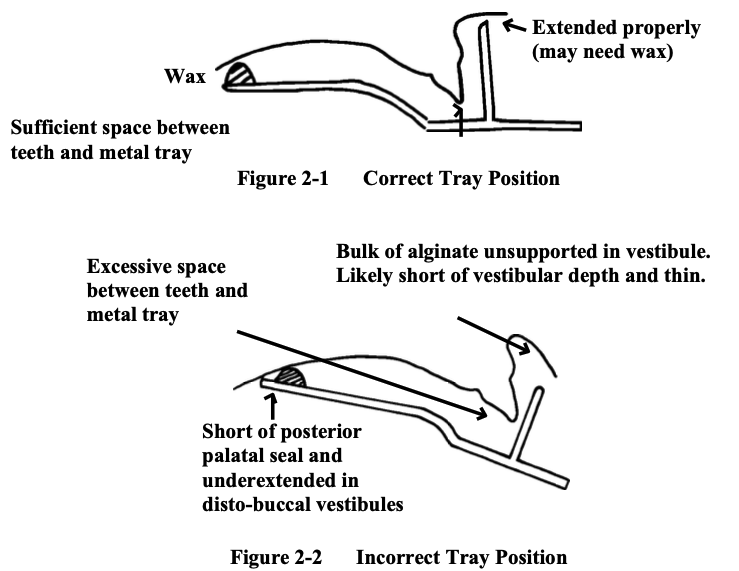
Why should you avoid seating the maxillary tray in the posterior first, then anterior?
The alginate gets trapped inside the tray and prevents proper seating
Spray the impression with _______ (iodine-based antiseptic and sanitizer) and wrap it in a wet paper towel. The alginate impression for an RPD master cast must be poured within 3 minutes. In those cases, when do you disinfect?
Iodophore; the cast is disinfected instead of the impression in order to pour it quickly
What can you use under the tray to make the occlusal plane parallel to the surface of glass slab when boxing the alginate impression?
Play-doh!
Use play-doh to box this area of a lower impression
Lingual area- do not create buccal and labial land areas
What should be your water-powder ratio when mixing the stone?
32 mL H2O / 100 grams of type III white or yellow stone (microstone)
Why is die stone not used when pouring impressions?
It is harder to trim and more expensive
What can happen if you separate the cast from the impression too early?
Leaves a rough surface in those areas contacted by the alginate (notably the teeth) because alginate retards the setting of stone
What can happen if you separate the cast from the impression too LATE?
Also yields a rough surface because the alginate dries out and pulls water out of those parts of the cast in contact with alginate.
When trimming the cast, why can it be helpful to soak the cast one or two minutes in water?
Sludge from the model trimmer will cling to the surface of the cast and ruin its accuracy
What landmark should you use as a guide in establishing the sides?
Outer edge of vestibule
How thick should the cast be?
10-15 mm thick in the palate of the upper and tongue area / lingual vestibule of the lower
The occlusal plane should be ______ to the bench top and the sides of the cast should be at ________ degrees to the base
parallel; 90
How can you disinfect the cast after trimming?
Set cast on wet paper towel and spray with disinfectant solution until the surface of the cast is saturated with disinfectant solution. Cover the cast with a paper towel saturated with Iodophore for 10 min, remove paper towel and let cast air dry
Does iodophore affect the compressive strength of the stone?
No, it can be repeated after each clinical session or incidence of contamination
Why is it useful to make casts of both arches, even tho the RPD is for just one of the arches?
You can determine if enough space exists between the edentulous ridges for the dentures.