6.2.1 Nerve impulses
 Call Kai
 Learn
Learn Practice Test
 Spaced Repetition
 Match
Match Flashcards
 Knowt Play
1/15

There's no tags or description
Looks like no tags are added yet.
Name | Mastery | Learn | Test | Matching | Spaced | Call with Kai |
|---|
No analytics yet
Send a link to your students to track their progress
16 Terms
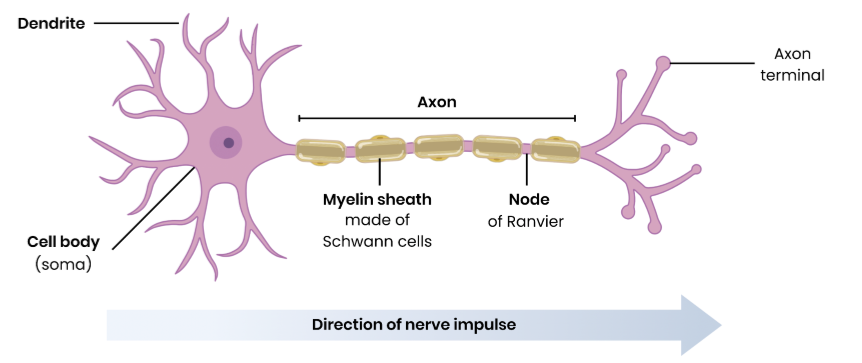
Describe the structure of a myelinated motor neurone
one long axon (carries impulse away from cell body)
Many short dendrons (carries impulse towards cell body)
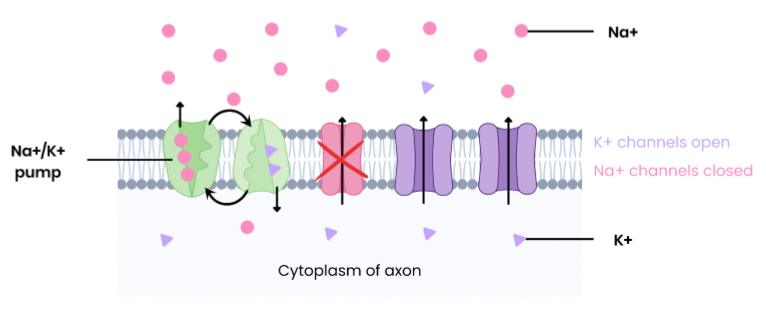
Describe resting potential
Inside of axon has a negative charge relative to outside (as more positive ions outside compared to inside)
Explain how resting potential is established across the axon membrane in a neurone
Na+/K+ actively transports:
→ 3 Na+ out of axon and 2 K+ into axon
creating an electrochemical gradient
→ higher K+ concentration inside and higher Na+ concentration outside
Differential membrane permeability:
→ more permeable to K+ → move out by facilitated diffusion
→ less permeable to Na+ (closed channels)
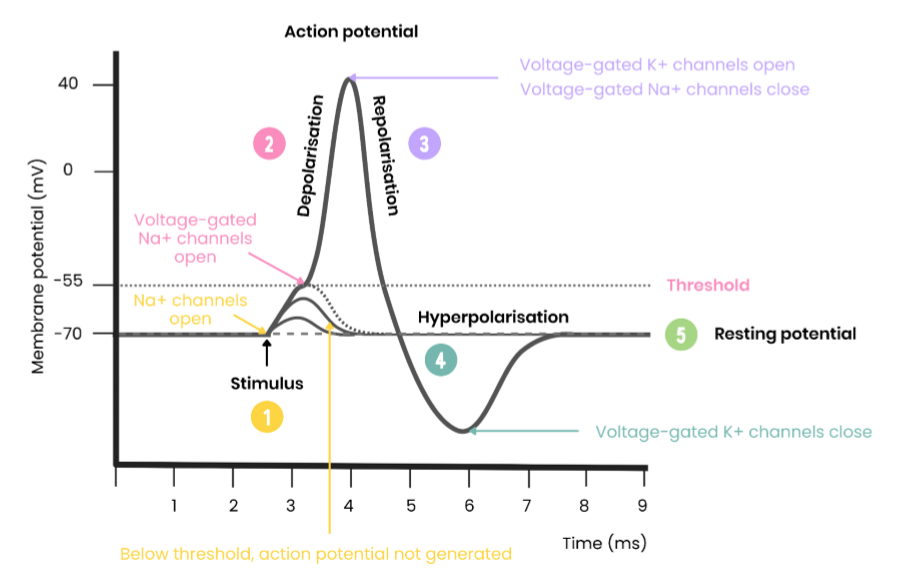
Explain how changes in membrane permeability lead to depolarisation and the generation of an action potential (stimulus)
Na+ channels open; membrane permeability to Na+ increases
Na+ diffuse into axon down electrochemical gradient (causing depolarisation)
Explain how changes in membrane permeability lead to depolarisation and the generation of an action potential (depolarisation)
if threshold potential is reached, an action potential is generated
as more voltage-gated Na+ channels open (positive feedback effect)
so more Na+ diffuse in rapidly
Explain how changes in membrane permeability lead to depolarisation and the generation of an action potential (repolarisation)
voltage-gated Na+ channels close
voltage-gated K+ channels open; K+ diffuse out of axon
Explain how changes in membrane permeability lead to depolarisation and the generation of an action potential (hyperpolarisation)
K+ channels slow to close so there’s a slight overshoot - too many K+ diffuse out
Explain how changes in membrane permeability lead to depolarisation and the generation of an action potential (resting potential)
restored by Na+/K+ pump
Draw/ label a graph showing an action potential
Describe the all-or-nothing principle
if depolarisation exceeds threshold potential → action potential
if depolarisation does not exceed threshold potential → no action potential
action potentials produced are always same magnitude / size / peak at same potential
→ bigger stimuli instead increase frequency of action potentials
Explain how the passage of an action potential along non-myelinated axons result in nerve impulses:
action potential passes as a wave of depolarisation
influx of Na+ in one region increases permeability of adjoining region to Na+ by causing voltage-gated channels to open so adjoining region depolarises
depolarisation along whole length of axon
Explain how the passage of an action potential along myelinated axons result in nerve impulses:
myelination provides electrical insulation
depolarisation of an axon at nodes of Ranvier only
resulting in saltatory conduction (local currents circuits)
so there is no need for depolarisation along whole length of axon
Suggest how damage to the myelin sheath can lead to slow responses and / or jerky movement
less / no saltatory conduction; depolarisation occurs along whole length of axon
→ so nerve impulses take longer to reach neuromuscular junction; delay in muscle contraction
ions / depolarisation may pass / leak to other neurones
→ causing wrong muscle fibres to contract
Describe the nature of the refractory period
time taken to restore axon to resting potential when no further action potential can be generated
as Na+ channels are closed / inactive / will not open
Explain the importance of the refractory period
ensures discrete impulses are produced (action potentials don’t overlap)
limits frequency of impulse transmission at certain intensity (prevents over reaction to stimulus)
→ higher intensity stimulus causes higher frequency of action potentials
→ but only up to certain intensity
also ensures action potentials travel in one direction → can’t be propagated in a refractory region
In the second half of the refractory period an action potential can be produced but requires greater stimulation to reach threshold.
Describe the factors that affect the speed of conductance
Myelination:
depolarisation at Nodes of Ranvier only → saltatory conduction
impulse doesn’t travel / depolarise whole length of axon
Axon diameter:
bigger diameter means less resistance to flow of ions in cytoplasm
Temperature:
increases rate of diffusion of Na+ and K+ as more kinetic energy
but proteins / enzymes could denature at a certain temperature