STREETCAR/CASTLE FLASHCARDS
 Call Kai
 Learn
Learn Practice Test
 Spaced Repetition
 Match
Match Flashcards
 Knowt Play
1/28

There's no tags or description
Looks like no tags are added yet.
Name | Mastery | Learn | Test | Matching | Spaced | Call with Kai |
|---|
No analytics yet
Send a link to your students to track their progress
29 Terms
Young
Young, young, young man! Has anyone ever told you that you look like a young Prince out of the Arabian Nights
Epizeuxis, idealised imagery, intertertexual allusion, rhetorical q
Violence
Stanley gives a loud whack of his hand on her thigh
Public display of dominance ( performative), objectification of women, sexualised agression, stage direction - no mediation through dialogue
He springs towards her and overturns the table
Animalistic imagery, destruction of domestic space, symbolism fo table, structural escalation
Mention Hollywood changing ending here
I don’t
‘I don’t want realism - I want magic’
Parataxis, antithesis, caesura, abstract nouns
CULTURE/ARTS
‘I was never a very good english student (STANLEY)
‘Such things as art- as poetry and music - such kinds of new light have come into the world since then!’
Culture as Blanche’s chosen medium of self invention, frames herself through poetry, romantic expressionistic language, refinement detached from material reality, superficial common ground with Mitch, culture as a refuge however powerless against physical force, Stanley tearing down paper lantern symbolically represents the destruction of asesthitic mediation, culture as a nostalgic role, represents dying order of the old south that can no longer sustain itself economically or morally
MASCULINITY ( PARTICULARLY ANIMALS)
‘ there is someting about her uncertain manner, as well as her white clothes, that suggests a moth (scene 1)
Symbolism, adjective, colour symbolism
‘With the power and pride of a richly feathered male bird among hens’ STANLEY among the women, animal imagery, noun choices, collective noun
‘But I have been foolish - casting my pearls before swine’
Biblical allusion, symbolism class divide, self dramatising tone
‘Bearing the raw meat home from the kill in the jungle!’
Primitive imagery, adjective, exclamatory toen
‘Men at the peak pf their physical manhood…coarse and direct and powerful’
Tricolor, polysyndeton, superlative
Stanley embodies this primal masculinity, instinct + sexual appetite, Blanche’s attachement to civilisation and refinement yet those values ineffective
Culture refinement civilisation argument bad as was used to justify slavery in terms of social Darwinism - view snobbish and outdated
Masculinity money
Napoleonic code!
I got an acquaintance who deals in this sort of merchandise
Noun merchandise reflects the crass materialism, semantic feild of trade, declarative tone i got
Primal masculinity trough colour/ taking over of domestic space
The kitchen now suggests that sort of lurid nocturnal brilliance, the raw colours of childhood’s spectrum’
Oxymoronic langauge, metaphor spectrum, semantic feild colour, connotations of adjs, structural shift change in perspective to now,
Patriarchal society female identity contingent upon being desires, Stanley’s desire is physical and unapolagteic, balance is shame ridden, Blanche desires security youth validation and rescuer exististial not sexual longing, sexual encounters and comfort to overcome grief, stellas sexual desire overrides moral judgement - desire weapon which blurs attraction and agression, Mitch hypocritically desires Blanche sexually but punishes her for her security
Narrative of desire still pertinent to social norms - eg Allan homoerotic desire illegal in 1950s America + patriarchy submissive female role unlike Blanche who forges own path - must conform.
STAGECRAFT
Varsouviana Polka - the memories of Allan + Blanche’s terror and the internal experinece of the threat Stanley poses INITIALLY NON-DIAGETIC - characters cant ere then we find out balance can actually hear it
The blue piano upon opening - expressionistic quality of the music - used to reveal a truth which might not be conveyed by more realist elements of the play - alerts to moments of drama and tension
Contrapuntal irony of Blanche singing paper moon from the bath
Stanley as a nemesis, undermining and exposing Blanche’s theatrical pretensions
Costume - shaping external appearance and perception Blanche;s tiara as ‘a crown for an empress’ actual reveals how he feels threatened Blanche inauthentic playing a role as visually changes costumes a lot
FEMINIST READING
Tennessee William himself as misogynist - through part of a marginalised and victimised minority was the product of dominant patriarchy in the power politics of American society
Blanche as a tool to undermine and devalue women - offfered neithe rphysical nor emotional support fo r her husband ensuring the righteous condemnation by the audience for her inaction
First productions of the play followed this view character of Blanche as a threat to te domestic ideal of womanhood
WRONG misogynistic forces at work within society not Williams himself - final scene reflects the choice to ignore the suffering of women - condemns through irony the heartless edifice of an oppressive patriarchal ideology
Uses sexuality as a power tool however ultimately cannot due to broader partriarchal society - she knows partriachy prizes female youth and beauty
Condemnation of Blanche’s sexuality vs counterparts - challenge value system of particachy act of insanity indoctrinated Eunice and Stella
SYMBOLS
Bath - Blanche trying to cleanse herself of sins, lady Macbeth + youth fountain of youth temporary respite
Streetcar - Williams calls ‘ideal metaphor for the human condition’ power of desire as driving force
Paper lantern and paper moon again temporary
CONTEXT
Patriotic aftermath of WW2 was reflected in mainstream American Art - Brando dangerous yet deceptive portrayal as Stanley leading the wya for they youth movement rock and roll culture New America
THE GLASS MENAGERIE (ALSO WILLIAMS) Amanda Wingfeild (research more)
Deep South - romanticisation of past way of life gone now
Vs New Orleans - urban risqué jazz music
Williams use of stage direction unconventional stage directions - expressionistic
Georges-Micheal Sarotte ‘Stanley is the Other, he is what Williams is not but would have liked to be’ hint of admiration in description relaly acc what he was afraid of
FANTASY AND DELLUSION
Cemeteries - Elysian feilds - journey allegorically foreshadows Blanche’s mental descent
Art’s place in a modern consumerism driven society - what is important truth or beauty
Edgar Allan Poe - similarities in ideas fo decay of the old, death in life existence,
DRIVE FOR CRASS MATERIALISM - artistic joie de vivre - she was an english teacher - meta-theatrical symbolic of Williams as a playwright creating fantasy worlds within reality - blanches destruction = Williams’ mourning of the loss of the artistic world
New America emerging from depression into the materially acquisitive culture
Destruction of artistic force by brute power
LANGUAGE
Blanche constructs identity through ‘feminine’ language choice
Stanley’s vigorous command of profundities and obscene expressions
Social function of empty phrases - Blanche
Women’s make more precise discriminants in colours - willliams - colour as illustrative of class struggle
Female langauge lack of assertiveness
Symbolic value of social etiquette
Collapse of linguistic order - expressionsim vs realism reflected in this too
STANLEY/STELLA
Full of raw strength, animal magnetism
Lurid colours parades physicality
His extreme virility is a direct contrast to Blanche’s homosexual husband
Stella feminine voil to Stanley’s violent ways - physical relationship overpowers
Calm and reasonable, wistful has no desire to return to past, pregnancy underscores her commitment to her kowalski future
Tragedy
Tragic dénouement achieved - character in state of ruin
Indivual trapped in a harsh world
Modern realist play - each characters fate is the product of a complex interweaving of their own failings with forces outside of their control
Possibility of hope Mitch
So although not technically a traditional Aristotelian tragedy
MARXIST READING
See Blanche a symbol of the inevitable defeat of capitalist elite - antithesis Blanche and Stanley bourgeoisie and proletariat
Blanche dislocated ideologically
Blanche referring to Stanley as an executioner - Blanche must be destroyed
American Dream vehicle for fulling the destructive rhetoric of capitalism
Self alienation - Stanley
Microcosm of the social political and economic dialectic that exists within the Ines-capable arc of history
Desire itself functions as an economic system - trade in illusions - currency outdated whereas Stanley operates un material post war capitalism
STRUCTURE
Aristotelian to an extent
Blanche as a person outside of time - temporal dislocation - she moves through memory nostalgia and reputation where Stanley is aggressively present focused and future oriented
Streetcar context
Post WW2 America - Rise of industrial, working-class masculinity - Decline of traditional Southern aristocracy | - Stanley representing the emerging dominant class (practical, aggressive, modern) - Blanche represents the fading Old South (illusion, fragility, moral decay) - Their conflict = symbolic clash of social eras |
Gender roles and patriarchy - 1940s-50s America reinforced strict domestic roles - Male authority normalised, female dependence expected
| - Stanley’s dominance reflects accepted male control - Stella’s return after abuse shows internalised patriarchy - Blanche is punished for sexual autonomy – double standards |
Mental health attitudes - Mental illness poorly understood and heavily stigmatised - Institutionalisation as common solution | - Blanche’s breakdown treated with removal, not care - Society rejects those who cannot conform - Her fate reflects fear of psychological instability |
The American South (Old vs New) - Old South: aristocracy, illusion, inherited status - New America: capitalism, immigration, urbanisation | - Belle Reve’s loss = collapse of old values - New Orleans= modern, multicultural, chaotic reality - Blanche’s inability to adapt to her destruction |
Sexual morality and repression - Female sexuality judged harshly - Male promiscuity tolerated | - Blanche’s past defines her downfall - Stanley’s behaviour is excused - Highlights hypocrisy in sexual ethics |
Tennessee Williams’ personal context - Exposure to mental illness (sister Rose institutionalised) - Interest in fragile, marginalised characters | - Blanche reflects Williams’ sympathy for psychological vulnerability - Play critiques a society that destroys the sensitive |
Class divide streetcar
Pig - Polack - disgusting - vulgar
Derogatory language, semantic feild of disgust, animal imagery, xenophobic slur, adjectives
Her appearance is incogrous to the setting
Symbolism of appearance, contrast/juxtaposition
CONTEXT CASTLE
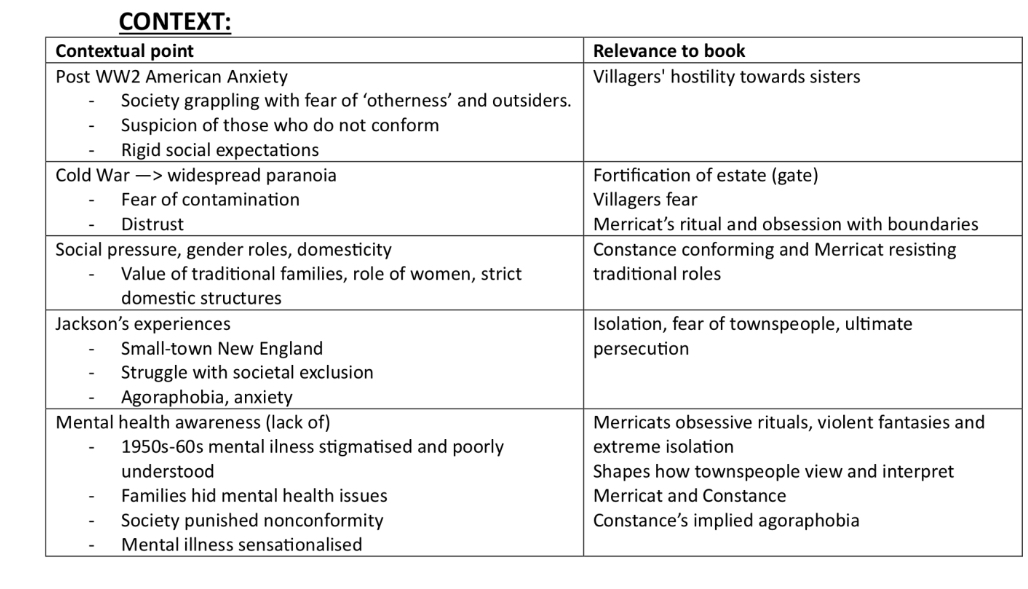
STAGNANCY LACK OF CHANGE
‘We rarely moved things… we always put things back where they belong’ juxtaposition rarely always, collective we rejection of alternate ideals, represión of decisions mirrors ritual
‘
FANTASY EXPRESSIONISM CASTLE
‘I am living on the moon’ present continuous suggests sustained state as opposed to temporary fantasy, simple declarative, impossibility as fact
I shall commence... with a slight exaggeration... an outright lie."
Metafiction - narrator exposes storytelling process
Irony - honesty about dishonesty
Unreliable narrator (explicit)
Self-reflexivity - narration interrogates truth
Nine-tenths of that feeling is your imagination."
Gaslighting - emotional manipulation
Minimization - dismissing trauma
Rationalist rhetoric - false logic used as control
GENDER
‘In this village the men stayed young and did the gossiping and the women ages with grey evil weariness’ parallel syntax as gender opposition, verb contrast, polysyndeton to build critique
‘A ghost slept in father’s bed’
Gothic imagery, juxtaposition, domestic vs not, fails to take role of father
They have power due to isolation men try to usurp it - feminist utopia at the end reject STRCUTURE and icons of male power male as money - witchcraft associated with women who transgress social expectations - destruction of house by villagers mimics execution by burning or stoning expect they survive and happier than ever
Enjoy food alone - with each other
The men stayed young and did the gossiping, and the women aged with a grey evil weariness."
Gender role inversion - men gossip, women endure
Juxtaposition - youth vs decay
Loaded diction - "evil," "weariness" moralizes aging
Social satire - critique of village misogyny
Our house was built up with layers of Blackwood property...
Symbolism - house as legacy, isolation, power
Metaphor - property as physical weight
Personification - house "steady against the world"
Gothic setting - fortress mentality
Let it burn."
Imperative mood - active embrace of destruction
Moral nihilism - reiection of social order
Sumbolic purification - fire as cleansing rather than loss
Defiant tone - agency reclaimed through chaos
Subversion of domestic space
‘All our land was enriched with my treasures buried in it’
[pssessive, symbolism, declarative tone, embedded clause
Subversion of domestic
‘Stood side by side in our cellar and would stand there forever, a poem by the Blackwood women’
Metaphor, visual imagery, refern ce to culture, structurally replicates jars, subversion of norms
MONEY/masculinity castle
‘I could bury him in the hole where my box of silver dollars has been so safe before he came’
"Rotting hearts... coveting our heaps of golden coins..
Metaphor - moral decay
Hyperbole - exaggerated paranoia
Projection - Merricat externalizes guilt/fear
Fairytale diction - "golden coins" mythologizes conflict
‘Charles is yelling for the men to get the safe’
Auditory imagery, present progressive tense, symbolism, liner syntax, gendered noun
Social ostracism/othering
‘They had no colour’
Dehumanisation, simple sentence, metaphor for conformity
‘The people of the village have always hated us’
Juxtaposition , binary, collective pronouns, no punción
Violence - castle
I am going to put death in all their food and watch them die
Violent imagery, 1st person, jcutapsoion
‘The least charles could have done…was shoot himself through the head in the driveway;
Dark irony, graphic imagery, conditional phrasing
READINGS CASTLE
Psychological lens - how the mind protects itself from trauma threat not village but rather inability to engage with reality
House - go this isolation/domestic prison - safe but trapped in stagnation
Food - power female - symbolic for their control of knowledge
Decay/post aristocracy
Moral ambiguity - both