2.1 Forces
 Call Kai
 Learn
Learn Practice Test
 Spaced Repetition
 Match
Match Flashcards
 Knowt Play
 Podcast
1/134

There's no tags or description
Looks like no tags are added yet.
Name | Mastery | Learn | Test | Matching | Spaced | Call with Kai | Chat |
|---|
No analytics yet
Send a link to your students to track their progress
135 Terms
Vector
A Vector has magnitude and direction
Scalar
A Scalar has just magnitude
Momentum
Momentum is vector
Energy
Energy is scalar
Time
Time is scalar
Acceleration
Acceleration is vector
Force
Force is vector
Mass
Mass is scalar
Speed
Speed is scalar
Velocity
Velocity is vector
Distance
Distance is scalar
Displacement
Displacement is vector
Non-Contact Forces
Forces between objects that are physically separated.
Electrostatic Force
The charges cause a force of attraction/repulsion.
Gravitational Attraction
The mass creates a force of attraction.
Contact Forces
Forces between objects that are physically touching.
Normal Contact Force
The force felt in the opposite direction to contact.
Friction
The surfaces and their roughness cause friction when moved in contact.
Weight
The force exerted on a mass by the gravitational field, in Newtons.
Weight Formula
weight = mass × gravitational field strength
Weight Measurement
Measured by a force meter (also known as calibrated spring-balance).
Gravitational Field Strength on Earth
On earth, g = 9.8
Acceleration in Free Fall
Acceleration in free fall is due to gravity, and is the same as g, i.e. 10 m/s².
Resultant Force
A single force representing the sum of all the forces acting on an object.
Free Body Diagrams
Show the forces (and their directions) acting on an object.
Resolving Forces
A force F at angle 𝜃 to the ground can be resolved parallel and perpendicular to the ground.
Pythagoras' Rule
Used to find the two components of a force resolved at an angle.
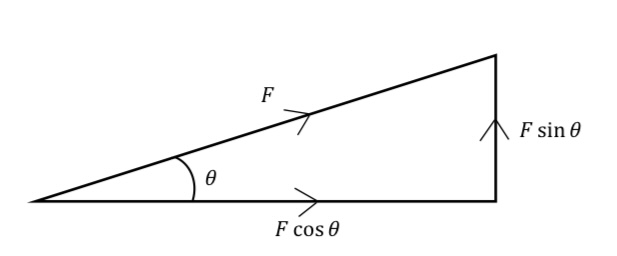
Resolving forces
F²=(Fcos0)²+(Fsin0)²
Work Done
Calculated as Force × Distance.
Work Done Formula
W = Fs, where W is in joules J, F is in newtons N, and s is in metres m.
Distance in Work
Distance is the distance moved along the line of action of the force.
Energy Transfer in Work
Work done is when energy is transferred from the object doing the work to another form.
One Joule Definition
One joule of work is done when a force of one newton causes a displacement of one metre.
Work Against Friction
Work done against frictional forces causes a rise in temperature of the object.
What must be true about the forces acting on an object for it to be in equilibrium?
The sum of the forces acting on an object must be zero.
Springs
To stretch,bend or compress an object more than one force has to be applied
Single force on a spring
It will just move in the direction of the force
Spring pulled in opposite direction
The spring will stretch
Spring is fixed at one point and stretched
a force is still being applied at the fixed point
Deformation
Changing shape of an object.
Elastic Deformation
The object returns to its original shape when the load has been removed.
Plastic Deformation
The object does not return to its original shape when the load has been removed.
Hooke's Law
The extension of an elastic object is directly proportional to the force applied, provided that the limit of proportionality is not exceeded.
Hooke's Law Formula
F = kx, where F is the force applied, k is the spring constant, and x is the extension.
Force/Extension Graph
A linear line indicates the elastic region following Hooke's Law.
Limit of Proportionality
The point at which the relationship between force and extension stops being linear.
Brittle Material
If the graph is just linear with no non-linear end section, the material is brittle, so snaps instead of stretches after the elastic limit.
Work Done on a Spring
When a force stretches/compresses a spring, the spring does work.
Work Done Formula for Spring
Work Done = 1/2 kx², where elastic potential energy is stored in the spring.
Moments and Rotation
For an object attached to a pivot point, if a force is applied along a line passing through the pivot, the object does not rotate.
Moment of a Force
Calculated as force × perpendicular distance from the pivot to the line of action of the force.
Moment Formula
M = Fd, where M is in newton-metres Nm, F is in newtons N, and d is the perpendicular distance in metres m.
Example of Moments
Bike Riding - pressing your foot down on the pedal causes a moment about the pivot, turning the pedal arms.
Equilibrium
Equilibrium is when: sum of anticlockwise moments = sum of clockwise moments
Gears
Gears can change speed, force or direction by rotation.
Smaller Gear
If connected to a gear with fewer teeth (i.e. a smaller gear), the second gear will turn faster but with less force and in opposite direction to first gear.
Larger Gear
If connected to a gear with more teeth (i.e. a larger gear), it turns slower, more force, and in opposite direction.
Power Supply
The second gear will always turn in the opposite direction.
Buoyancy Force
The buoyancy force is the upwards force that counteracts the weight of the floating object.
Pressure
Pressure, p = force/area = F/A.
Pressure Units
Where the pressure, p, is in pascals Pa, the force, F, in newtons N and the area, A, in metres squared, m².
Floating Condition
An object floats if its weight is less than the weight of the water it displaces.
Pressure in a Liquid
Pressure in a liquid varies with depth and density, leading to an upwards force on a partially submerged object.
Weight of Displaced Fluid
This is equal to the weight of the fluid displaced by the object.
Ping Pong Ball
A ping pong ball floats on water as its density is less than the density of the water.
Pressure Increase with Depth
Increasing the depth increases the weight of the water above you, resulting in greater pressure felt.
Pressure due to a column of liquid
height of column x density of liquid x gravitational field strength
Upthrust
Upthrust is the resultant force upwards experienced by a partially (or totally) submerged object due to greater pressure on the bottom surface than on the top surface.
Displacement
Displacement includes both the distance an object moves and the direction of that straight line.
Velocity
Speed in a given direction
Acceleration
A change in velocity.
Speed
Speed does not involve direction.
Distance
How far an object moves.
Earth's Atmosphere
Earth's Atmosphere is a thin layer of air around the Earth that gets less dense with increasing altitude.
Atmospheric Pressure
The weight of the air is the force which causes the pressure; fewer air molecules at higher elevations result in less pressure.
Idealised Assumptions of Atmosphere
Isothermal, transparent to solar radiation, opaque to terrestrial radiation.
Momentum of Gears
To increase the power, a larger gear is used for the secondary (red) gear, as the force on the red gear is a further distance from its pivot.
Pressure Formula
p = hρg, where pressure p is in pascals Pa, height h in metres m, density ρ in kilograms per metre cubed kg/m³, and gravitational field strength g in newtons per kilogram N/kg.
Pressure Direction
Pressure produces a net force at right angles to any surface.
Weight of Boat
A 1000kg boat will sink into the water until it has displaced 1000kg of water, providing it doesn't completely submerge before displacing this amount.
Typical Speeds of Wind
5 − 7 m/s
Typical Speeds of Sound
330 m/s
Typical Speeds of Walking
~ 1.5 m/s
Typical Speeds of Running
~ 3 m/s
Typical Speeds of Cycling
~ 6 m/s
Typical Speeds of Bus
14 km/h
Typical Speeds of Train
125 miles/h
Typical Speeds of Plane
900 km/h
Speed Formula
speed = distance / time (v = d / t)
Average Speed Formula
average speed = total distance / total time
Displacement-Time Graph
Gradient is velocity; sharper gradient means faster speed.
Velocity-Time Graph
Gradient is acceleration; sharper gradient means greater acceleration.
Terminal Velocity
The constant speed that a freely falling object eventually reaches when the resistance of the medium prevents further acceleration.
Newton's First Law
An object has a constant velocity unless acted on by a resultant force.
Inertia
The tendency for objects to continue in uniform velocity (or stay at rest).
Inertia is also
The measure of how difficult it is to change the velocity of an object
Newton's Second Law
The acceleration of an object is proportional to the resultant force acting on the object, and inversely proportional to the mass of the object.
Kinetic Energy Formula
Kinetic Energy = 1/2 mv²
Force Formula
𝐹 = 𝑚𝑎 where F is the force in newtons N, m is the mass in kg and a is the acceleration in m/s².