M4: Nina Wedell
 Call Kai
 Learn
Learn Practice Test
 Spaced Repetition
 Match
Match Flashcards
 Knowt Play
1/154

There's no tags or description
Looks like no tags are added yet.
Name | Mastery | Learn | Test | Matching | Spaced | Call with Kai |
|---|
No analytics yet
Send a link to your students to track their progress
155 Terms
What is reproduction?
passing genes to next generation
What is sex?
recombination
What are the two general modes of reproduction?
asexual reproduction
sexual reproduction
What is asexual reproduction?
creation of progeny without contribution from another individual
What is sexual reproduction?
requires gametes produced by two different individuals
True or false: sexual and asexual reproduction methods are mutually exclusive?
False! Some organisms can undergo both (fungi or aphids) depending on environmental circumstances!
Why asexuality?
breed without a partner
no need for meiosis (5-100x longer than mitosis)
no STIs, no time wasted on courtship/conflict
avoids males which cannot make more offspring
preserves high fitness combinations of alleles, unlike meiosis
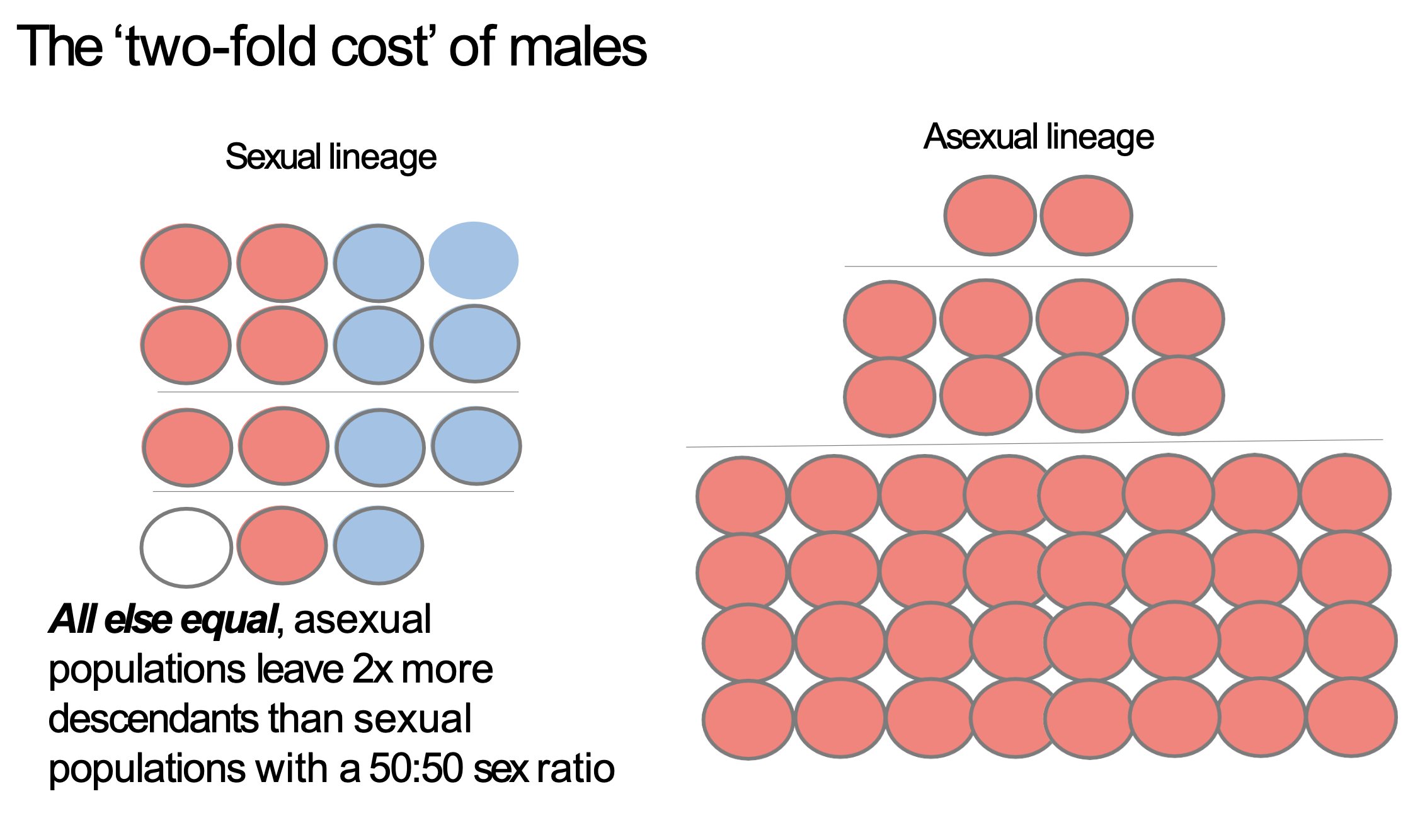
What is the ‘two-fold-cost’ of males?
asexual reproduction: need only one individual = one offspring
sexual + isogamy: need two individuals = one offspring
sexual + anisogamy: sperm contributes basically nothing
need two individuals = one offspring with greater time
Sexual reproduction con?
lethal homozygosity:
Assortment of chromosomes breaks up favourable dominant/recessive relationships
Sexual reproduction exposes recessive alleles to selection, lowering average fitness of individuals in sexual populations
Some offspring have low/zero fitness due to recessive mutations that their parents did not express
Recombination affects on reproduction modes?
breaks up co-adapted alleles and favourable epistatic effects
Recombination increases the variability in offspring fitness
Often, it reduces the average offspring fitness
How is the prevalence of sexual reproduction a paradox?
asexual reproduction is much more advantageous than sexual however… vast majority of multicellular species reproduce sexually
therefore sexual reproduction must confer higher fitness than asexual reproduction
What assumptions are made about sexual/aseuxual reproduction that would give them equal fitness?
equal number of offspring
males provide care = more offspring survive
equal survival
environment changes, some mothers no longer fittest therefore death of offspring
Why sexual reproduction?
recombination + crossing over = mechanism to edit mutations
recombination allows increased variability in subsequent generations
variability allows capacity to change = adaption to changing environments
How is sex linked to linkage disequilibrium and selection?
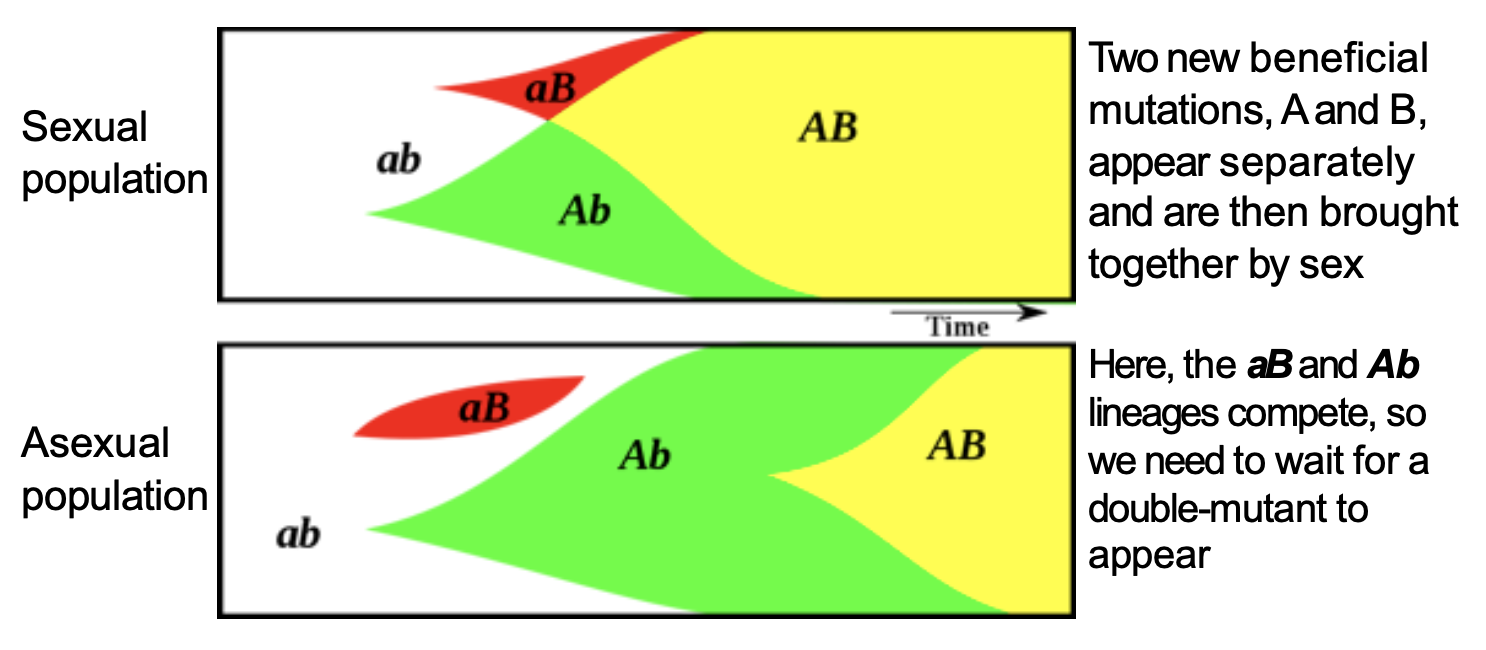
Recombination (sex) brings favourable alleles together faster than mutation
Recombination (sex) allows chromatids to lose disadvantageous alleles
Does recombination speed up or slow down adaptation?
sped up
sex brings together mutations that originated in different individuals
How is sex linked to deleterious alleles?
sex can remove deleterious alleles eg. Muller’s Ratchet, deterministic mutation hypothesis
What is Muller’s Ratchet?
asexual populations suffer from Muller’s Ratchet while sexual populations do not
asexual populations are stuck with whatever mutations they pick up
sexual populations can recover mutation-free genotypes by recombination
multi-mutants can die, removing those mutations from the gene pool
True or false: Muller’s Ratchet explains why sexual reproduction is more common than asexual?
sort of - it is by far not the only reason
Sexual lineages may get outcompeted by asexuals long before Muller’s ratchet etc. can kick in
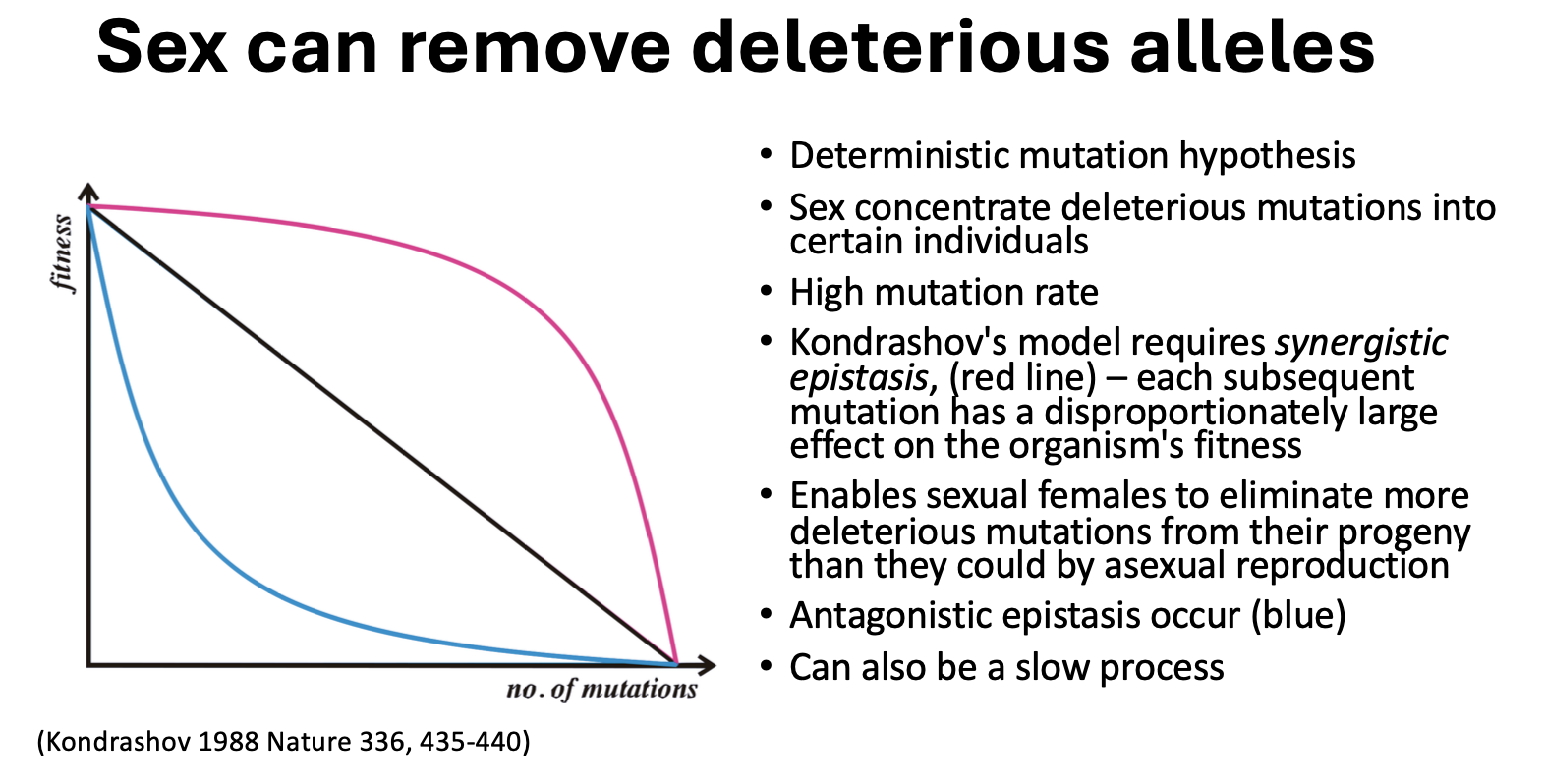
What is the deterministic mutation hypothesis?
a way for sex to remove deleterious alleles
sex concentrate deleterious mutations into certain individuals
requires a high mutation rate
mutations = negative effect on fitness
synergistic epistasis: mutation has disproportionately large effect
agnostic epistasis: mutation has disproportionately small effect
enables sexual females to eliminate more deleterious mutations from their progeny than they could by asexual reproduction
slow process
True or false: the deterministic mutation hypothesis explains why sexual reproduction is more common than asexual?
false - while beneficial it is too slow, not significant enough to explain alone
Why is sexual selection favoured?
sex = genetic recombination
crossing over during meiosis
mixing of genes from 2 parents
sex ‘reshuffles’ genes to create new multilocus genotypes in every generation
‘red queen’ hypothesis
has been proven in experiments like snails
What is the tangled bank hypothesis?
Charles Darwin: A diverse set of siblings may be more fit than a clone, because each sibling uses a slightly different nice = reduce competition
What is the Red Queen Hypothesis?
theory which explains importance of being able to change with your environment hence why sexual reproduction is favoured
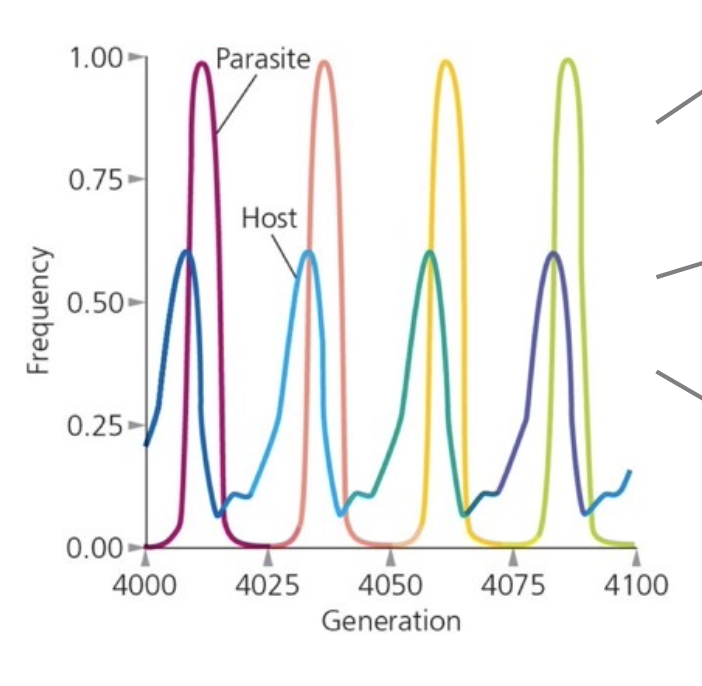
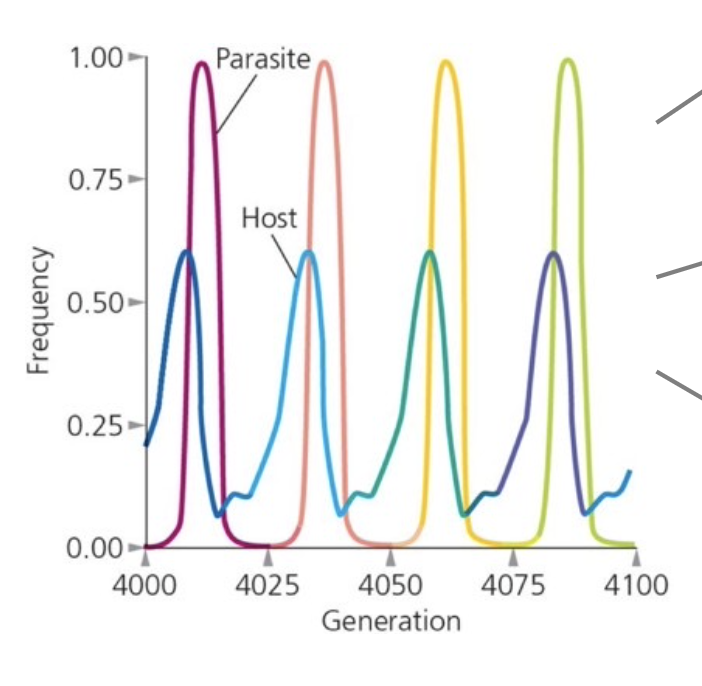
host-parasite coevolutionary ‘arms race’ - both sides must constantly evolve just to maintain the status quo
evolution by the parasite represents a changing environment for the host - sexual reproduction allows the host to produce offspring resistant to parasite via. recombination
Will the co-evolutionary arms race end?
No - we evolve and evolve but don’t really get anywhere
parasites/host constantly evolve to infect and resist one another
alleles that used to confer low fitness can become beneficial again
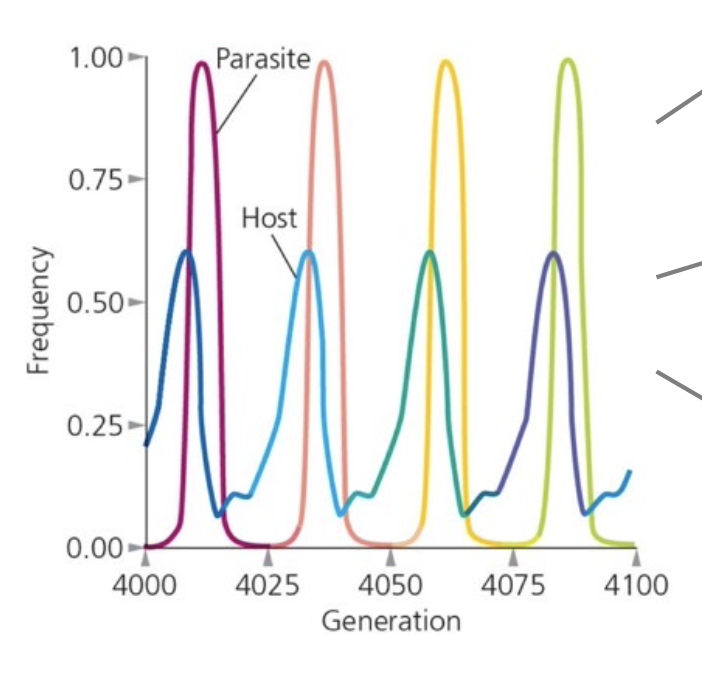
Link between Red Queen and sex?
cycles make sex advantageous
asexual individual might lose all its descendants to a well-adapted parasite
sex creates and preserves genetic diversity, giving large eukaryotes a fighting chance at out-evolving fast- growing things like bacteria
Advantages to sexual reproduction?
Recombination allows increased variability in subsequent generations
Variability allows capacity to change = adaptation to changing environments
Recombination and crossing over = mechanism to edit mutations
remove deleterious alleles
And brings together good mutations
Disadvantageous of sexual reproduction?
Cost of sharing your genes in offspring - would it not be better to have all of your genes in each offspring?
Cost of meiosis = breaking up of good gene combinations
especially in stable environments
Cost of producing males
Cost of courtship and mating - not needed in asexual reproduction
Increased predation risk
Disease: STIs
When is asexual favoured over sexual reproduction?
stable environments - both have advantages/disadvantages just depends on environment
Asexuality and sexuality summary:
Asexuality has 2-fold female fitness advantage, and no search cost or STI’s
Sex is advantageous because it eliminates bad mutations and brings together good mutations, and generate genetic variationc
Who invests more in reproduction - males or females?
Females!
males need to reproduce many times to produce maximum offspring - females only once
females more likely to exhibit parental care
offspring carry their genes
less to gain by further copulations
MALE BIASED OPERATIONAL SEX RATIO (males mate more)
Benefits/costs of parental care?
increase offspring survival
decrease ability to generate further offspring
What is sexual selection?
non-random variance in reproductive success
Forms of sexual selseciton?
INTRASEXUAL selection:
direct competition for mates between members of the same sex, usually male-male competition
INTERSEXUAL selection
differences in attractiveness to the opposite sex, usually non-random mate choice by females
Intra-sexual selection:
aka same-sex competition for access to mates
weaponry
large body size
sensory/locomotory apparatus
dominance hierachies
Inter-sexual selection:
aka mate choice based on individual’s perceived advantage
direct benefits eg. the best father, mating gifts, high fecundity, good genes
indirect benefits eg.
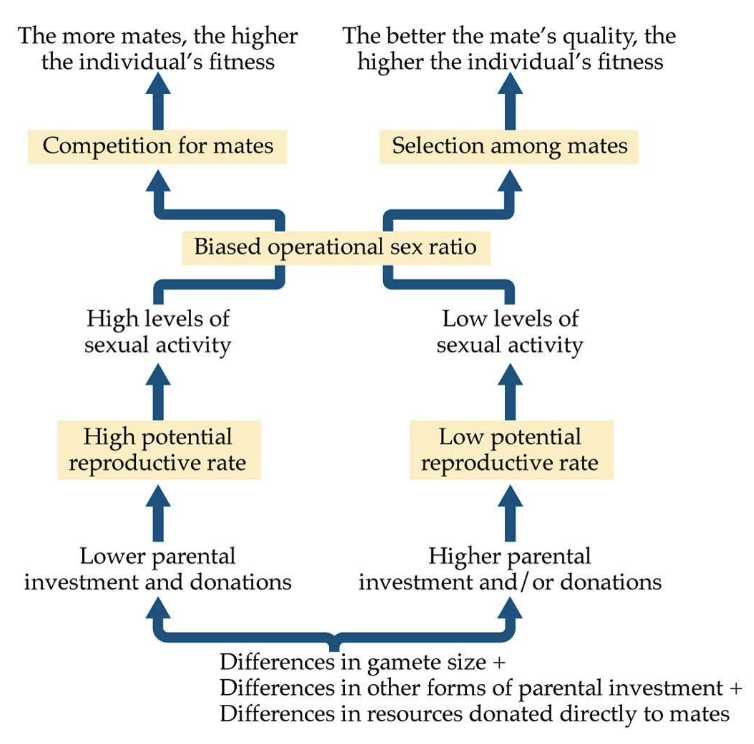
How does investment differ by sex?
difference in gamete size/parental investments/resources donated directly to mates affect investment
high investment/donations = low potential reproductive rate = low sexual activity = biased operational sex ration = selection among mates = the better the mate’s quality, the higher the individual’s fitness
low investment/donations = high potential reproductive rate = high sexual activity = biased operational sex ration = competition for mates = the more mates, the higher the individual’s fitness
What is sexual dimorphism?
difference between males and females in a species due to asymmetric nature of sexual selection, directly related to male-male competition and/or female choice
eg. decorated peacock vs. brown peahen
ornaments can be costly to maintain → direct survival cost
sexual selection pros and cons:
pros:
cons:
sexual selection has the capacity to evolve maladaptive traits ie. costly ornaments
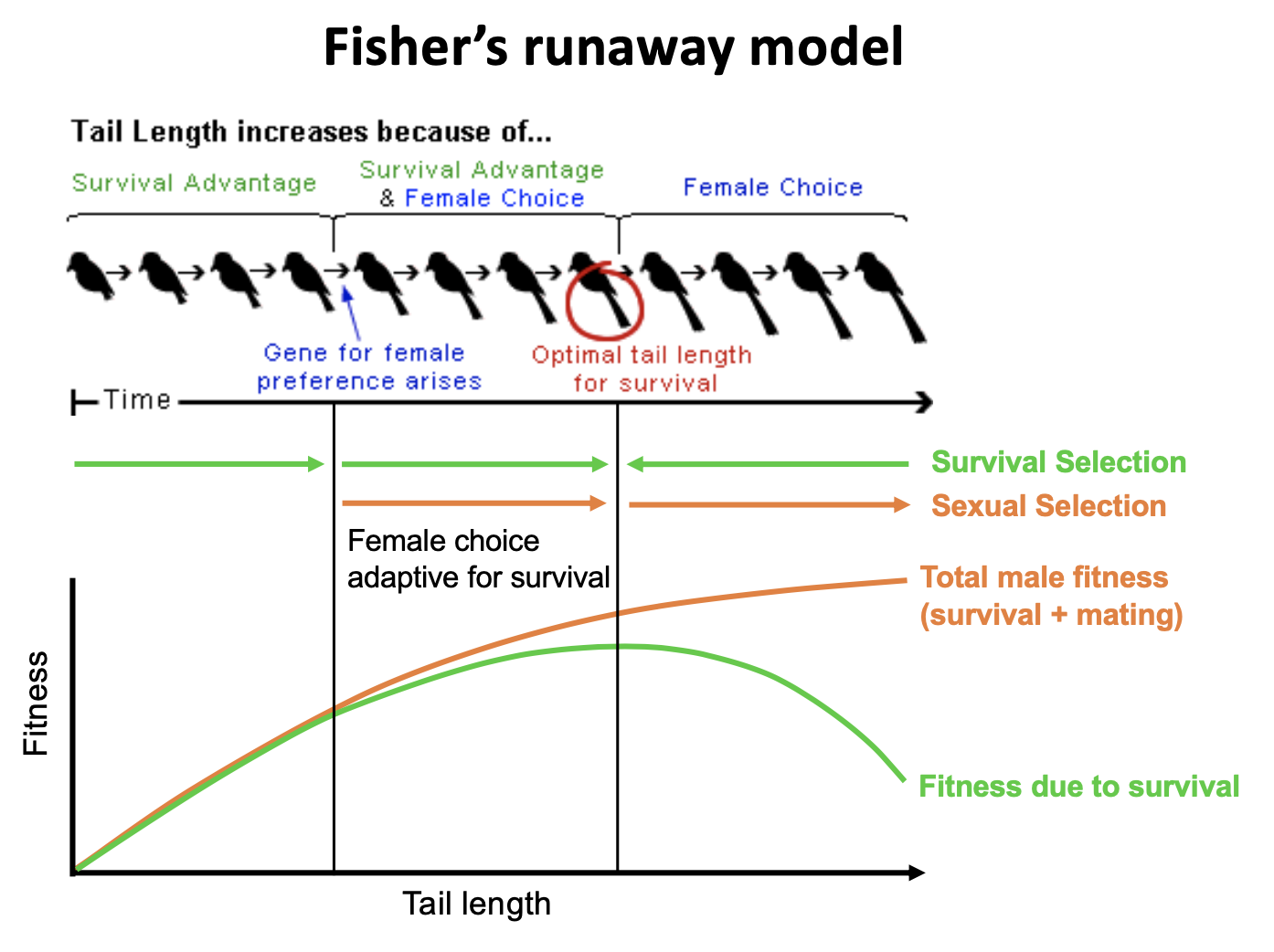
What is Fisher’s runaway model?
tail length increases due to survival advantage → females notice and start to sexually select for it → longer and longer tails become costly to maintain and are naturally selected against
What is a pre-existing sensory bias?
females associate a benefit in the environment with male phenotype
eg. guppies eat orange fruit (high in carotenoids) → males accumulate and have colourful patterns → female bias towards colourful males
is this due to pre-existing sensory bias for detecting orange fruit?
SENSORY EXPLOITATION:
males use courtship signals exploiting pre-existing sensory bias in female
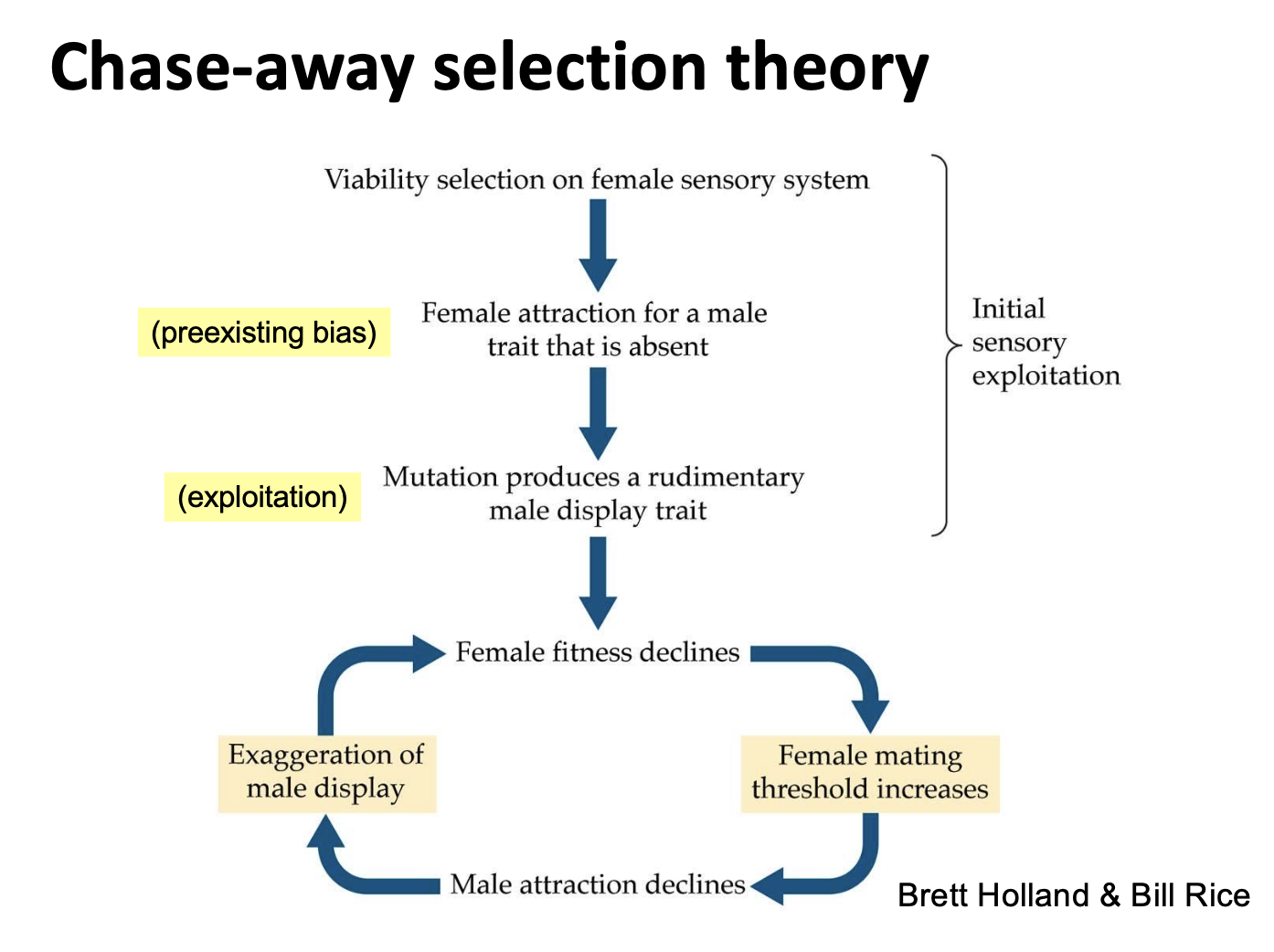
What is the chase-away selection theory?
there is a pre-existing bias in females but males do not have the trait yet → mutation produces rudimentary trait in males → females mate more, driving down female fitness → female mating threshold increases → male attraction declines → exaggeration of male display → female fitness declines and so on
Does intra-sexual selection stop after mating?
NO! male-male competition can continue after insemination
sperm competition when multiple ejaculation occurs
What is the ‘Lottery Principle’?
In many instances sperm competition is analogous to a raffle or lottery. Sperm equal the tickets, fertilisations the prize.
As in a raffle, the more tickets (sperm), the greater the probability of securing the prize (fertilisation).
Hence sperm are produced in large numbers
Why do we have two sexes?
possibly sperm competition?
Fixed amount of resources + zygote fitness size dependent (larger zygote = higher probability of survival)
Large gametes = high zygote fitness
Small gametes = numerous
Size dimorphic gametes (anisogamy)
Conflict over size of fusion partners
How does sperm competition relate to risk and intensity?
as risk increases, males invest in more sperm
Within species variation in the NUMBER of competitors = intensity
Reduce ejaculate expenditure ≥2 competitors due to diminishing returns
Is sperm costly? How?
Yes!
Energetically costly
Can reduce male lifespan
Food shortage reduce sperm number
Accumulate nutrients
Why tailor ejaculation?
sperm are a limited commodity
want to maximise fertilisation returns
males can detect already mated females, female quality and rival male presence
0-1 sperm competitors → increase sperm numbers
>2 sperm competitors → decrease sperm ejaculate
high intensity of sperm competition
can sperm competition promote bigger sperm?
YES! (how wild)
How do females select for sperm?
Selective sperm ejection
Selective sperm use
Selective egg hatching
Selective re-mating
Why should selection be stronger on males than on females?
ie. Why is the variance in fitness of males LARGER than the variance in fitness of females?
because of the variation in mate numbers between males = Greater selection on males generates differences between the sexes
How is female reproductive fitness determined?
Numbers of Eggs and Numbers of Clutches of Eggs that a female lays
How is male reproductive fitness determined?
Numbers of Mates a male has
variance in fitness = ???
Variance in fitness = strength of selection
True of False: ave male fitness > ave female fitness?
FALSE!!
Average male fitness must be equal to average female fitness
True of False: variation in male fitness = variation in female fitness?
FALSE!!
variation in male fitness >> variation in female fitness
Variance in fitness differ between the sexes generating sex differences
What are the costs of sex maintenance/paradox?
Sex makes some loci homozygous, which can be fatal
Recombination breaks up co-adapted alleles
Cost of courtship and mating
Two-fold cost of males
What are the benefits of sex?
Increase genetic variability (better for changing environments)
Red queen hypothesis
Can edit out deleterious alleles/mutations
Deterministic mutation hypothesis
Homozygous lethality
Speed up adaption/evolution
Recombination increases efficacy of natural selection
Lower extinction rates
What is the link between mutation and evolution?
If mutations are common, sexual populations evolve faster
If mutations are rare, sexual and asexuals evolve at the same rate
What is group selection?
the theory that natural selection acts on a whole group rather than individuals (individual selection)
animal behaviours like sacrificing for another kin
What are the theories for origins of sex?
Stress
RNA viruses
Parasitic DNA
Cannibalism
Explain Stress as an origin of sex
Primitive form of sex: an organism with damaged DNA replicating an undamaged strand from a similar organism to repair itself
Suggest sex is an adaptation for dealing with stress - particularly if causing DNA damage
Perhaps environmental stresses leading to DNA damage were common to survival of early microorganisms - suggest ongoing selection during the prokaryote to eukaryote transition
Bacterial transformation or archaeal DNA transfer gave rise to sexual reproduction in eukaryotes
Explain RNA viruses as an origin of sex
Origin of sex in the RNA world based on sexual interactions that occur in extant single-stranded segmented RNA viruses (e.g. influenza virus), and in extant double-stranded segmented RNA viruses (e.g. reovirus)
Exposure to conditions that cause RNA damage could have led to absence of replication and death of these early RNA life forms
Sex allow re-assortment between two individuals with damaged RNA, resulting in undamaged combinations of RNA segments coming together = survival
Explain Parasitic DNA as an origin of sex
sex originated from selfish parasitic genetic elements that exchange genetic material (that is: copies of their own genome) promoting their transmission and propagation
Explain Cannibalism as an origin of sex
Sex evolved as a form of predation
One primitive organism ate another one, but instead of completely digesting it, some of the eaten organism's DNA was incorporated into the DNA of the eater
What is the origin of sexual reporduction?
can be traced to early prokaryotes, around two billion years ago (Gya), when bacteria began exchanging genes
Although these processes are distinct from true sexual reproduction (recombination), they share some basic similarities and result in gene exchange
Question pondered on by Aristotle
What are matign systems about?
maximising the survivorship of offspring
if young require care, and a singly parent cannot provide for the brood/clutch then monogamy or cooperative breeding
What is the ecology of sexual selection?
Males compete with one another for access to females
Like competition for scarce resources, male reproduction is limited by the spatial and temporal availability of receptive females
The intensity of sexual selection depends on the rarity of receptive females in relation to the abundance of competing males
Sexual selection favours male attributes that permit their bearers to find and monopolise their mates
Ecological constraints on male monopolisation attempts leads to a species-specific pattern of male-female association, called a ʻmating systemʼ
What is a mating system?
environment affects male-female association
What are the determinants of spatial and temporal distribution of receptive females?
Abiotic factors: weather, latitude, seasonality
Habitat and food availability
Oviposition (where to lay eggs) sites
Species life history
Genetic quality
Other males and females
What affects the opportunity of sexual selection>
spatial and temporal distribution of receptive females
Who controls reproduction? Males/females?
Spatial and temporal distribution of receptive females
Can males monopolise females and/or resources?
Operational sex ratio
What key decisions are mainly controlled by females?
Egg investment: what material and how much
Mate choice: which males will donate sperm
Fertilisation: which sperm to use for each egg
Offspring investment: how much maintenance and care to each embryo and offspring
How do males influence female decisions?
Resources transferred to females: may influence egg investment, mate choice, or fertilisation
Elaborate courtship: may influence mate choice and fertilisation
Sexual coercion: may overcome female preferences
Infanticide: may overcome female decisions about offspring investment
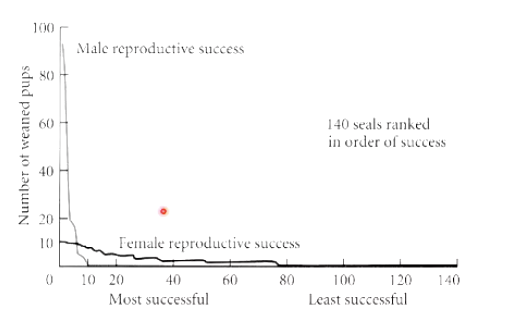
Explain this graph
How are mating systems classified?
Based on number of mating partners and the number of reproductive events
Influences the variance in mating success
Impacts on the opportunity for sexual selection (Imates ) = variance in fitness of each sex/mean fitness for each sex
What is the equation for spatial distribution?
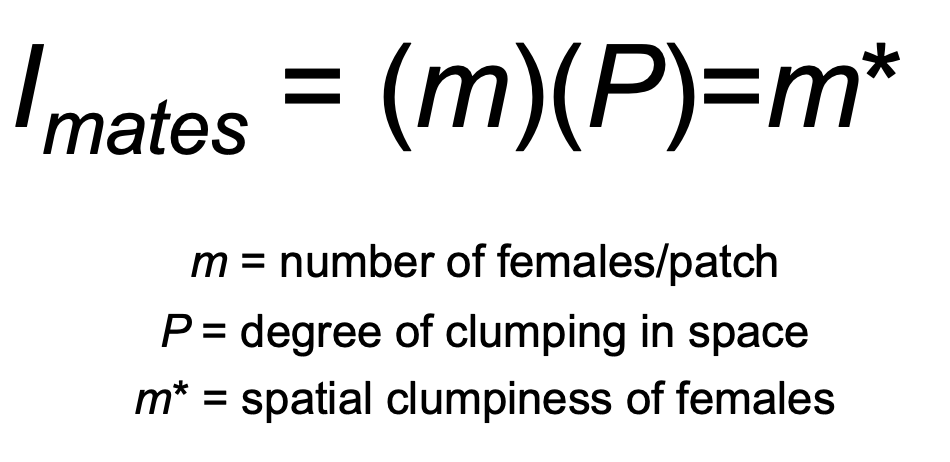
What is another way to say spatial distibution?
sexual selection
What affects the intensity of sexual selection?
Female distribution affects the intensity of sexual selection
Spatial distribution affected by habitat (e.g. host plants) and population density
Can males monopolize resources?
What is the effect of sex ration?
Influence the number of receptive females on a patch
Hence directly influence the spatial distribution of females
Stronger sexual selection when males are abundant
How are m* and Imates related?
relationship is proportional
the more clumped females are the fewer males can mate
should spatial and temporal distribution of females on male mating variance be examined separately or simultaneously?
SIMULTANEOUSLY
How do we reproduce sexually?
semelparity (once)
iteroparity (many)
Interoparity
Reproduce >once in successive years or breeding seasons
Variation in number of clutches and number of offspring per clutch
Monomogamy
male and female pair mate only with one another during a single breeding season
when both sexes are needed for a successful reproduction
could also evolve as a paternity assurance for males = mate
guarding
Males often help in raising young
Polyandry, polygyny and promiscuity
Polyandry = females mate with >1 male during a breeding season
Polygyny = males mate with > 1 female during a breeding season
Promiscuity = both males and females mate with many partners during a breeding season
Effect on monandy and polyandry and iterparity on Imates
MONANDRY: female mates once + produces only one clutch of offspring
she awards her entire reproductive output to a single male
POLYANDRY: female makes more than once + partitions her clutch into sub-clutches
each mating male sires only a fraction of the offspring
variance in reproductive success in males goes down
ITERPARITY: females produces more than one clutch +
variance in offspring numbers can be partitioned into within- and among- female components
Multiple reproductive episodes by females erode Imates
As clutch number increases, Imates becomes a smaller fraction of the total variance in offspring number
When is Imates eroded most and least?
most: polyandrous, iteroparous
least: monandrous, semelparous
How is protandy a male strategy?
Related to temporal distribution of females
Males emerge before females
Maximise no. of mating with virgin females
Increased fertilisation returns
What are leks?
Courtship arenas where males display
Often involve intense male-male competition leading to a dominance hierarchy
Dominance reflects male fitness and assessed by females
What is cooperative breeding and parental care
>2 individuals care for the brood
Variation in reproductive skew
Habitat saturation?
Increase survival of offspring?
Low mortality and small clutch size
Constant environments
What is a sex role reversal?
males provide nutrients
pollen availability varies
female nutritional need
male donations > female investment
result in sex role reversal
How do hemaphrodites affect mating systems?
The condition of having both male and female reproductive structures
Simultaneous hermaphrodites
Sequential hermaphrodites; males first = protandry, female first = protogyny
choose which sex is more beneficial
low population density - finding a mate is hard
What are alternative mating strategies?
Not all males get to mate
Do the best of a bad job?
Means more males get to mate
Success is directly dependent on the strategy played by competitor
Game theory analyses
alternative mating strategy: male polymorphism
alpha, beta, gamma male morphs
males control resources
alpha fight other alpha males for female access
beta males mimic females
gamma males are tiny and hide among females
alternative mating strategy: unequal fitness
large males: guard dead insects
medium males: produce salivary gifts to attract females
small males: force copulations on females
describe three male strategies
Isopods:
equal fitness
frequency dependent equilibrium
Lizards:
not equal fitness; cyclical dynamics
blue beats orange, yellow beats blue, orange beats yellow
Scorpion flies:
not equal fitness; ‘best of a bad job’
large male: guard insect, medium male: salivary gift, small male: forced copulation
What are mating systems determined by?
environment and species’ life history
What affects the spatial (m*) and temporal (t*) distribution of receptive females?
the environment
What dictates opportunity for sexual selection?
spatial (m*) and temporal (t*) distribution of receptive female
Alternative mating tactics =
more males get to mate. The variance in male mating success, and therefore the opportunity for sexual selection decreases