Week 9 - Value Change
 Call Kai
 Learn
Learn Practice Test
 Spaced Repetition
 Match
Match Flashcards
 Knowt Play
1/16

There's no tags or description
Looks like no tags are added yet.
Name | Mastery | Learn | Test | Matching | Spaced | Call with Kai |
|---|
No analytics yet
Send a link to your students to track their progress
17 Terms
What is Inglehart's Postmaterialism thesis in one sentence?
As societies become wealthier and more secure, people's values shift from materialist priorities (economic security, physical safety) to postmaterialist priorities (autonomy, self-expression, quality of life).
What is the Scarcity Hypothesis?
People prioritise whatever is scarce in their formative years.
Those who grew up in economic hardship and existential threat prioritise security and order.
Those who grew up in prosperity and safety prioritise self-expression and autonomy.
Draws on Maslow's hierarchy of needs — survival needs must be met before higher-order needs become salient.
What are Maslow's five levels of the hierarchy of needs?
Physiological (food, shelter) → Safety (security, order) → Love/belonging → Esteem → Self-actualisation. Postmaterialist values only become priorities once the bottom levels are reliably met.
What is the Socialisation Hypothesis?
Core values are formed during impressionable formative years (childhood and adolescence) and remain relatively stable throughout adult life. Therefore, societal value change happens primarily through cohort replacement — as older materialist cohorts die, younger postmaterialist cohorts replace them. This means change is slow and gradual.
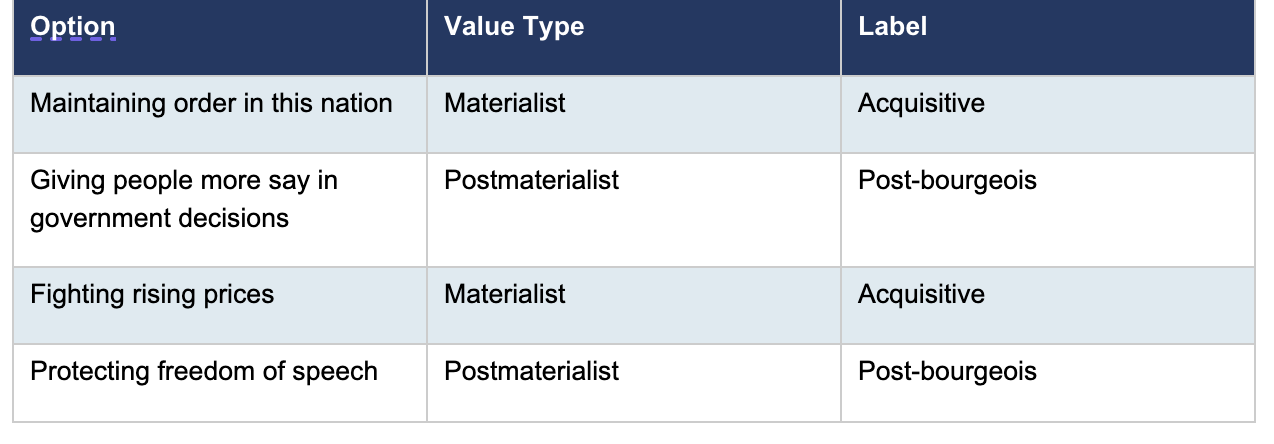
What are the four items in Inglehart's postmaterialism battery and how are they coded?
Maintaining order in this nation (materialist/acquisitive)
giving people more say in government decisions (postmaterialist/post-bourgeois)
fighting rising prices (materialist)
protecting freedom of speech (postmaterialist).
Choosing both materialist items = pure materialist ("acquisitive"). Choosing both postmaterialist items = pure postmaterialist ("post-bourgeois").
Materialists want "Order & Prices" (Survival/Stability).
Postmaterialists want "Say & Speech" (Self-expression).
What are the key empirical findings supporting Inglehart's thesis?
(1) In 1970, younger cohorts were consistently more postmaterialist than older cohorts across all six European countries studied.
(2) Longitudinal cohort data shows values remain relatively stable within cohorts as they age — supporting cohort over age effects.
(3) Period trends in West Germany show a clear rise in postmaterialism from 1970–2006, consistent with cohort replacement. (4) Cross-nationally, wealthier countries score higher on postmaterialism (r = .64).
What is the age/life-cycle rival interpretation of the postmaterialism age gradient?
Young people may always be more idealistic and postmaterialist regardless of cohort — and become more materialist as they age, get mortgages, and have families. To distinguish this from a cohort effect you need longitudinal data tracking the same cohorts over time. Inglehart's cohort data shows values remain stable within cohorts, favouring the cohort interpretation.
What are the two dimensions of cross-cultural value variation? (Inglehart & Baker, 2000)
Traditional vs Secular-rational
traditional values: religion, obedience, national pride, anti-abortion, respect for authority.
Secular-rational: opposite. Survival vs Self-expression — survival values: priority to economic/physical security, low trust, intolerance. Self-expression: autonomy, quality of life, tolerance, civic engagement. Based on factor analysis of the World Values Survey across 65 countries.
What does the Inglehart-Welzel Cultural Map show?
Plotting countries on both dimensions reveals distinct culture zones. Protestant Europe (Sweden, Norway, Denmark) scores highest on secular-rational AND self-expression. Ex-communist countries (Russia, Ukraine) score high on secular-rational but low on self-expression (survival values) — because communism secularised them but economic hardship kept survival values dominant. This shows the two dimensions are genuinely independent.
How does the scarcity hypothesis apply at a cultural level?
When survival is uncertain, diversity feels threatening, outsiders are seen as competitors, and traditional norms provide stability. As prosperity grows, diversity becomes acceptable and then positively valued. This links postmaterialism directly to tolerance — scarcity produces intolerance, abundance produces tolerance.
What are the political implications of postmaterialist value change?
It explains the rise of environmentalist, peace, and feminist movements from the 1970s. It also explains the fracturing of the left — traditional left (working class, wages, redistribution) vs new left (postmaterialist — environment, identity, human rights). It produced a second political divide alongside traditional left-right: a libertarian-authoritarian dimension (gay rights, gender equality, abortion, religion in public life).
What is the authoritarian backlash problem for Inglehart's thesis?
If prosperity produces ever more postmaterialist values, why have Brexit, Trump (2016 and 2024), Orbán in Hungary, Law and Justice in Poland, and the AfD winning young voters in Germany all emerged? These movements appeal to materialist and authoritarian values — precisely what the thesis predicts should be in retreat. This is the most powerful contemporary challenge to Inglehart.
What is the education alternative explanation for postmaterialism?
Within each cohort, education is a very strong predictor of liberal, tolerant, postmaterialist values. This raises the rival explanation that rising educational levels — not formative-years prosperity — are the real driver of value change. If so, the cohort effect may reflect expanding university attendance rather than childhood economic security.
What is the period effects critique of the Socialisation Hypothesis?
The socialisation hypothesis predicts values should be stable within cohorts. But postmaterialist values appear sensitive to current economic conditions — short-term downturns shift values towards materialism even among younger cohorts. This suggests period effects are larger than the theory allows, and that values are not as fixed in formative years as Inglehart claims.
What is the measurement critique of Inglehart's battery?
The four-item forced-choice battery creates a false dichotomy — people must choose between value pairs, which may not reflect real priorities. Most people likely hold mixed values. The 12-item extended battery attempts to address this but faces similar problems.
How do you read a factor loading table?
A factor loading is a correlation between an indicator and a latent factor, ranging from -1 to +1.
High positive loading (e.g., 0.91) = indicator strongly measures the factor. Example: "God is very important in my life" loads at .91 on the traditional/secular-rational factor — meaning it strongly identifies traditional values.
High negative loading = strongly inversely related. Loading near 0 = not measuring that factor.
High Positive on Factor 1: Traditional (Pro-God, Pro-Authority).
High Negative on Factor 1: Secular-Rational (Pro-Science, Pro-Logic).
High Positive on Factor 2: Survival (Low Trust, Materialist).
High Negative on Factor 2: Self-Expression (High Trust, Postmaterialist).
These factors are independent of each other!
Factor 1 (Traditional vs. Secular): This is purely about Authority. Do you follow God/Parents/Country, or do you think for yourself?
Factor 2 (Survival vs. Self-Expression): This is purely about Safety. Are you scared/hungry, or are you secure enough to care about rights and the environment?
What is the key evidence that the age gradient reflects a cohort effect rather than an age effect?
Longitudinal data tracking the same birth cohorts over time shows values remain relatively stable within cohorts as they age — people do not become more materialist as they get older. But each successive cohort starts more postmaterialist than the last. This pattern supports the socialisation hypothesis over the life-cycle hypothesis.