Bio Cellular Signaling Ch 9
 Call Kai
 Learn
Learn Practice Test
 Spaced Repetition
 Match
Match Flashcards
 Knowt Play
1/13

There's no tags or description
Looks like no tags are added yet.
Name | Mastery | Learn | Test | Matching | Spaced | Call with Kai |
|---|
No analytics yet
Send a link to your students to track their progress
14 Terms
Cell signaling pathway
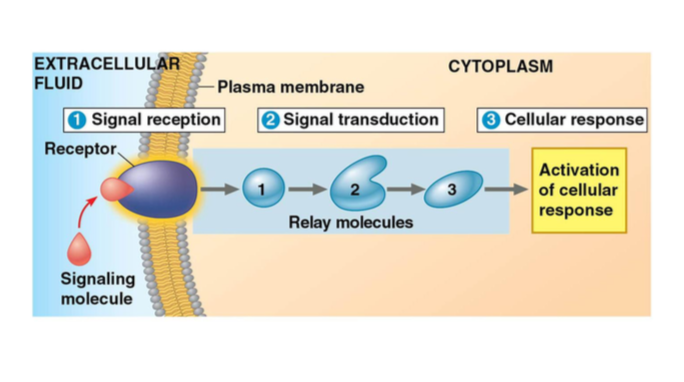
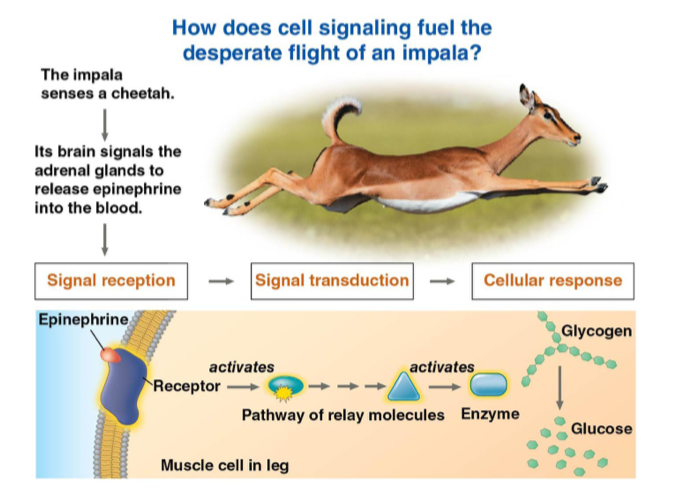
signal reception —> signal transduction —> cellular response
CONCEPT 9.1: _______ signals are converted to _______ within the cell
CONCEPT 9.1: External signals are converted to responses within the cell
• Ancestral signaling molecules likely evolved in prokaryotes and single-celled eukaryotes and were adopted for use in their multicellular descendants
CONCEPT 9.2: ________: A ______ing molecule binds to a _______ ________, causing it to change ______
CONCEPT 9.2: Reception: A signaling molecule binds to a receptor protein, causing it to change shape
• The binding between a signal molecule (ligand) and receptor is highly specific
• A shape change in a receptor is generally the initial transduction of the signal
• Most signal receptors are plasma membrane proteins, but others are located inside the cell
CONCEPT 9.3: ______: _______ of _______ interactions transmit ______ from ______ to _____ molecules in the cell
CONCEPT 9.3: Transduction: Cascades of molecular interactions transmit signals from receptors to relay molecules in the cell
• Cell signaling is usually a multistep process
• Multistep pathways can greatly amplify a signal
• Multistep pathways provide more opportunities for coordination and regulation of the cellular response
CONCEPT 9.4: _______ __________: Cell ______ leads to _________ of ___________ or _________ activities
• The cell’s response to an extracellular signal is called the “______________”
CONCEPT 9.4: Cellular response: Cell signaling leads to regulation of transcription or cytoplasmic activities
• The cell’s response to an extracellular signal is called the “output response”
Signal receptors, relay molecules, and second messengers participate in a variety of pathways, leading to nuclear and cytoplasmic responses, including cell division