Ornithology Final
 Call Kai
 Learn
Learn Practice Test
 Spaced Repetition
 Match
Match Flashcards
 Knowt Play
1/72

There's no tags or description
Looks like no tags are added yet.
Name | Mastery | Learn | Test | Matching | Spaced | Call with Kai |
|---|
No analytics yet
Send a link to your students to track their progress
73 Terms
Genetic basis of migratory behavior
pop of some species can take different routes
expirment showed f1 offspring migrated same way while hybrids mediated
senses used for migration
olfacotry cues
sun
stars
magnetic field
visual landmarks
types of social behavior
territoriality
dominance hierarcheis
colonies
flocking
solitary
raptors are usually
pairs
songbirds and ducks are usually
gregarious
shorebirds are usually
family groups
coop breeders are usually
when benefits outweigh the costs
health of offspring
inc fittness
energy lost
inc predation risk
death
territorality arises when
2 classes of territory
breeding
non-breeding
breeding territories
size often cor w/ bird size
breeding/courtship purposes
nesting
food
size could depend on resources
less resources = bigger
vice versa
swallows territory = just their nest
defend the area to protect against cuckolding
lek
communal display ground where only alpha male gets copulation.
(prarie grouse, woodcock, bird of paradise)
roosting territory
nocturnal security, murmurations
feeding territory
often nectar feeders defend large feeding site against others
territories should be economically defendable
energy avalible in a territory should not be less than energy expanded in defense of territory.
personal space territory
groups perch together but still remain distanced
coloniality
response to shortage of safe nesting sites or abundant/unpredicatable resources that are not worth defending
occurs often in seabirds
benifits to group living
saftey in numbers
pred detection
mobbing
pred sampling
predator sampling
all babies born at same time = less chance ur baby gets got by pred
wintering communal roosts
bald eagles roost together in winter for why?
Information center hypothesis
costs of group living
depletion of resources
inc intraspecific comp
loss of paternity
attract pred
disease
flocking
aggregation outside of breeding
flock feeding = info sharing, cooporation, more comida yum yum yum
mixed spp flocks
common in tropics
exist in NA too, think cardinals titmice, chickadees
hierarchy w/in mixed spp flock
often shared distinct plumage
caraco et al 1980
optimal or intermediate flock size due to tradeoffs between feeding, fighting, scanning for pred
birds w/ dick (cloacal phallus)
ratities
caracids
waterfoul
kiwis lost it
intermetiant organ special modification of the ventral wall of coloca
explodes in air??
teste size breeding stratagy specific
larger in spp that breed colonially than those who breed solitarily
inc sperm comp
inc breeding density associated with
bird sperm
acrosome w/ axial filimant, midpiece, nucleus, and tail membrane,
males release 1.7 to 2.5b per ejaculation (8b possible)
females can store for 10 days to 5 weeks
protoporphyrn pigment from hemoglobin
egg strength is derived from
egg resource strat
lots of food → more eggs but smaller egg size
less food → less eggs but bigger size
pyriform egg shape
pelagic birds
more SA per vL
more gass exchange??
egg rolls in circle not off cliff
more resistant to impacts
Egg laying
usually 1 laid per day or every other day
penguins 3-6dy
1st and last eggs tend to be smaller in size
younger birds lay smaller eggs avg
egg process
reproductive anatomy
intrasexual selection
male-male comp
intersexual selection
mate choice
anisogamy
many small sperm vs few eggs means inital investment of female in offspring is larger
ebbinghaus illusion
bowerbirds create forced perspective w gesso to attract mates and make their treasures look larger
male traits as cues
color
size
tail length
symmetry
song
display rate
courtship feeding
male quality cues
disease resistance
survival
nutrition
development
parental care
good genes hypothesis/good health hypothesis
suggests that individuals with desirable traits signal their genetic fitness, leading to better offspring survivability.
why isnt the trait selected to fixation
variation in female choice
condition dependance of male traits
multiple traits at play
lek paradox
lesser males do not get copulations so why dey do dat
3 lek models
hotspots
m gather where f are likely to be
hotshots
lesser m gather around top dawg for even 00.1% chance of mating
female preference
f preffer to visit large clusters of m
EPP (Extra Pair Paternity)
young sired by male other than the females social pair mate
only 14% of socially mono birds are genetically mono
uncommon in pirds of prey
polgynandry
males and females getting it on w everyone songbirds (maybe only in jims head but hes a dreamer)
polgyny
one male many females, arises when resources are abundant and f can raise offspring alone
RWBB
male benifits EPP
more offspring
parasitize paternal care
spread risk due to predation
Male EPP costs
providing care to unrelated young
female EPP benefits
inc gen var in young
inc quality of young
inc access to resources
fertiliy insurance (jim thinks no silly)
sperm comp
Female EPP costs
STDs
dessertion by primary male
HYP for varation in EPF
breeding synchrony
breeding density
genetic variance
polygyny threshold
why f mate w/ mated m and not unmated?
certain benefits outweigh the costs like territory quality is better in older males than unmated
predictions of polygny
male territory quality will be correlated with mating success
or female should be compensated by sharing territory other female for sufficient benefit
more common in patchy envi (more var in qual)
resource defense polygny
females chose high qual territory not neccesarily male
polyandry
one f many m
m does parental care
reverse sex dimorphism
common in shorebirds
high var in f success
some raptors
brood parasites
faculative (blackbirds) or obligate (YBCU, BHCO)
originated from egg dumping
only 1 precosial bird (black headed duck in Africa)
originated twice in passeriformes
new world cowbirds
african finches
three origins in Old World and New World cuckoos
cuculina
phaenicopanadiae
Neomorphinae-Crotophaginae
single origin in Old World honeyguides
Farming Hyp
Brood parasites destroy host spp nest so they are forced to relay the nest and the parasite can then lay her own eggs in there
arms race between parasites and hosts
parasitic spp develop faster in the nest
bee-eater has ‘killer tooth’ to kill foster siblinings
parasites mimic egg patern/ gape pattern (Vidua family)
hosts may use hatch order to determine parasites (coots)
songbirds nest away from edges where parasitism risk is highest
mafia hypothesis
parasites kill your babies to ‘threaten’ hosts into raising their young
Cooperative Breeding
Helping non-offspring appears to be altruistic
Helpers benefit others while incurring costs
Cooperative Groups
> 200 species of birds
3% of bird species
Helpers at the nest
80% of coop breeders
breeding pair plus 1 or more younger indivuals
ex: florida scrub jay, harris hawks, bell miner
plural breeders
multipule nests within colony
ex: groove billed anis, galapagos hawks
why is coop breeding so rare
requires some form of delayed dispersal and benefits of family must outweigh costs
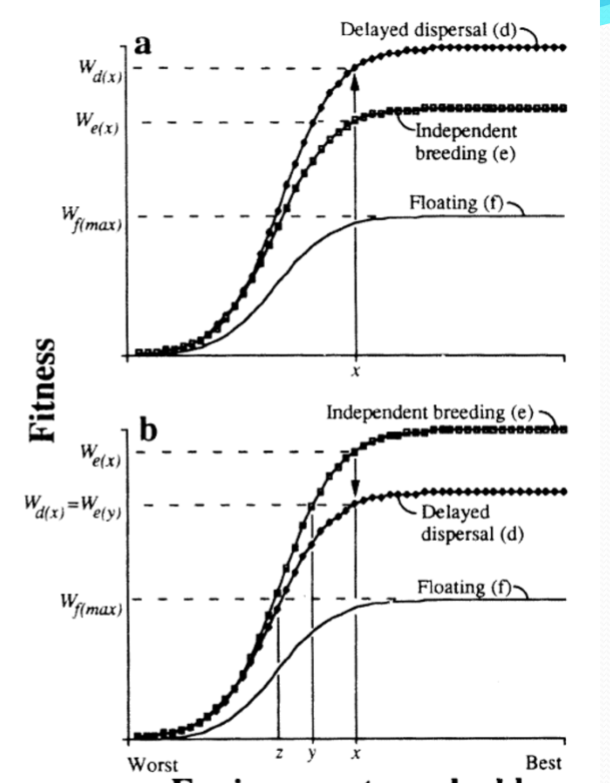
delayed dispersal
ecological constraints model
caused by scarcity in breeding vacancies
stay in parents territory untill vacancy opens
benefits of cooporative breeding
familiar territory
survival improves
parents benefit from help
offspring benefit from help
helpers gain indirect fitness ( and offspring? )
costs of cooporative breeding
drain on territory resources
helpers forgoe breeding although capable (lose direct fitness)
absolute fitness
number of offspring that survive and reproduce
relative fitness
absolute fitness of one individual or genotype compared to another
inclusive fitness
direct fitness and indirect fitness
do helpers exist because of ecological consstraints or because indirect fit outweighs direct
hamiltons solution
kin selection
hamiltons solution
inclusive fitness = own contribution + relatives contribution / average contribution of population
B x r > C
Or rearranged…
C/B < r
Where:
B = fitness benefit given to a recipient
C = fitness cost to actor (self)
r = coefficient of relatedness
Kin Selection
Direct component
Production of own offspring
Indirect component
Pass on your genes by enhancing
the reproductive success of
relatives
r = coefficient of relatedness
factors affecting helping
habitat selection
kin selection
testes inc with
increasing clutch size