Chapter 3: Mendelian Inheritance
 Call Kai
 Learn
Learn Practice Test
 Spaced Repetition
 Match
Match Flashcards
 Knowt Play
1/288

There's no tags or description
Looks like no tags are added yet.
Name | Mastery | Learn | Test | Matching | Spaced | Call with Kai |
|---|
No analytics yet
Send a link to your students to track their progress
289 Terms
What is the Theory of Pangenesis?
The idea proposed by Hippocrates that all body parts produce “seeds” that collect in reproductive organs and are passed to offspring.
Who proposed the Theory of Pangenesis?
Hippocrates
Around when was the Theory of Pangenesis proposed?
Around 400 B.C.
According to Pangenesis, where are “seeds” produced?
By all parts of the body.
According to Pangenesis, where do the “seeds” collect?
In the reproductive organs.
When were the “seeds” transmitted to offspring in Pangenesis?
At the moment of conception.
How long did the Theory of Pangenesis remain accepted?
About 2,000 years.
What is the Theory of Pre-formationism?
The belief that a miniature human called a homunculus existed inside sperm and simply grew larger during development.
What is a homunculus?
A miniature human believed to exist inside sperm.
Why did people believe in Pre-formationism?
Because early microscope users thought they saw tiny humans in sperm.
According to Pre-formationism, what caused the homunculus to grow?
Proper nourishment from the mother.
What were the two groups involved in the Pre-formationism debate?
Spermists and Ovists.
What did Spermists believe?
That the miniature human was inside the sperm.
What did Ovists believe?
That the miniature human was inside the egg.
What is the Blending Theory of Inheritance?
The idea that hereditary traits from parents blend together in offspring.
During what time period was the Blending Theory of Inheritance popular?
From the 1760s to the 1860s and later.
According to the Blending Theory, can both parents contribute traits?
Yes, both mother and father contribute traits.
According to the Blending Theory, what happens to traits over generations?
Traits blend together from generation to generation.
Who is known as the “Father of Genetics”?
Gregor Mendel
What was Gregor Mendel’s occupation?
An Austrian monk.
When did Gregor Mendel live?
1822–1884.
What was Mendel’s monastery devoted to?
Scientific teaching and research.
What organization was Mendel an active member of?
His city’s Agricultural Society.
What scientific topic interested Mendel?
Selective breeding.
What farming experience did Mendel have growing up?
He grew up grafting fruit trees on a farm.
What is heredity?
The transmission of traits from parents to offspring.
When did Mendel begin his pea plant experiments?
1856.
What organism did Mendel use in his inheritance experiments?
Garden peas.
When did Mendel announce his rules of inheritance?
1865.
What was the title of Mendel’s published work?
“Experiments on Plant Hybrids.”
When was Mendel’s work published?
1866.
How long was Mendel’s work ignored?
34 years.
Why was Mendel’s work initially ignored?
The title did not capture the importance of the work and there was a lack of chromosome knowledge.
What major scientific knowledge was lacking when Mendel published his work?
Knowledge about chromosomes.
When was Mendel’s work rediscovered?
1900.
Who rediscovered Mendel’s work?
Three independent botanists.
Where did Mendel perform his experiments?
In the monastery garden.
What type of experiments did Mendel perform on pea plants?
Inheritance crosses.
What is a genetic model organism?
An organism commonly used to study genetics and heredity.
What characteristics make a good genetic model organism?
Easy to grow, easy to study, short generation time, and produces many offspring.
Why are garden peas considered a good model organism?
They exist in many varieties with distinct traits.
Why was Mendel able to easily control pea plant crosses?
Their flower structure allowed controlled breeding.
What two types of fertilization studies can be done with pea plants?
Self-fertilization and cross-fertilization studies.
Why were pea plants convenient for Mendel to use?
They were easy to grow.
What is the scientific name for garden peas?
Pisum sativum.
What does heredity study?
The transmission of traits from parents to offspring.
What bacterium is commonly used as a model organism?
Escherichia coli.
What is the common name of Escherichia coli?
E. coli.
What model organism is a yeast?
Saccharomyces cerevisiae.
What model organism is known as the fruit fly?
Drosophila melanogaster.
What type of organism is Caenorhabditis elegans?
A nematode worm.
What model organism is known as the zebra fish?
Danio rerio.
What model organism is commonly known as the mouse?
Mus musculus.
What plant is commonly used as a model organism?
Arabidopsis thaliana.
Why are distinct characteristics useful in model organisms?
They make inherited traits easier to observe and study.
What is selective breeding?
Choosing parents with desired traits to produce offspring with those traits.
Why did Mendel “get lucky” with pea plants?
Many pea traits followed clear inheritance patterns that were easy to observe.
What seven characters did Mendel study in pea plants?
Height, flower color, flower position, seed color, seed shape, pod color, and pod shape.
What were the two height variants Mendel studied?
Tall and dwarf.
What were the two flower color variants Mendel studied?
Purple and white.
What were the two flower position variants Mendel studied?
Axial and terminal.
What were the two seed color variants Mendel studied?
Yellow and green.
What were the two seed shape variants Mendel studied?
Round and wrinkled.
What were the two pod color variants Mendel studied?
Green and yellow.
What were the two pod shape variants Mendel studied?
Smooth and constricted.
What is a character in genetics?
A general phenotype or characteristic of an organism.
What is a trait (variant)?
A specific form of a character.
Give an example of a character and a trait.
Eye color is a character; blue eyes are a trait.
What is a true-breeder?
A variety that produces the same trait over several generations.
What structure in a pea flower produces pollen grains?
The anther.
What do pollen grains contain?
Male gametes (sperm).
What structure in a pea flower contains the female gametes?
The ovule.
What are the female gametes in plants?
Eggs.
What is the stigma?
The part of the female organ that receives pollen.
What is self-pollination?
When pollen and eggs come from the same plant.
Does self-pollination naturally occur in peas?
Yes.
What is cross-pollination?
When pollen and eggs come from different plants.
How did Mendel control cross-pollination in pea plants?
He removed immature anthers and transferred pollen manually.
Why did Mendel remove immature anthers?
To prevent self-pollination.
What is the function of the male organs in pea flowers?
To produce pollen grains containing sperm cells.
What is the function of the female organ in pea flowers?
To receive pollen.
What is transferred during cross-pollination?
Pollen from one plant to another plant’s female organs.
Label the structure of a pea flower
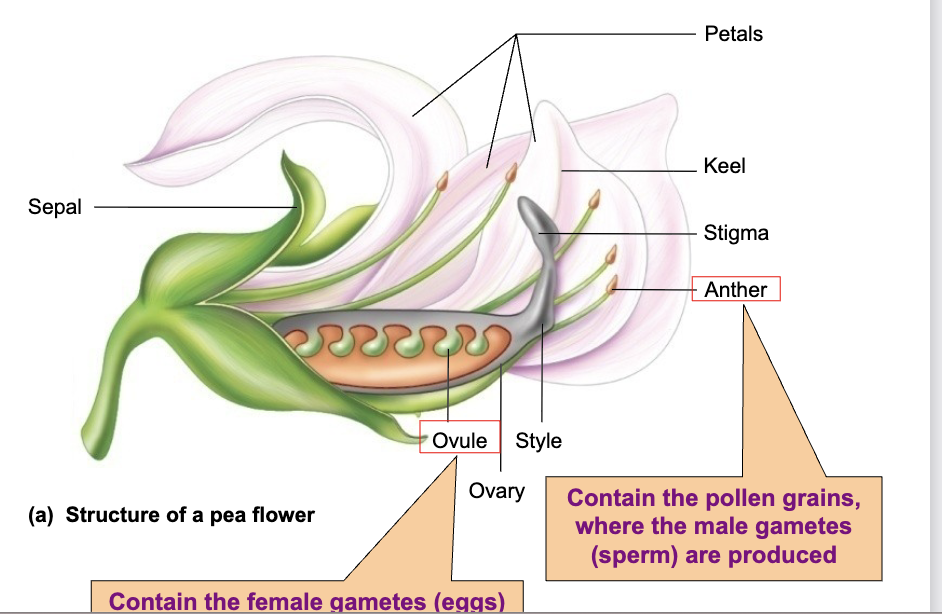
What are true-breeding pea lines?
Pea plants that produce offspring identical to themselves.
How do true-breeding pea lines produce identical offspring?
Through self-pollination.
How long did Mendel test pea plants before doing hybrid crosses?
Two years.
What is a hybrid cross?
Mating two different pure lines that differ in one or more traits.
What is the parental generation called?
The P generation.
What is the first offspring generation called?
The F₁ generation.
What does F₁ stand for?
First filial generation.
What is a pure line in genetics?
A line of organisms that consistently produces the same traits over generations.
What two seed shape traits are shown in Mendel’s parental generation example?
Round and wrinkled.
What did Mendel hope to discover through crosses?
Mathematical relationships governing hereditary traits.
Did Mendel originally have a hypothesis explaining hybrids?
No.
What approach did Mendel use to study heredity?
An empirical approach.
What is an empirical approach?
A method based on observation, experimentation, and collected data.
What are empirical laws?
Laws deduced from experimental observations and data.
Why did Mendel use many plants in his experiments?
To collect quantitative results that could be analyzed mathematically.
What are monohybrid crosses?
Crosses that study one trait.
What does “single-factor cross” mean?
cross examining only one characteristic.