Chapter 20: The Chemistry of Carboxylic Acids
 Call Kai
 Learn
Learn Practice Test
 Spaced Repetition
 Match
Match Flashcards
 Knowt Play
1/32

There's no tags or description
Looks like no tags are added yet.
Name | Mastery | Learn | Test | Matching | Spaced | Call with Kai |
|---|
No analytics yet
Send a link to your students to track their progress
33 Terms
How do you (common) name carboxylic acids?
add the suffix -ic and the word acid to the end
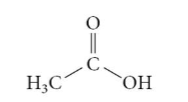
draw acetic acid
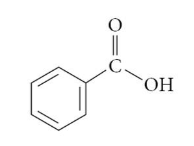
draw benzoic acid
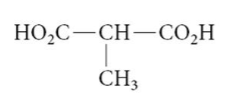
draw methylmalonic acid
What are carboxylic acids with two carboxy groups called?
dicarboxylic acids
Name this structure: HCO2H
Common: formic acid
IUPAC: methanoic acid
Name this structure: CH3CO2H
Common: acetic acid
IUPAC: ethanoic acid
Name this structure: CH3CH2CO2H
Common: propionic acid
IUPAC: propanoic acid
How do you (IUPAC) name carboxylic acids?
drop the final e from the hydrocarbon name and add the suffix -oic acid
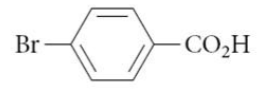
Give the common and IUPAC name of this structure.
Common: p-bromobenzoic acid
IUPAC: 4-bromobenzoic acid
What is the priority of substituents when naming carboxylic acids with more than one functional group?
carboxylic acid > aldehyde > ketone > —OH > —SH
Carboxylic acids have (higher/lower) boiling points than alcohols/aldehydes/ketones with similar molecular masses.
higher
Why do carboxylic acids have generally higher boiling points?
hydrogen bonding and dimer formation
What is the IR spectroscopy of carboxylic acid?
C=O at 1710 cm-1
and
O—H at 2400 - 3600 cm-1 (veryyy broad)
What is the 1H NMR spectroscopy of carboxylic acid?
α-protons at 2.0 - 2.5 ppm
O—H proton at 10 - 13 ppm (exchanges with D2O)
What is the 13C NMR spectroscopy of carboxylic acid?
160 - 180 ppm
Why does the carbonyl C of carboxylic acid have a lower chemical shift than aldehydes/ketones?
shielding effects of nonbonding electron pairs on the carboxylate O (OH group)
Conjugate bases of carboxylic acids are called…
carboxylate ions
What are the factors influencing acidic strength of carboxylic acids?
resonance
polar effect
How does resonance influence acidic strength of carboxylic acids?
it stabilizes the conjugate base
How does the polar effect influence acidic strength of carboxylic acids?
the carbonyl group (C=O) stabilizes the carboxylate charge because it is EN
Halogen substitution of alkyl groups connected to carboxylic acids (increases/decreases) acidity.
increases
Sulfonic acids are much (stronger/weaker) than carboxylic acids.
stronger
Why are sulfonic acids stronger than carboxylic acids?
high oxidation state of S (expanded octet)
Sulfonic acids are useful as ____ in organic solvents.
acid catalysts
Why are sulfonic acids useful as acid catalysts in organic solvents?
they are more soluble than more inorganic acids
Moderately-sized carboxylic acids are (soluble/insoluble) in water.
insoluble
Although moderately-sized carboxylic acids are insoluble in water, what about them is soluble in water?
their alkali metal salts
The carbonyl oxygen is weakly (acidic/basic).
basic
What reagent is used in oxidation of an aldehyde or a primary alcohol to a carboxylic acid?
H2CrO4, H2O
or
CrO3, H2SO4
or
Na2Cr2O7, H2SO4
What reagent is used in oxidation of an alkyl benzene to a carboxylic acid?
KMnO4, -OH
H3O+
draw the mechanism for turning a Grignard reagent into a carboxylic acid
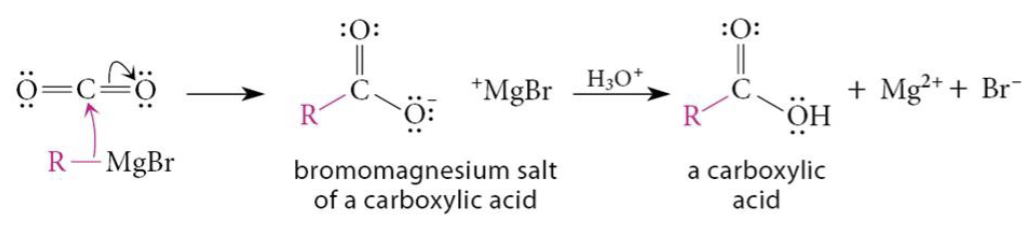
What reagent is needed for turning a Grignard reagent into a carboxylic acid?
CO2, THF
H3O+