Lecture 10: Collateral & Multiple Ligament Injury/Meniscal Injury
 Call Kai
 Learn
Learn Practice Test
 Spaced Repetition
 Match
Match Flashcards
 Knowt Play
1/38

There's no tags or description
Looks like no tags are added yet.
Name | Mastery | Learn | Test | Matching | Spaced | Call with Kai |
|---|
No analytics yet
Send a link to your students to track their progress
39 Terms
What is the difference between a sprain and a strain?
sprain = ligament injury
strain = muscle tendon unit
What is the function of medial and lateral collateral ligament function?
limit varus-valgus motion of stifle joint
What prevents tearing of lateral meniscus?
Meniscofemoral ligament
What are all the types of meniscus injuries?
Radial, longitudinal, medial peripheral detachment, folded caudal horn
What is the correct grading of sprains?
1st degree, 2nd degree, 3rd degree, 1st is mild, 3rd is severe
When are medial or lateral collateral ligaments typically injured?
with injury to other primary and secondary restraints of stifle joint (usually result from severe trauma to stifle joint)
How is the stifle joint positioned to examine for collateral injury?
stifle joint extended
Which collateral ligament does the valgus stress test and varus stress test evaluate?
valgus = medial
varus = lateral
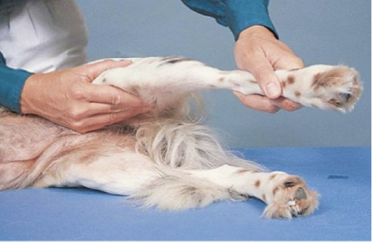
What is this person assessing?
integrity of collateral ligaments
What is the valgus stress test?
• Patient in lateral recumbency
• One hand stabilizes femur-other hand grasps distal tibia & applies upward force (abduction)
• If medial joint restraints torn → See opening of medial joint line (Medial collateral ligament (MCL), joint capsule, peripheral meniscal ligaments)
What is the varus stress test?
• Patient in lateral recumbency
• One hand stabilizes femur-other hand grasps distal tibia & applies inward force (adduction)
• If lateral joint restraints are torn → See opening of lateral joint (Lateral collateral ligament (LCL), joint capsule, peripheral meniscal ligaments)
What differential diagnosis need to be ruled out when considering an MCL/LCL tear?
• Muscle strains
• Cranial or caudal cruciate ligament tears
• Nondisplaced physeal fractures in immature animals
What is conservative or surgical treatment for isolated collateral ligament injury based on?
degree of injury:
• Collateral ligament itself
• Secondary joint restraints (joint capsule, peripheral meniscal ligaments)
What is the criteria for medical management of collateral ligament injuries?
Minimal swelling & only slight opening of joint space w/ stress test
Indications for conservative treatment
1st degree sprain
What is the criteria for surgical management of collateral ligament injuries?
Moderate to severe swelling & significant opening of joint space w/ stress test
Indicates greater injury to collateral restraints
2nd and 3rd degree sprains
When is primary repair of collateral ligaments performed?
• Point of failure is origin or insertion of ligament
• An intrasubstance tear w/ large segments of ligament intact
What is done preop to a collateral ligament surgery to prevent additional damage to articular cartilage or menisci?
• Place modified Robert Jones bandage on limb
• Limit activity to leash walking
What are the origin and insertion point of medial collateral ligament?
• Originates from medial femoral epicondyle
• Runs distally to insert onto proximal tibial metaphysis
• As ligament crosses medial joint line - Strong attachment to joint capsule & medial meniscus
• Lies deep to caudal sartorius muscle
What are the origin and insertion point of lateral collateral ligament?
• Originates from oval area on lateral femoral epicondyle
• Runs distally to insert onto fibular head
• Lies deep to fascia lata
What do you need to be careful of when dissecting near lateral collateral ligament?
preserve peroneal (fibular) nerve
How is the patient positioned for collateral ligament procedures?
• Lateral Collateral Ligament Injury: Position patient in lateral recumbency w/ affected leg up
• Medial Collateral Ligament Injuries: Position animal in dorsal recumbency
• Multiple Ligament Tears: Dorsal recumbency to facilitate exposure of both sides of limb → Suspend limb & prepare for aseptic surgery
When repairing a medial restraint injury, incise insertion caudal head of ____ muscle and deep fascia along craniomedial border of proximal tibia?
sartorius
How is medial ligament injury repaired if ligament injury is intrasubstance tear?
• Primary repair by suturing ligament ends w/ locking-loop suture pattern
• Supplement primary repair w/ screws & figure-eight support
How is repair of a lateral restraint injury performed?
• Craniolateral approach
• Make proximal-to-distal parapatellar incision through fascia lata
• Continue incision distally 4 cm below tibial crest parallel to joint line
• Use caution isolate and protect peroneal nerve
• Reflect fascia lata caudally
• Expose collateral ligament & lateral joint capsule
• Repair ligament as described for MCL
What is the prognosis for isolated collateral ligaments vs if multiple ligaments are torn?
• isolated collateral ligament = good to excellent
• multiple ligaments = fair
What structures are commonly injured with multiple ligament derangement of the stifle joint? (common triad?
• Cranial & caudal cruciate ligament tears
• Failure of primary and secondary medial restraints
• Peripheral medial meniscal tears
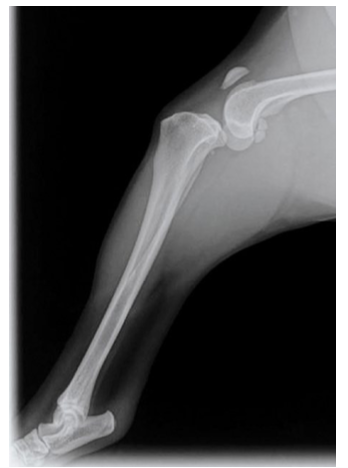
What is this?
deranged stifle (luxation of stifle joint due to multiple ligamentous injuries)
What are the locations of release of medial meniscus?
A. Transection of meniscotibial ligament
B. Transection of midbody of meniscus
What surgical technique developed in association with TPLO is a means of “protecting” medial meniscus following surgical stabilization of stifle?
meniscal release
Why is meniscal release controversial?
Function of meniscus is compromised by elimination of hoop stresses
uncertain efficacy
What happens with midbody release or transection of meniscotibial ligament?
• Femoral condyle increases contact w/ articular cartilage of tibial plateau → Contributes to osteoarthritis
• Impairs functions of meniscus to provide stability & congruence
True or false: No clinical studies demonstrate efficacy of meniscal release in decreasing incidence of post TPLO meniscal injury; but technique remains in widespread use.
true
Why is conservative tx not an option for meniscal injuries?
continued back and forth sliding of torn meniscus causes severe pain that will not improve with conservative management and accelerates DJD
What are the tx methods of meniscal injuries?
1. Partial meniscectomy
2. Primary repair of peripheral meniscal injuries
3. Total meniscectomy
True or false: partial meniscectomy carries more morbidity than a total meniscectomy.
false
What is the tx of choice for bucket handle tears of medial meniscus?
partial meniscectomy
What type of meniscal tear is primary repair reserved for?
peripheral tears
True or false: total meniscal removal induces severe DJD in stifle.
true
The more meniscal tissue removed the more rapidly ______ develops.
OA