Exam 1 - Exss 181 Final Review Flashcards
 Call Kai
 Learn
Learn Practice Test
 Spaced Repetition
 Match
Match Flashcards
 Knowt Play
1/35

Earn XP
Description and Tags
Based on Exam 1 review guide
Name | Mastery | Learn | Test | Matching | Spaced | Call with Kai |
|---|
No analytics yet
Send a link to your students to track their progress
36 Terms
Definition of Sport and Exercise Psych
The scientific study of human behavior in sport and exercise, and the practical application of that knowledge.
3 Roles of Sports Psychologists
Research - theoretical and applied research
Teaching - all levels including Uni
Applied/Consulting - help individuals and teams improve performance
2 Major objectives of the field
Understand the effects of:
psychological factors on bx and performance
participating in sports/physical activity on psych development, health, and well-being
B = f(P, E)
An underlying theme of sport psychology research: Behavior is a function of the person and their environment. (The need to understand both person and context.)
Main historical figures
Normal Triplett - studied social facilitation of bikers —> tested whether cyclists rode faster in groups or alone.
Coleman Griffith - “father of modern sport psychology,” 1st research lab, 25 research articles, worked with Notre Dame and Chicago Cubs
6 Periods of Sports Psych
Early Years - (1893-1919) Normal Triplett
Dev of Labs and Psych Testing - (~1920-1938) Coleman Griffith
Prep for the Future - (1939-1965) Franklin Henry establishes grad program
Establishment of Academic Sport Psych - ('66-'77)
Multidisciplinary Science and Practice in Sport and Exercise Psych - (‘78-’99) Dorothy Harris, new research and establishment of journals
Contemporary Sport and Exercise Psych (2000 - now)
3 Ways of Knowing and Scientific Method
Knowing:
Common Sense - intuition, easy, quick, unreliable
Practical Experience - observation, holistic, no causality
Science - systematic, empirical, reliable, slow
Method:
Develop the problem - identify IV and DV, purpose of study
Formulate Hypothesis - testable
Gather Data - participants/methods/run experiment
Analyze and Interpret - support/refute hypothesis, compare, rework
Personality Definition
the pattern of characteristic thoughts, feelings, and behaviors that distinguishes on person from another and persists over time and situations
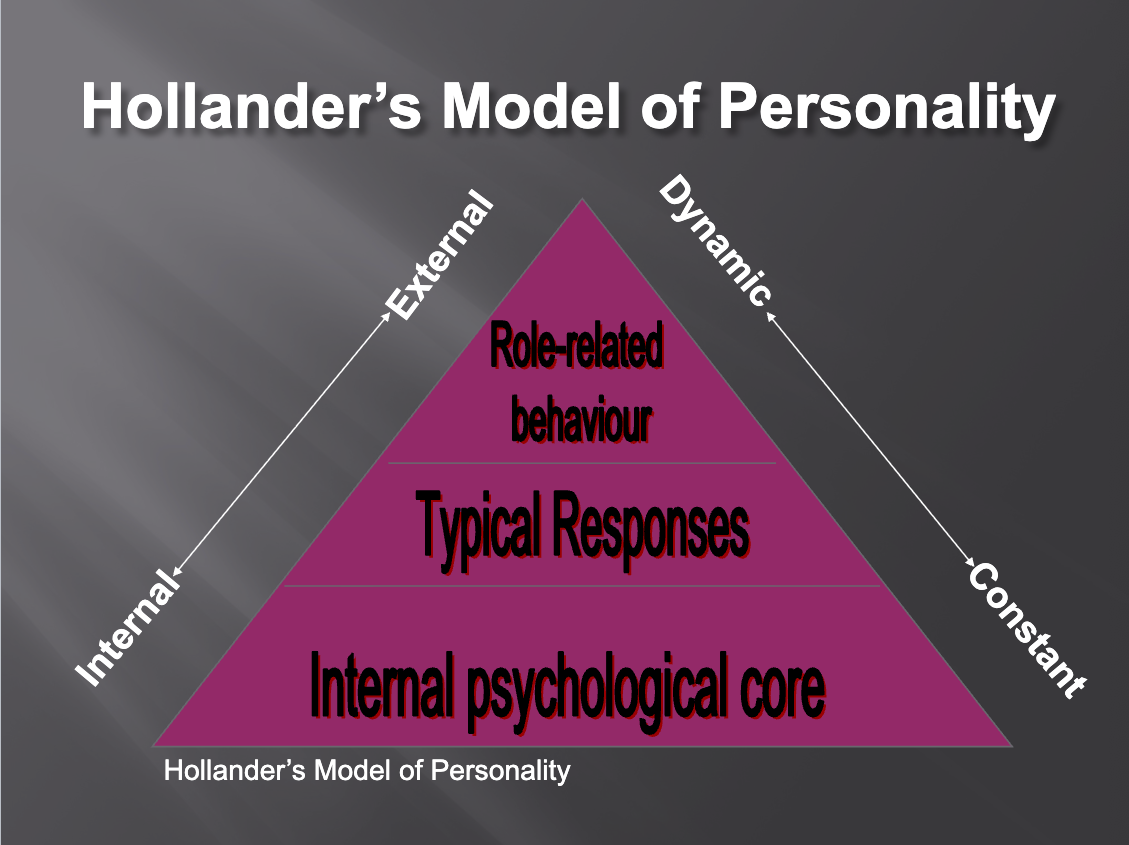
Hollander's Model of Personality
Internal psychological core - most constant, least likely to change
Typical responses - may change with situation
Role-related behavior - subject to change with situation, external
Big 5 Personality Traits - Trait Approach
Openness to Experience
need for variety ←————————→ routine
Conscientiousness
disciplined, constrained ←————————→ impulsive, careless
Extraversion/Introversion
extrovert ←————————→ introvert
Agreeableness
altruistic, modest ←————————→ egocentric, skeptical
Neuroticism
nervous, depressed, anxious ←————————→ emotionally stable
Situation influences personality development - 2 Theories
Behaviorism - people learn certain bx for specific situations via reward/punishment
Social Learning Theory - people learn bx for specific situations via observational learning/modeling
Interactionist Approach
Person factors and situational factors interact to determine bx
B = f(P, E)
Coaching use of personality tests
not sufficient evidence of reliability & validity (of personality tests)
social desirability and psych skills can be learned
doesn't account for non-psychological factors that affect sport perf.
not recommended for making coaching/roster decisions
Definition of Motivation
the direction and intensity of effort
Attribution Theory
Attributions - Explanations individuals give for success or failure. AT says motivation is influenced by our attributions.
3 Characteristics of Attributions:
Stability: stable or unstable
Locus of Causality: internal or external
Locus of Control: in one's control or out of one's control
Achievement Goal Theory
Assumptions of AGT
people are motivated to demonstrate competence
motivation is influenced by the personal meaning one assigns to perceived success and failure
Two Ways to Define Success/Failure:
Relative to other people = EGO/OUTCOME
winning, beating a rival, coming out on top
Relative to your own past performance = TASK/MASTERY
personal best, learning to improve, working hard
4 Possible Combos of Goal Orientations
High task, low ego
High task, high ego
Low task, low ego
Low task, high ego
3 Predictors of Goal Involvement
Goal Orientation
Concept of Ability
Motivational Climate
2 Conceptions of Ability
Undifferentiated concept of ability
an inability or choice to differentiate between ability and effort
working hard = ability
Differentiated concept of ability
differentiating between ability and effort
just because I work hard doesn't mean I'm automatically good at it
2 Kinds of Motivational Climates
Performance/Competitive Climate - emphasis on winning, competition, social comparison
Mastery Climate - emphasis on improvement, cooperation, learning
TARGET
Task - what athletes are asked to do and learn
Authority - type and frequency of involvement in decision-making process
Recognition - encourage to recognize one's own progress
Grouping - how athletes are brought together or kept apart in training/games
Evaluation - procedures for monitoring performance and progress
Timing - appropriateness of time demands placed
Intrinsic vs. Extrinsic Motivation
Intrinsic - bx demonstrated voluntarily, performing an activity for its own sake
Extrinsic - bx displayed for purpose of achieving some end goal
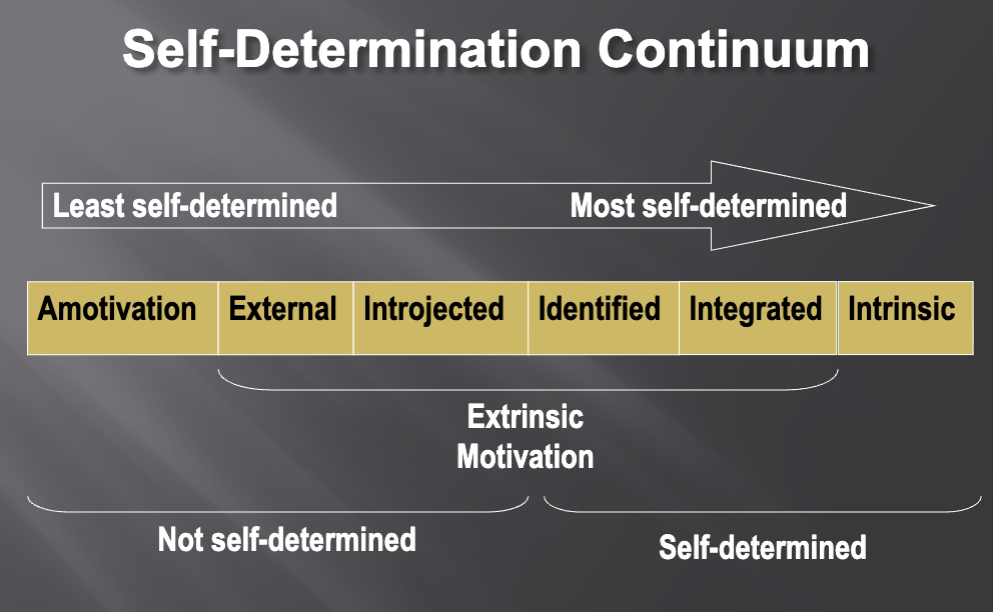
Self-Determination Continuum
Amotivation
External Reg - performing activity to receive reward or avoid punishment
Introjected Reg - performing to avoid guilt and/or anxiety
Identified Reg - performing to achieve valued extrinsic outcome
Integrated Reg - performing becomes part of sense of self
Intrinsic Motivation - performing for activity's own sake
Cognitive Evaluation Theory and Rewards
Critical factor here is not the reward itself, but the person's interpretation of it.
2 Aspects of Rewards:
Controlling Aspect:
more controlling = undermines self-determination
affects autonomy perceptions
Informational Aspect:
more informational = enhances self-determination
affects competence perceptions
Ryan (1977, 1980) Scholarship Studies
Previous idea: Intrinsic Motivation (IM) + Extrinsic Reward = Increased Motivation
Study 1: Scholarship < Non-Scholarship on Intrinsic Motivation
Study 2:
for Football: Scholarship < Non-Scholarship on IM
for Wrestling and female athletes: Scholarship > Non-Scholarship on IM
Competence Motivation Theory 3 Key Assumptions
Perceptions of control work along with self-worth and competence evaluations to influence self-motivation.
Perceptions of control, competence, self-esteem do influence motivation directly.
Rather, these perceptions influence affective or emotional states that in turn influence motivation. (ex. enjoyment, pride, shame)
Mastery Attempts
sporting choices
intensity
persistence
3 Stages of Children's Competence Motivation
Autonomous Competence Stage - before age 4; no comparison to others, children master their environment through self-testing their abilities.
Social Comparison Stage - starts around 5; comparing their performance with that of others
Integrated Stage - dif. age for everyone; combines both previous — understanding that there is a time for both.
Arousal vs. Anxiety
Arousal - a general state of activation from deep sleep to extreme excitement
Anxiety - a neg. emotional state characterized by nervousness, apprehension, worry, and increased psychological activaition
Cogntive Anxiety - mental component (ex. racing thoughts)
Somatic Anxiety - physical component (ex. heart rate increase)
State vs. Trait Anxiety
State Anxiety - The actual apprehension experienced at a given time (in the moment)
Trait Anxiety - the tendency to become anxious in stressful situations (dispositional)
2 Ways in which Anxiety Affects Performance
Increased Muscle Tension and Coordination Difficulties (generally bad)
Attention and Concentration Changes (could be good or bad)
Arousal Performance Theories
Drive Theory - direct linear relationship between anxiety and performance
Inverted U Theory - performance peak at optimal moderate level of anxiety
IZOF (individualized zones of optimal functioning) - optimal level not always at the midpoint, also not a single point but a bandwidth.
Multidimensional Theory - cognitive vs. somatic anxiety affect performance differently
Catastrophe Theory - as arousal increases, performance increases to a point, but too much leads to a sharp drop-off in performance (catastrophe).
Reversal Theory - arousal affects performance based on interpretation
3 Types of Modeling Effects
Skill/behavior Acquisition
acquire motor coordination info
develop strategies to solve movement problem
Psychological Response
inhibition - ex. observe injury, induce anxiety
disinhibition - ex. gain confidence
Response Facilitation
4 Key Components of the Modeling Process
Attention
Retention
Motor Reproduction
Motivation
4 Ways to Measure Degree of Learning
Verbal production
Recognition
Comprehension test
Actual performance
Feedback Strategies
positive reinforcement - ex. reward
positive punishment - ex. spanking
negative reinforcement - ex. no need to do chores
negative punishment - ex. taking away xbox