physiology: chapter 1 review
 Call Kai
 Learn
Learn Practice Test
 Spaced Repetition
 Match
Match Flashcards
 Knowt Play
1/45

There's no tags or description
Looks like no tags are added yet.
Name | Mastery | Learn | Test | Matching | Spaced | Call with Kai |
|---|
No analytics yet
Send a link to your students to track their progress
46 Terms
physiology
study of biological function; how the body works
pathophysiology
study of how disease or injury affects body processes
steps of scientific method
observations
hypothesis: testable
experiment, observations
analyze
replicate results and draw conclusions
control group
A baseline group in an experiment that does not receive the treatment being tested, used for comparison to assess the effects of the treatment.
scientific theory
a well-substantiated explanation of phenomena based on several verified hypotheses
blind experiment
A study where participants are unaware of which group they belong to, preventing bias in the results.
double blind experiment
an experimental procedure where neither the participants nor the experimenters know who is receiving a particular treatment,
placebo
a substance with no therapeutic effect used as a control in testing new drugs.
phase 1 in clinical trials
test the drug on healthy human volunteers; test for side effects, rates of passage and dosage
phase 2 of clinical trials
tests drug effectiveness on people with the particular disease
phase 3 of clinical trials
tests the drug on a larger population to include both sexes, many age groups and ethnicities and people with more than the one health condition
phase 4 of trials
tests other applications for the drug
homeostasis and examples
constancy of the internal enviroment. Ex: body temp, body ph and blood glucose
pathway and mechanism of feedback loops
sensors: detect changes and send information to;
integrating center: assseses information and sends instructions to;
effector: make appropriate adjustments to counter the change from the set point
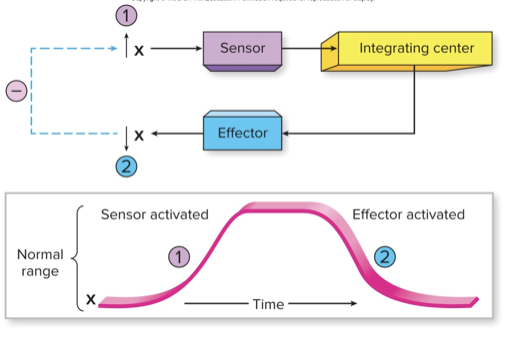
negative feedback
moves in the opposite direction to reverse the change in the set point.
A continuous process, always making fine adjustments to maintain homeostasis
examples: body temp, glucose, calcium, blood PH
positive feedback
the end product stimulates the process and moves in the same direction. Amplifing changes stimukated to the effectors.
example: uterine contractions, blood clots
negative feedback inhibition
usually involves an antagonist to maintain homeostasis by inhibiting the initial stimulus in a system, thus preventing excessive responses and restoring balance.
antagonistic effectors
Two opposing mechanisms that regulate a physiological variable, working to maintain homeostasis by balancing each other.
ex: glucagon secretion rising blood sugar when blood sugar is too low
intrinsic regulation
cells within an organ sense a change and signal to neighboring cells
extrinsic regulation
the brain or other organs regulate an organ using the endocrine or nervous system
feedback inhibition
hormones are secreted in response to specific stimuli. Secretion can be inhibited by its own effects
levels of orginization
cell- basic unit of structure and function
tissue- group of similar cells performing a similar function
organ- group of two or more tissues into structual and functional units
system- group of organs working together to perform related functions
organism- systems working together in coordination
muscle tissue
contraction, voluntary control; skeletal, cardiac, smooth
striations: skeletal, cardiac- intercalated discs
nervous tissue
neurons and gilia: found in brain, spinal cord and nerves
conduct impluses
epithelial tissue
form membranes that cover body surfaces, line organs and glands
simple epithelium
a single layer of cells that transports substances
stratified epithelium
multi layers of cells that protect
squamous
flat epithelial cells that facilitate diffusion and filtration.
cuboidal
cube-shaped epithelial cells that assist in secretion and absorption.
columnar
tall, column-like epithelial cells that aid in absorption and secretion.
endocrine gland
secrete hormones directly into the bloodstream. derived from epithelial tissue.
exocrine gland
secretes hormones into ducts. Derived from epithelial tissue
stem cells
connective tissue
matrix made of protein fibers, extracellular material and specialized cells that supports, binds, and protects other tissues and organs in the body.
connective tissue proper
contains protein fibers and gel. like ground substance
loose: collagen fibers scarted loosely containing
loose connective tissue
collagen fibers loosely room for vessels and nerves
ex: upper dermis
dense regular connective tissue
densely packed collagen fibers with no room for ground substance
ex: tendons and ligaments
dense irregular connective tissue
densely packed collagen fibers arranged in various ways
ex: adipose tissue- which stores fat
cartilage connective tissue
composed of chondrocytes surronded by semi solid ground substance
ex: joints
bone connective tissue
osteoblasts and osteocytes embedded in a mineralized matrix around a canal filled with vessels and nerves
stem cells
highly specialized cells used for tissue development
totipotent
stem cells that can differentiate into any cell type,
ex: zygote
pluripotent
stem cells that can differentiate into nearly all cell types.
Ex: embryonic stem cells
multipotent
adult stem cells are limited to a narrow range of possibilities but can become several related cells
ex: bone marrow can become any type of blood cell
intracellular
area inside cells seperated by membranes; contains 65% total body water
extracellular
area outside of cells seperated by membranes; blood plaasma and intersitial fluidthat contains the remaining 35% of total body water.