4.1 benefits of international trade
 Call Kai
 Learn
Learn Practice Test
 Spaced Repetition
 Match
Match Flashcards
 Knowt Play
1/11

There's no tags or description
Looks like no tags are added yet.
Name | Mastery | Learn | Test | Matching | Spaced | Call with Kai |
|---|
No analytics yet
Send a link to your students to track their progress
12 Terms
define free trade
occurs when there are no barriers to trade. It allows goods and services to be traded from one country to another without impediment.
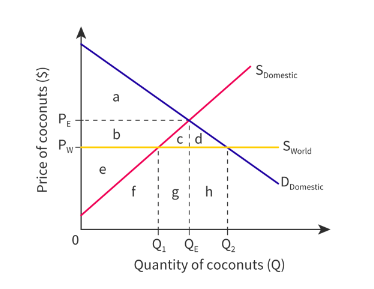
Before trade, how much do Scottish firms earn from selling coconuts?
Before trade, what is the
consumer surplus
and the
producer surplus
?
After trade, price decreases from PE to … and the quantity of coconuts consumed in Scotland increases from QE to ... , where … are produced domestically and ... are imported.
After trade, how much do Scottish firms earn from selling coconuts? And how much is spent on imports?
After trade, what is the consumer surplus and what is the producer surplus?
1. Before trade, the
equilibrium price
and quantity of coconuts in Scotland is at PEand QE.
Total revenue earned by Scottish firms is equal to PE × QE.
Total revenue = b + c + e + f + g
2. The consumer surplus is the triangle under the
demand curve
and above the equilibrium price PE.
Consumer surplus = a
The producer surplus is the triangle above the supply curve and under the equilibrium price PE.
Producer surplus = b + e
3. After trade, price decreases from PE to Pw, and the quantity of coconuts consumed in Scotland increases from QE to Q2 where Q1 are produced domestically and Q2 − Q1 are imported.
4. Total revenue earned by Scottish firms after trade is equal to Pw × Q1.
Total revenue = e + f
Total expenditure on imports is equal to PW × (Q2 − Q1).
Total expenditure = g + h
5. The consumer surplus is the triangle under the demand curve and above the equilibrium price Pw.
Consumer surplus = a + b + c+ d
The producer surplus is the triangle above the supply curve and under the equilibrium price Pw.
Producer surplus = e
draw graphs for exporting and importing nations’ markets for coconuts
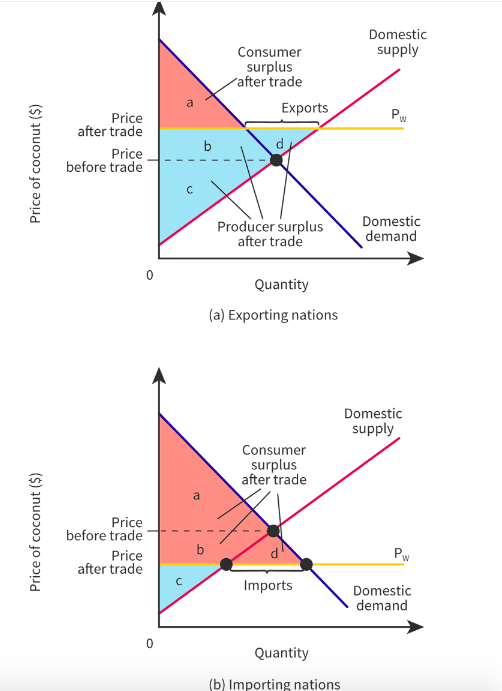
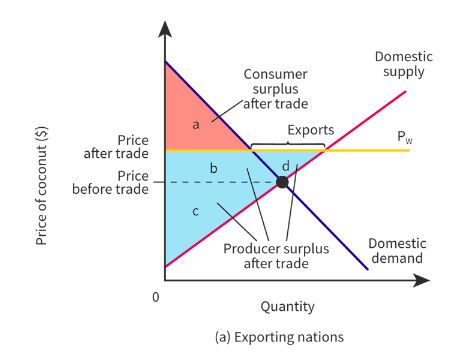
Describe what happens to the philippines if they export coconuts
Before trade, what is the consumer surplus in the exporting nation? What about after trade?
Before trade, what is the producer surplus in the exporting nation? What about after trade?
What is the net benefit to the exporting nation from trade?
Before trade, what is the consumer surplus in the importing nation? What about after trade?
Before trade, what is the producer surplus in the importing nation? What about after trade?
What is the net benefit to the importing nation from trade?
Before trade —> made QE at PE
after free trade —> drives up prices from PE to PW
overall, more coconuts are produced in Philippines at higher prices
1. Consumer surplus of the the exporting nation before trade = a + b
Consumer surplus after trade = a
2. Producer surplus of the the exporting nation before trade = c
Producer surplus after trade = c + b + d
3. As a result of trade, consumers lose consumer surplus area b. However, producers gain b + d. Area b is simply transferred from consumers to producers.
Hence, the net benefit of the exporting nation from free trade = d
4. Consumer surplus for the importing nation before trade = a
Consumer surplus after trade = a + b + d
5. Producer surplus for the importing nation before trade = b + c
Producer surplus after trade = c
6. As a result of trade for the importing nation, consumers gain consumer surplus b + d. However producers lose b.
Area b is simply transferred from consumers to producers.
Hence, the net benefit from free trade = d
List benefits of international trade
increased competition
drives firms to pursue least costly method of production and be efficient
lower prices
greater choice
aquisition of resources
more foreign exchange earnings
refers to the financial gain made by selling goods and services or by exchanging currencies in global markets
Trade provides countries, such as emerging economies, with the opportunity to access hard currencies (ex. USD)
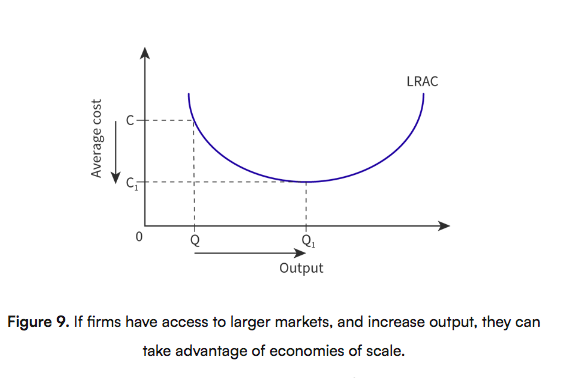
access to larger markets
economies of scale (spread fixed costs across more and more units of output, decreasing average costs)
more efficient resource allocation
each country can specialise in the production of good best suited for them
more efficient production
countries can get raw resources cheaper
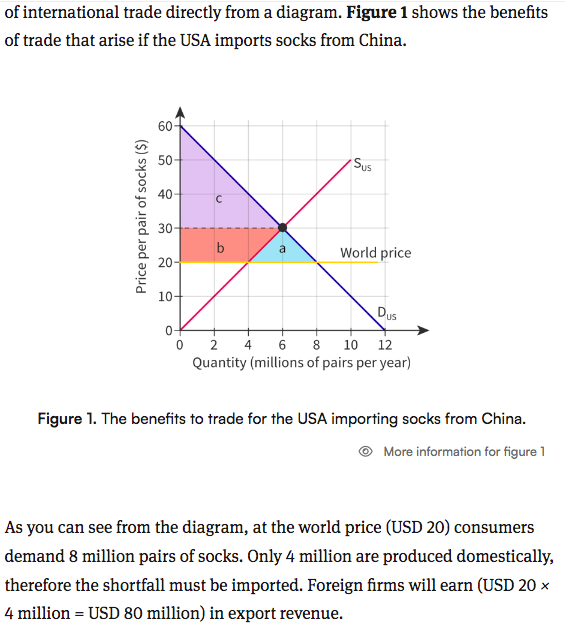
Before trade, how much do US firms earn from selling socks?
Before trade, what is the consumer surplus?
Before trade, what is the producer surplus?
After trade, the price decreases from USD 30 to …
After trade, the quantity of socks consumed in the USA increases from 6 million to ... pairs, where … pairs are produced domestically and … pairs are imported. Fill in the blanks in this sentence.
After trade, how much do US firms earn from selling socks?
After trade, what is the consumer surplus?
After trade, what is the producer surplus?
After trade, how much is spent on imports?
What are the net benefits to free trade?
1. Before trade, the equilibrium price is USD 30 and the quantity of socks is 6 million pairs.
Total revenue earned by US firms is equal to 30 × 6 million.
Total revenue = USD 180 million
2. The consumer surplus is the triangle under the demand curve and above the equilibrium price of USD 30.
Consumer surplus = c
Consumer surplus = 1/2 × 6 million × 30
Consumer surplus = USD 90 million
3. The producer surplus is the triangle above the supply curve and under the equilibrium price of USD 30.
Producer surplus = 1/2 × 6 million × 30
Producer surplus = USD 90 million
4. USD 20
5.After trade, the quantity of socks consumed in the USA increases from 6 million to 8 million pairs, where 4 million pairs are produced domestically and 4 million pairs are imported.
6. Total revenue earned by US firms after trade is equal to USD 20 × 4 million.
Total revenue = USD 80 million
7. The consumer surplus is the triangle under the demand curve and above the equilibrium price of USD 20.
Consumer surplus = 1/2 × 8 million × 40
Consumer surplus = USD 160 million
8. The producer surplus is the triangle above the supply curve and under the equilibrium price of USD 20.
Producer surplus = 1/2 × 4 million × 20
Producer surplus = USD 40 million
9. Total expenditure on imports is equal to USD 20 × 4 million
Total expenditure = USD 80 million
The full benefit to the USA from importing socks is area a.
Net benefits = 1/2 × 4 million × 10
Net benefits = USD 20 million
define absolute advantage
A country has absolute advantage in the production of goods which it produces more efficiently than the rest of the world.
it can make goods at a faster rate and higher quality
ex. INdia has absolute advantage in providing call centres
what is comparative advantage theory?
states that two countries will gain from trade if they each choose to specialise in the production of the good with the lowest opportunity cost.
sources:
Factor endowments
Factor endowments refer to the resources that a country has. Countries like India and China have large labour endowments, the USA is well-endowed with capital and Saudi Arabia is naturally resource-rich with crude oil.
Levels of technology. Some countries are able to increase productivity through improvements in technology. For example, Japan has developed robotic assembly lines to build cars and China is currently developing 6G so factories can be fully automated and operated remotely. Increasing levels and innovations in technology allow countries to produce more efficiently, providing them with a competitive edge over other countries.
Dictionary
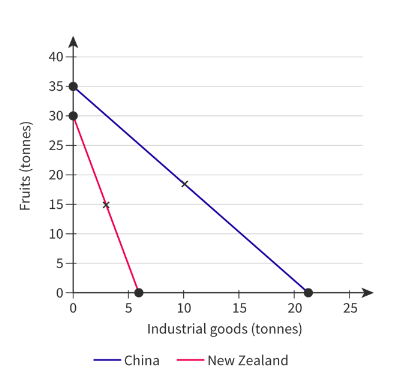
how can NZ beenfit from trade if it can’t produce fruit or industrial goods that well?
if it specialises in the production of the good its best at compared to other goods (with lowest OC)
what’s another way to explain Ricardo’s theory of comparative advantage?
even if a country was more efficient at producing every good than any other country (which is to say, it has absolute advantage), it can still benefit from trade. This is because even the most efficient country in the world will have some goods it produces comparatively better than other goods.
what are assumptions for theory of comparative advantage? what is the main goal?
goal: show that free trade leads to an overall incease in world output
assumptions
There are only two countries.
They only produce two goods (that are identical in quality)
There is
full employment
of resources in the best way.
There is
perfect information
Technology is constant.
There are zero transport costs.