Required practical 2 -Double slit experiment
 Call Kai
 Learn
Learn Practice Test
 Spaced Repetition
 Match
Match Flashcards
 Knowt Play
1/9

There's no tags or description
Looks like no tags are added yet.
Name | Mastery | Learn | Test | Matching | Spaced | Call with Kai |
|---|
No analytics yet
Send a link to your students to track their progress
10 Terms
Equipment and apparatus
Equipment:
Laser
Double slit
White screen
Metre ruler
Step 1 of experiment
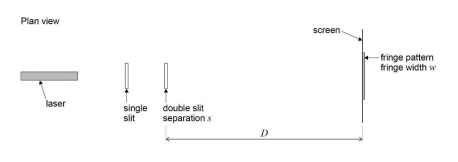
Ensuring that the laboratory is partially darkened, set up the apparatus as shown in the diagram. The single slit might not be required if the laser beam is wide enough to illuminate both the slits of the double slit.
Step 2 of experiment
Adjust the apparatus so that D is 0.500m, measured using the metre ruler
Step 3 of experiment
Measure across a large number of fringes using the ruler and divide by the number of fringe widths to find the fringe width w.
Step 4 of experiment
Increase D by 0.100m and repeat this, increasing it by 0.100m each time up to 1.500m.
Step 5 of experiment
Repeat the experiment twice more and find and record the mean w for each D.
Step 6 of experiment
If it is not quoted on the double slit, the slit separation must be measured using a vernier calliper or a travelling microscope.
Graphs and calculations
Plot a graph of w against D and draw a line of best fit. The wavelength of the laser light will be the gradient multiplied by the slit separation
w = λD/s => λ = ws/D = Gs, where G is the gradient
Safety
Shining a laser into someone’s eyes can be dangerous, so ensure that the lasers are pointed away from them.
Improvements and notes
Make sure that the screen and double slit are aligned perfectly normal to the laser to avoid parallax error in the measurement of the fringe width. A set square can be used in conjunction with the ruler