Lecture 35: Infections of hemolymphatic system - III
 Call Kai
 Learn
Learn Practice Test
 Spaced Repetition
 Match
Match Flashcards
 Knowt Play
1/62

Earn XP
Description and Tags
Anthrax (Woolsorters’ disease, Ragpickers’ disease, Splenic fever, Malignant pustule, Bacillus anthracis Malignant edema),
Name | Mastery | Learn | Test | Matching | Spaced | Call with Kai |
|---|
No analytics yet
Send a link to your students to track their progress
63 Terms
Anthrax is a serious ___ disease
zoonotic
Anthrax affects what species?
Most mammals and several species of birds, but is particularly important in herbivores
What is the causative agent that causes Anthrax?
Bacillus anthracis
Characteristics of Bacillus anthracis
Gram-positive, large rod, non-motile, endospore forming
“Medusa head” on blood agar
What is important about the vegetative forms B.anthracis?
They are more "fragile" than the vegetative forms of other Bacillus species (die in water or milk)
B. anthracis is dependent on sporulation for species survival making it an
obligate pathogen
What does sporulation require?
A nutrient poor environment and the presence of free oxygen
What is the predominant phase Bacillus anthracis in the environment?
The spore form.
Can survive for decades in soil
What is important about the spore form of B. anthracis?
Markedly resistant to biological extremes of heat, cold, pH, desiccation, and chemicals (and thus to disinfection)
Can B. anthracis spores be produced in the unopened carcass?
No
So, no post-mortem
Transmission of Anthrax in humans is caused by
Cutaneous
Inhalational
Gastrointestinal
Where is Anthrax bacteria present in
Present in hemorrhagic exudate from mouth, nose, anus
Soil
Spores viable for decades!
What are the forms of transmission for Anthrax in animals?
Ingestion
Inhalation
Mechanical (Insects)
What is the MOST common transmission of Anthrax in animals?
Ingestion
Herbivores - contaminated soil
Carnivores - contaminated meat
Where in the US is anthrax sometimes endemic?
Western US
Anthrax outbreaks are often associated with
alkaline soil
What species of animal is primarily affected by Anthrax?
Cattle
The virulence factors of B. anthracis derives from
Presence of a capsule and the ability to produce a complex toxin
Antigenic components of B. anthracis
Protective antigen (PA) – helps toxins enter cells
Edema factor (EF) – causes fluid accumulation (edema)
Lethal factor (LF) – disrupts cell signaling → cell death
Both virulence factors of B. anthracis are encoded by
plasmids and are required for disease production
What is the expression of Anthrax virulence factors regulated by
Host temperature and carbon dioxide
The capsule of Anthrax is composed of
poly-D-glutamic acid and inhibits phagocytosis
Protective antigen of anthrax acts as
The binding moiety for both edema factors and lethal factor
Edema factor of anthrax is an
adenylate cyclase which upsets water homeostasis and has a role in absence of rigor mortis and inhibition of platelet aggregation
Lethal factor of anthrax is a
zinc metalloprotease and is essential for the lethal effects of the toxin, and inhibition of platelet aggregation
The cutaneous form of anthrax in humans accounts for how many cases globally?
95%
Incubation period of anthrax in humans
2 to 3 days
Order of anthrax development in humans
Papule→ Vesicle→ Ulcer→ Eschar
The eschar caused by Anthrax may be surrounded by
Moderate to severe non pitting, gelatinous edema
If left untreated, the case fatality rate for Anthrax in humans is
5 to 20%
Cutaneous anthrax in humans
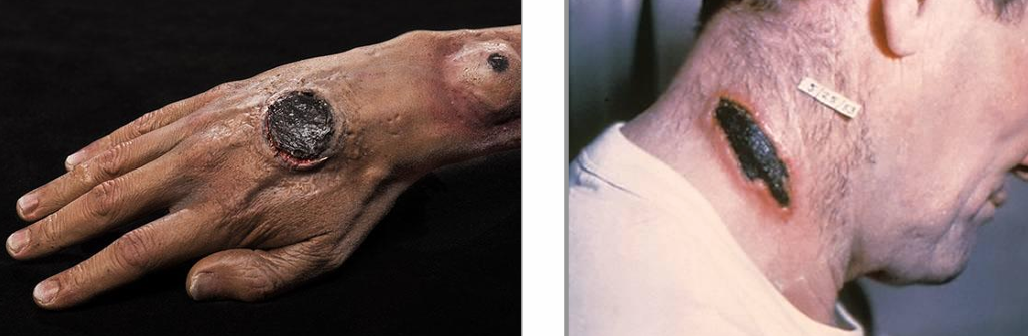
Incubation period of Gastrointestinal Anthrax
2 to 5 days
Case fatality rate of Gastrointestinal Anthrax
25 to 75%
GI anthrax is __ in the US
rare
What can cause Gastrointestinal Anthrax.
Consumption of undercooked or contaminated meat
Leads to severe gastroenteritis
Incubation period of Inhalation Anthrax
1 to 7 days
Initial phase of Inhalation Anthrax includes
Nonspecific (mild fever, malaise)
Second phase of Inhalation Anthrax includes
Severe respiratory distress
Dyspnea, stridor, cyanosis, mediastinal widening, death in 24 to 36 hours
Case fatality rate of Inhalation Anthrax (untreated)
75-90%
Anthrax treatment in humans
Penicillin
Ciprofloxacin
Doxycycline
Course of treatment: 60 days
Antibiotic treatment of anthrax is only effective in what stage?
Vegetative stage
Prevention and Control of Anthrax in Humans
By preventing disease in animals
Improved industry standards – decreased occupational hazard
Safety practices in laboratories
US human anthrax vaccines is
cell-free filtrate produced from an avirulent strain; it contains no whole bacteria, dead or alive
Who is anthrax vaccine mandatory for
Designated military and emergency-essential personnel, as well as comparable Department of Defense civil employees
Which species is at greatest risk of Anthrax
Ruminants
What are the 3 forms of anthrax in animals
Per-acute: Ruminants (cattle, sheep, goats, antelope)
Acute: Ruminants and equine
Subacute-chronic: Swine, dogs, cats
Pre-acute anthrax in ruminants leads to
sudden death
Signs of Acute Anthrax in ruminants
Tremors, dyspnea
Bloody discharge from body orifices
Chronic (rare) form of Anthrax in ruminants
Pharyngeal and lingual edema
Death from asphyxiation
Acute Anthrax in Equines
Fever, anorexia, colic, bloody diarrhea
Swelling in neck
• Dyspnea
• Death from asphyxiation
Death in 1 to 3 days
How can equines get Anthrax
Insect bite
o Hot, painful swelling at site
Anthrax in pigs causes
Septicemia and sudden death
Pigs with Anthrax have mild subacute to chronic infections characterized by
localized swelling and systemic signs, such as fever and enlarged lymph nodes
Dogs and cats can be relatively __ to anthrax
resistant
Transmitted by Ingestion of contaminated raw meat
Signs of Subacute to chronic Anthrax in Dogs and Cats
Fever, anorexia, weakness
Necrosis and edema of upper GI tract
Lymphadenopathy and edema of head and neck
Death - due to asphyxiation, toxemia, septicemia
What is not advised for animals who died from Anthrax?
Necropsy not advised!
Aka do not open carcass
Treatment of Anthrax
Penicillin, tetracyclines
Is Anthrax a reportable disease?
YES
In livestock, anthrax can be controlled largely by
Annual vaccination of all grazing animals in the endemic area
The anthrax vaccine produced in the US is licensed for use in
livestock only (cattle, sheep, horses, goats, and swine)
What type of vaccine is used almost universally for livestock immunization?
The nonencapsulated Sterne-strain vaccine