Standing waves and resonance and damping
 Call Kai
 Learn
Learn Practice Test
 Spaced Repetition
 Match
Match Flashcards
 Knowt Play
1/9

There's no tags or description
Looks like no tags are added yet.
Name | Mastery | Learn | Test | Matching | Spaced | Call with Kai |
|---|
No analytics yet
Send a link to your students to track their progress
10 Terms
standing wave is formed when
When two waves of the same speed, wavelength and amplitude travelling in opposite directions meet, a standing wave is formed. According to the principle of superposition, the resulting wave has a displacement that is the sum of the displacements of the two travelling waves.
damping
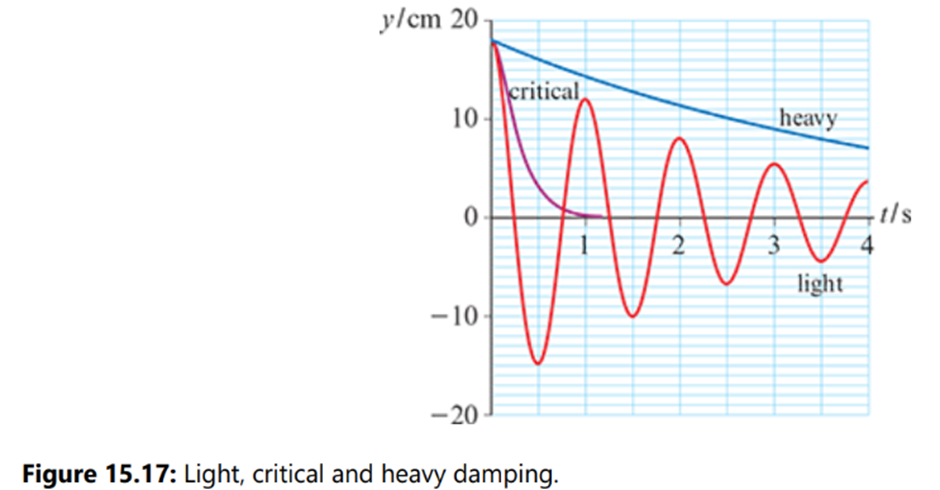
An oscillating system that is subject to frictional forces will lose energy, and the amplitude of oscillations will decrease; we have damping.
resonance
When these two frequencies are equal, we have resonance, and the system responds by showing oscillations with large amplitude.
nodes
There are some points on the string where, as a result of destructive interference between the two waves, the displacement is always zero. We call these points nodes. The distance between two consecutive nodes is half a wavelength.
antinodes
Half-way between nodes are points where, as a result of constructive interference, the displacement gets as large as possible. These points are called antinodes. Note that the nodes always have zero displacement whereas the antinodes are at maximum displacement for an instant of time only
for 2 closed or 2 open

For one closed and one open

natural frequency
We will now examine qualitatively the effect of an externally applied force F on a system that is free to oscillate with frequency f0. This is called the natural frequency of the system.
driving frequency
The force F will be assumed to vary periodically with time with frequency fd, called the driving frequency.
Light, critical and heavy damping