Bio 1 Final
 Call Kai
 Learn
Learn Practice Test
 Spaced Repetition
 Match
Match Flashcards
 Knowt Play
1/37

There's no tags or description
Looks like no tags are added yet.
Name | Mastery | Learn | Test | Matching | Spaced | Call with Kai |
|---|
No analytics yet
Send a link to your students to track their progress
38 Terms
What is glycolysis?
The first step of getting energy from food; the process of breaking down glucose
When does glycolysis occur?
Occurs in the cytoplasm
What does glycolysis not require?
Requires no oxygen; 2 ATP and 2 molecules of pyruvic acid are produced
How must pyruvic acid molecules be broken down
cellular respiration
OR
fermentation
What are the two steps of Cellular Respiration?
Kerbs Cycle
Electron transport chain
What is Kerb’s Cycle
A chain of reactions occurring in the mitochondria, through which almost all living cells produce energy in aerobic respiration
How many more ATP is produced from cellular respiration?
34 more
What does fermentation mean?
The breakdown of pyruvic acid to release energy with no oxygen (anaerobic) present
What are the two types of fermentation?
Alcoholic Fermentation
Lactic acid fermentation
What does Alcoholic Fermentation mean?
Occurs primarily in yeast (also some bacteria and plants)
What does lactic acid fermentation mean?
Occurs in animals and some bacteria
What does Alcoholic Fermentation do?
The breakdown of pyruvic acid to produce alcohol and carbon dioxide
What is produced in alcoholic fermentation?
Ethyal alcohol is produced
What is alcoholic Fermentation used in?
Used in baking bread, added to gasoline, used to produce certain beverages
What does lactic acid fermentation do?
The breakdown of pyruvic acid to produce lactic acid and energy (ATP)
What is produced in lactic acid fermentation?
Lactic acid is produced
What does lactic acid fermentation make?
Makes muscles sore, found in “sour” foods (sauerkraut, yogurt, etc)
What does fermentation not produce as much as?
Fermentation does not produces as much ATP as cellular respiration
What does fermentation only produce from?
It only produces the 2 ATP gained from gylcolysis
Fermentation methods make only what? Into what?
Fermentation methods only make the 2 pyruvic acid molecules into compounds that are less dangerous to the cells
What is the aerobic respiration equation?
C6H12O6 + 6O2 → 6CO2 + 6H2O + energy/energy out
Cellular Respiration Diagram
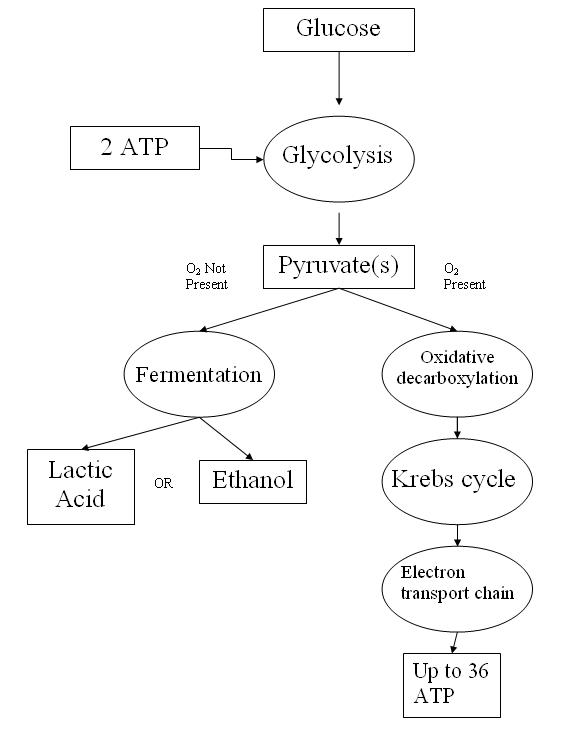
Explain an elaborate on all parts of the cellular respiration diagram
Glucose enters glycolysis in the cytoplasm
Glycolysis breaks glucose into 2 pyruvate molecules and produces a small amount of ATP and NADH
After, glycolysis, pyruvate can follow two different pathways depending on oxygen availability
If oxygen is NOT present:
Pyruvate undergoes fermentation in the cytiplasm
Fermentation produces lactic acid or alcohol and carbon dioxide
This process regenerates NAD+ so glycolysis can continue making small amounts of ATP
If oxygen IS present:
Pyruvate enters the mitochondria and undergoes oxidative decarboxylation
Pyruvate loses carbon dioxide and forms acetyl-CoA and NADH
Acetyl-CoA enters the Krebs cycle
Electrons from NADH and FADH2 move through the electron transport chain
Large amounts of ATP are produced through aerobic cellular respiration
Cells divide instead of growing to large sizes for what two reasons?
Amount of DNA
Exchangeing Materials
Amount of DNA meaning
DNA must be accessible to the cell. A large cell’s needs would not to be able to be met by one copy of DNA located in the nucleus
Exchanging Material meaning
Materials move into and out of a cell through it’s membrane. There must be a high surface area to volume ration to ensure that all materials are exchanged with the cell in the required time
What does cell division mean?
The process by which a parent cell divides to form two identical daughter cells. Cell division is accomplished via the cell cycle
The cell cycle meaning
This is the schedule a cell keeps in order to grow and divide properly and at the proper times
What are the 2 main phases to the cell cycle?
Interphase
Mitosis and cytokinesis (M-phase)
What is the interphase composed of
Composed of G1, the S-phase, and G2
What happened during Interphase?
During the Interphase, the cells grow, replicates its DNA, and prepares for division
Why do cells spend the majority of its time in the interphase?
Because of the time it takes to copy the DNA during the S-phase
What happens in the G1 (Gap 1) of interphase?
Cells grow in size and produces organelles
What happens during the S-Phase (synthesis) of interphase?
Cell copies its DNA
What happens during the G2 (Gap 2) phase of interphase?
Organelles and molecules needed for cell division are produced
What does mitosis consists of?
Mitosis consists of a series of phases that serve to duplicate the nucleus and ensure that each nucleus has one complete copy of the cell’s DNA
What are the four phases of mitosis?
Prophase
Metaphase
Anaphase
telophase