Unit 1 Principles of Chemistry Chp 1 State of Matter
 Call Kai
 Learn
Learn Practice Test
 Spaced Repetition
 Match
Match Flashcards
 Knowt Play
1/42

There's no tags or description
Looks like no tags are added yet.
Name | Mastery | Learn | Test | Matching | Spaced | Call with Kai |
|---|
No analytics yet
Send a link to your students to track their progress
43 Terms
What are 3 states of matter?
Solid, Liquid and Gas
OBJQ
What is the arrangement of solid particles?
Regular arrangement/packed closely together
OBJQ
What is the movement of solid particles?
Vibrate as fixed position
OBJQ
What is the force of solid particles?
Have strong attractive force between them
OBJQ
What is the arrangement of liquid particles?
Arranged randomly
OBJQ
What is the movement of liquid particles?
Move around (less kinetic than gas)
OBJQ
What is the force of liquid particles?
Weaker than solid
OBJQ
What is the arrangement of gas particles?
Arrange randomly further apart
OBJQ
What is the movement of gas particles?
Move freely at high speed in all directions. (has most kinetic energy)
OBJQ
What is the force of gas particles?
Almost no forces
OBJQ
What are the interconversions between 3 states of matter?
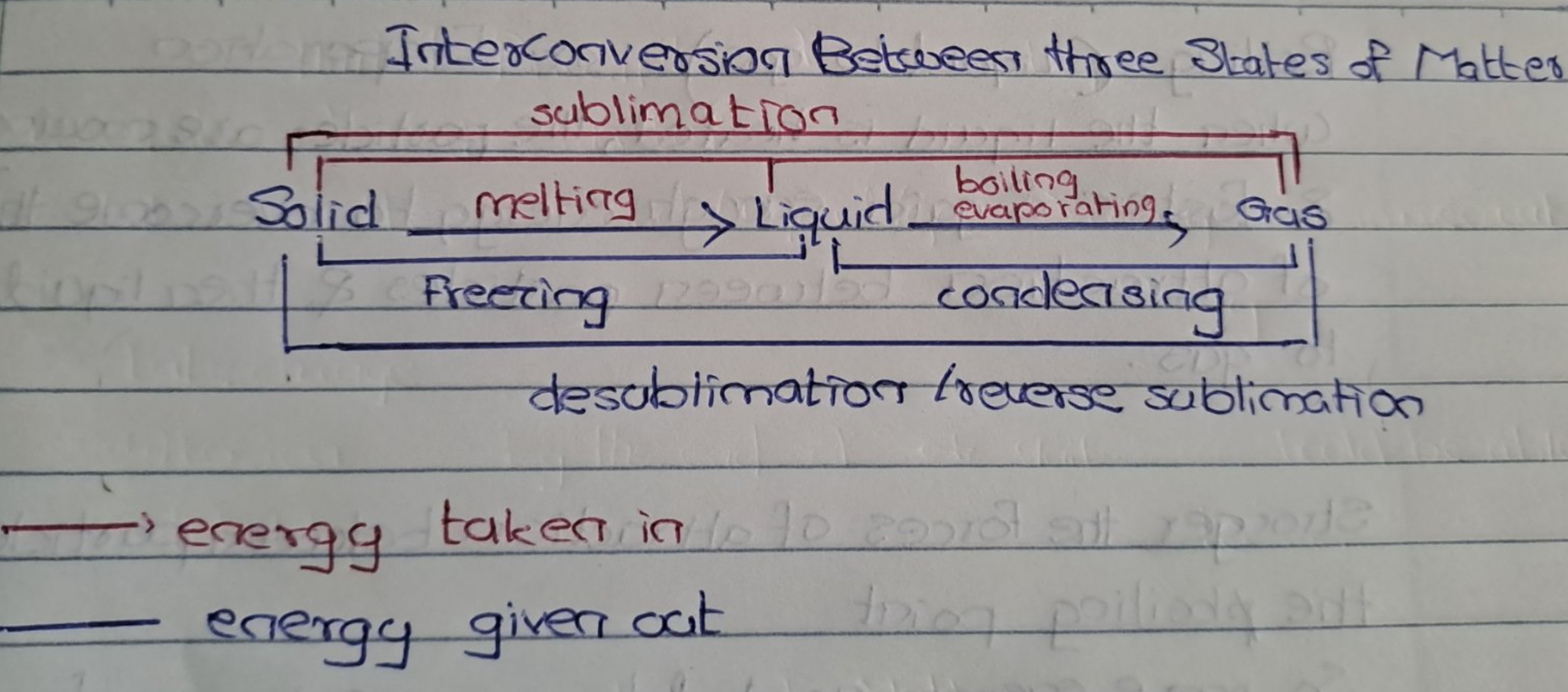
OBJQ
What is the process of melting
When a solid is heated, particles gain energy.
It vibrates faster and faster to break the fixed position.
So after that, a solid turns into a liquid.
What is the melting point?
A temperature at which a solid melts is called a melting point.
OBJQ
What is the process of freezing?
When liquid is cooled, liquid particles move around and around more and more slowly. Moving slowly causes forces of attraction to hold them so the state changes from liquid to solid.
What is freezing point?
A temperature at which liquid freezes is called a freezing point.
OBJQ
What is the process of boiling or evaporating?
When liquid is heated, the particles are moving faster and faster and gain enough energy to overcome the forces of attraction between particles, and then liquid changes to gas.
What is the relationship between forces of attraction and boiling point?
Stronger the forces of attraction, the higher the boiling point. So more energy needed to overcome stronger forces.
OBJQ
What is the process of condensing?
If a gas cooled, the particles would move slowly enough that forces of attraction between them would start to form and hold together as liquid
What are the differences between boiling and evaporation?
Boiling occurs at a specific temperature, while evaporation occurs at any temperature.
Boiling occurs throughout the liquid, while evaporation occurs on the surface.
Boiling has bubbles but evaporation doesn’t see any bubbles
Which processes occur in a closed container?
Evaporation and condensation
Which processes occur in an open container?
Evaporation only
What is sublimation?
Conversion of a solid to gas
What is deposition?
Conversion of a gas to solid
What is the relationship substance temperature and melting point and boiling point of its?
Substance is solid at temperature below its melting point.
Between it melting point and boiling, it is liquid
Above its boiling point, it is a gas.
OBJR
What is diffusion?
Random movement of particles from an area of higher concentration to lower concentration by colliding with other particles.
Why does diffusion only happen in liquids and gases but not solids?
Diffusion doesn’t happen in solids because solids only vibrate at fixed positions.
OBJQ
P.A
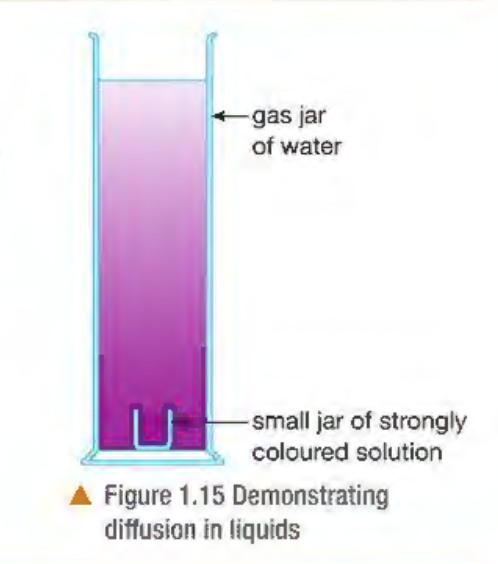
How to carry out a diffusion experiment in gas that shows particles of different gases travel at different speeds?
NH₃ and HCl experiment
NH₃ particles and HCL particles diffuse along the tube.
White ring of solid ammonium forms where they meet.
White ring of ammonium chloride takes time to forms
White ring appears close to hydrochloric acid (Because ammonia is lighter than HCL so it travel further)
NH₃ travels further in the same amount of time.
So a white ring forms further away from the ammonia end or closer to hydrochloric acid.
What is the rule of diffusion for lighter particles and heavier particles?
Lighter particles diffuse faster and travel a distance further. Heavier particles diffuse slower and travel less further.
OBJQ
P.A
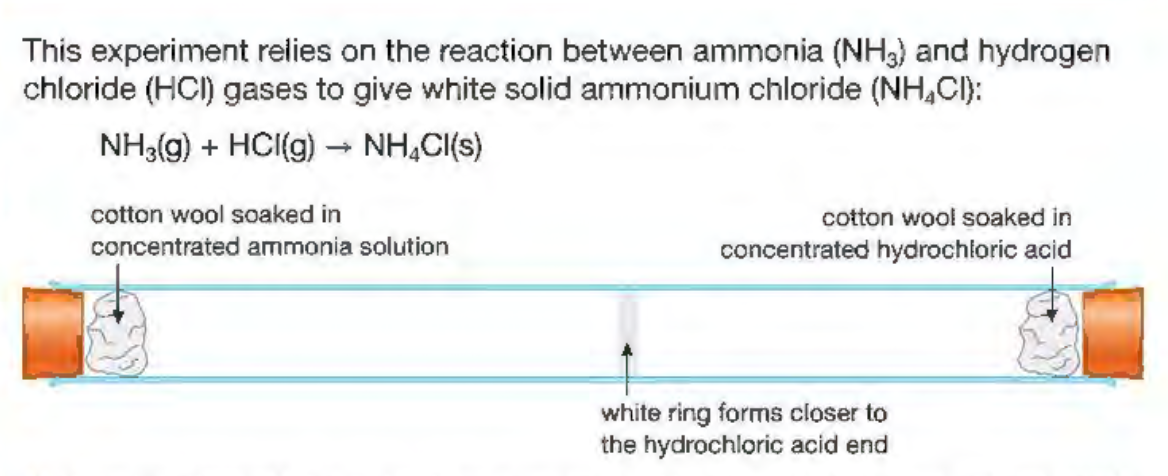
Discuss the result of the experiment of diffusion in liquid.
Can take days for color to diffuse throughout all water
Particles in liquid moves more slowly than particles in gas
The particles in liquid are so much closer than in gas, so there is less space for particles to move into without colliding with another one.
OBJQ
What is the term solute?
Substances that dissolve
OBJQ
What is the term solvent?
Liquid that dissolves in
OBJQ
What is the term solution?
The liquid formed
Why can some substances dissolve but some can’t?
If the substances can overcome forces of attraction, they can dissolve. If not, they aren’t dissolvable.
What are 2 types of mixtures?
Homogeneous mixture (solution) & Heterogeneous mixture
What are the steps of preparing and forming a solution?
When you make solution, attractive forces between the particles in solute (solid) are broken down
At the same time, new attractive forces are being formed between solvent particles and solute particles
Whether particular solid is soluble in any solvent depends on whether new attractive forces (forces of attraction between solute and solvent) are strong enough to overcome old one (forces of attraction between particles in the solid).
OBJQ
What is meant by the term "solubility"?
The mass of solute that must dissolve in 100g of solvent to form a saturated solution at a particular temperature.
OBJQ
What is the term saturated solution?
Maximum amount of solute dissolved in 100g of solvent at a particular temperature.
OBJQ
P.A
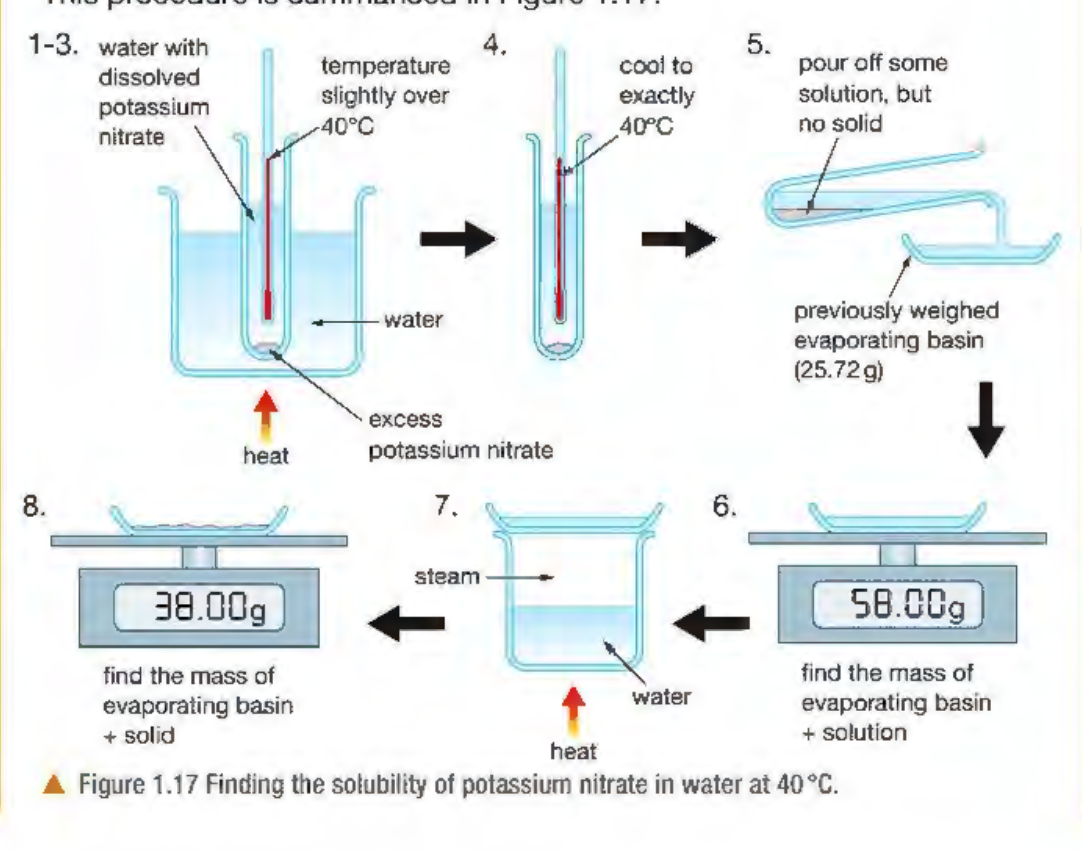
How to carry out an experiment that determines the solubility of potassium nitrate, KNO₃?
Weight an evaporation basin
Heat a boiling tube of water to just above 40°C
Add potassium nitrate to the water in the boiling tube and stir rapidly until no more of it will dissolve and there is undissolved solid left over
Allow the solution to cool to exactly 40°C
Pour off some of the solution into the evaporating basin (only solution, no solid). Doesn’t pour all solution
Weight the evaporating basin and contents
Heat the evaporating basin and contents gently to evaporate off all the water.
When it looks as if all the water has evaporated, weigh the evaporating basin and contents
Heat the evaporating basin and contents again and then re-weigh. This is to make sure water has indeed evaporated and is called “Heating to constant mass."
What apparatuses are used in this experiment?
-Water bath
-Beaker
-boiling tube
-thermometer
-evaporating basin
How to find solubility?
Mass of solute/mass of solvent x 100
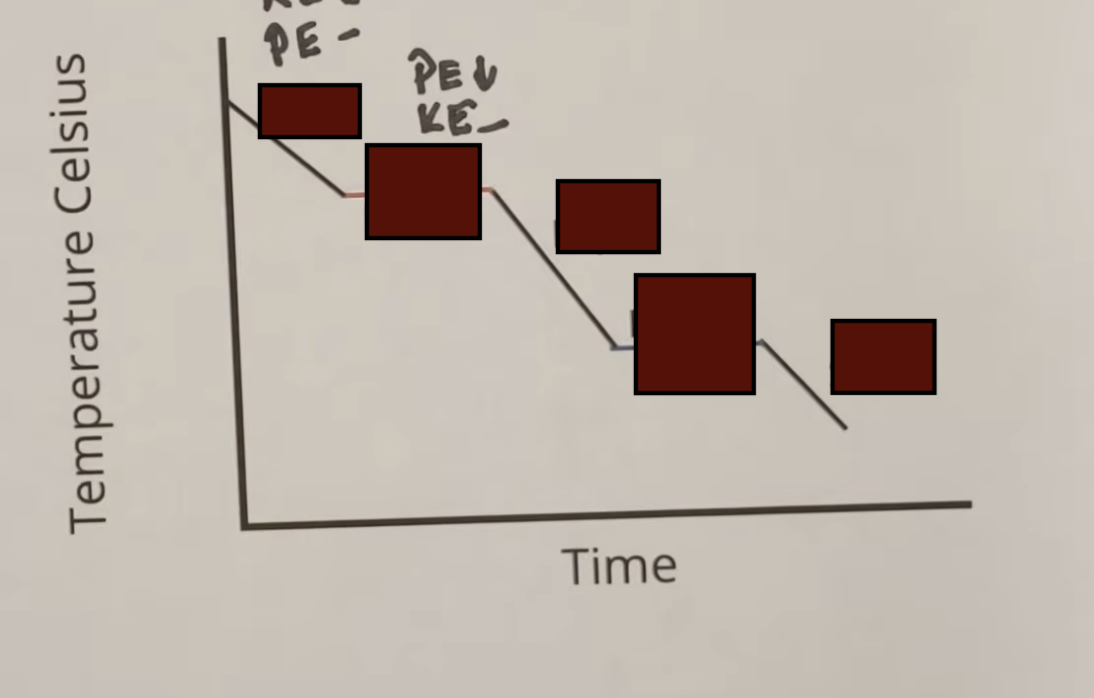
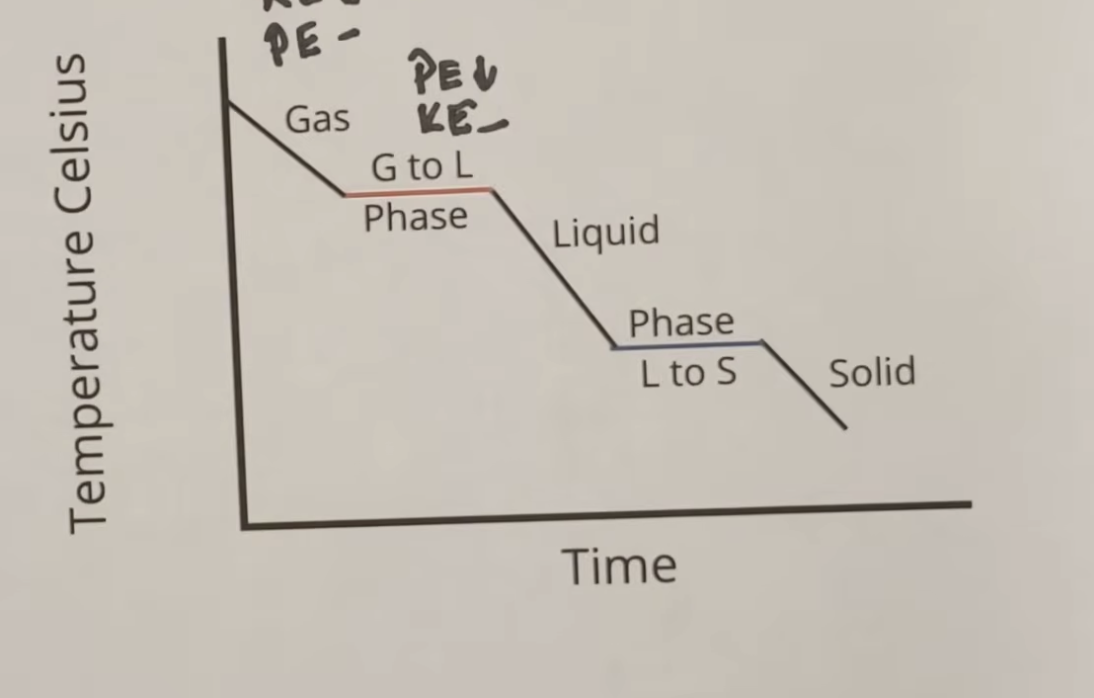
Lavel the parts of cooling curve
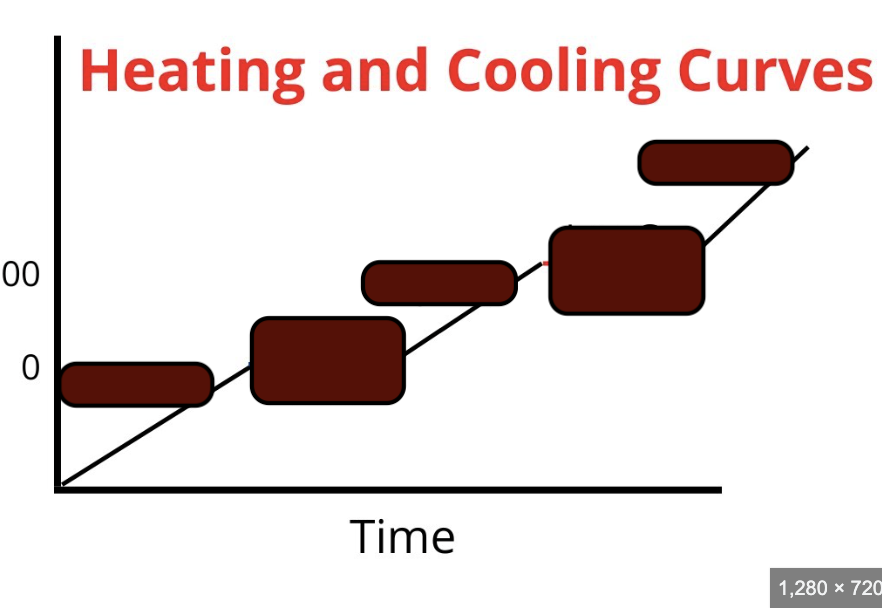
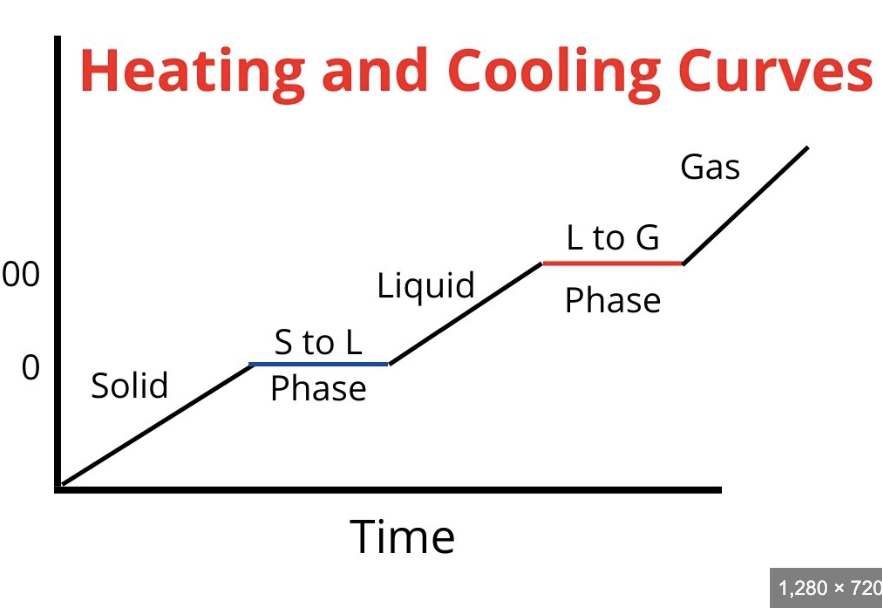
Label the parts of heating curve
What is Brownian motion?
Random movement of microscopic particles suspended in a liquid or a gas caused by bombardment of smaller particles