CASE STUDY PT.4
 Call Kai
 Learn
Learn Practice Test
 Spaced Repetition
 Match
Match Flashcards
 Knowt Play
1/20

There's no tags or description
Looks like no tags are added yet.
Name | Mastery | Learn | Test | Matching | Spaced | Call with Kai |
|---|
No analytics yet
Send a link to your students to track their progress
21 Terms
A 24-year-old woman develops flu-like symptoms, including fever, myalgia, and joint pain, particularly in her knees and ankles, after a camping trip in the Appalachian Mountains. She also complains of a dry cough and has difficulty breathing during exertion.
What is the most likely diagnosis?
Blastomycosis
Max, a 7-year-old boy, is brought to the clinic by his parents with complaints of throat pain and difficulty swallowing. His parents report that he has had a fever for the past 24 hours and seems very tired. Max's older sister had strep throat a month ago.
Which factor most likely contributed to Max's condition?
Recent family history of strep throat
A 35-year-old woman with HIV/AIDS presents with fever, cough, and shortness of breath. She has a CD4 count of 180 cells/mm³ and is not on antiretroviral therapy. She has had previous contact with a family member who had TB.
Which imaging study is most indicated for this patient?
Chest X-ray
Michael and Claire, both 24 years old and in a committed relationship, present with symptoms indicative of a sexually transmitted infection. Michael has a mild urethral discharge, while Claire has lower abdominal pain. Both test positive for chlamydia. They admit to having had unprotected sex.
Question: What likely contributed to both Michael and Claire contracting chlamydia?
Having unprotected sex
A microbial geneticist, 40-year-old Linda, experiences dysuria and a mucopurulent cervical discharge.
She is aware that the infection is likely caused by a small, gram-negative bacterium with no cell wall, and it's often resistant to many standard antibiotics.
Mycoplasma genitalium
A 28-year-old male presents with no symptoms but is anxious because he learned that his recent partner was diagnosed with an STD. They had protected intercourse, but he knows that some infections can be transmitted despite protection.
He's trying to determine what STDs he should be tested for.Question: Which STD is the partner most likely worried about contracting despite using protection?
Herpes
Mark, a 22-year-old college wrestler, developed clusters of painful blisters on his torso. He had a recent history of intense wrestling matches. His doctor recognized the blisters as herpes gladiatorum, an HSV infection common in wrestlers, and ordered an HSV serologic test, which came back positive.
Question: What activity most likely led to Mark's HSV infection?
Participating in wrestling matches
Linda, a 34-year-old community health worker, presented with lower abdominal pain and vaginal discharge. She conducts educational sessions on STIs and was aware of the symptoms. Suspecting trichomoniasis, she requested specific testing, which confirmed her self-diagnosis.Question: Linda's awareness of STI symptoms led her to suspect she had what condition?
Trichomoniasis
The most common curable sexually transmitted infection (STI), caused by the parasite Trichomonas vaginalis
After being released from prison, 39-year-old Greg develops jaundice and joint pain. He recalls that his cellmate had chronic liver disease. He suspects a virus that can be spread in overcrowded conditions and through close personal contact.
Hepatitis B
Brian, a 33-year-old healthcare worker, presents with jaundice and malaise. He recently suffered a needlestick injury while treating a patient. He considers a virus known for its resilience, capable of causing a chronic condition that could lead to cirrhosis or liver cancer.
Hepatitis C
History: A newborn presents with hydrocephalus, intracranial calcifications, and jaundice. Mom owns 27 cats.
Symptoms: Hydrocephalus, chorioretinitis, and generalized developmental delay.
Differential Diagnosis:
Congenital toxoplasmosis
History: A 30-year-old ecotourist develops fever, muscle pains, and nausea after visiting a yellow fever-endemic area in Africa.
Symptoms: Fever, backache, nausea, followed by jaundice and hemorrhagic symptoms.
Differential Diagnosis:
Yellow fever
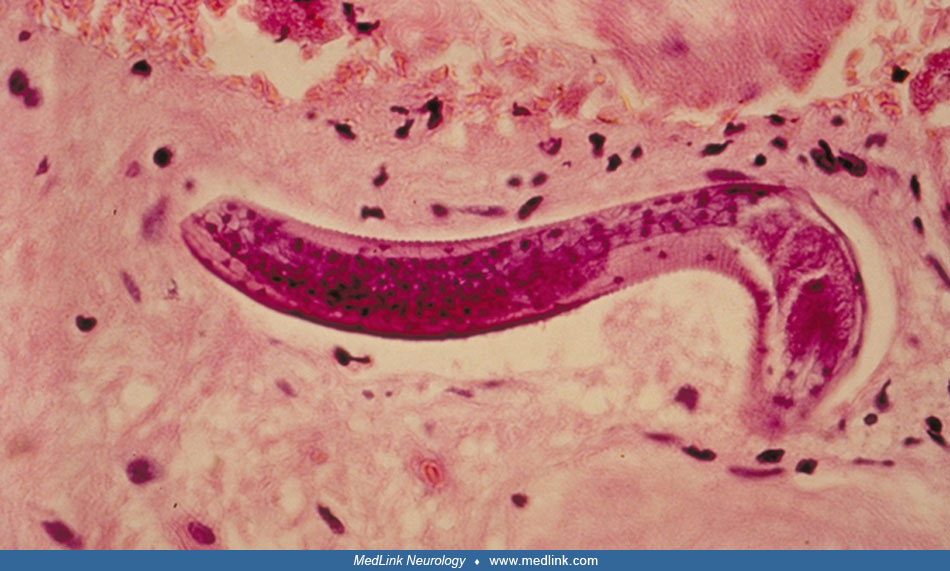
While volunteering in a rural clinic, 29-year-old Dr. Emily noticed several patients presenting with symptoms of myositis, fever, and subconjunctival hemorrhages.
She knew that these were signs of a parasitic infection, often associated with the ingestion of larvae from infected meat, and she recalled the spiraled appearance of the larvae under the microscope.
Trichinosis
A parasitic infection contracted by eating raw or undercooked meat containing Trichinella roundworm larvae
Tim, a 26-year-old veterinary student, developed watery diarrhea, stomach cramps, and dehydration after spending time on a local farm. He remembers discussing a protozoan parasite in class that is transmitted through fecal-oral routes, often from animal hosts, and can resist chlorination in water treatment.
Cryptosporidiosis
History: A 35-year-old veterinarian experiences sudden fever, headache, and muscle aches, followed by nausea and vomiting.
Symptoms: Abdominal pain, diarrhea, and signs of septic shock.
Microbiological Clues: Isolation of bipolar-staining, Gram-negative rods from stool samples, non-lactose fermenting.
Differential Diagnosis:
Gastrointestinal plague
Several cases of a rash-associated illness are reported in a local school. Children present with fever, cough, and a rash that starts on the face and neck before spreading. The school finds out that many of the affected children were not vaccinated.
What can the school promote to prevent further outbreaks?
Measles, mumps, and rubella (MMR) vaccination
Background: Aria travels often for work and stays at various hotels. After her last trip, she noticed an itchy rash on her body, especially around her hands and feet.
Symptoms:
Intense itching.
Small red bumps on the hands and feet.
Inflamed skin due to scratching.
Burrows and blisters.
Rash on the back of her knees and inside her elbows.
The most probable cause of Aria contracting scabies is:
Exposure to hotel bed linens.
Which treatment is commonly used for Tinea Faciei?
Antifungal creams.
After returning from a trip abroad, 28-year-old Aiden begins to feel ill. He initially develops a high fever, cough, and runny nose. A few days later, a red, blotchy rash appears, starting on his face and spreading downward.
What is the most likely diagnosis for Aiden?
Measles (Rubeola)
Samantha, a 13-year-old girl, develops a honey-colored crusty rash around her mouth and nose. She reports that it started as a small red sore that spread over the last few days. She has no significant medical history but is active in her school's drama club, which recently had a makeup-sharing session.
Which symptom is most indicative of streptococcal impetigo in Samantha?
Honey-colored crusty rash
A 38-year-old man with a known HIV infection and a CD4 count of 150 cells/mm³ presents with a cough, diarrhea, and weight loss. He recently volunteered at a local farm in the Midwest. A chest X-ray reveals diffuse infiltrates, and a CT scan shows enlarged abdominal lymph nodes.
Which management strategy is most indicated for this patient?
Start antifungal treatment with amphotericin B