Financial Management Final for MONDAY
 Call Kai
 Learn
Learn Practice Test
 Spaced Repetition
 Match
Match Flashcards
 Knowt Play
1/212

There's no tags or description
Looks like no tags are added yet.
Name | Mastery | Learn | Test | Matching | Spaced | Call with Kai |
|---|
No analytics yet
Send a link to your students to track their progress
213 Terms
Finance is concerned with decisions about
money (cash flows)
Finance decisions deal with how money is
raised and used in the future
Everything else being equal
More value is preferred to less
the sooner cash is received, the more valuable it is
less risky assets are more valuable than (preferred to) riskier assets
Financial markets and institutions
banks, insurance companies, savings and loans, and credit unions
stock markets, bond markets, derivatives markets
Investments
determining the values, risks, and returns associated with financial assets as stocks and bonds
determining the optima combination of securities that should be held in a portfolio of investments, such as a retirement fund
Financial services
functions provided by organizations that deal with the management of money
Managerial finance
how firms (large and small) manage inflows and outflows of cash
All areas of business are impacted by finance
marketing
management
accounting
operations
information systems
Proprietorship
unincorporated business with one owner.
Partnership
unincorporated business with two or more owners
Corporation
legal entity separate and distinct from its owners; can conduct business for its owners.
incorporated in a state
has owners (shareholders)
managers operate the company separately from its owners
Advantages of proprietorship
• Ease of formation.
• Subject to few government regulations.
• Taxed at the individual level.
Limitations of proprietorship
• Unlimited personal liability.
• Limited life.
• Transferring ownership is difficult.
• Difficult to raise large amounts of capital.
Partnership
two or more owners
same advantages and limitations as proprietorship
partnership can raise more capital than a proprietorship, b/c there are more owners w/more credit
Corporation advantages
• Unlimited life.
• Easy transfer of ownership.
• Limited liability- owners are only responsible for the amount they invested, not personal debts of the corporation.”
• Ease of raising capital—can issue stocks and bonds.
Corporation disadvantages
• Cost of creating and report filing.
• Double taxation- taxed once to the corporation and again to shareholders through dividends.
Hybrid forms of business
• Limited Liability Partnership (LLP).
• Limited Liability Company (LLC).
• S Corporation—no more than 100 stockholders.
Primary goal of a company
maximizing owner’s wealth
Capital structure decisions
How are the assets financed?
The mix of debt and equity used to finance a business
Capital budgeting decisions
what assets (investments) should the firm purchase?
Dividend Policy decisions
How much of the firm’s income should be distributed (paid) to stockholders and how much should be retained and reinvested in the firm?
Factors Influenced by Managers that Affect Firm Value
• Projected cash flows.
• Timing of cash flow streams.
• Risk of projected cash flows (earnings).
• Use of debt (capital structure).
• Dividend policy.
Mechanisms to motivate managers to act in shareholder’s best interest
Managerial compensation (incentives)
Shareholder intervention: Shareholders can influence or replace management
Threat of takeover: Poor management may lead to another company taking over and replacing managers
Discussion of operations
• Usually, a letter from the chairman
• Provides highlights, strategy, news about the company
• Financial statements
Balance sheet
Represents a picture taken on a specific date (one point in time) that shows a firm’s assets and how those assets are financed (debt or equity).
Items on the balance sheet are shown as:
Lower of cost or market
not market value
Assets are reported at the lower of original cost or current market value, not increased to higher market prices
Items on the balance sheet are listed in order of
liquidity
Net fixed assets
represents what the asset is really worth from an accounting perspective. We would refer to this as the ‘book value’ of the assets.
gross fixed assets - accumulated depreciation
Accrued expenses
expenses that have been made but not yet paid.
Preferred stock
is a form of equity that has both debt and equity-like features. Often, it is described as a “hybrid.
Common stock
represents the owners’ initial investment in the company
Retained earnings
represent the cumulative total of all net income that has been reinvested in the company
Income Statement (profit and loss statement)
Summarizes the revenues generated and the expenses incurred during a particular period, such as one year or a quarter or a month.
Top line
refers to a company's gross sales (or revenues)
For a retail company, the COGS is
the cost of materials purchased for resale.
Gross profit
are the funds available to meet the company’s operating expenses
Bottom line
net income - standard measure of company’s profitability
Net income can “go to” two places
it is paid out as dividends to shareholders
added to or subtracted from retained earnings
Statement of cash flows
cash generated by firm is different than reported on the income statement
depreciation
increased/retiring debt
investments
Cash flows from operations
• Net Income + Depreciation
• Changes in A/R and A/P
• Changes in Inventory
• Changes in Pre-paid and Accrued Balances
Cash flows from investment activities
Transactions involving buying and selling :
• Property, Plant and Equipment.
• Investments (current and non-current).
• Notes Receivable (current and non-current).
Cash flows from financing activities
Funds secured by borrowing funds or issuing Stock
cash received from issuance of CS, bonds, or NP
cash outflows from paying off stock, NP, dividends, or repurchasing stock
Ratio analysis
provides an idea of how well the company is doing
highlights weaknesses and strengths
indicates the future financial health of the firm
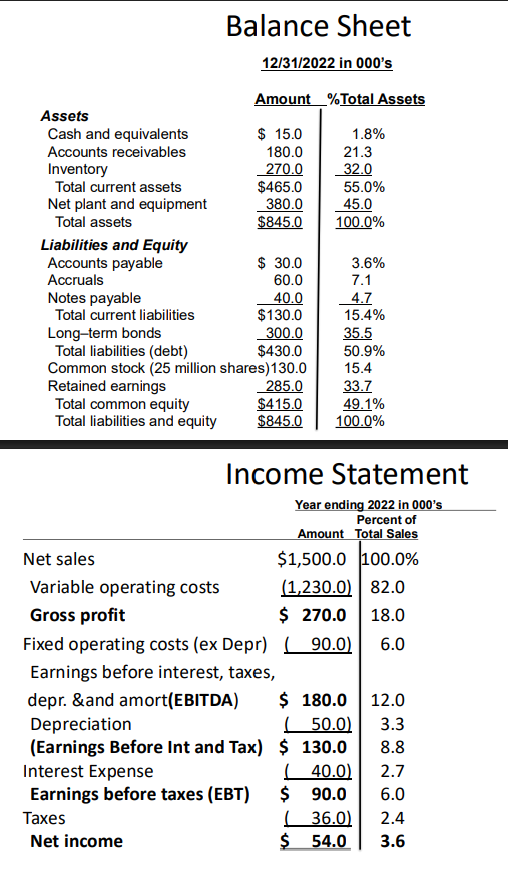
What sets a base for which all items are compared on the BS and IS when doing ratio analysis?
Sales
Assets
This is 100%
Liquidity Ratios
How well the company is able to meet current obligations
Asset Management Ratios
Measure how effectively a firm is utilizing its assets.
Debt Management Ratios.
• Indicate the amount of debt a firm has and whether it can take on more.
• Is the firm using debt wisely?
Profitability Ratios
Measure how much of each sales dollar is going to the shareholders.
Market Value Ratios
How the company’s stock price is doing relative to its earnings and book value
Liquidity ratios
Current ratio
Quick ratio
Liquidity ratios indicate
Ratio should yield about 1.25 - 1.50
lower numbers suggest a liquidity crunch- not enough cash or easy-to-access money available
larger numbers suggest lost opportunities - company may be holding too much cash instead of using it to grow the business.
Asset Management ratios
inventory turnover
days sales outstanding
fixed asset turnover
total asset turnover
Inventory turnover
Measures how quickly a company is selling it’s inventory
Days sales outstanding
Measures how quickly a company is being paid by customers
Fixed & Total asset turnover
measures how efficiently a company is utilizing it’s assets
Debt management ratios
shows how well a company can meet its debt obligations
debt ratio
times interest earned
fixed charge coverage
Profitability ratios
Gross profit margin
net profit margin
return on assets
return on equity
Market Value ratios
Measure a firm’s market value (stock price) to its earnings and book value
PE Ratio
Market to book ratio
PE ratio
• 𝑆ℎ𝑎𝑟𝑒 𝑃𝑟𝑖𝑐𝑒 ÷ 𝐸𝑎𝑟𝑛𝑖𝑛𝑔 𝑝𝑒𝑟 𝑆ℎ𝑎𝑟𝑒
• Measures how much investors are paying for each $$ of earnings.
• High expectations for growth in earnings yield higher P/E ratios.
Market to book ratio
• 𝑀𝑎𝑟𝑘𝑒𝑡 𝑉𝑎𝑙𝑢𝑒 𝑝𝑒𝑟 𝑆ℎ𝑎𝑟𝑒 ÷ 𝐵𝑜𝑜𝑘 𝑉𝑎𝑙𝑢𝑒 𝑝𝑒𝑟 𝑆ℎ𝑎𝑟𝑒
• Shows how investors value the company relative to its Balance Sheet (Book Value)
Limits of financial statement analysis
• “Window dressing” can make ratios look better than they really are.
• Different operating and accounting practices distort comparisons.
• Sometimes hard to tell whether a ratio is “good” or “bad.”
• Difficult to tell whether company is, on balance, in strong or weak position.
The most important, as well as the most difficult, ingredient of successful financial statement analysis is the _______ that is used to reach final conclusions about a firm’s _____ financial position.
judgement, future
Users or capital are
individuals, corporations, governments.
Providers of capital are
individuals and companies
Financial markets
where financial assets are traded between investors
debt markets
where short and long term loans/bonds are traded
not an exchange
equity markets
where public stocks are traded
Money markets
• Used by companies to borrow for short term needs < 1 yr.
• Typically for working capital requirements.
• Always are debt instruments.
Capital markets
• Used by companies to attract funds for longer term > 1yr.
• Can be debt or equity instruments
Primary markets
where companies go to issue new debt/equity instruments
where companies go “public”
Initial Public Offering (IPO).
Secondary Offering.
Where companies receive the $$ from purchasers.
Secondary markets
where investors trade debt or equity instruments
Existing shareholders trade shares among themselves.
Corporation does not receive the funds.
Derivatives markets
where options, futures, commodities are traded
Stock markets
Stock exchanges where Equity Shares are traded.
• NYSE
• Chicago Stock Exchange
• Over The Counter Exchange
• NASDQ Exchange
What kind of listing requirements do stock markets have?`
size of company
income, assets, # of shares
Securities and Exchange Commission (SEC).
• Jurisdiction over most interstate offerings of new securities to the general public.
• Regulation of national securities exchanges.
• Power to prohibit manipulation of securities’ prices.
• Control over stock trades by corporate insiders.
Investment Banker
Assist in bringing users and investors together.
Helps corporations' issue new debt/equity.
Helps corporations design securities attractive to investors.
Offering Price.
# of securities
The Investment Banking Process
Companies decide:
Dollars to be raised (how much does it need).
Type of securities used to raise funds (debt/equity).
Selection of an investment banker.
Investment Bankers:
Files registration with the SEC.
Prospectus.
Road Show
road show
presentations by a company and its investment bankers to potential investors before issuing securities.
Investment banker role
reevaluate initial decisions
vest efforts or underwritten issues
issuance (floatation) costs
Underwritten Arrangement
investment bank guarantees the sale by purchasing the securities from the issuer.
Best Effort Arrangement
investment bank gives no guarantee that the securities will be sold.
Intermediaries
are “middle men” between providers of capital and users of capital.
Types of Financial Intermediaries
• Commercial banks.
• Credit unions .
• Mutual funds.
• Whole life insurance companies.
• Pension funds.
When financial markets perform poorly, Congress tends to regulate financial activities
more than normal
When financial markets are performing efficiently and producing above-normal returns, Congress tends to
deregulate financial activities
U.S. stock markets represent ____ of the total value worldwide.
35% - 40%
International Financial Markets
• U.S. markets dominate the stock markets in other countries.
• Not as heavily regulated.
Financial Organizations in Other Parts of the World
• U.S. financial institutions are more heavily regulated.
• Historically, U.S. financial institutions have faced greater limitations on branching, services offered, and relationships with non-financial businesses.
Monday today is worth _____ than money in the future
MORE
Opportunity cost
The cost of the ability to do something.
Lump Sum Amount
a single payment (received or made) that occurs either today or at some date in the future.
Annuity
payments of the same amount over equal time periods.
Annually, semi-annually, quarterly, monthly, daily.
Uneven Cash Flows
payments of different amounts over a period of time
Compounding
What is the Future Value of the cash flows?
Discounting
What is the Present Value of the cash flows?
Perpetuity
Streams of equal payments that are expected to go on forever
EX: Preferred Stock, Real Estate, Bonds
Net Present Value
• Discounting investment’s projected cash inflows at the investor’s required rate of return and then subtracting the original investment (initial cash outflow) from this figure.
• Positive-Accept
• Negative-Reject
Internal rate of return
• In IRR you are solving for the discount rate.
• Solves for the interest rate which makes the Net Present Value $0
• If the IRR is > than the rate required by the investor accept the project.
APR = Annual Percentage Rate
Only the true annual rate if interest is compounded annually
EAR or EAY = Effective Annual Rate or Effective Annual Yield.
• Takes into account that interest is being compounded more frequently than annually.
• If compounding is annual> APR=EAR