Sensory Receptors, Neuronal Circuits for Processing Information
0.0(0)
Studied by 2 people Call Kai
 Learn
Learn Practice Test
 Spaced Repetition
 Match
Match Flashcards
 Knowt Play
Card Sorting
1/73

Earn XP
Description and Tags
Last updated 2:05 AM on 11/3/22
Name | Mastery | Learn | Test | Matching | Spaced | Call with Kai | Chat |
|---|
No analytics yet
Send a link to your students to track their progress
74 Terms
1
New cards
neuronal pool
group of neurons that processes signals in a unique way (typically due to its unique organization). A functional group of interconnected neurons - the foundation for the differences in function found in various brain areas. Within neural structures/brain regions there are different types of neuronal pools, subgroupings called nuclei that perform specific subfunctions or process a specific type of information.
2
New cards
neuronal pool examples:
cerebellum performs a different function than the medulla, and the nuclei in the thalamus each perform different functions.
3
New cards
neuronal pools: input neurons
each input neuron branches to form thousands of terminals which synapse with various neurons in the pool.
4
New cards
True or false: each input neuron can only synapse once with an output neuron.
false. each input neuron can synapse multiple times with the same output neuron, or synapse with multiple different output neurons.
5
New cards
neuronal pools: stimulatory field
the neuronal area stimulated by each incoming nerve fiber.
6
New cards
neuronal pools: excitatory/suprathreshold stimulus.
signal from an input neuron is sufficient to elicit an action potential in an output neuron.
7
New cards
neuronal pools: subthreshold stimulus
signal from an input neuron increases membrane potential in an output neuron, but is not sufficient to elicit an action potential. (the output neuron is facilitated).
8
New cards
neuronal pools: facilitated neuron
the neuron is activated/enhanced, now readily excitable for an incoming signal
9
New cards
neuronal pools: discharge zone
all neurons in this zone receive sufficient input to trigger action potentials (usually at the center of the neuronal pool because those neurons receive more terminals from input fibers)
10
New cards
neuronal pools: facilitated zone
neurons in this zone receive excitatory input, but not sufficient to elicit action potentials. (usually at the peripheries of the neuronal pool)
11
New cards
neuronal pools: inhibitory zone
neurons in this zone receive inhibitory input, impeding the formation of action potentials. (The whole pool is an inhibitory zone, but the degree of inhibition is greater at the center of the neuronal pool because there are more terminals receiving more inhibitory neurotransmitters.)
12
New cards
List the 2 main functions of neuronal pools:
relaying signals and prolonging signals
13
New cards
List the 3 mechanisms of relaying signals
divergence, convergence, and reciprocal inhibition circuit
14
New cards
List the 3 mechanisms of prolonging signals:
synaptic after-discharges, reverberatory (oscillatory) circuit, and continuous signal output
15
New cards
Divergence
when a small number of weak signals entering the neuronal pool lead to excitation of many neurons leaving the pool.
16
New cards
What are the 2 types of divergence?
Amplifying divergence and divergence into multiple tracts
17
New cards
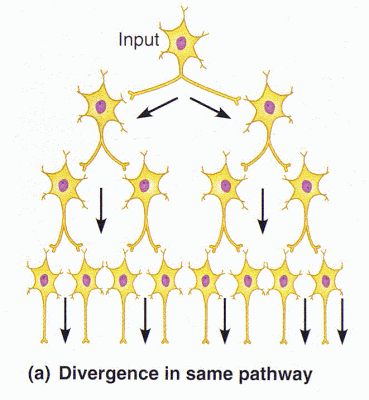
Amplifying divergence
An input signal spreads to an increasing number of neurons as it passes through successive neuros in its path
18
New cards
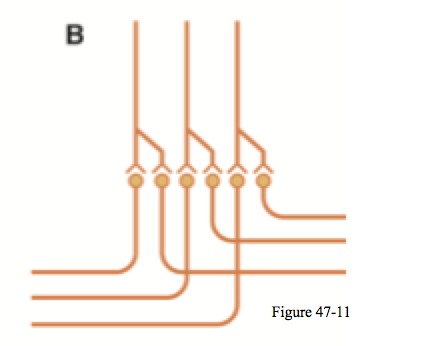
Divergence into multiple tracts
information entering the pool is transmitted in two directions (through 2 tracts) when it leaves the pool
19
New cards
convergence
signals from multiple inputs unite to excite a single neuron
20
New cards
what are the 2 types of convergence?
convergence from a single source and convergence from multiple sources
21
New cards
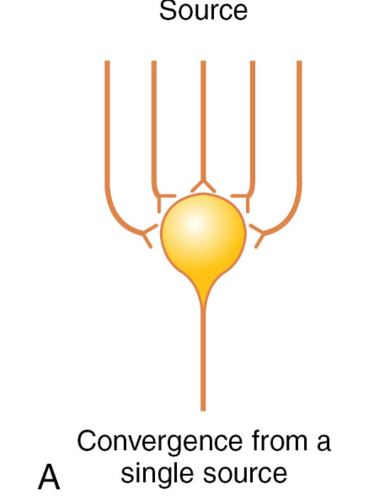
Convergence from a single source
multiple terminals from a single incoming fiber tract terminate on the same neuron
22
New cards
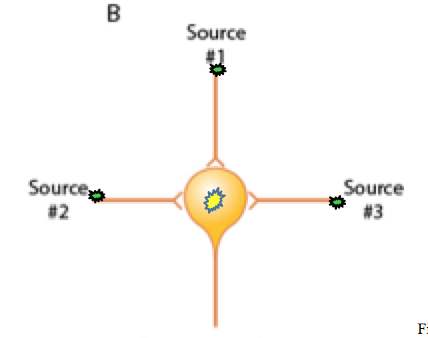
convergence from multiple sources
summation of information from multiple neural pathways to control activation of a single neuron
23
New cards
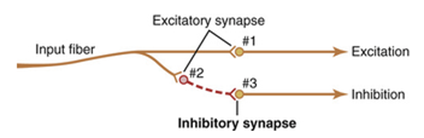
Reciprocal inhibition circuit
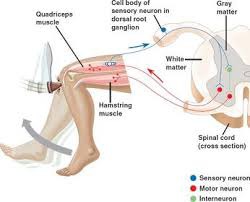
incoming signal to neuronal pool causes an excitatory signal in one direction and a simultaneous inhibitory signal in another direction
24
New cards
where are reciprocal inhibition circuits important?
important for antagonistic pairs of muscles - muscle groups working in opposition to each other, like for flexion/extension. Also important in the brain to prevent overactivity of certain circuits.
25
New cards
Afterdischarge
neural firing that lasts longer than the incoming signal in order to increase the duration of an incoming signal. discharges can last a few milliseconds to many minutes after the incoming signal is over.
26
New cards
Synaptic afterdischarge
prolonged firing of an output neuron due to prolonged elevation of membrane potential due to long-acting neurotransmitters
27
New cards
Reverberatory (oscillatory) circuit
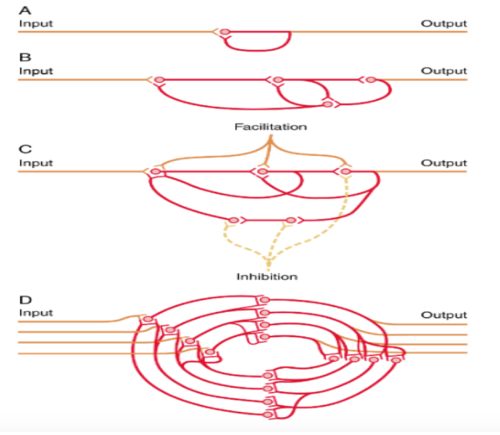
positive feedback within the neuronal circuit feeds back to re-excite the input of the same circuit. (circuit can discharge repetitively for a long time, important for rhythmical output signals like rhythmic breathing and walking)
28
New cards
What can cause the cessation of a reverberatory circuit?
inhibitory input or fatigue of the synaptic junctions in the circuit. (Fatigue could mean that you run our of neurotransmitters, vesicles, ATP, etc.)
29
New cards
facilitated reverberatory circuits (vs. inhibited and normal):
facilitated circuits have higher output pulse rate for longer period of time - they might recruit more parallel fibers or increase action potential frequency to do this. Their signals are higher, last longer, and they fatigue slower.
30
New cards
list the 2 mechanisms of continuous signal output:
continuous intrinsic neuronal discharge and continuous reverberatory signals.
31
New cards
continuous intrinsic neuronal discharge
some neurons spontaneously discharge because their membrane potential at rest is above threshold
32
New cards
continuous reverberatory signals
continual output occurs in a reverberatory circuit where fatigue does not fully stop reverberation
33
New cards
True or false: because continuous signal outputs are constantly occurring, their rate remains constant.
false. even though they are continuously happening, the rate of firing can be changed with excitatory or inhibitory signals. (example: your heart is always beating but your heart rate changes because the autonomic nervous system upregulates or downregulates the rate.)
34
New cards
what are epileptic seizures?
uncontrolled bursts of electrical activity that spread through the brain due to reverberating signals, state of continuous re-excitation.
35
New cards
what are the 2 mechanisms that stabilize neuronal circuits?
inhibitory circuits and synaptic fatigue
36
New cards
Inhibitory circuits
prevent the excessive spread of signals.
37
New cards
What are the 2 categories of inhibitory circuits?
inhibitory feedback circuits and widespread inhibition
38
New cards
inhibitory feedback circuits
prevent self-re-excitation
39
New cards
widespread inhibition
some neuronal pools function to inhibit large areas of the brain.
40
New cards
synaptic fatigue
synaptic transmission becomes progressively weaker the more prolonged or more intense the excitation stimulus.
41
New cards
what are the 2 types of mechanisms for controlling synaptic activity?
short-term control and long-term control
42
New cards
short-term control
(fatigue) decrease in sensitivity of neural excitation when the neuronal pathway is overused due to depletion of neurotransmitter or vesicles, and vice versa
43
New cards
long-term control
decreasing the number of receptor proteins at the synapses when there is overactivity and vice versa
44
New cards
Recovery flashcard

45
New cards
sensory receptors
specialized cells that transduce a physical stimulus from the environment (or from within the body) into neural signals
46
New cards
list the types of sensory receptors
mechanoreceptors, thermoreceptors, nociceptors, photoreceptors, and chemoreceptors.
47
New cards
mechanoreceptors
transduce mechanical stimuli (pressure, vibration, stretching, etc.)
48
New cards
thermoreceptors
transduce temperature
49
New cards
nociceptors
pain receptors, detect physical or chemical damage to the body
50
New cards
photoreceptors
electromagnetic receptors, transduce light
51
New cards
chemoreceptors
transduce chemical stimuli (taste, smell, blood oxygenation, etc.)
52
New cards
differential sensitivity
each type of sensory receptor is highly sensitive to one type of stimulus but unresponsive to other types of sensory stimuli (your retinas won't react when someone shouts at you lmao)
53
New cards
Receptor potential
change in membrane potential due to incoming sensory stimulus
54
New cards
list the mechanisms of eliciting receptor potentials:
mechanical deformation (stretches membrane and opens ion channels), chemical applied to membrane (opens ion channels), change temperature of membrane (alters membrane permeability), and light applied to membrane (opens ion channels or changes membrane characteristics leading to a change in potential).
55
New cards
true or false: receptor potentials are graded potentials
true. the amplitude of the receptor potential scales with the strength of the input stimulus, very sensitive at weak stimuli but can still detect changes even at strong stimuli)
56
New cards
what happens when the receptor potential surpasses the threshold?
action potentials occur. action potential frequency scales with the amplitude of the receptor potential.
57
New cards
Receptor adaptation
decrease in response of a receptor over time due to a continuous prolonged stimulus.
58
New cards
mechanisms of adaptation:
generally depends on the type of receptor. However, ALL receptors have accomodation.
59
New cards
Accomodation:
progressive inactivation of sodium channels in the neuron membrane (closing of inactivation gates over time)
60
New cards
what are the 2 types of receptors (in terms of adaptation?)
slowly-adapting receptors and rapidly-adapting receptors
61
New cards
Slowly-adapting receptors
detect continuous stimulus strength (aka tonic receptors). they continue to transmit signals as long as a stimulus is present, keeping the brain up to date on the current state of the body.
62
New cards
rapidly-adapting receptors
detect changes in stimulus strength (aka rate receptors). transmit info about changes in stimuli acting on the body. have a predictive function - the brain uses info about movement speed to predict future position of the body to make anticipatory corrections.
63
New cards
What are the 4 dimensions of sensation?
modality, location, intensity, and duration.
64
New cards
modality
what the stimulus is (type of input)
65
New cards
location
where the stimulus is. depends on receptive fields and innervation density.
66
New cards
receptive fields
area of the skin where a stimulus will excite the nerve fiber. (each neuron branches to several terminals, receptive fields overlap.)
67
New cards
innervation density
the number of neurons supplying a region of the skin per unit area. relates to spatial acuity (spatial sensitivity) of touch.
68
New cards
intensity
how strong the stimulus is. based on spatial and temporal summation.
69
New cards
spatial summation
additive effects based on number of neurons recruited
70
New cards
temporal summation
change in the frequency of action potentials
71
New cards
duration
when the stimulus is, timing of action potentials
72
New cards
labelled line hypothesis
each neuron transmits information only about one modality of stimulus. (separate receptors, separate tracts, separate areas in the brain for processing.)
73
New cards
Neural transmission time (bonus flashcard)
different senses have different transmission times based on transduction time (how long it takes to detect stimuli) and conduction velocity (how fast the signal travels), and for touch, distance from the brain. Is important during intersensory synchrony (when different senses should be perceived simultaneously). There are temporal windows of integration to deal with this - anything within a certain window of integration is perceived as from the same phenomenon.
74
New cards
Recovery flashcard