Biological Profiling (Forensic Anth)
 Call Kai
 Learn
Learn Practice Test
 Spaced Repetition
 Match
Match Flashcards
 Knowt Play
1/38

There's no tags or description
Looks like no tags are added yet.
Name | Mastery | Learn | Test | Matching | Spaced | Call with Kai |
|---|
No analytics yet
Send a link to your students to track their progress
39 Terms
Big 4 of Biological Profiling
Ancestry, Sex, Age, and Stature
Order of Estimation
The order of estimation outlines the sequence of which estimation examiners should do first
Ancestry
Sex
Age
Stature
Order of Accuracy
Sex
Age of Subadult
Stature
Age of adults
Ancestry
Population vs. Sample
Population: the global or total set of something
Sample: A subset of the population
Anthroposcopic Method
Gross observation of patterned traits
Present or absent
Looking for varying degrees of present patterns
Morphoscopic (the visual assessment of skeletal shape, structure and features)
Osteometric
Metric (measured)
Index
Statistics
Ancestry in Forensics
Categories - African, Asian, and European
Based of US societal constructs (not evidence)
Problematic
Some skeletal variation is geographically patterned
Morphoscopic Estimation of Ancestry (Key Features)
Anterior Nasal Spine (ANS)
Inferior Nasal Aperature (INA)
Interorbital Breadth (IOB)
Nasal Aperture Width (NAW)
Orbit Outline Shape (ORB)
Post Bregma Depression (PBD)
Mental Eminence Shape (ME)
Femur
Shovel Shaped Incisors
Asian trait
Anterior Nasal Spine
Slight = African
Intermediate = Asian
Marked = European
Inferior Nasal Aperture
Sloped or Partial Slope = African
Straight - Sill = Asian - European
Interorbital Breadth & Nasal Aperture Width
Broad = African
Intermediate = Asian
Narrow = European
Orbit Outline Shape
Rectangular = African
Rounded = Asian
Oval = European
Post Bregma Depression
Absent = Asian or European
Present = African
Mental Eminence Shape
Rounded = African
Broad or Intermediate = Asian
Squared = European
Femur
Anterior curation of the diaphysis
Torasion of the neck
Intercondyler shelf angle
Estimation of Sex
More pronounced in adults
Best indicator: Pelvis
90-95% Accuracy
Cranium and Other Postcrania ~80-90%
3 categories: Female, Male, Intermediate
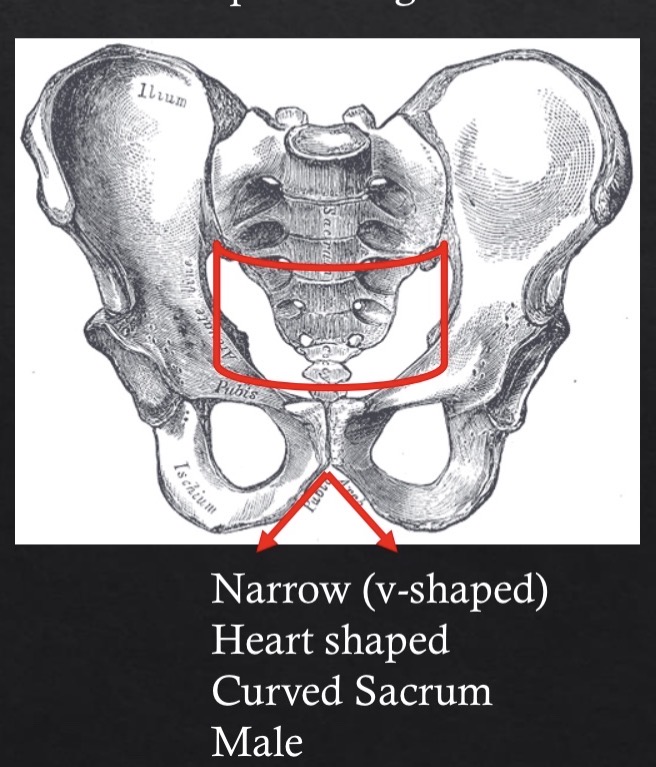
Pelvis Sex Estimation: Male
Male
Size: large and rugged
Ilium: high and vertical
Pelvic Inlet: heart shaped
Subpubic Angle: V-shaped
Pubic Shape: narrow and rectangular
Greater Sciactic Notch: narrow
Pre auricular sulcus: rare
Shape of Sacrum: long and narrow
Obturador foramen: large and oval
Pelvis Sex Estimation: Female
Female
Size: Small and gracile
Ilium: low and flat
Pelvic Inlet: circular
Subpubic Angle: U-shaped
Pubic Shape: broad and square
Greater Sciactic Notch: wide
Preauricular Sulcus: well developed
Shape of Sacrum: Short and broad
Obturador Foramen: small and rectangular
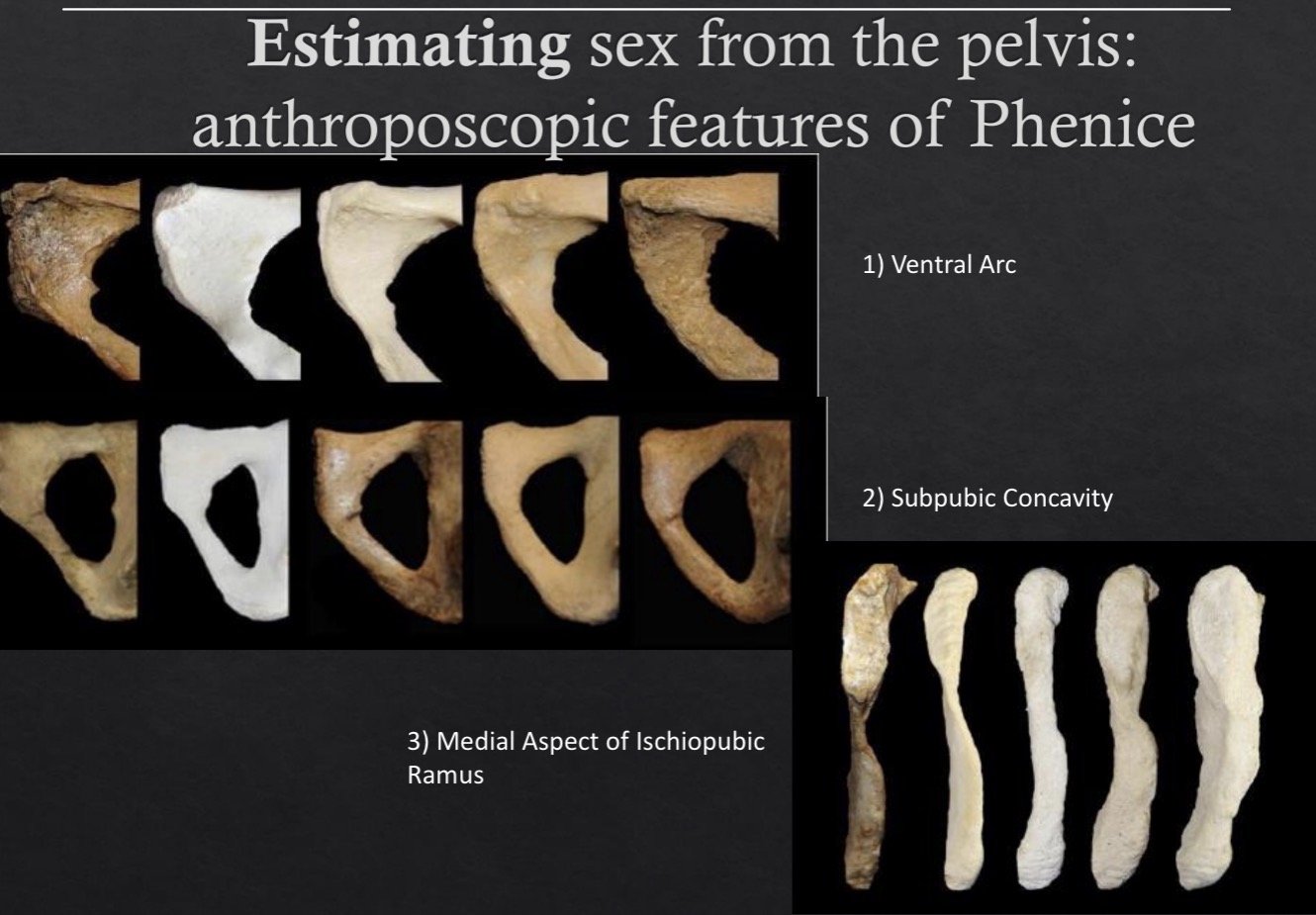
Phenice Method
Phenice Method: ranking pubic features from 1 to 5 ~90-95% accuracy
Greater Sciatic Notch: broader in females
Ventral Arc: females have a ridge on ventromedial aspect of pubis
Subpubic Concavity: "bowing" of inferior pubic border in females
Medial Aspect of the Ischiopubic Ramus: females have a sharp border
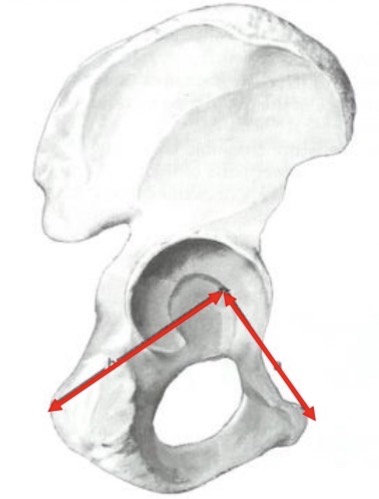
Pelvis Sex Estimation: Metric Ischium-Pubis Index
Pubis length x 100/Ischium length
below 90 = Male
90-95 = Intermediate
95+ = Female
Pelvis Sex Estimation: Metric Sacral Index
Anterior Breadth x 100/Anterior Height
Above 117 = Female
Below 117= male
(Lots of overlap)
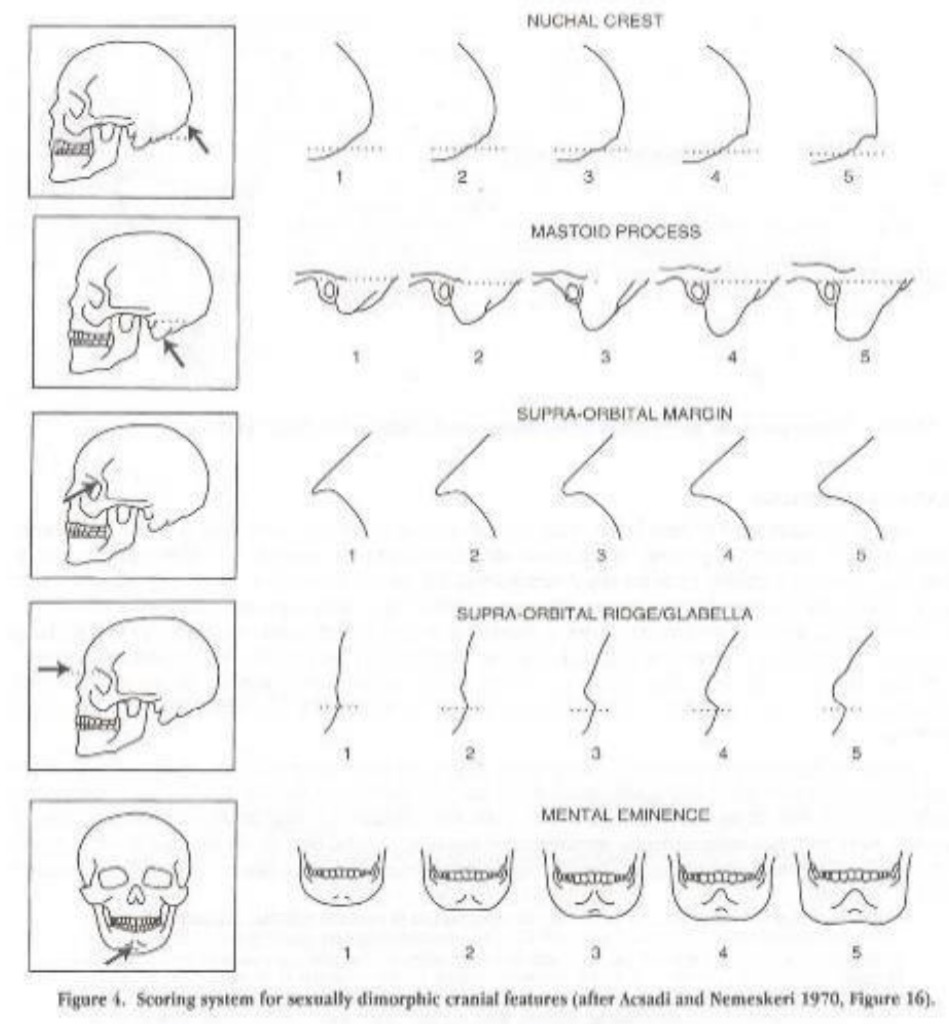
Cranium Sex Estimation
Nuchal crest - robust/male, gracile/female
Mastoid process - Large/male, small/female
Parietal boss - marked/female, reduced/male
Supraorbital margin - sharp/female, rounded/ male
Supraorbital tori/Glabella - defined/male, reduced/female
Calvaria shape (frontal) - rounded/female, sloped/male
Mental eminence - defined/male, rounded/female
Gonial angle - oblique/female, right/male
Gonial flare - flared/male, unflared/female
Cranium Sex Estimation: Scoring System
1) Female
2) Probable female
3) Ambiguous sex
4) Probable male
5) Male
FORDISC
Computer Program used to estimate sex, ancestry, and stature
compares two populations for affinity
Age at Death: Subadult
2nd most accurate demographic estimation
Developmental processes
Dental development
tooth eruption
Bone growth
Epiphyseal fusion
Nutrition and health can greatly effect age and stature estimations
Age Estimation: Dental Formation
Eruption of deciduous and permanent teeth
Most accurate age estimation technique from birth to 10-12 years
Dental Eruption Schedule - Deciduous
First tooth erupts at 6-9 months
Lower central incisors
Formation of deciduous begin by the end of 6 months
Last eruption by 2-3 years (complete)
Second molars
Dental Eruption Schedule - Permanent
Molar 1 erupts ~6 years
Incisor 1-2 erupts ~6-9years
Canines, Premolars, and Molar 2 ~10 years
M3 ~18-25 years but is erratic
Can be used for ID
Bone Development - Subadult
Epiphyseal Fusion
Ends ~21-22 years (range of 16-32+)
Activity greatest between 15-23 years
Diaphyseal Length
can be used until the epiphyses fuse ~10 years
Best for fetal age estimation
Age Estimation - Adults
Pubic symphysis
Auricular surface
Sternal ends of ribs
Cranial suture closure
Dental wear
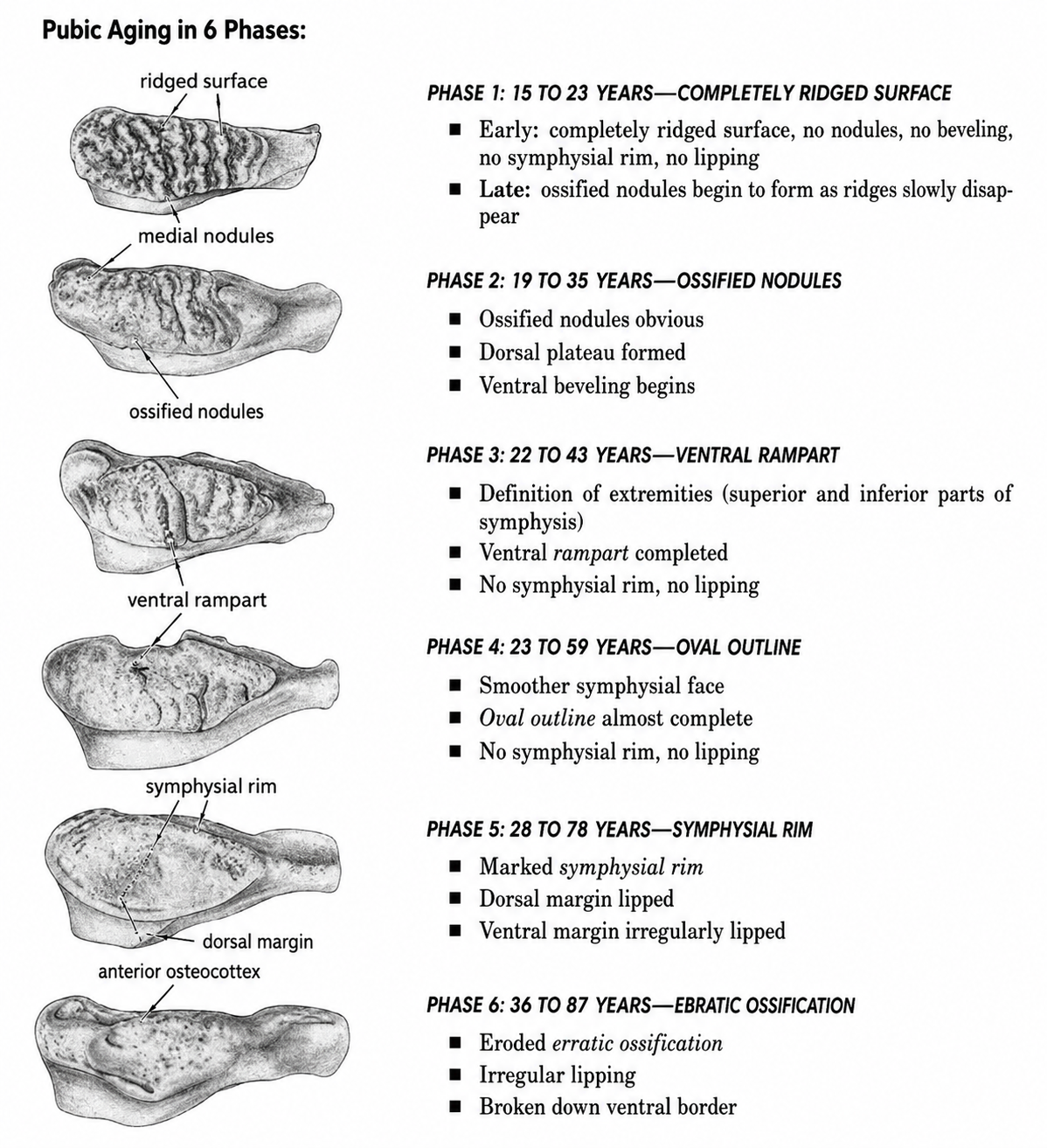
Age Estimation: Pubic Symphysis
Phases:
Phase 1 (15-23): Ridged surface, no beveling, no symphysis rim, no lipping
Phase 2 (19-35): Nodules and beveling, ventral beveling begins
Phase 3 (22-43): Ventral rampart complete, no rim, no lipping
Phase 4 (23-59): Smooth face, oval outline almost complete, no rim, no lipping
Phase 5 (28-78): marked rim and lipping,
Phase 6 (36-87): erratic ossification, irregular lipping
Best method for adult age estimation
Changes in billowing, boarder, face shape, etc.
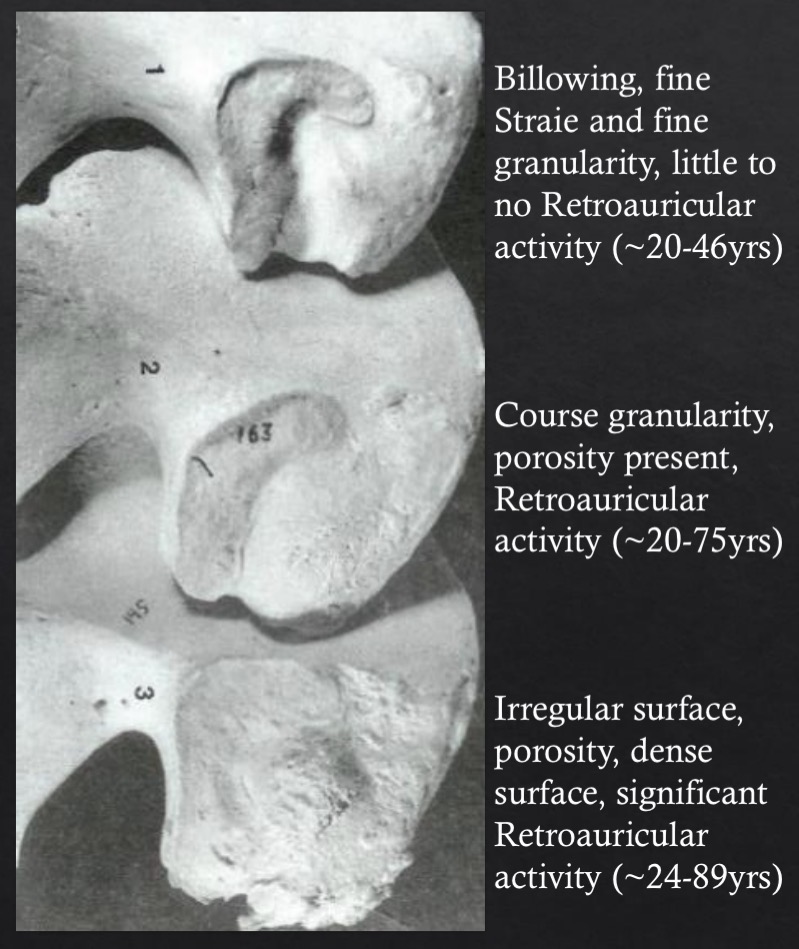
Age Estimation: Auricular Surface
Changes in billowing, striae, porosity, surface changes, etc.
~20-46 yrs: billowing, fine striae, and fine granularity
~20-75 yrs: Course granularity, porosity present
~24-89 yrs: irregular surfaces, porosity, dense surface
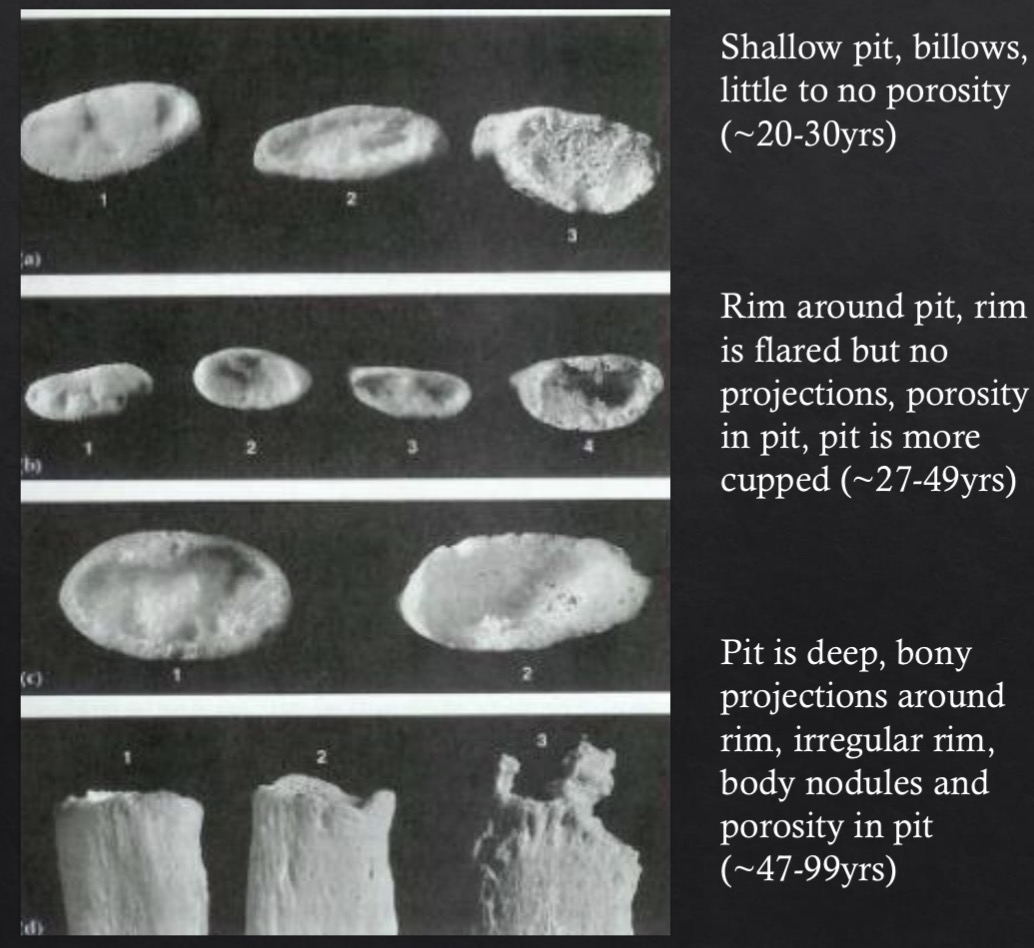
Age Estimation: Sternal Ends of Ribs
Billowy to marked, flat to cupped
~20-30 yrs: Shallow pit, billows
~27-49 yrs: Rim around pit, rim is flared, no projections
~47-99 yrs: Pit is deep, bony projections around rim, irregular rim, body nodules
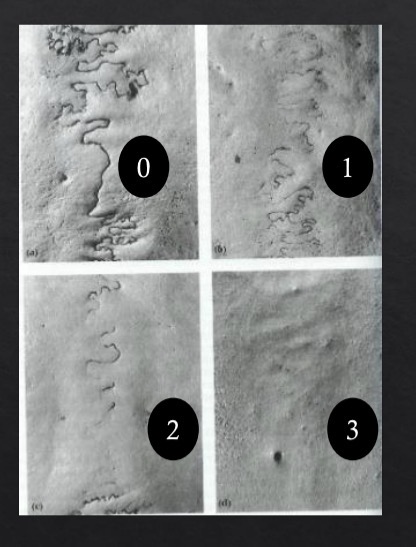
Age Estimation: Cranial Suture Closure
0 - open
1 - partially open
2 - Partially obliterated
3 - obliterated
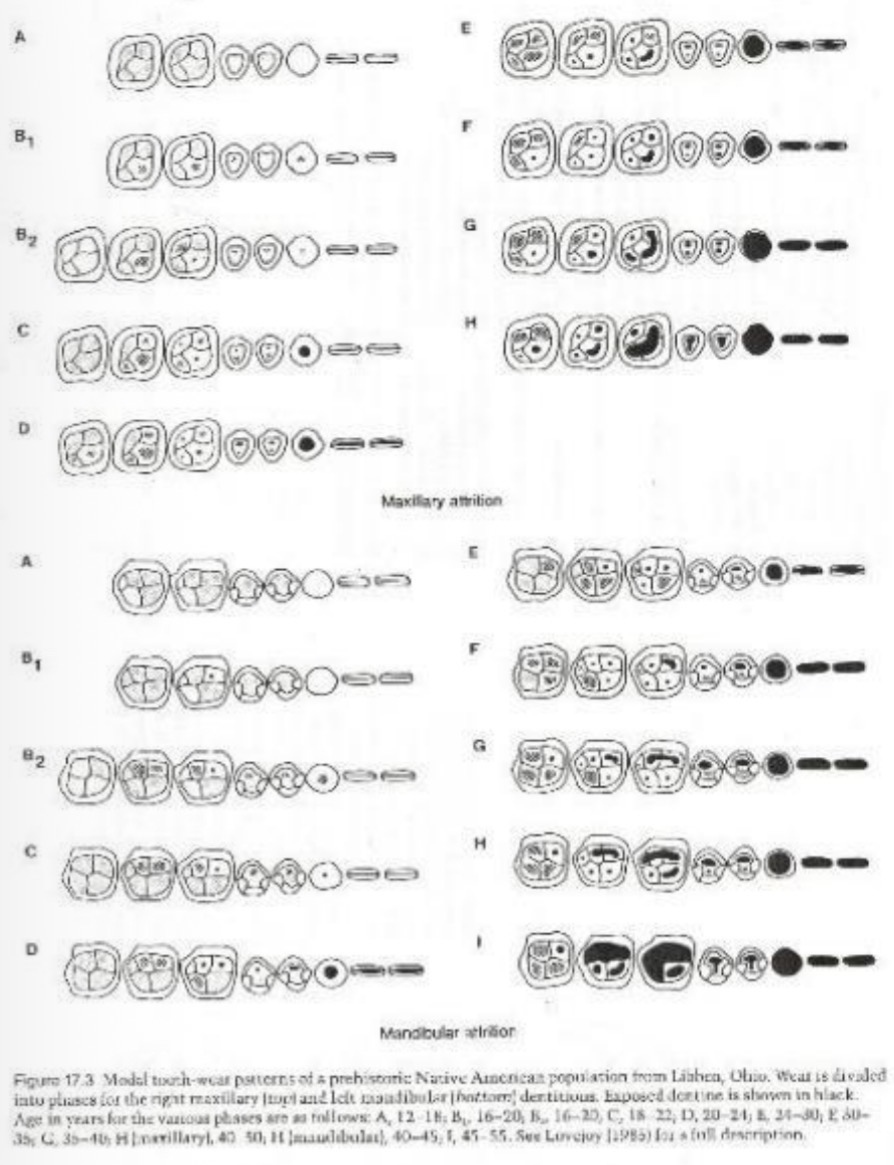
Age Estimation: Dental Wear
Exposure of dentine
Most useful for prehistoric or paleo contexts
Not very accurate in modern context (~60-75% for adults ± 10yrs, but 90% for ± 50yrs)
Stature Estimation
Whole body measurements
Whole skeletal measurements
Quick estimations
Body is roughly 5x length of the humerus
Osteometric: regression formulae using long bone lengths
Tibia, Femur, Fibula, Humerus, Ulna, etc.
Stature Estimation: Whole Skeletal
Skeletal height = sum of bones 1-6
2 = sum of all vertebrae C2-L5
3 = S1 only
6 = Talus and calcaneus
Add and Subtract standard 2 x Standard Error of the estimate (SE)
Stature Estimation Formulae (Important Info.)
Femur is best for single
Lower limb is better than upper limb
Multiple elements best