Chapter 16 Cancer biology & ch16 pt2
 Call Kai
 Learn
Learn Practice Test
 Spaced Repetition
 Match
Match Flashcards
 Knowt Play
1/69

There's no tags or description
Looks like no tags are added yet.
Name | Mastery | Learn | Test | Matching | Spaced | Call with Kai |
|---|
No analytics yet
Send a link to your students to track their progress
70 Terms
What is a complex genetic disease in which changes in DNA results in uncontrolled cell division, causing tumor development
Cancer
Cancer alters DNA in what cells
somatic
Is cancer inherited
No
not cancer
Benign tumors
cancer
Malignant tumors
rarely life-threatening
Benign tumors
may be life-threatening
Malignant tumors
can be removed, and usually do not grow back
Benign tumors
can be removed, but sometimes they grow back
Malignant tumors
do not invade the tissues around them or spread to other parts of the body
Benign tumors
can invade and damage nearby tissues and organs
Malignant tumors
spread of cancer
metastasis
Cancer cells spread by breaking away from the original primary tumor and entering the what or lymphatic system. The cells can invade other organs, forming new tumors that damage these organs.
bloodstream
cancer that begins in the skin or in epithelial tissues that line or cover internal organs
Carcinoma
cancer that begins in bone, cartilage, fat, muscle, blood vessels, or other connective or supportive tissue
Sarcoma
cancer that starts in blood-forming tissue such as the bone marrow and causes large numbers of abnormal blood cells to be produced and enter the blood
Leukemia
cancers that begin in the cells of the immune system
Lymphoma and myeloma
cancers that begin in the tissues of the brain and spinal cord
Central nervous system cancers
Gene expression in cancer cells is altered
genetic disorders
Cancer cells proliferate in an uncontrolled manner, forming what tumors
malignant
Malignant tumors tend to
metastasize (establish what tumors)
secondary
Cancer cells ignore inhibitory growth signals, and grow in the what of stimulatory growth signals required by normal cells
absence
Cancer cell growth uninhibited by
– Contact with other what
cells
Cancer cell growth uninhibited by
– Growth factor what
signals
what in cancer cells attributes to tumor growth
Telomerase
Absence of telomerase in normal somatic cells: major defense against what growth
tumor
Diet and environment cannot or can influence risk of developing cancer
can
Diet and environment can influence risk of developing cancer: alter the genome – favoring cell cycle progression and no what
apoptosis
occurs by a cumulative progression of genetic alterations
Tumorigenesis
A cancer what cell can self-replicate and produce progenitors that generate all of the cell types that make up a tumor
stem
In Tumorigenesis Cells become more or less responsive to growth regulation and more invasive
less
The proposed cells of origin of malignant tumors: tumors can arise from either tissue stem cells or what cells
progenitor
Cancer occurs in a what-step process
multi
Usually how many mutations are needed to develop a cancer
multiple
a preparation of homologous pairs ordered according to size
karyotype
The pattern on a karyotype may be used to screen chromosomal what
abnormalities
Cancer cells are also often what
aneuploid
Cancer cells are also often aneuploid
• but- this may or may not be causative
• and this occurs what
somatically
Encode proteins that restrain cell growth
Tumor-suppressor genes
Tumor-suppressor genes:
– Both cellular gene copies must be what
altered
Encode proteins that promote loss of growth control
Oncogenes
Oncogenes are altered cellular genes (proto-oncogenes) that act what
dominantly
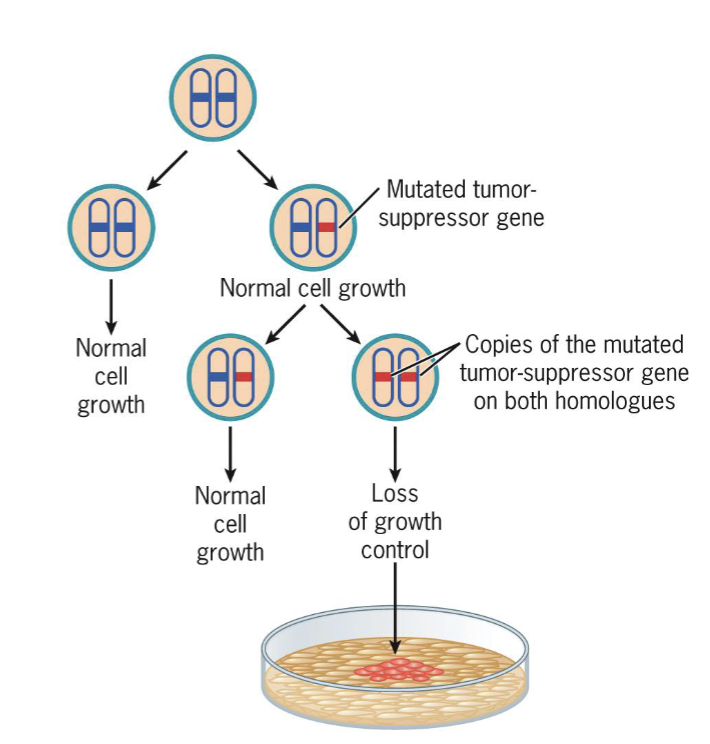
Series of events through which loss of two copies of a tumor suppressor gene gives rise to loss of cellular what control
growth
Mutant is non-functional
Recessive
Mutant is more function/always On
Dominant
Tumor-Suppressor Genes: acts as a repressor to regulate the G1 to S transition via E2F transcription factors
Retinoblastoma (RB) mutation: retinoblastoma
Tumor-Suppressor Genes: responsible for about 3% of breast cancers (about 7,500 women per year) and 10% of ovarian cancers (about 2,000 women per year)
BRCA (BReast CAncer gene) 1 and 2 mutation
was the first tumor-suppressor gene to be discovered
Retinoblastoma (RB)
Children with a high risk for RB have how many copies of the mutated RB gen
one
The RB protein (pRB) acts as a what to regulate G1 to S transition via transcription factors of E2F family
repressor
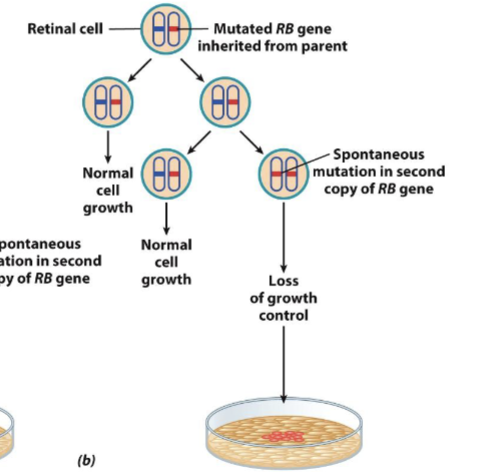
familial
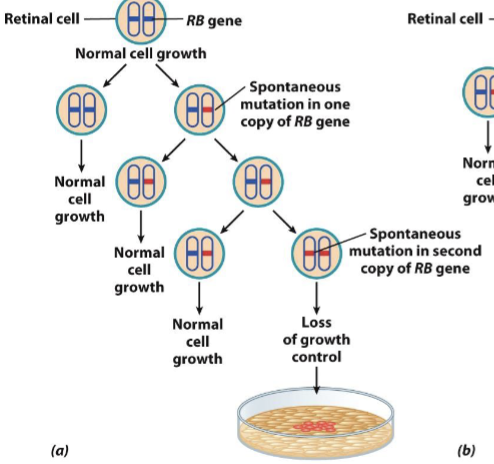
sporadic
The breast cancer susceptibility genes BRCA1 and 2, important for what repair
DNA
BRCA act through the what factor P53 important for DNA repair and cell cycle
transcription
BRCA mutations does what to the risk for breast cancer
increase
?% of the breast cancer cases show defects in brca1 or 2
5-10
breast cancer affects 1/? women (US)
8
a tumor suppressor gene, produces the p53 protein, often called the "guardian of the genome
TP53 gene
TP53 is the most commonly mutated what in human cancers
gene
Lacking TP53 causes inherited disorder called what syndrome, disease with high cancer incidence
Li-Fraumeni
Tumors with TP53 mutations have what prognosis than wild-type TP53 gene
poorer
Loss of TP53 function critical in progression toward which cancer
malignant
p53 is a what factor
transcription
p53 is activated by what double stranded breaks
DNA
p53 turns on what (cdk inhibitor), that inhibits the G1-S transition
p21