Formulas: Frequency, Wavelength and E photon (Bohr Model Formula)
 Call Kai
 Learn
Learn Practice Test
 Spaced Repetition
 Match
Match Flashcards
 Knowt Play
1/7

There's no tags or description
Looks like no tags are added yet.
Name | Mastery | Learn | Test | Matching | Spaced | Call with Kai |
|---|
No analytics yet
Send a link to your students to track their progress
8 Terms
E photon formula when given frequency (v)
E photon = h X v
E photon formula when given wavelength (λ)
E = h X c / λ
h =
6.626 × 10⁻³⁴ J x S (Planck’s Constant). This constant describes the size of the smallest “packets” of energy in the universe. It is the link between the frequency of a wave and the energy of a particle.
c =
3.0 × 10⁸ m/s. The speed of light; acts as the bridge between wavelength and frequency. It is how fast energy moves forward through space. It never changes.
To find Wavelength (λ)
(λ) = c/v (wavelength MUST be in meters). Distance of one peak point to another, it’s how long one wave is.
To find Frequency (v)
v = c/λ The speed of the vibration. It is how often the wave “vibrates or wiggles” every second”.
Bohr Model Formula
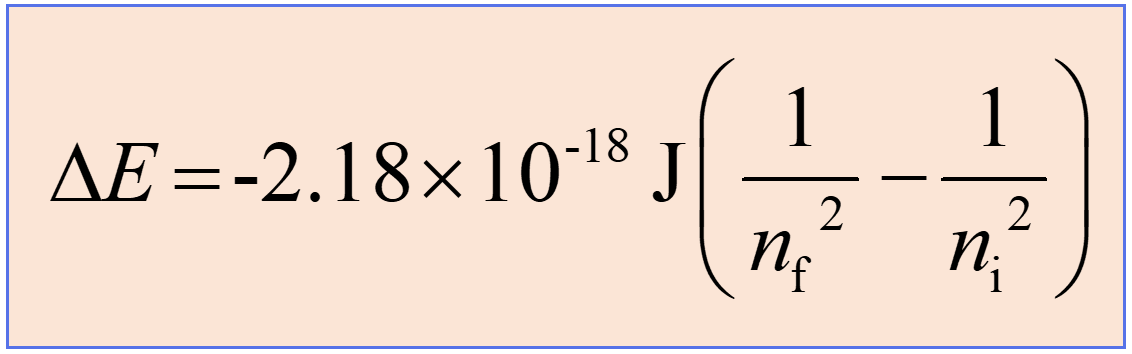
When an electron jumps between n levels (orbitals), it either absorbs or releases a photon. To find that energy, we use the Bohr Model formula (see image):
E: The energy of the photon emitted or absorbed.
RH (Rydberg Constant): This is the energy scale for the hydrogen atom. Value: 2.18 × 10⁻¹⁸ J
nfinal: The ending orbital level
ninitial: The starting orbital level
If E is positive: the electron absorbed energy (it moved from a low level to a higher level)
If E is negative: the electron released energy (it fell from a higher level to a lower level) and a photon was emitted.
Rydberg Constant (R)
the fundamental unit of energy for atomic transitions.
For energy, the constant is: 2.18 × 10⁻¹⁸ Joules. This represents the energy needed to completely pull an electron away from a Hydrogen atom (ionization).
For wavelength, the constant is 1.097 × 10⁷ m-1. This number is used to calculate the physical size of the light wave emitted.