Explosions
 Call Kai
 Learn
Learn Practice Test
 Spaced Repetition
 Match
Match Flashcards
 Knowt Play
1/21

There's no tags or description
Looks like no tags are added yet.
Name | Mastery | Learn | Test | Matching | Spaced | Call with Kai |
|---|
No analytics yet
Send a link to your students to track their progress
22 Terms
Explosion definition + examples
Explosion = a sudden and violent release of physical or chemical energy, often accompanied by the emission of light, heat and sound.
= a rapid increase of pressure in a confined space, generally caused by the occurrence of exothermic chemical reactions in which gases are produced in large amounts.
Examples:
Physical (overpressure à pV = Nrt
Nuclear
Chemical
Primary, secondary, tertiary explosives + examples
Primary explosive:
Easily initiated
Sensitive to shock, heat, light, electricity
Extremely dangerous to user
Not generally synthesised on large scale
Examples: copper azide, nitrogen trihalides, lead azide, silver azide, lead styphnate
Secondary explosive:
Difficult to initiate
More difficult to detonate
Contact-insensitive
Typically detonated by a small amount of primary explosive à ‘blasting cap’/ detonator
Examples: TNT, RDX
Tertiary explosives:
Very difficult to initiate
Example: ammonium nitrate
Low + high explosives + examples
Low explosives:
Typically deflagrate
Essentially burn expect when pressurised (when they can detonate)
Used as propellants
Examples: gunpowder, fuels, fireworks
High explosives:
Typically detonate
Chemical reaction yields a supersonic shock wave
Tend to contain the oxidiser in one molecule
Examples: TNT, nitrogylcerin, RDX
RDX features
Organic compound
Military explosive usage
Highly energetic material, as contains nitro group
Has high brisance
Brisance definition
= refers to the shattering capability of a high explosive, determined by its detonation pressure. Measure of how effectively an explosive can shatter materials upon detonation.
Deflagration + detonation
Deflagration – conceptualisation:
= rapid oxidation reaction generating a low intensity pressure wave of moving gases.
Propagation of the reaction takes place at the surface of the material, and is subsonic (slower than the speed of sound)
Detonation – conceptualisation:
= process of supersonic combustion in which a shock wave is propagated forward due to energy release in a reaction zone behind it.
High speed shock wave causes a violent disruptive effect.
Uses of explosions
Mining
Excavation (construction)
Cladding (explosion wielding)
Forensic investigations
Research
High explosives uses
Military uses
TNT: almost impossible to prematurely detonate, less sensitive than picric acid. Used in armour piercing shells for tanks, warships
RDX-HMX → have high brisance power - shattering power
Non military use, nitro glycerine, but too unstable mainly. Volatile
Polymer bonded explosives + applications
• Polymer bonded explosives are extremely insensitive
• The polymeric binder acts as a ‘cushion’ and protects (captures) much of the blast overpressure à elastic/plastic response or deformation
− An ‘integral sacrificial barrier’
• Applications include:
− Nuclear weapons (detonation)
− Cruise missiles
Any high performance application
Aromatic and amine groups added to an explosive, as stabilising groups
Assessing explosive performance - sensitivity to friction
• Place a small quantity of explosive onto a sliding block
• Apply a load with known weight
• Hit the sliding block using a pendulum and observe any evidence of initiation
• Repeat 100 times to ensure reproducibility
• Different frictional surfaces are often considered
• Can also explore more advanced properties
− Type of cleavage of explosive (even to a specific miller plane)
− Effect of environmental conditions (e.g. moisture, temperature)
Assessing explosive performance - sensitivity to impact
• Primarily carried out using drop towers
• A known weight is dropped from increasing heights
• High speed camera used to monitor ignition event
• Use new sample for every drop height to prevent impact-induced sensitiveness
• Plot height vs ignition event using median drop height
Assessing explosive performance - sensitivity to sparks and discharge
• A capacitor is charged using a high potential source
• A small quantity of explosive is placed on a roller
• The sample is gradually wound upwards toward the discharge electrode
• At a critical distance energy is released via a spark and initiation is monitored
• Testing starts with a high spark energy
• Repeat measurements are made gradually reducing the spark energy until no initiation events occur
• Some important levels assessed are:
− Average static shock from a human
− The maximum energy from initiation devices
• The mass, shape and size of sample are considered
• Environmental conditions can also be examined
• Multiple samples tested at each energy level to ensure reproducibility
Assessing explosive performance - sensitivity to heat
• Small quantities of explosive are placed in holes within a metal block (typically 6 to 12)
• The block is heated slowly at a fixed temperature gradient set by regulations
• The temperature of ignition is monitored using a high-speed camera
• Experiment repeated 10 times to ensure reproducibility of sample
• External environmental conditions are carefully controlled (e.g. ambient heat, humidity)
• Heating can also be used to examine the chemical stability of certain explosives
• The Abel Test measures the decomposition of energetic materials into NOx gases
• Used for nitrocellulose, smokeless powders, rocket fuels & nitro containing compounds
• Apparatus very similar to normal heating test but includes standardised Abel test paper (white) which exhibits a colour change (brown) when exposed to NOx gases
• Test paper primarily composed of starch coated with potassium iodide (KI)
• Temperatures used are typically between 65 oC and 80 oC
• The time required for the onset of colour change is compared to standards
• A simple method but not quantitative
Differential Scanning Calorimetry
• Useful technique for controlled detection and quantification of deflagration/detonation
− Similar to bomb calorimetry but with increased control
• Compare the heat flow between the sample and reference as temperature increases
• Used to examine exothermic (e.g. detonation) and endothermic (e.g. melting) processes
Figure of insensitivity + initiation correlations for C, N, O
Figure of insensitivity:
• The figure of insensitivity is an arbitrary metric of explosive stability
A higher value means more stable
Bonded through the oxygens = least stable, nitrogen’s = next stable, carbons = most stable
Higher initiation correlation = less stable
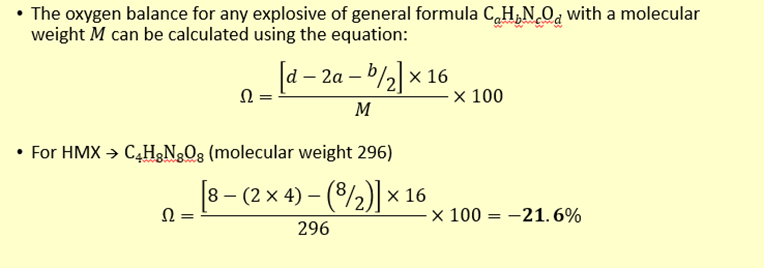
Oxygen balance + formula
• Oxygen balance dictates whether a detonation consumes external O2
• Oxygen balance can be determined from molecular formula à in the form CaHbNcOd

kw rules + alternative equation used
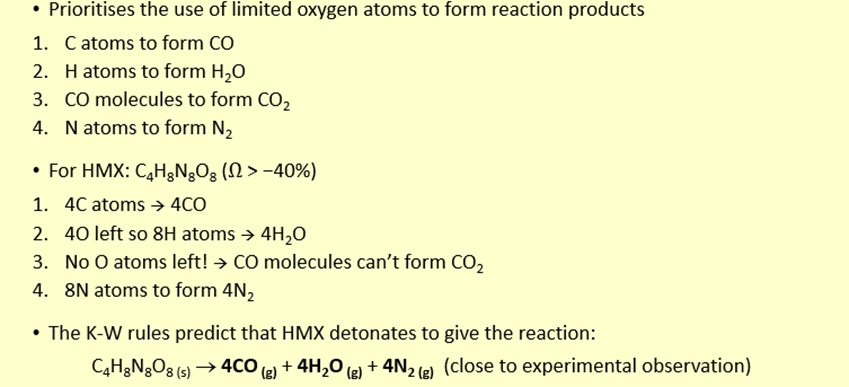
• The Kistiakowsky-Wilson rules can be applied when the oxygen balance is negative
− Strictly speaking when oxygen balance is > −40%
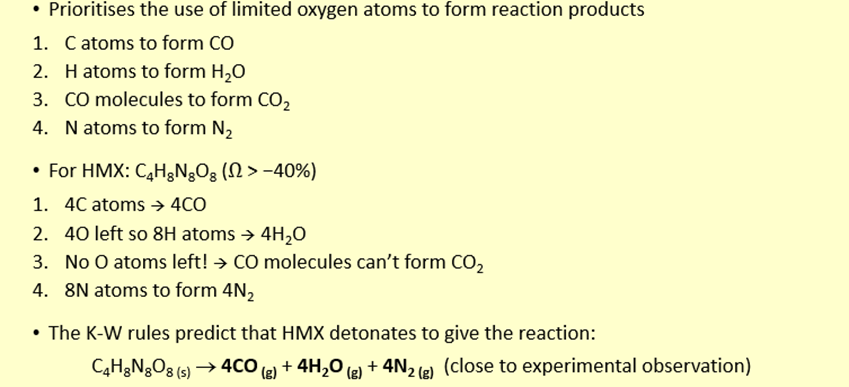
Using kw rules prioritising oxygen atoms to form products
Volume of detonation
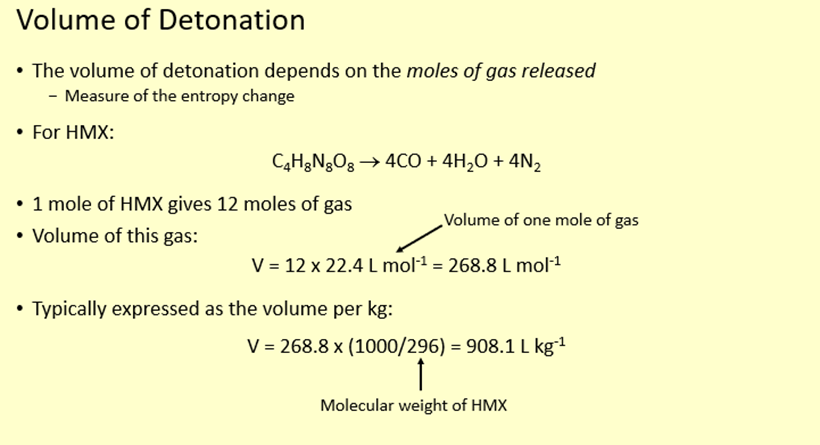
Explosive power
= the product of the heat x volume of gas
Aluminium and thermite
Al is used, as has a high enthalpy of combustion and increases the length of blast wave
Al scavenges oxygen atoms from the gaseous products increasing the enthalpy of detonation, but too much Al may reduce the volume of gas formed
Thermite (usually Al and iron oxide) used for incendiary weapons