current, resistance & potential difference
 Call Kai
 Learn
Learn Practice Test
 Spaced Repetition
 Match
Match Flashcards
 Knowt Play
1/19

There's no tags or description
Looks like no tags are added yet.
Name | Mastery | Learn | Test | Matching | Spaced | Call with Kai |
|---|
No analytics yet
Send a link to your students to track their progress
20 Terms
Define potential difference
The work done by a unit charge passing through a component
What is potential difference measured in
Volts
What's is the energy transferred between 2 points on a circuit
The potential difference between those two points in a circuit
Define current
The flow of electrical charge
What is current measured in
Amps
Define resistance
The opposition to current
E.g higher the resistance, lower the current
What is resistance measured in
Ohms
The resistance of a circuit can be increased by….
adding resistors to it
Every electrical component has a resistance, so the more you add the more resistance
The greater the resistance of the component the ___ the current for a given potential difference across the component
Lower
The lower the resistance of the component the ___ the current for a given potential difference across the component
Greater
What is the equation linking potential difference, current and resistance
Potential difference = current x resistance
V = IR
State Ohm’s law
The current through a conductor is directly proportional to the potential difference across it
What are ohmic conductors and give an example
Electrical conductors that obey Ohm’s law
fixed resistors
Wires
Heating elements
What will the IV graph of an ohmic conductors look like
Straight line through the middle
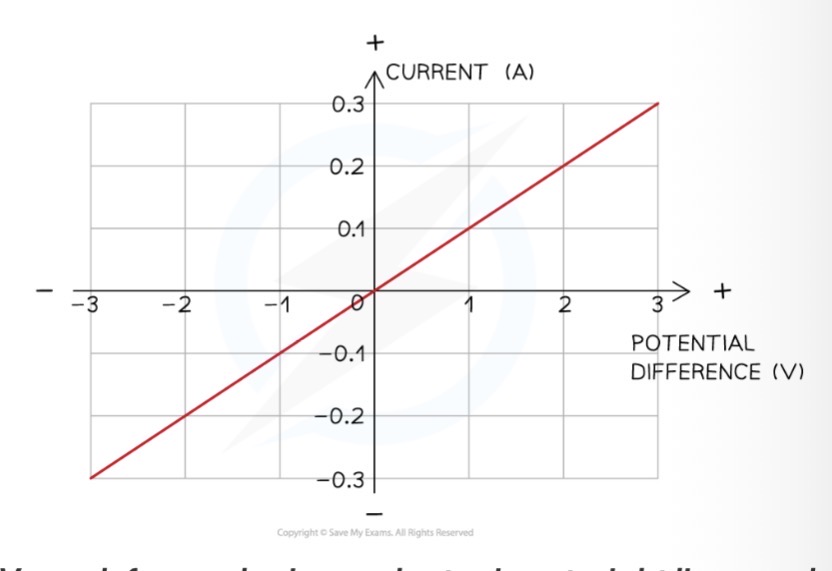
What equation is Ohm’s law represented by
V = IR
Ohms law is only relevant at constant ___
Temperatures
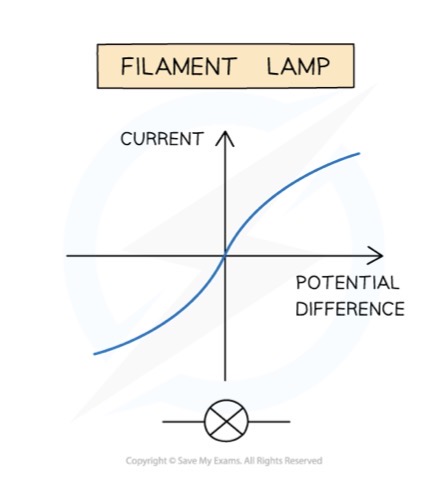
What will the IV graph of a filament bulb look like and why
As the current increases, the temperature of the filament in the lamp increases.
The higher temperature causes the atoms in the metal to vibrate more.
This increases resistance and therefore current increases more slowly.
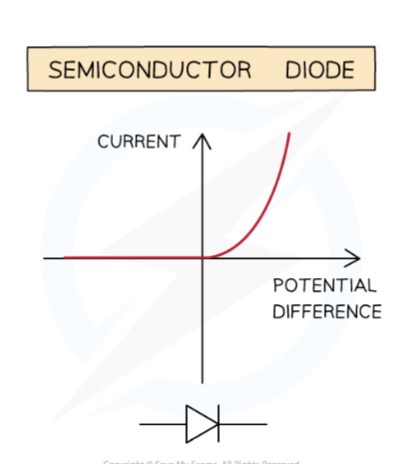
What will the IV graph of a diode look like and why
A diode only allows current to flow in one direction, meaning in the reverse direction there is very high resistance
This means one side of the graph (reverse) has 0 current and potential difference
The other side (normal) has a sharp incraese in potential difference and current
What is the difference betweeen non-linear and linear components and how is it relevant to Ohms law
linear components have a linear (straight line) graph and obey ohms law
Non-linear components have a non-linear (Not straight line) graph and do not obey ohms law
Name 4 non-linear elements
filament lamps
Diodes & LEDs
LDRs
Thermistors