PHY 1 DYNAMICS
 Call Kai
 Learn
Learn Practice Test
 Spaced Repetition
 Match
Match Flashcards
 Knowt Play
1/14

There's no tags or description
Looks like no tags are added yet.
Name | Mastery | Learn | Test | Matching | Spaced | Call with Kai |
|---|
No analytics yet
Send a link to your students to track their progress
15 Terms
Dynamics
why objects move
Newton’s First Law/Galileo’s Law of Inertia
A body moving at a velocity will remain
moving with that velocity unless it is
acted upon by a net force
Inertial reference frame
an object’s velocity is relative to a given frame and is constant in the absence of forces
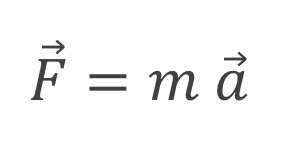
Newtons Second Law
Net external force = mass x acceleration
Newton’s Third Law
Whenever a body A exerts a force on another body B, then B exerts a force on A that is equal in magnitude and opposite in direction to the force that A exerts on B
An object is moving with constant non-zero velocity. Which of the following statements about it must be true?
the objects net force is zero according to Newton’s 1st Law
A fireman of mass m is sliding down a fire pole. As he speeds up, he tightens his grip on the pole, thus increasing the vertical frictional force that the pole exerts on the fireman. When the force on his hands equals his weight mg, what happens to the fireman?
The fireman continues to descend, but with constant speed (fireman wouldn’t stop bcz he is already moving, and that would require an equal normal force).
You are standing in a moving bus, facing forward, when you suddenly slide forward as the bus comes to an immediate stop. Which force, if any, caused you to slide forward?
there isn't an actual force causing you to slide forward, it is the inertia of your body.
static friction
force that resists the initiation of motion (holds an object still).
kinetic friction
is the force that opposes the motion of 2 surfaces sliding past each other (resists sliding).
You swing a bat and hit a heavy box with a force of 1500 N. The force the box exerts on the bat is
exactly 1500 N whether or not the box moves.
A car goes around a circular curve on a horizontal road at constant speed. What is the direction of the friction force on the car due to the road?
perpendicular to the curve inward (to keep the car moving in a circle).
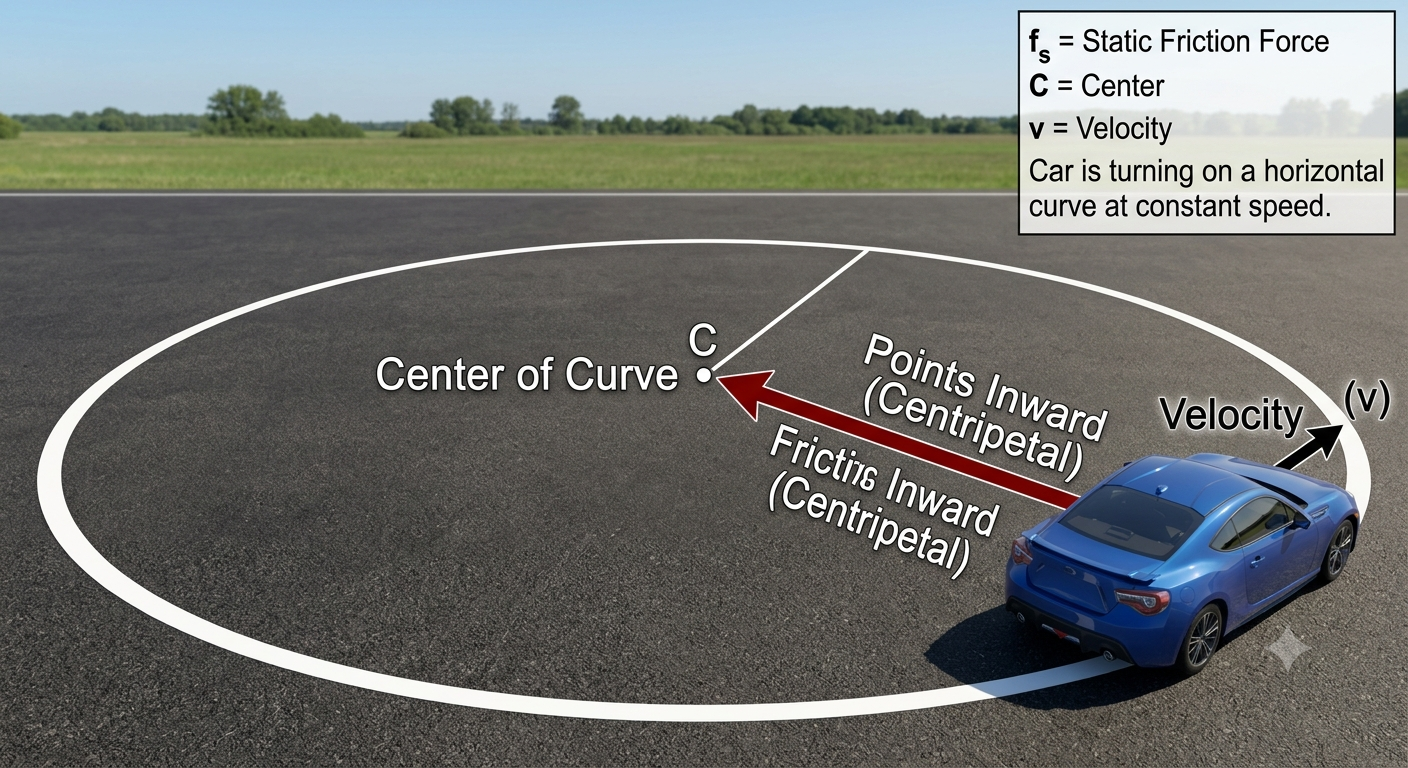
Centripetal force
the inward pull that keeps an object moving in a circle.
Consider a person of mass M inside an elevator that is accelerating upwards (acceleration = a m/s2). Which of these statements about the normal force exerted by the floor of the elevator on the person is true?
Because the elevator is accelerating upwards (a > 0), the value of Ma is added to your regular weight (Mg). Therefore, the floor must push up with a force greater than your weight (N > Mg) to both support you and accelerate you upward.
The figure shows two possible ways a person can try to move a heavy block of ice. In part a), the person pushes the ice block at an angle of 25° below the horizontal. In part b), the person pulls the ice block at an angle of 25° above the horizontal.
The frictional force on the ice block when the person is pulling it is smaller than the frictional force on the ice block when the person is pushing it.
(When you push downward, you press the block harder into the ground, so the friction increases.
When you pull upward, you lift some of the block's weight off the ground, so the friction decreases.)